The biggest crypto heist in history just took a major turn — and this time, the good guys are winning.
The U.S. Department of Justice filed a civil forfeiture action on Monday to permanently seize over $1.1 billion in $USDC stolen from Binance in the October 29 hack, blamed on North Korea's TraderTraitor group (Lazarus/APT38). The funds — about $1.17 billion across 36 addresses on 18 blockchains, per The Block — were already frozen by Circle, which will issue replacement USDC once a court signs the forfeiture order.
The wider recovery is now substantial: over $2.9 billion of the $6+ billion stolen has been frozen, seized or returned — nearly half the haul — and Binance also holds a $6.5 billion worldwide freezing order from Abu Dhabi courts. But the race is real: Elliptic says hackers already pushed $247 million through Bitcoin coinjoin mixers, and $2.35 billion was still unlaundered last week.
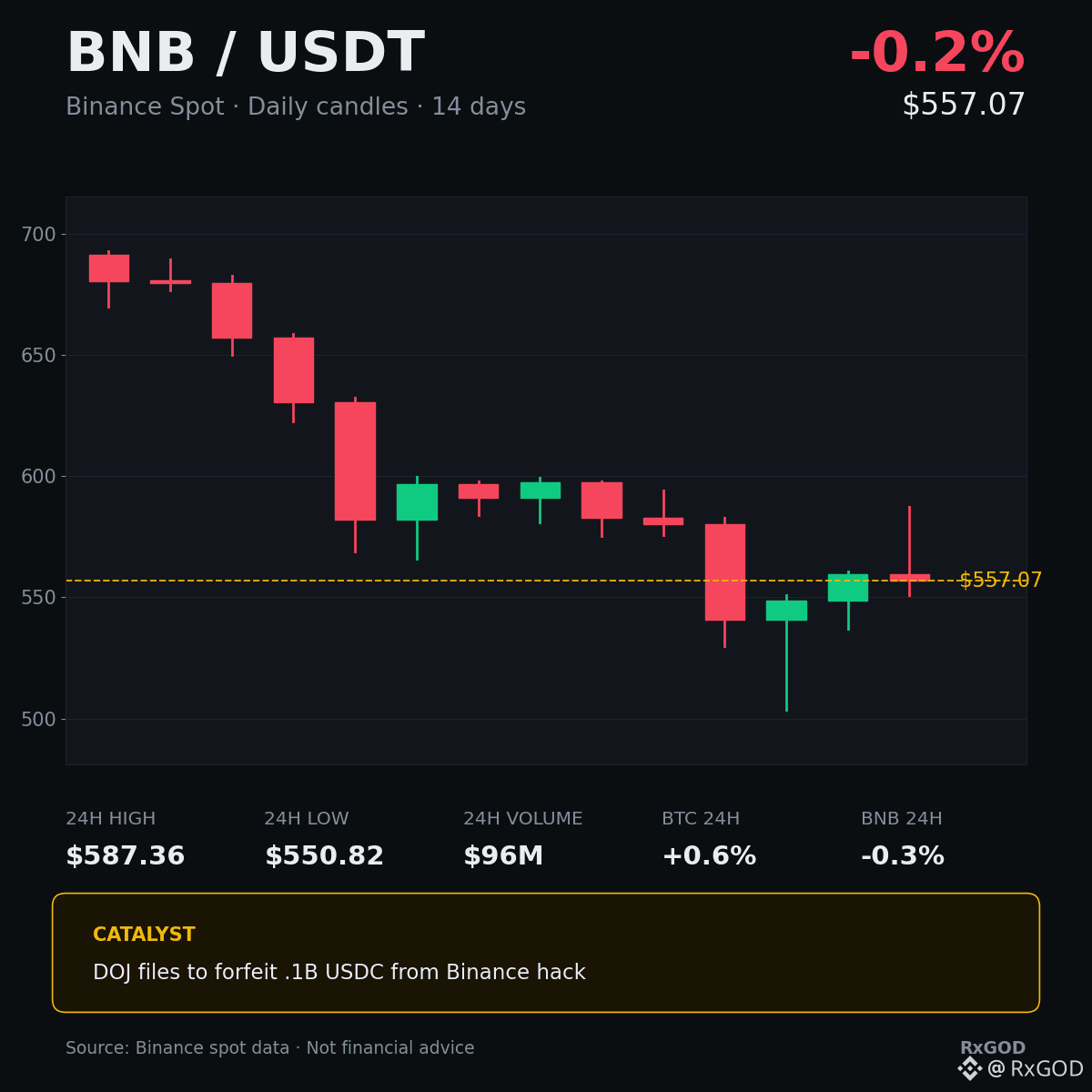
Meanwhile $BNB trades at $557, flat (-0.2%) and down 18% over two weeks, near the low end of its 14-day range. $BTC holds $61,437 (+0.6%) — the market treats this as a managed recovery, not an existential threat.
The honest caveat: forfeiture is a process, not a done deal — a judge still has to sign, and the laundered slice may never come back.
So here's the debate: does a $2.9 billion recovery change how you see exchange risk — or does one $6 billion breach prove no CEX is truly safe? And is a frozen stablecoin a security backstop, or centralization risk of its own?
Not financial advice — DYOR.
#BinanceHack #CryptoNews #DOJ #NorthKorea