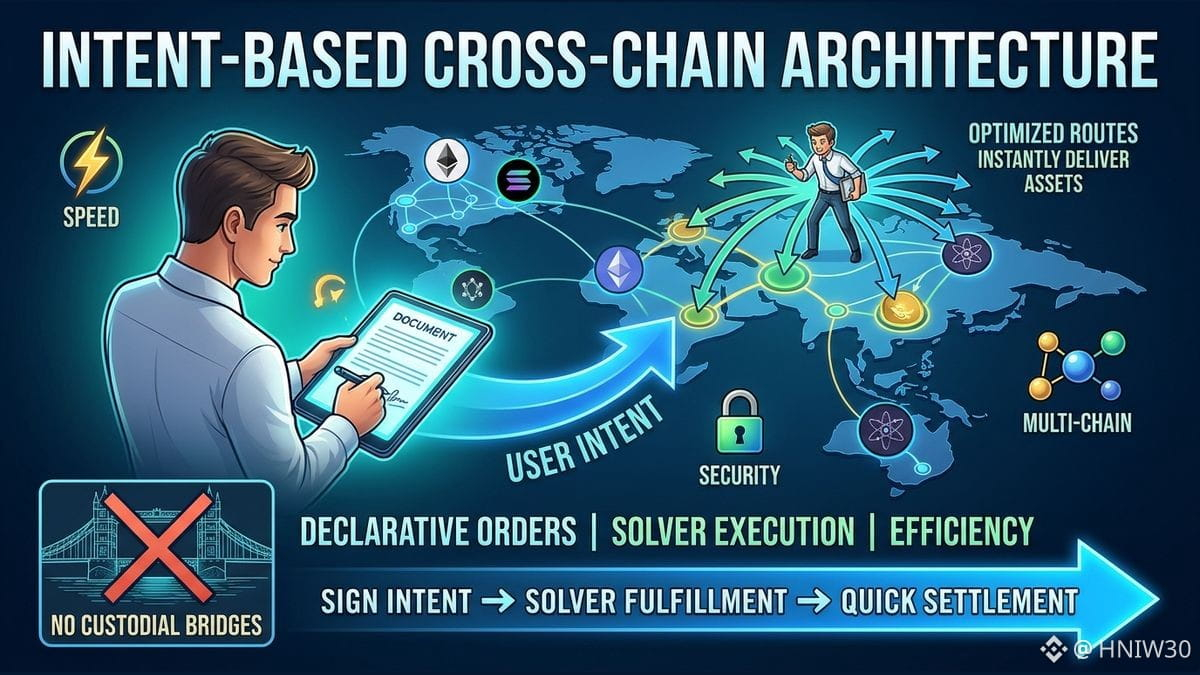
In cross-chain architecture, lock-and-mint bridge models typically rely on contracts or validator committees to lock assets on an originating network and mint synthetic representations on a destination network. This design concentrates pooled liquidity into specific contracts, creating custodial and smart contract attack surfaces alongside capital fragmentation across separate networks. In contrast, intent-based execution frameworks decouple user requests from direct route execution.
Under an intent-driven model, users sign declarative orders specifying a desired end state rather than executing explicit bridging transactions across multiple chains. Independent market makers, commonly referred to as solvers or fillers, assume inventory and settlement risk across networks to fulfill these orders directly. This structure shifts user execution latency from multi-chain block confirmation cycles to local fulfillment, limiting user exposure to intermediate bridge contracts during transit.
Generalized messaging protocols also allow networks to pass arbitrary data, enabling cross-chain interaction between distinct virtual machines. For instance, a protocol can verify state on one network while triggering logic on another without maintaining duplicate reserve pools. However, these architectures present distinct engineering and security tradeoffs. Implementations must account for asynchronous state dependencies, solver centralization risks, variable message verification costs, and divergent consensus finality across heterogeneous environments.
#IntentArchitecture