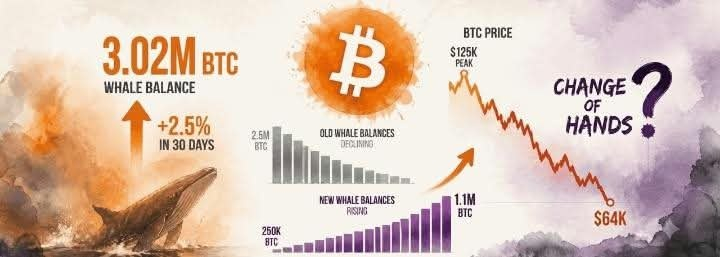


Bitcoin's largest holders are increasing their exposure, with whale balances reaching approximately 3.02 million BTC. The latest figures have attracted attention across the cryptocurrency market, especially as Bitcoin continues to navigate challenging market conditions. The growing holdings raise an important question: Are major investors buying the dip, or are existing holders simply moving their coins between wallets?
According to recent CryptoQuant data, whale balances have increased by approximately 2.5% over the past 30 days, suggesting a notable shift in large-holder activity.
Whale Accumulation Reaches a New Milestone
Bitcoin whale holdings have experienced considerable growth, with approximately 84,000 BTC added to tracked whale balances during the past month.
This represents the strongest monthly increase since February 2026. Such movements are closely monitored because large investors can influence market liquidity and potential price direction.
Whales are generally identified as entities holding at least 1,000 BTC. Their accumulation patterns can provide useful insights into how major market participants are positioning themselves during uncertain conditions.
The latest increase suggests that substantial amounts of Bitcoin are now associated with large-holder wallets.
New Whales Are Expanding Their Holdings
Another important development is the rapid growth in Bitcoin balances attributed to newer whale entities.
Since Bitcoin reached its October 2025 peak, holdings associated with new whales have reportedly increased from approximately 250,000 BTC to 1.1 million BTC.
Their realized capitalization has also climbed significantly, moving from around $20 billion to approximately $79 billion.
This development highlights a changing distribution of Bitcoin ownership. Newer large holders are becoming increasingly important participants in the market.
However, these figures do not necessarily confirm that all the additional Bitcoin represents fresh purchases.
Could Wallet Transfers Explain the Increase?
Despite the bullish appearance of rising whale balances, there is another possibility that investors should consider.
Large Bitcoin holders frequently move their assets between different wallets for security, custody management, or portfolio organization. When existing coins move into newly created addresses, on-chain classifications can sometimes make it appear that new whales are entering the market.
Consequently, an increase in whale balances does not automatically mean that fresh capital has entered Bitcoin.
Analysts need to examine wallet ownership and entity-adjusted data to determine whether these movements represent genuine accumulation or internal transfers.
What Does This Mean for Bitcoin's Price?
Increasing whale holdings during a market correction could be an encouraging development if the activity reflects genuine buying.
Large-scale accumulation may reduce the amount of Bitcoin available for immediate selling and potentially provide support during future market recoveries.
Nevertheless, other market indicators remain important. Institutional demand, Bitcoin ETF flows, trading volume, and broader investor sentiment will help determine whether the market can establish a sustainable recovery.
The Next Important Signal to Watch
Bitcoin's growing whale balances present an interesting development, but investors should avoid treating the figures as automatic confirmation of a bullish reversal.
If additional data confirms that independent investors are consistently accumulating BTC, confidence in the trend could strengthen.
For now, the 3.02 million BTC milestone highlights increasing activity among large holders. The real question is whether this represents genuine buying pressure or simply Bitcoin changing hands between wallets.