
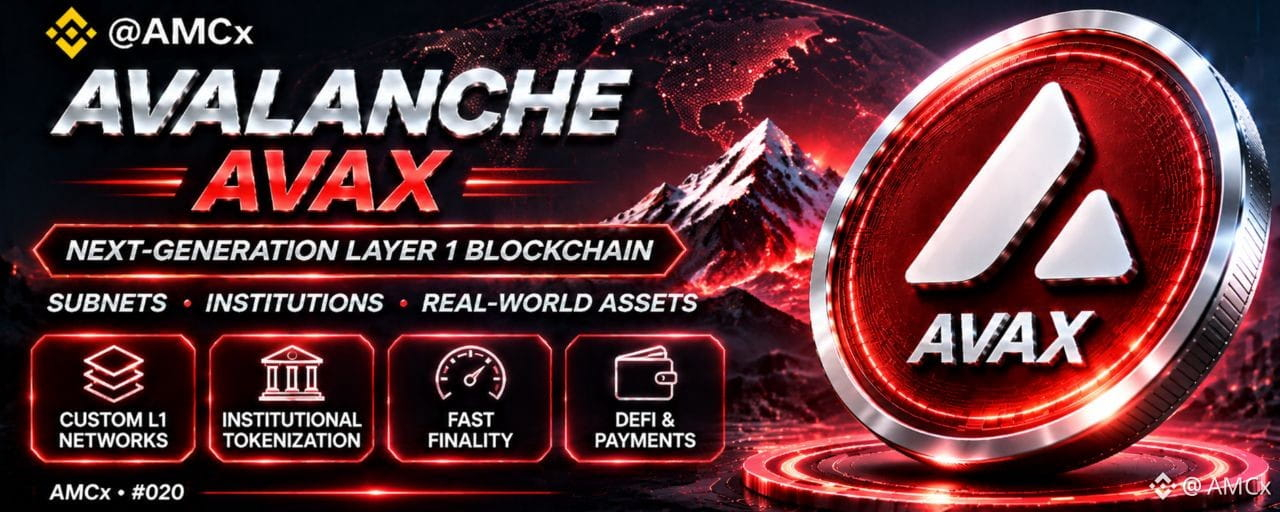

AVALANCHE (AVAX): The Next Chapter of Blockchain Infrastructure — What Lies Ahead in 2027?
By @AMCx
1. Introduction: More Than Just a Fast Blockchain
Avalanche (AVAX) is a blockchain platform designed to support decentralized applications, financial services, institutional infrastructure, and custom blockchain networks.
Its main strength is its flexible architecture. Rather than forcing every application to operate on one shared blockchain, Avalanche allows developers and organizations to build dedicated Layer 1 networks tailored to their specific needs.
This approach makes Avalanche particularly interesting for financial institutions, tokenized real-world assets (RWA), payment systems, and enterprise blockchain applications.
As the crypto industry moves toward real-world adoption, Avalanche is positioning itself as infrastructure that can connect traditional finance with blockchain technology.
2. Recent Developments: What Is Happening in 2026?
Avalanche has continued to develop its technology and institutional ecosystem throughout 2026.
Some of its most important developments include:
Helicon Network Upgrade
One of Avalanche's major developments is the Helicon upgrade, which activated on the mainnet on September 22, 2026.
The upgrade introduced several improvements, including:
Continuous Execution on the C-Chain to improve transaction processing.
Automatic renewal options for validator staking.
A higher validator uptime requirement of 90%.
A shorter minimum validator staking period of 48 hours.
Dynamic minimum gas pricing.
Adjustments to the staking reward curve.
These changes are designed to improve network performance, validator operations, and the economics of securing Avalanche.
Institutional Adoption and Tokenization
Avalanche is also gaining attention in traditional finance.
Its infrastructure is being used and explored for tokenized assets, institutional financial products, and digital payments. In November 2026, Avalanche announced developments involving the New York Stock Exchange's tokenized securities plans.
This direction could become an important part of Avalanche's long-term growth if institutional adoption continues.
Real-World Assets (RWA)
Tokenization is one of the sectors Avalanche is targeting.
The idea is to represent assets such as funds, securities, and other financial instruments on blockchain networks. This could make certain financial processes more accessible, programmable, and efficient.
3. What Is Avalanche Planning for the Future?
Looking toward 2027, several strategic areas are likely to remain important for Avalanche.
1. Expanding Custom Avalanche L1 Networks
Avalanche aims to make it easier for businesses and developers to launch their own blockchain networks.
These networks can be customized for different requirements, including transaction fees, validators, performance, and compliance.
2. Growing Institutional Finance and RWA
Avalanche is positioning itself as infrastructure for tokenized financial products.
If more financial institutions choose blockchain-based settlement and asset issuance, Avalanche could benefit from increased network usage.
3. Improving Network Economics
The Avalanche Foundation has been researching ways to connect the economic value created across its ecosystem more directly to AVAX.
Its published research framework focuses on measuring ecosystem income, identifying sustainable ways to capture value, and deciding how that value could be distributed.
This is an ongoing research direction, not a guarantee that new value-sharing mechanisms will be implemented.
4. Expanding Payments and Financial Applications
Stablecoin payments, financial applications, and institutional settlement are other important areas for Avalanche.
The long-term objective is to make blockchain infrastructure useful beyond crypto trading.
4. AVAX Tokenomics: Why Does the Token Matter?
AVAX is the native token of the Avalanche ecosystem.
Its primary functions include:
Paying transaction fees on the network.
Staking to help secure the Primary Network.
Participating in the validator economy.
Supporting network operations and ecosystem activity.
AVAX has a maximum supply cap of 720 million tokens.
An important feature of Avalanche's token economics is that C-Chain transaction fees are burned. This means those fees are permanently removed from circulation.
However, staking rewards also introduce new AVAX into circulation. Therefore, the actual supply dynamics depend on both token issuance and token burning.
The relationship between ecosystem growth and AVAX value is an important subject for the project's ongoing economic research.
5. What Could Drive AVAX Growth in 2027?
Several factors could influence Avalanche's future development:
Institutional Adoption: More financial institutions using Avalanche could increase demand for its infrastructure.
RWA Expansion: Growth in tokenized funds, securities, and other real-world assets could create additional network activity.
Developer Ecosystem: More applications and custom L1 networks could strengthen Avalanche's position in the blockchain market.
Network Performance: Continued technical improvements could make Avalanche more attractive to developers and businesses.
Token Economics: Future research and potential changes to value accrual could influence how ecosystem activity relates to AVAX.
These are potential growth drivers, not guaranteed outcomes.
6. Risks and Challenges
Despite its potential, Avalanche still faces several challenges.
Competition: Ethereum, Solana, and other blockchain ecosystems are competing for developers, users, and institutional adoption.
Market Volatility: AVAX remains exposed to broader cryptocurrency market cycles.
Adoption Risk: Institutional partnerships and announcements do not always translate into long-term usage.
Token Economics: Network growth does not automatically mean that all economic value flows to AVAX holders.
Regulatory Uncertainty: Changes in digital asset regulations could affect institutional blockchain adoption.
Investors should consider these risks before making financial decisions.
7. Final Thoughts: Is Avalanche Ready for Its Next Phase?
Avalanche is building more than a blockchain for decentralized applications. Its broader strategy focuses on custom blockchain infrastructure, institutional finance, tokenized real-world assets, and payment systems.
The Helicon upgrade demonstrates that the network continues to evolve technically, while its institutional initiatives show an ambition to connect blockchain infrastructure with traditional financial markets.
Looking toward 2027, Avalanche's biggest opportunity may be its ability to turn institutional interest and ecosystem development into sustained real-world network activity.
However, long-term success will depend on actual adoption, sustainable token economics, competition, and the execution of its development strategy.
Avalanche is a project worth watching as blockchain technology moves closer to mainstream financial infrastructure.
This article is for educational and informational purposes only. It is not financial advice. Always conduct your own research before investing.
AMCx — Researching the Future of Crypto, One Project at a Time.