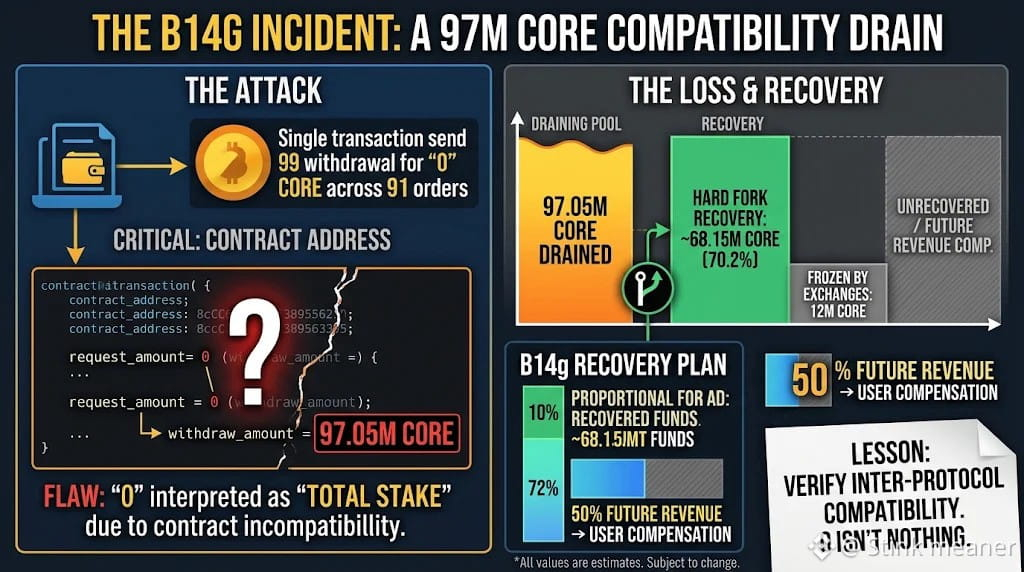
🚨 A crypto protocol lost 97 million CORE without an attacker stealing anyone's private keys.
The B14g incident on October 31 reveals a different kind of DeFi vulnerability.
The attacker exploited a compatibility flaw between B14g's staking contract and Core Network's native staking contract.
In a single transaction, 99 withdrawal requests containing zero CORE were submitted across 91 staking orders.
The problem? The underlying logic interpreted zero as a request to withdraw the entire stake.
Approximately 97.05 million CORE was drained, worth around $1.47 million at the time.
But the recovery is equally interesting.
A Core hard fork recovered approximately 68.15 million CORE, representing 70.2% of the stolen amount. Another 12 million CORE was reportedly frozen by exchanges.
B14g says it intends to distribute recovered assets proportionally and use 50% of future Core staking revenue to compensate remaining losses.
However, frozen funds should not be confused with funds already returned to users.
The uncomfortable lesson is that a protocol does not need a private-key leak or a malicious contract upgrade to lose millions.
Sometimes the vulnerability exists in how two supposedly compatible systems interpret the same instruction.
🔍 Market implication: CORE's reputation, staking participation and the wider Bitcoin staking narrative could face additional scrutiny. For DeFi, this incident reinforces the importance of integration testing, withdrawal validation and emergency recovery mechanisms.
Not financial advice. Recovery plans can change, and technical vulnerabilities can create losses beyond those initially reported.
$BTC
#US Data Center Rules May Constrain AI Expansion #CryptoSecurityIncidents #MarketWatch #BinanceNews