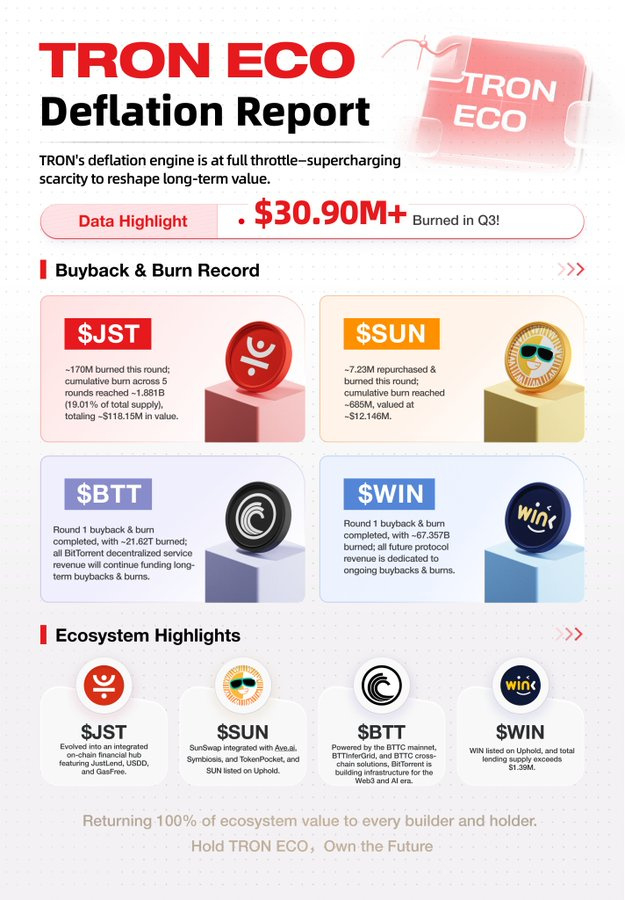
The TRON ecosystem has highlighted more than $30.90 million in combined buyback-and-burn value across JST, SUN, BTT, and WIN.
This milestone reflects an increasingly visible approach to token economics: connecting protocol-generated economic activity with mechanisms designed to reduce circulating token supply.
However, the four programs are not at identical implementation stages.
According to the announcement, BTT and WIN have completed their first burns, while JST has updated its buyback-and-burn mechanism.
Why revenue-linked tokenomics matters
Decentralized protocols can generate economic activity through their products and services.
A revenue-backed buyback mechanism creates a framework through which part of that economic activity may be directed toward acquiring tokens.
When purchased tokens are permanently burned, the corresponding token supply is reduced.
This creates a measurable connection between protocol operations and token supply management.
Understanding the $30.90 million figure
The reported amount represents combined buyback-and-burn value across the highlighted ecosystem programs.
It should not be interpreted as the net profit of the four protocols.
Nor does it establish that $30.90 million was spent during one specific day or reporting period.
The announcement does not provide a complete breakdown of the combined figure.
Why completed burns matter
A completed burn can be examined through the relevant blockchain transaction records.
This distinguishes executed supply reduction from a proposed or announced mechanism.
However, a completed burn does not automatically establish a particular effect on market price.
Different implementation stages
BTT and WIN have completed initial burns.
JST has announced changes to its mechanism.
These developments should be evaluated according to their respective execution status rather than treated as identical completed events.
What should investors monitor?
Future burn transactions, applicable revenue-allocation rules, changes in circulating supply, and the sustainability of protocol-generated revenue.
These indicators provide more context than a single cumulative value.
The broader significance
Revenue-linked tokenomics offers a framework for connecting real protocol activity with token supply dynamics.
Its long-term relevance depends on consistent execution, transparent reporting, and sustainable economic activity.
The $30.90 million milestone is therefore a useful reference point, but the durability of the underlying mechanisms matters more than the headline alone.
@JUST DAO @justinsuntron #TRONEcoStar