


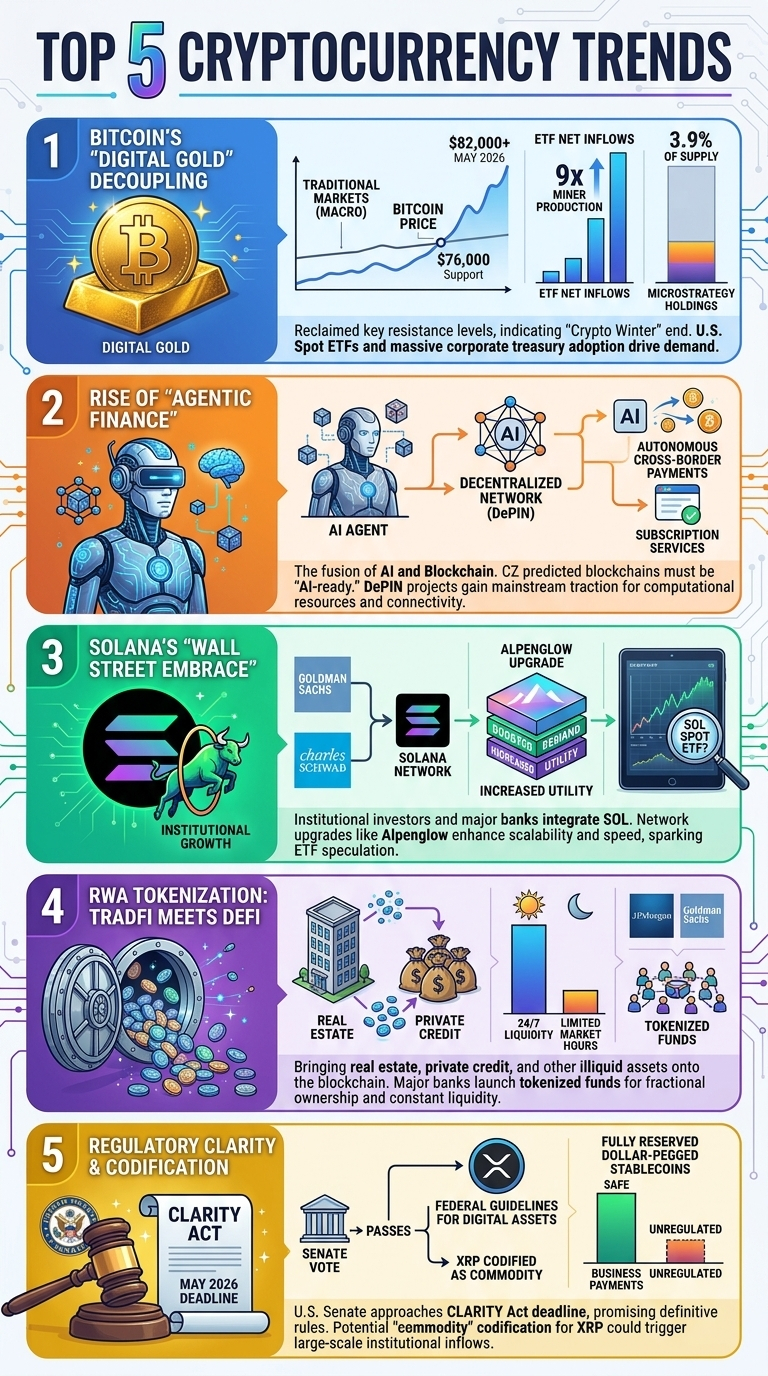
1. Bitcoin continues to serve as the macro bellwether for the digital asset ecosystem, increasingly behaving as a decoupled institutional asset class.
ETF Dominance: U.S. spot Bitcoin exchange-traded funds (ETFs) have structurally altered market supply dynamics, routinely absorbing newly minted supply significantly faster than miners can produce it.
Corporate Treasuries: Publicly traded corporate giants like MicroStrategy continue to anchor a massive share of circulating supply through aggressive, long-term treasury adoption strategies.
2. The Rise of "Agentic Finance": AI-Native Payment Layers
The convergence of artificial intelligence and blockchain technology is creating entirely new use cases for automated digital economies.
Autonomous Microtransactions: As AI agents evolve to execute complex tasks independently, they require permissionless, borderless settlement rails. Cryptocurrencies and specialized programmable networks are increasingly acting as the native payment layers for AI-driven subscriptions and services.
DePIN Integration: Decentralized Physical Infrastructure Networks (DePIN) are gaining mainstream traction, allowing decentralized compute, storage, and wireless resources to power the massive back-end demands of the AI boom.
3. Solana’s Institutional Scale and Scalability
Solana has aggressively expanded beyond its retail-focused roots to capture serious attention from Wall Street and major financial infrastructure providers.
Network Upgrades: High-throughput networks like Solana continue to focus heavily on performance scaling—such as the anticipated Alpenglow consensus updates designed to radically improve finality and network capacity.
Wall Street Integration: Major financial institutions and custodians are increasingly exploring or integrating Solana rails, with market watchers closely monitoring the horizon for potential regulated spot product expansions.
4. RWA Tokenization: Bridging TradFi and DeFi
The tokenization of Real-World Assets (RWA) has transitioned from an experimental narrative into a core pillar of institutional finance.
Traditional Banking Entry: Major global banking institutions (including heavyweights like JPMorgan and Goldman Sachs) are actively developing tokenized fund products and on-chain debt instruments.
Enhanced Liquidity: By breaking traditionally illiquid assets—such as real estate, private credit, and government treasuries—into fractionalized, tradeable blockchain tokens, protocols are unlocking 24/7 global liquidity and higher capital efficiency.
5. Regulatory Clarity and Market Structure
Regulatory oversight remains one of the most powerful catalysts for institutional capital deployment.
Legislative Frameworks: Legislative efforts—such as the ongoing debates surrounding comprehensive market structure bills like the CLARITY Act—aim to formally draw the operational and jurisdictional boundaries between agencies like the SEC and CFTC.
Asset Classification and Stablecoins: Regulatory proposals heavily influence how specific assets (such as XRP or digital commodities) are codified, while separate frameworks focus on ensuring robust operational standards and oversight for fully-reserved, dollar-pegged stablecoins.
Would you like to explore a detailed price and market analysis for a specific asset like Bitcoin or Solana, or dive deeper into how AI agents utilize crypto rails?
#BitcoinCoreIdentifiesThreeVulnerabilities #BTC走势分析 #SolanaStrong $BTC $SOL $BNB