

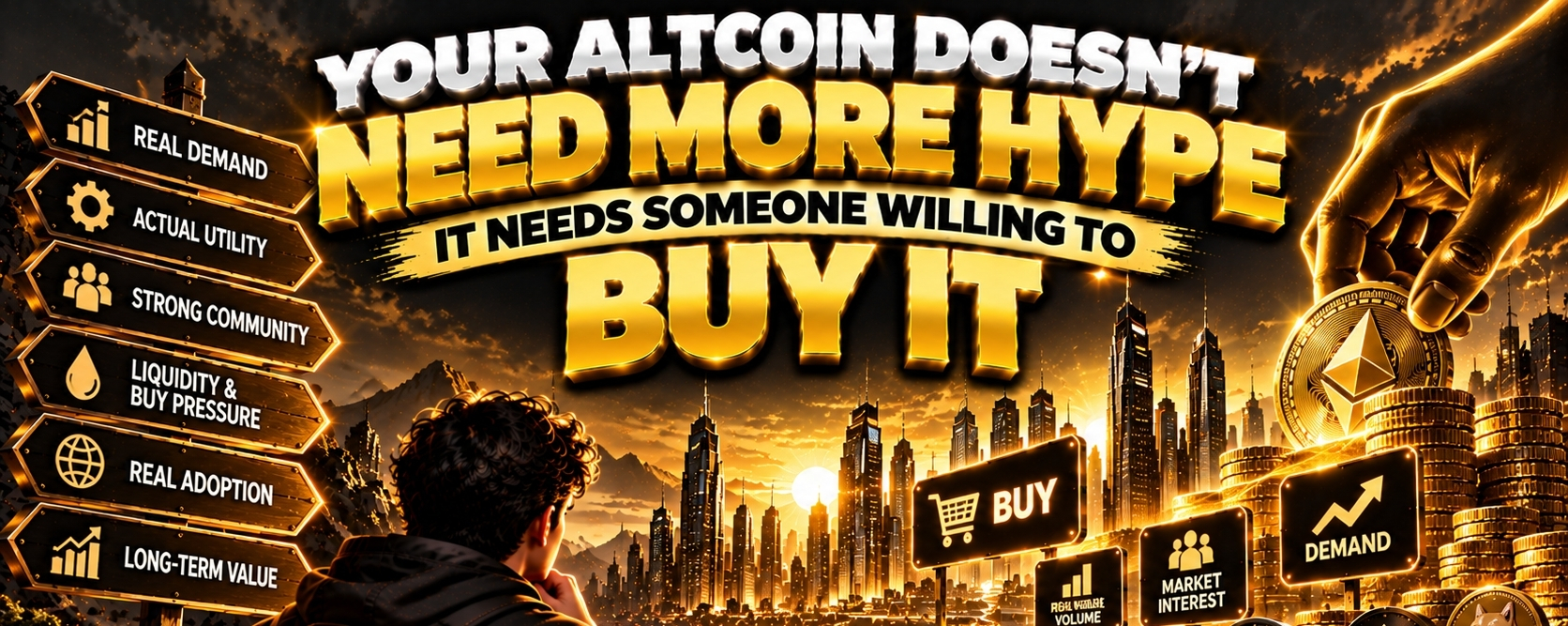


Every crypto community has the same dream. They want their favorite altcoin to explode, break its previous all-time high, and finally reward everyone who has been holding through the difficult months.
Social media is full of bullish predictions, exciting announcements, and people claiming their coin is seriously undervalued.
But there's one problem nobody wants to discuss.
A thousand people saying a coin should pump means very little if nobody is actually willing to buy it.
That's one of the biggest realities of the crypto market, and it explains why some altcoins struggle even when their communities are incredibly active.
Hype Can Create Attention, but It Can't Guarantee Demand
Crypto investors love excitement.
A new partnership announcement, an influencer mentioning a token, or a trending hashtag can suddenly bring thousands of people into a project's community.
Everyone starts talking about massive price targets and the possibility of life-changing profits.
But attention and buying demand are not the same thing.
People can discuss a cryptocurrency all day without putting any money into it.
Even when hype attracts buyers, the excitement may disappear quickly if there isn't enough lasting interest.
That's why some tokens experience impressive pumps followed by equally disappointing corrections.
The market doesn't reward a project simply because its community believes it deserves a higher price.
Your Favorite Coin Might Be Popular but Still Struggling
Imagine a cryptocurrency with hundreds of thousands of followers across social media.
Its community is constantly posting bullish charts, sharing project updates, and encouraging people to stay confident.
From the outside, everything looks positive.
But when you open the price chart, the token is still trading near its lows.
Why?
Because social media popularity doesn't automatically translate into sustained demand.
Some followers may already own the token and have no intention of buying more.
Others might be waiting for a lower entry price, while some are simply following the project out of curiosity.
Meanwhile, existing holders may be selling into every small rally.
A large community can help a project grow, but it doesn't guarantee that buyers will consistently outweigh sellers at higher prices.
The Crypto Market Has a Demand Problem
The number of cryptocurrencies competing for investor attention has grown enormously.
There are tokens connected to artificial intelligence, gaming, decentralized finance, real-world assets, meme culture, and almost every blockchain idea imaginable.
Each project wants investors to believe it could become the next major success story.
But there isn't unlimited money available for every token.
When new projects attract attention, older cryptocurrencies may struggle to maintain their market share.
Even strong projects must compete for liquidity, users, developers, and investor confidence.
This creates an uncomfortable situation for altcoin holders.
Their favorite project might continue building while its token price remains weak.
A project can be making progress without its token becoming a better investment.
Token Supply Can Make the Problem Worse
Buying demand is only one side of the equation.
Supply matters just as much.
Imagine a project has 100 million tokens circulating, but hundreds of millions more are scheduled to enter the market over the coming years.
As additional tokens become available, the market may need more buying demand to absorb potential selling pressure.
If demand doesn't grow enough, the price can struggle even when the project announces positive developments.
This is why token unlocks, inflation, circulating supply, and fully diluted valuation deserve attention.
A coin that looks cheap based on its unit price may still carry a large valuation relative to its adoption.
And a project with an impressive roadmap can still have token economics that create challenges for holders.
Not Every Partnership Creates Real Value
Crypto projects frequently announce partnerships, integrations, and ecosystem expansions.
These developments can be meaningful, especially when they attract users or improve a product.
But investors should look beyond the announcement itself.
Does the partnership create actual demand for the token?
Does it increase network usage?
Does it generate revenue, improve adoption, or provide a clear benefit to the ecosystem?
Or is it mainly a marketing announcement designed to attract attention?
A partnership can be good for a company or blockchain ecosystem without necessarily increasing the value of its cryptocurrency.
That's an important difference many investors overlook.
Why Some Altcoins Pump While Others Stay Behind
During a crypto rally, investors often notice that certain tokens experience explosive gains while others barely move.
It can feel unfair, especially when a struggling project appears to have better technology.
But markets don't always reward technical quality immediately.
Liquidity, investor expectations, trading activity, available supply, and changing narratives can all influence short-term performance.
Sometimes a smaller token rises sharply because relatively little buying activity is needed to move its price.
However, low liquidity can also make prices fall just as quickly.
A massive percentage gain doesn't automatically mean a project has strong fundamentals.
And a quiet price chart doesn't necessarily mean development has stopped.
Understanding the difference between speculation and sustainable demand is essential.
Real Adoption Could Become More Important
As the cryptocurrency industry develops, investors may become more interested in projects that demonstrate practical value.
Blockchain networks supporting useful applications, financial infrastructure, payments, or other real-world services could attract attention if their adoption continues growing.
But even real adoption doesn't automatically guarantee token price appreciation.
A project must also have a token model that connects network activity to meaningful demand.
If users can benefit from a platform without needing its token, growing popularity may not translate into stronger token performance.
This is why understanding how a cryptocurrency fits into its ecosystem matters more than simply believing the technology is impressive.
The Next Altcoin Season Might Not Save Every Coin
Many investors are waiting for Bitcoin to rally so that money eventually flows into smaller cryptocurrencies.
Historically, some crypto cycles have included periods when altcoins significantly outperformed Bitcoin.
But that doesn't mean every token will participate equally in the next rally.
Some projects could attract new buyers because of stronger adoption, improved fundamentals, or changing investor interest.
Others may remain under pressure because of weak demand, increasing supply, or declining relevance.
The next altcoin season could create major winners while leaving many former favorites behind.
And that's why waiting for the entire market to become bullish isn't a complete investment strategy.
Stop Asking Why Your Coin Isn't Pumping
A more useful question is what could create lasting demand for the token.
Are people actually using the project?
Is the network attracting developers and users?
Does the token have a meaningful purpose?
Is its supply increasing faster than demand?
Are investors buying because they see long-term value, or simply because they expect someone else to pay a higher price later?
These questions won't predict every price movement, but they can help investors understand what they're holding.
Sometimes the answer may reveal genuine potential.
Other times, it may expose weaknesses that community excitement has been hiding.
Final Thoughts: The Market Needs Buyers, Not Just Believers
Crypto communities can be powerful.
They bring people together, spread information, support development, and help projects gain visibility.
But belief alone cannot guarantee a rising token price.
For a cryptocurrency to sustain higher valuations, buyers must be willing to absorb available selling pressure at those prices.
That demand may come from speculation, practical utility, investment interest, or a combination of different factors.
The challenge is whether it can last.
Your altcoin doesn't need another thousand posts predicting a 100x rally. It needs a convincing reason for people to keep buying and using it.
The next bull market may reward projects that successfully turn attention into lasting demand.
Others could discover that a loyal community isn't always enough.
And perhaps that's the lesson many altcoin investors need to understand before the next major market cycle.
Now here's my question for the Binance Square community.
Do you believe your favorite altcoin has real demand behind it, or is most of its popularity coming from social media hype?
#Altcoins #AltcoinSeason #CryptoMarket #Tokenomics #BinanceSquare