


Blockchain was built on a powerful promise: decentralization, transparency, and fairness.
The idea was to create systems where trust doesn't depend on a single company, authority, or intermediary.
But somewhere along the way, we need to ask ourselves: Are all blockchain projects truly living up to that vision?
With the rise of Agentic AI, I believe we're approaching an opportunity to take decentralization to the next level.
Not just AI trading bots. Not just AI tokens.
What if the blockchain itself could act as an autonomous AI agent?
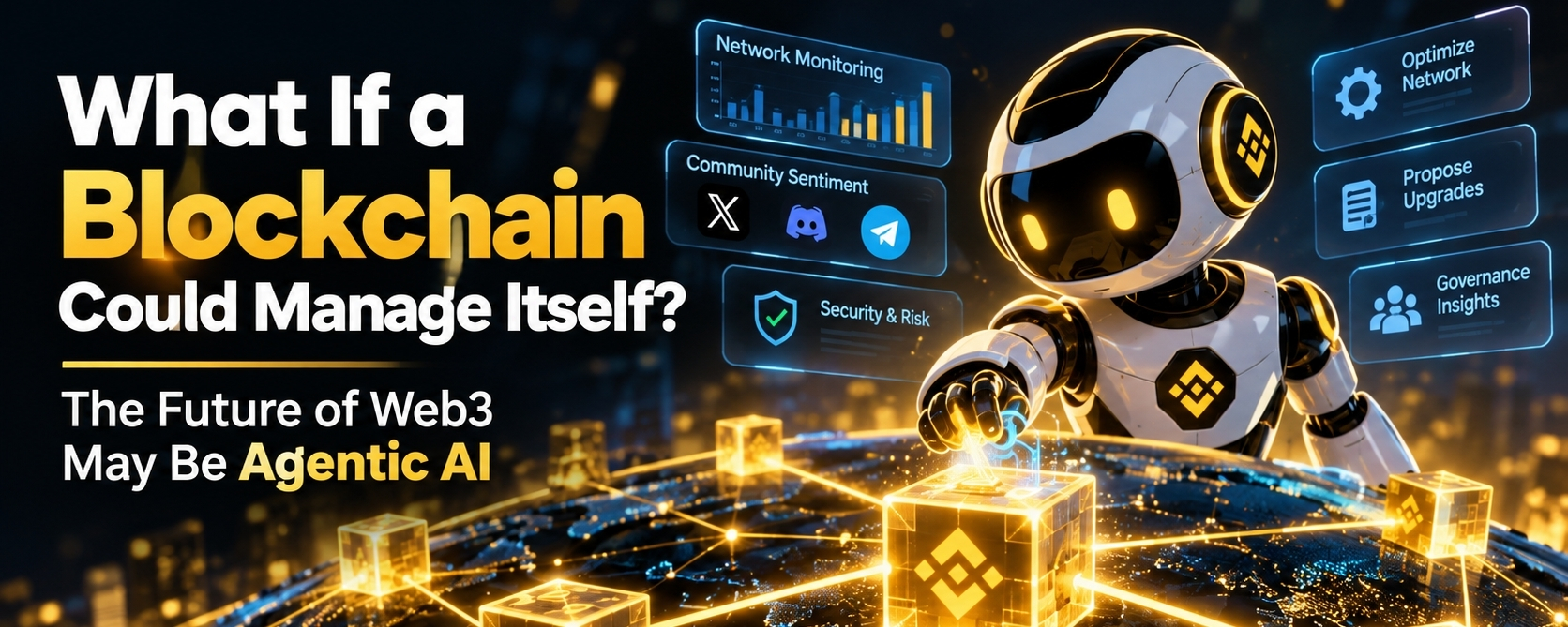
1. A Blockchain That Thinks, Monitors & Acts
Imagine a blockchain with an intelligent agent continuously monitoring its own ecosystem.
It could:
🔹 Monitor network performance, transaction fees, congestion, and validator activity.
🔹 Detect unusual behavior, potential vulnerabilities, and operational issues.
🔹 Analyze discussions across X, Discord, GitHub, and governance forums to understand what developers and users are actually saying.
🔹 Identify recurring community complaints and recommend improvements.
🔹 Test proposed network changes and automate routine maintenance within predefined permissions.
Instead of waiting for a development team to notice every problem, the network could proactively identify issues and coordinate solutions.
Think of it as a self-monitoring, self-managing blockchain ecosystem.
2. Community Voices Could Become More Meaningful
One of the biggest opportunities lies in decentralized governance.
Today, communities can submit proposals and vote on changes, but understanding technical implications, analyzing competing proposals, and evaluating community concerns can be difficult.
Agentic AI could help bridge this gap.
Imagine an AI agent that continuously analyzes community feedback, identifies the most pressing issues, evaluates possible solutions, and prepares evidence-based governance proposals.
The community would still make the important decisions.
But it would have better information, faster analysis, and a clearer understanding of the consequences.
AI should strengthen decentralized governance, not replace it.
3. Autonomy Without Centralized Control
There is an important challenge here.
If one AI agent has unrestricted control over a blockchain, we haven't necessarily achieved decentralization. We may simply have replaced human centralization with algorithmic centralization.
The solution could involve:
✅ Multiple independently operated AI agents.
✅ Transparent, auditable decision-making.
✅ Smart-contract-enforced permissions and spending limits.
✅ Automatic execution of predefined, low-risk operations.
✅ Community approval for major protocol upgrades and treasury decisions.
The objective isn't to create an AI that can do anything.
It's to create an AI that can act independently within rules that nobody can secretly change to benefit themselves.
4. From AI-Powered Crypto to AI-Native Blockchains
There is a difference between using AI on a blockchain and building a blockchain ecosystem around autonomous intelligence.
An AI-powered crypto project might offer a chatbot, trading signals, or automated portfolio management.
An AI-native blockchain could go much further.
Its agents could coordinate network operations, analyze security threats, assist developers, optimize authorized resources, and improve governance processes.
Over time, networks could evolve from infrastructure that merely executes predefined instructions into infrastructure that can monitor conditions, identify problems, and respond intelligently.
Of course, AI-generated decisions would still require verification, and critical operations would need safeguards against manipulation, errors, and attacks.
5. Is This the Next Evolution of Web3?
We have already seen blockchain evolve through smart contracts, DeFi, DAOs, and tokenized ecosystems.
Agentic AI introduces another possibility: autonomous digital infrastructure capable of operating with less continuous human intervention.
The real opportunity isn't simply launching another AI token.
It is building systems where AI contributes intelligence, blockchain provides verifiable execution, and decentralized governance preserves community control.
Imagine a network that can identify its own operational problems, propose solutions, coordinate maintenance, and demonstrate transparently what it did and why.
That would be a meaningful step toward a new generation of decentralized infrastructure.
My question to the Binance Square community:
If blockchain was originally about removing the need to trust centralized authorities, could Agentic AI help us build networks that are not only decentralized and transparent, but also capable of intelligently managing themselves
Are we heading toward a future of self-governing, AI-native blockchains?
Or does putting AI at the center of blockchain introduce an entirely new risk to decentralization?
Let's discuss. 👇