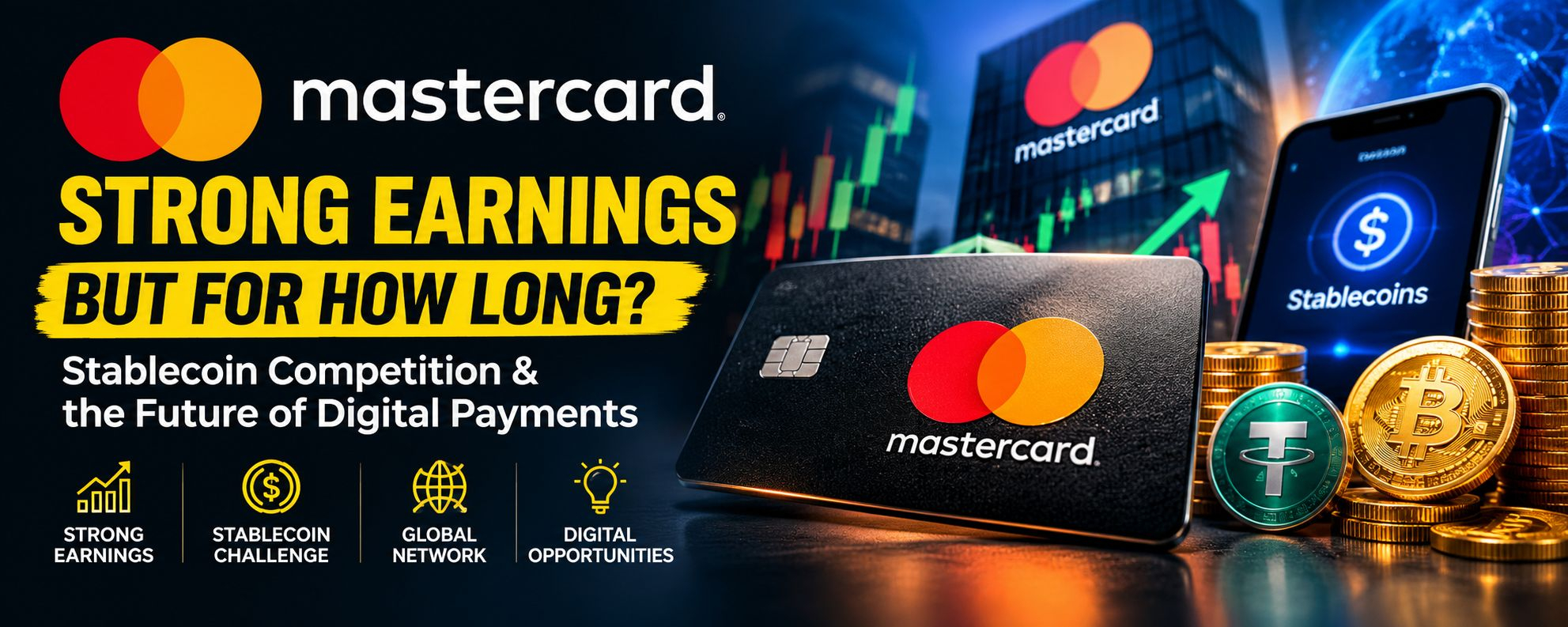


Mastercard (MA) continues to demonstrate strong operating performance, but investors are increasingly evaluating whether its growth can withstand the rapid evolution of digital payments.
According to the news shared, Mastercard has beaten adjusted earnings-per-share estimates for six consecutive quarters. Its latest adjusted EPS reached $5.04, exceeding the consensus estimate of $4.77, while revenue climbed 14.1% to $9.28 billion. These figures highlight the company's ability to maintain solid financial momentum in a competitive environment.
Strong Fundamentals Remain a Key Advantage
Mastercard benefits from its extensive global payment network, established relationships with financial institutions, and broad acceptance among merchants and consumers. Its reported network scale provides a significant competitive advantage that newer payment platforms may find difficult to replicate.
However, strong earnings alone do not guarantee continued stock appreciation. Investors must also consider valuation, future growth expectations, and emerging competitive threats.
Stablecoins: A Challenge or an Opportunity?
Stablecoins and alternative payment networks are becoming increasingly important in the financial industry. Their potential to enable faster settlement and more flexible cross-border transactions could challenge traditional payment infrastructure.
For Mastercard, this development creates both risks and opportunities. If stablecoin adoption reduces reliance on conventional card networks, it could pressure certain revenue streams. On the other hand, Mastercard could benefit by integrating digital-asset infrastructure, expanding value-added services, and developing solutions that connect traditional finance with blockchain-based payments.
The key question is not simply whether stablecoins will grow, but how effectively established payment companies adapt to that growth.
What Investors Should Watch Next
Several factors could influence Mastercard's future performance:
Revenue growth: Can the company sustain double-digit growth in upcoming quarters?
Cross-border payments: Will international transaction volumes remain strong?
Digital-asset strategy: How will Mastercard respond to stablecoins and emerging payment technologies?
Valuation: Can future earnings growth justify the premium investors are paying?
Regulatory developments: Could new rules or fee pressures affect profitability?
Final Outlook
Mastercard's latest reported results reflect strong business fundamentals, but the long-term investment case depends on more than quarterly earnings beats. Its ability to preserve its competitive position while adapting to digital-asset innovation will be crucial.
For investors, the most important signal will be whether Mastercard can combine consistent revenue growth with successful adaptation to changing payment technology. Strong execution could support its long-term outlook, while intensifying competition or valuation pressure may limit further upside.
The bigger picture: The future of payments may not be a simple battle between traditional networks and stablecoins. It could be a race to build the most efficient, trusted, and adaptable financial infrastructure.
This article is for informational purposes only and does not constitute financial advice.
#Mastercard #MA #digitalpayments #Stablecoins #BinanceSquare $MA.US