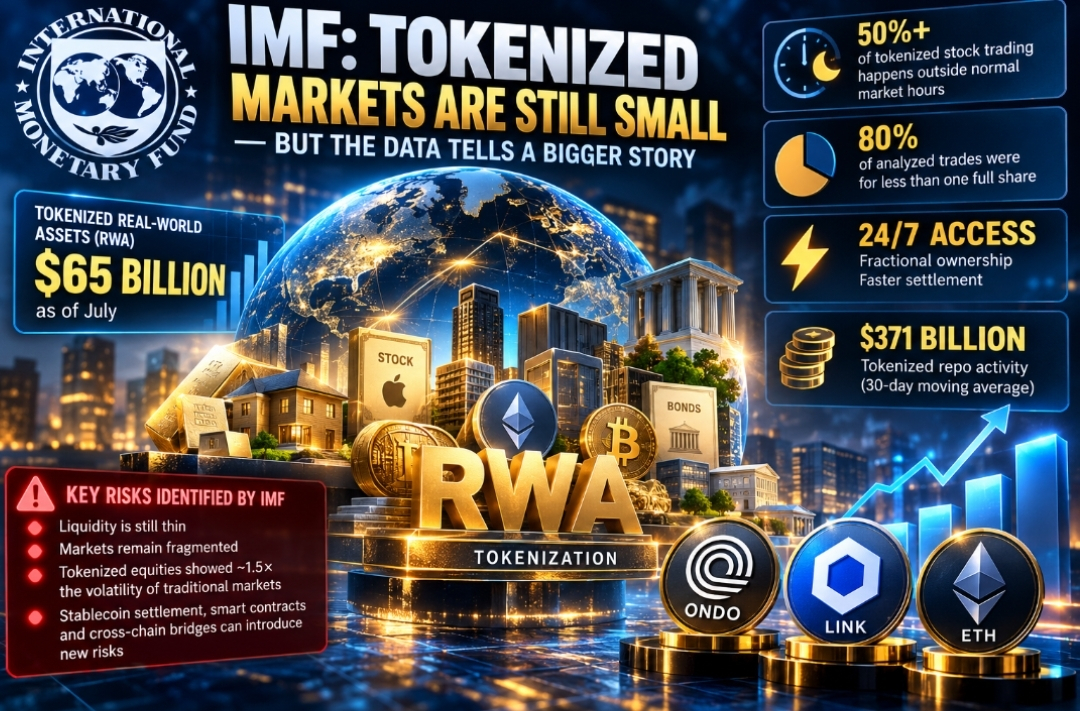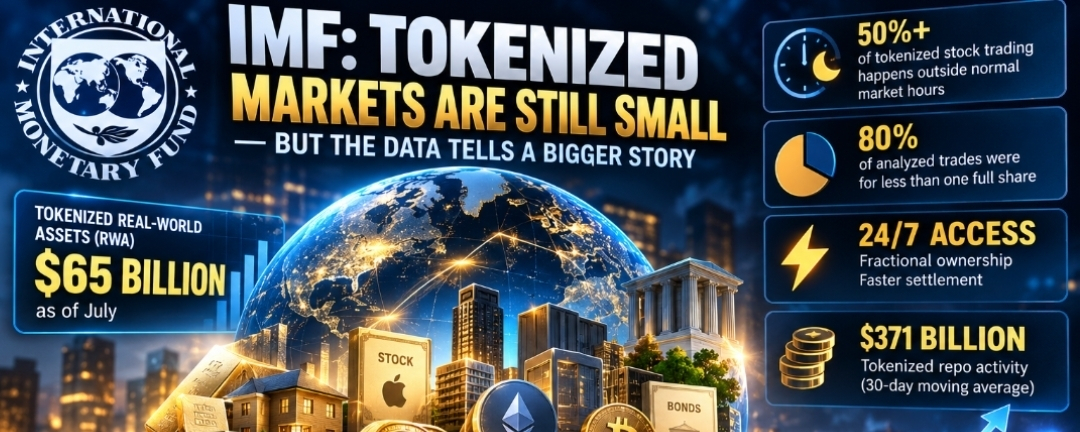


Tokenization has become one of the biggest narratives in crypto and traditional finance. Yet according to the IMF, tokenized real-world assets were still valued at only around $65 BILLION as of July.
At first glance, $65B may sound like a huge number. But compared with the size of global financial markets, it is still relatively small. And that is exactly what makes the current stage of tokenization so interesting.
🌙 The way these markets are being used is already changing.
More than 50% of tokenized stock trading takes place outside traditional market hours, showing that investors are already using blockchain-based markets for access beyond the normal trading day.
Even more interesting, around 80% of analyzed trades were smaller than one full share. That highlights one of tokenization’s biggest advantages: fractional ownership.
Instead of requiring investors to purchase an entire asset, tokenized markets can allow exposure to smaller portions, potentially making traditionally difficult-to-access assets more flexible and accessible.
⚡ 24/7 access. Fractional ownership. Faster settlement.
These are some of the reasons tokenization continues to attract attention from both crypto-native companies and traditional financial institutions.
And the numbers are not limited to tokenized equities.
Tokenized repo activity has already reached roughly $371 BILLION on a 30-day moving-average basis, showing that blockchain infrastructure is beginning to find practical applications within financial markets.
But there is another side to the story.
⚠️ The IMF is also highlighting significant risks.
Liquidity remains relatively thin, markets are fragmented, and tokenized equities in the IMF analysis showed approximately 1.5× the volatility of traditional markets.
There are also additional risks surrounding stablecoin settlement, smart contracts, custody infrastructure and cross-chain bridges.
So, is tokenization already overhyped?
Not necessarily.
The bigger question may be whether today’s relatively small market size represents a weakness — or simply the early stage of a much larger adoption curve.
For me, the interesting part is not blindly buying every token carrying the “RWA” narrative.
The real opportunity may be in the infrastructure supporting tokenization, settlement, interoperability and on-chain financial markets.
👀 I’m watching projects such as $ONDO, LINK and $ETH closely as the broader RWA and tokenization ecosystem develops.
The market may still be small today.
But if traditional financial assets continue moving on-chain, $65B could eventually look like the starting point rather than the ceiling.
The real question is:
Are tokenized markets still too small to matter — or are we simply looking at the beginning of the next major financial transition? 🚀
#RWA #Tokenization #Crypto #RealWorldAssets #DeFi #Blockchai #ONDO #LINK #ETH