🔐 “Not your keys, not your coins” just got a lot more complicated...
#BrazilOrdersReportingOf$10KSelfCustodyTransfers
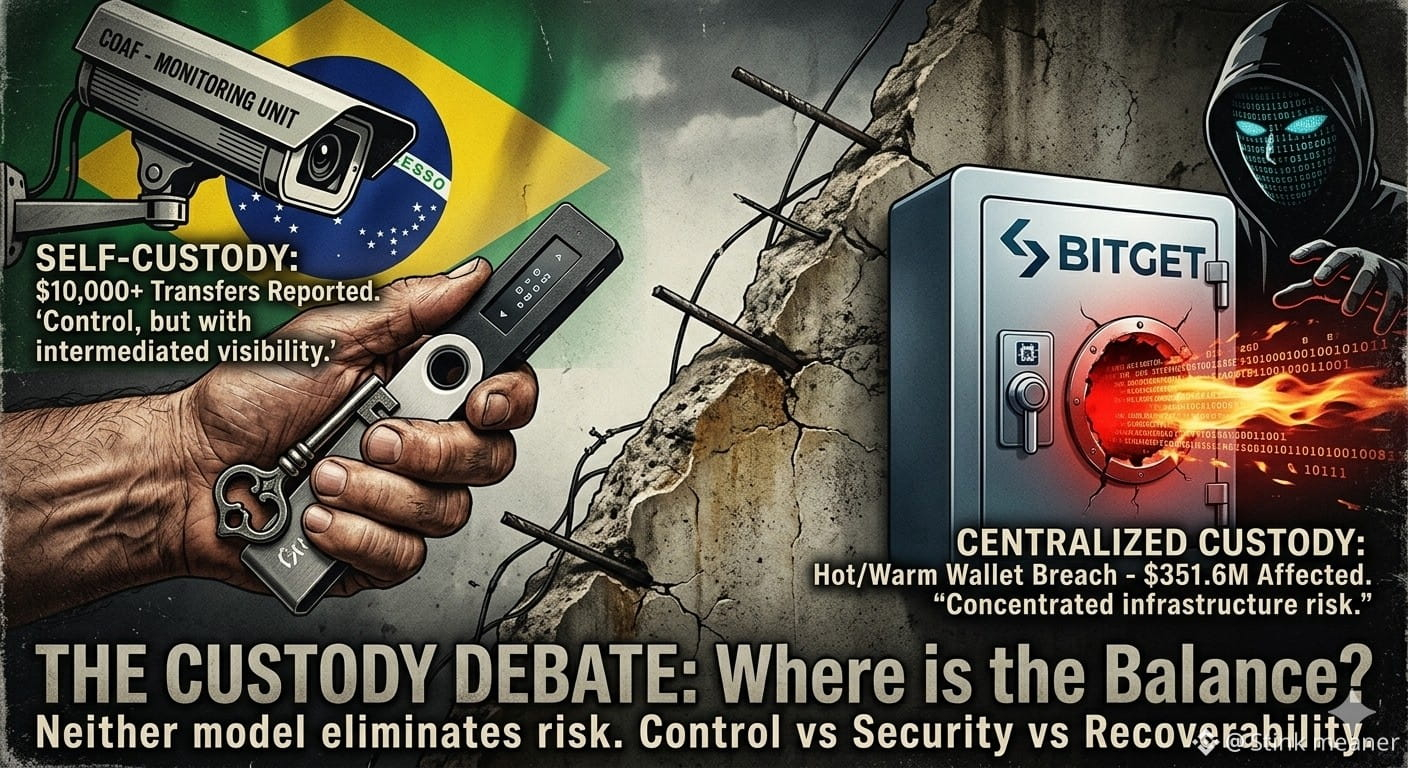
Brazil will require covered institutions to report crypto transfers of $10,000+ to or from self-custodied wallets to COAF starting October 1. The rule does not ban self-custody or impose a transaction ceiling.
The reason given by Brazil's central bank is information: when users control their own keys, there can be less data available for monitoring and risk assessment.
Then Bitget disclosed a completely different custody problem.
About $351.6M in assets were affected by unauthorized transfers from parts of its hot/warm wallet infrastructure. Bitget says cold wallets remained secure and its $464M+ protection fund covers the affected amount; withdrawals were temporarily suspended while the investigation continues.
So within roughly 24 hours, crypto got two reminders:
SELF-CUSTODY: more control, less intermediary visibility.
CENTRALIZED CUSTODY: more institutional visibility, but concentrated infrastructure risk.
That's why I think the future debate isn't simply “self-custody vs exchanges.”
It's about finding a custody model that balances control, transparency, recoverability and security without pretending any one model eliminates risk.
$BTC $SOL $PLAY
Bitget has not disclosed the attack vector, and its statements about user-fund protection remain its own disclosure. Brazil's reporting rule is a monitoring requirement, not a self-custody ban.
#BitgetSays$352MAffectedInHack #CryptoRegulation #SelfCustody #Binance
#BrazilOrdersReportingOf$10KSelfCustodyTransfers
Brazil will require covered institutions to report crypto transfers of $10,000+ to or from self-custodied wallets to COAF starting October 1. The rule does not ban self-custody or impose a transaction ceiling.
The reason given by Brazil's central bank is information: when users control their own keys, there can be less data available for monitoring and risk assessment.
Then Bitget disclosed a completely different custody problem.
About $351.6M in assets were affected by unauthorized transfers from parts of its hot/warm wallet infrastructure. Bitget says cold wallets remained secure and its $464M+ protection fund covers the affected amount; withdrawals were temporarily suspended while the investigation continues.
So within roughly 24 hours, crypto got two reminders:
SELF-CUSTODY: more control, less intermediary visibility.
CENTRALIZED CUSTODY: more institutional visibility, but concentrated infrastructure risk.
That's why I think the future debate isn't simply “self-custody vs exchanges.”
It's about finding a custody model that balances control, transparency, recoverability and security without pretending any one model eliminates risk.
$BTC $SOL $PLAY
Bitget has not disclosed the attack vector, and its statements about user-fund protection remain its own disclosure. Brazil's reporting rule is a monitoring requirement, not a self-custody ban.
#BitgetSays$352MAffectedInHack #CryptoRegulation #SelfCustody #Binance