
#cardanojoinsx402paymentstandard
Cardano Joins x402: Can ADA Become Part of the AI-Agent Economy?
Cardano ($ADA) has just connected to one of the more interesting payment standards being developed for the emerging AI-agent economy.
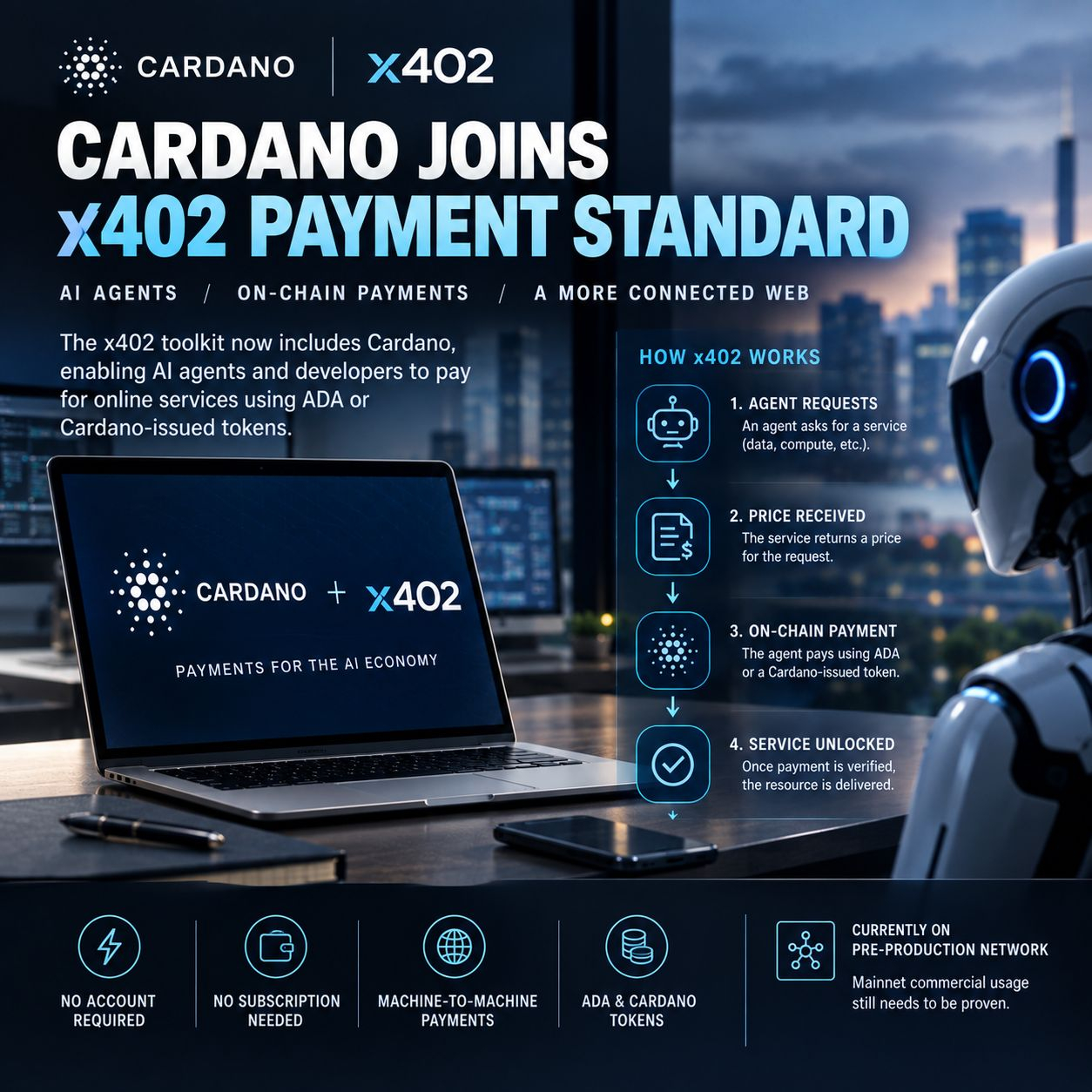
The official x402 toolkit now includes Cardano, giving developers the ability to build applications and AI agents that can pay for online services using ADA or Cardano-issued tokens.
But the interesting part isn't simply giving AI agents another cryptocurrency to use.
It's the payment model behind x402.
Turning Web Requests Into Payments
The basic idea is surprisingly simple.
An AI agent can request a digital service, such as data or computing resources. The service can return a price, the agent can make an on-chain payment, and the requested resource can then be delivered once the payment is verified.
That creates a potential payment flow directly around an ordinary web request.
No traditional account needs to be created for every service.
No recurring subscription necessarily needs to exist.
Instead, the model can support pay-per-use machine-to-machine payments.
For an AI agent operating autonomously, that could be particularly useful.
An agent might need access to a specific dataset, API, computing resource or other digital service for only a few seconds. Rather than maintaining accounts and payment credentials across dozens of providers, the payment itself could become part of the request.
A Different Use Case for ADA
This creates a potentially different role for ADA.
The narrative isn't simply that AI agents might hold cryptocurrency.
It's that blockchain assets could potentially become part of the infrastructure that allows autonomous software to transact with other services.
If that model scales, AI agents could become economic participants that continuously make small payments without requiring a human to manually approve every transaction.
But there's an important caveat.
Cardano's current x402 implementation has demonstrated the payment flow on a pre-production network. Commercial-scale mainnet usage still needs to be proven.
That distinction matters.
An integration can demonstrate that the technology works. Real adoption requires developers to build on it, services to accept the payments, and enough autonomous agents to actually generate meaningful transaction activity.
The Real Test Is Usage
That's why the next milestone isn't another announcement.
It's activity.
If AI agents eventually begin making millions of small payments for data, computing and other digital services, networks supporting those transactions could see a completely different type of on-chain demand.
For Cardano, the question is whether x402 can move beyond an interesting integration and become a source of real machine-to-machine economic activity.
The technology is there to test the idea.
Now the market gets to see whether developers and AI agents actually use it.
Can Cardano turn x402 integration into real on-chain machine-to-machine activity?