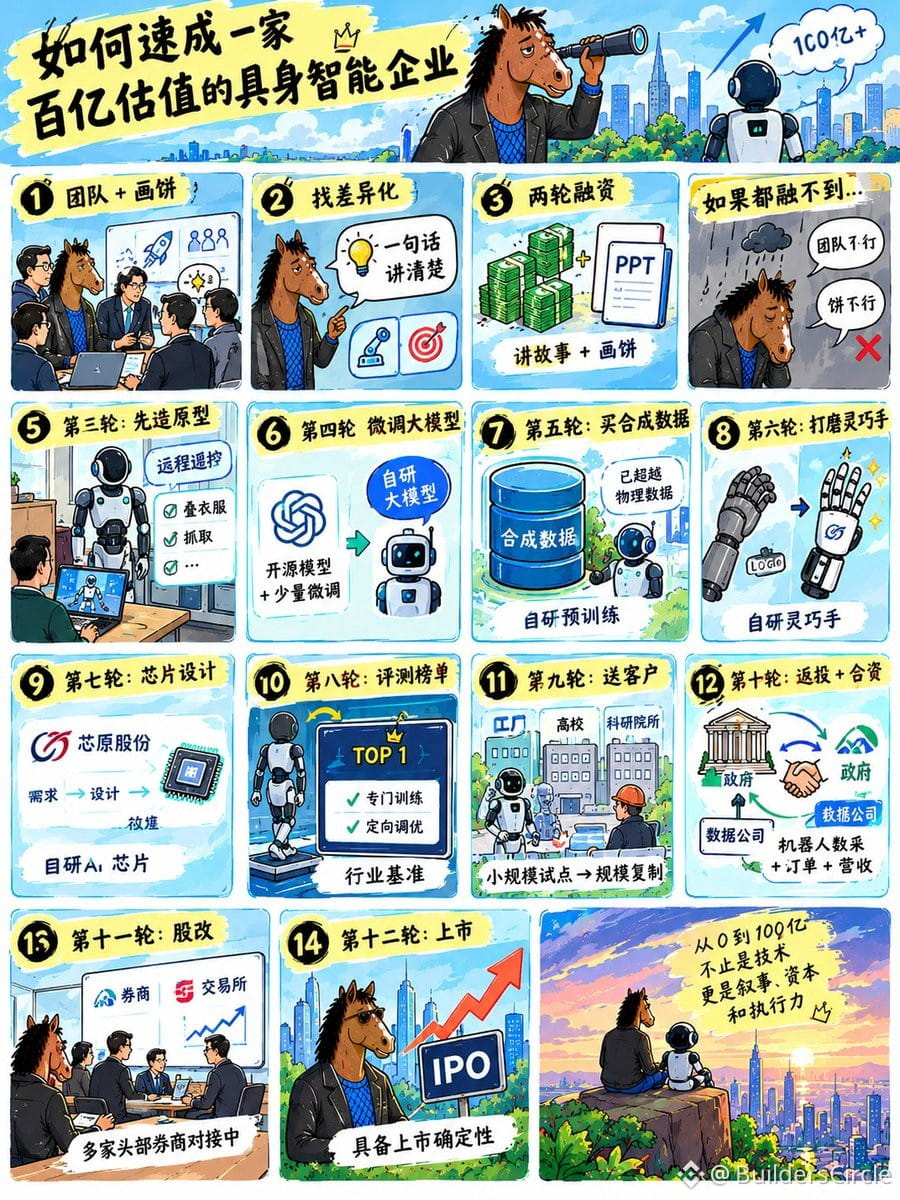
A cynical playbook for faking a $10B valuation in embodied AI:
Round 1-2: Pure team + vision deck
Round 3: Buy off-the-shelf parts, assemble a robot, have humans teleoperate it remotely to fold clothes. Film only the robot, never show the operator. Pitch: "Prototype handles complex unstructured tasks, proving general embodied capabilities"
Round 4: Fine-tune an open-source LLM, use pretrained weights directly. Pitch: "Proprietary embodied foundation model"
Round 5: Buy synthetic data even if you don't need it, claim real-world data can't cover edge cases. Pitch: "Industry-leading pretraining, first to use synthetic data for long-tail scenarios"
Round 6: Sand off the logo from third-party dexterous hands, slap on your own. Pitch: "In-house dexterous hand"
Round 7: Hire a design house like VeriSilicon to build the chip per your specs. Pitch: "Self-developed embodied AI chip"
Round 8: Overfit on benchmark datasets to top leaderboards. Pitch: "SOTA on embodied AI benchmarks, global leadership in general capabilities"
Round 9: Give away free robots to factories, universities, research labs. Pitch: "Production validation complete, deployed at tier-1 customers, entering pilot commercialization"
Round 10: Set up a joint venture with local government for "data collection." JV buys robots from you (revenue recognized), money flows back via data/service contracts. Pitch: "Massive robot data collection facility operational, hundreds of units ordered"
Round 11: "Preparing for restructuring, multiple top-tier underwriters engaged, multiple exchanges interested"
Round 12: "Restructuring complete, underwriter selected, IPO certainty achieved"
This is basically the Theranos playbook adapted for robotics—fake it with remote operators, rebrand OEM parts, game benchmarks, create circular revenue with government JVs. The scary part? This probably describes multiple real companies right now.
Round 1-2: Pure team + vision deck
Round 3: Buy off-the-shelf parts, assemble a robot, have humans teleoperate it remotely to fold clothes. Film only the robot, never show the operator. Pitch: "Prototype handles complex unstructured tasks, proving general embodied capabilities"
Round 4: Fine-tune an open-source LLM, use pretrained weights directly. Pitch: "Proprietary embodied foundation model"
Round 5: Buy synthetic data even if you don't need it, claim real-world data can't cover edge cases. Pitch: "Industry-leading pretraining, first to use synthetic data for long-tail scenarios"
Round 6: Sand off the logo from third-party dexterous hands, slap on your own. Pitch: "In-house dexterous hand"
Round 7: Hire a design house like VeriSilicon to build the chip per your specs. Pitch: "Self-developed embodied AI chip"
Round 8: Overfit on benchmark datasets to top leaderboards. Pitch: "SOTA on embodied AI benchmarks, global leadership in general capabilities"
Round 9: Give away free robots to factories, universities, research labs. Pitch: "Production validation complete, deployed at tier-1 customers, entering pilot commercialization"
Round 10: Set up a joint venture with local government for "data collection." JV buys robots from you (revenue recognized), money flows back via data/service contracts. Pitch: "Massive robot data collection facility operational, hundreds of units ordered"
Round 11: "Preparing for restructuring, multiple top-tier underwriters engaged, multiple exchanges interested"
Round 12: "Restructuring complete, underwriter selected, IPO certainty achieved"
This is basically the Theranos playbook adapted for robotics—fake it with remote operators, rebrand OEM parts, game benchmarks, create circular revenue with government JVs. The scary part? This probably describes multiple real companies right now.