
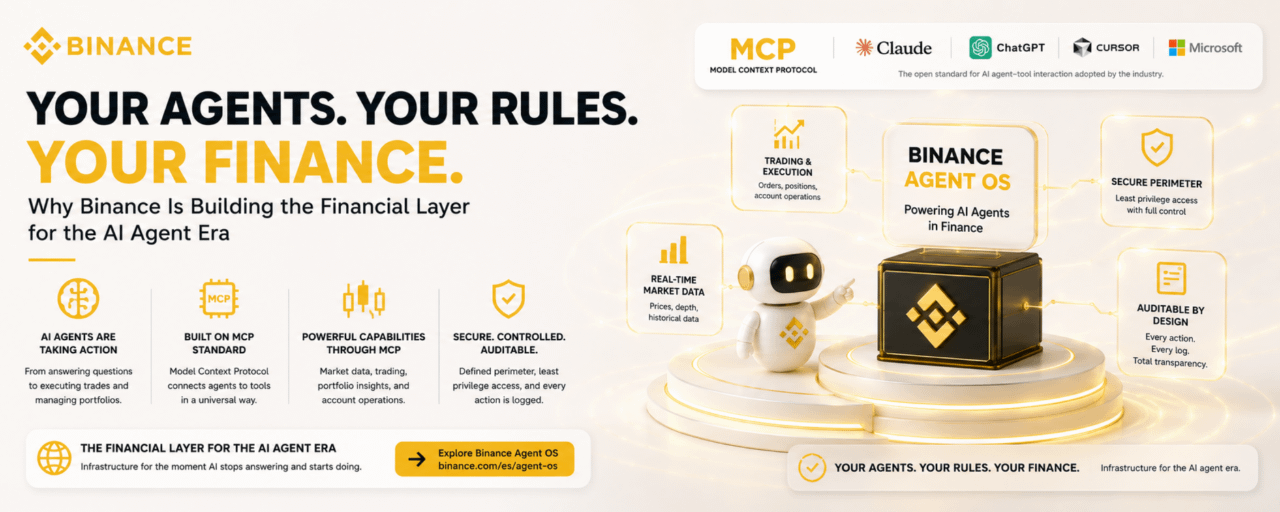

Your Agents, Your Rules, Your Finance: Why Binance Is Building the Financial Layer for the AI Agent Era
There is a line that AI is crossing right now. For most of the past few years, AI has been answering questions — summarizing documents, generating text, explaining concepts. The model sits on the other side of a chat interface and responds.
That is changing. AI agents are beginning to take action. They book appointments, manage files, write and deploy code, and make decisions on behalf of users across extended workflows. The agent does not just suggest — it executes.
When software starts taking action in the financial world, a new problem appears. Financial markets and platforms were built for humans — authenticated humans, operating within defined risk parameters, subject to compliance frameworks and audit trails. An AI agent that wants to check a price, execute a trade, or manage a portfolio position needs a way to reach those capabilities that was not designed for agents acting on behalf of humans.
Binance Agent OS is the answer to that problem.
What MCP Is and Why It Matters
To understand Binance Agent OS, you need to understand MCP — the Model Context Protocol.
MCP is an open standard for how AI agents discover and use external tools and services. Think of it as a universal interface: an AI agent built inside Claude, ChatGPT, Cursor, or any other MCP-compatible environment can query what tools are available, understand what those tools do, and invoke them — all within a structured, documented protocol that both the agent and the platform can interpret.
OpenAI, Google, Microsoft, and AWS have all adopted MCP as the standard for agent-tool interaction. This is significant not because of which companies are involved, but because it signals that MCP is becoming the infrastructure layer that agent developers expect to be present. An agent developer building a financial workflow does not want to write a custom API integration for every platform they want to touch. They want the platforms they care about to be MCP-accessible, so that the tools appear automatically in the agent's context.
Binance Agent OS exposes Binance's market data, trading functions, and financial capabilities through MCP. That means an agent inside any MCP-compatible environment — Claude, Cursor, ChatGPT, or a custom enterprise deployment — can discover Binance's capabilities, understand what they do, and use them within a defined perimeter.
What Binance Agent OS Actually Exposes
The specific capabilities available through Binance Agent OS cover the full scope of what a financially capable agent would need.
On the market data side: real-time prices, order book depth, historical data, and portfolio position information. An agent that needs to answer "what is the current price of BTC relative to the 30-day moving average" or "what is my current portfolio exposure to ETH" can retrieve that information directly through MCP, without requiring the user to copy-paste data into a chat window.
On the execution side: order placement, position management, and account operations within a controlled, auditable framework. The execution capabilities are the more consequential ones — they are what transforms an AI agent from an information tool into a financial actor.
The perimeter design is deliberate. Binance Agent OS does not give an agent unconstrained access to an account. It exposes specific, defined capabilities through a protocol that logs what the agent requested, what it received, and what it executed. Every action is auditable. The user retains control over what the agent can and cannot do. The scope of the agent's authority is explicit and bounded, not implicit and open-ended.
Why the Perimeter Architecture Matters
The way Binance has designed Agent OS reflects a considered answer to a question that most of the AI-in-finance conversation has not yet addressed seriously enough: how do you make financial markets safe for AI agents to touch?
The answer is not to give agents maximal access and trust that they will behave correctly. The answer is to define the authorized perimeter precisely, enforce it technically, and make every action within that perimeter auditable. If an agent executes a trade, the log exists. If an agent queries market data to inform a decision, the query is recorded. If an agent attempts to do something outside its authorized scope, the architecture prevents it.
This design pattern is familiar to anyone who has worked in enterprise software security — it is the principle of least privilege applied to AI financial agents. The agent gets exactly the access it needs to perform its authorized functions, nothing more, and every access is logged.
For users, this matters because it separates trust in the AI model from trust in the financial infrastructure. You do not need to trust that a particular AI model will never behave unexpectedly in order to use it with Binance Agent OS. You need to trust that the perimeter is correctly defined and that the infrastructure enforces it reliably. Those are tractable engineering problems with auditable outcomes — a much stronger foundation for financial agent deployment than blanket model trust.
The Larger Shift
Binance Agent OS is not a product launch in the conventional sense. It is infrastructure — the financial capability layer that the AI agent ecosystem needs to exist before agents can act meaningfully in financial markets.
The parallel to earlier infrastructure moments in finance is instructive. When electronic trading arrived, the question was not whether algorithms could trade — it was whether the market infrastructure existed to let them trade reliably within defined rules. When mobile banking arrived, the question was not whether people wanted to bank on their phones — it was whether the API infrastructure existed to let mobile apps access banking functions securely. In both cases, the infrastructure preceded broad adoption, and adoption followed the infrastructure.
AI agents are at that inflection point now. The question is not whether agents will eventually act in financial markets. They will. The question is whether the infrastructure exists to make that action auditable, controllable, and safe. Binance Agent OS is Binance's answer to that question — built on an open standard already adopted by the major AI platforms, exposed through a controlled perimeter, and designed for the moment when AI stops answering and starts doing.
Your agents. Your rules. Your finance.
👉 https://www.binance.com/es/agent-os
Disclaimer: This article is for educational purposes only and does not constitute financial advice. All trading and investment activities involve risk. Please conduct your own research before making any decisions.