

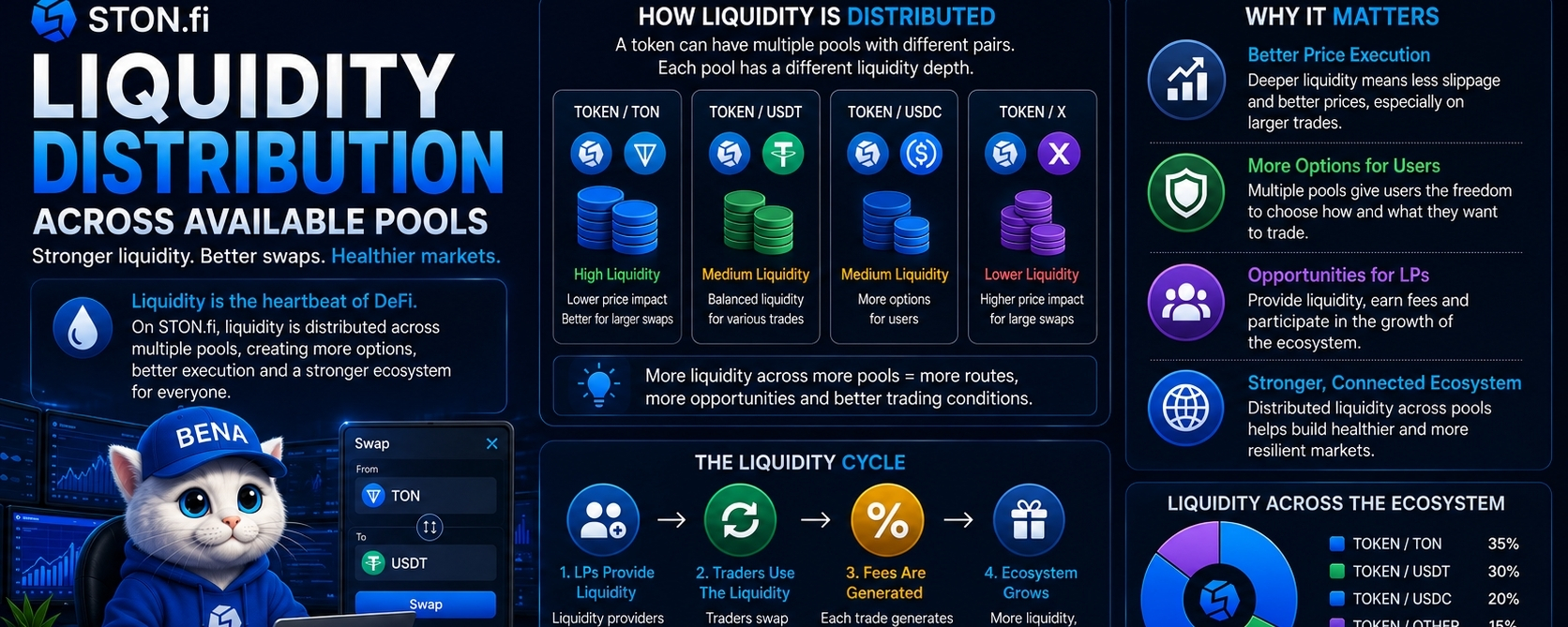

When you make a swap on STON.fi, you probably don't think about where the liquidity is coming from.
You choose your tokens, check the amount you'll receive, and confirm.
But behind that simple experience, liquidity is doing most of the heavy lifting.
So, What Does Liquidity Distribution Mean?
In simple terms, it's about how liquidity is spread across the different pools available for trading.
A token might have pools paired with $TON , USDT, USDC, or other assets. Each pool can have a different amount of liquidity depending on how much users have deposited.
And that difference matters.
A deeper pool can usually handle larger trades with less price impact, while a pool with less liquidity can be affected more by the same trade.
Why Have Multiple Pools?
Because users don't all trade the same way.
Someone might want to swap a token for TON, while another person prefers USDT or USDC. Multiple pools give users more options and create different markets around the same asset.
It also means the ecosystem doesn't have to depend entirely on one liquidity pool.
Where Do These Pools Get Their Liquidity?
This is where liquidity providers (LPs) come in.
LPs deposit assets into a pool so other users can trade against that liquidity.
In return, they can earn a share of eligible trading fees, and some pools may also have additional incentives.
So the basic cycle looks like this:
LPs provide liquidity → traders use the pools → trading generates fees → liquidity providers participate in the market.
Why Should Traders Care?
Here's the part that's easy to overlook.
Two pools can support the same token but have completely different liquidity levels.
If you make a small swap, the difference might not matter much. But for a larger transaction, shallow liquidity can mean higher price impact and potentially worse execution.
That's why liquidity is something worth checking before making a trade.
The Bigger Picture
For me, liquidity distribution is one of the foundations of a healthy DeFi ecosystem.
The more useful liquidity there is across different markets, the easier it becomes for users to trade and for projects to build active markets around their tokens.
And as STON.fi continues expanding its liquidity infrastructure, pools become more than just places where tokens sit.
They're the markets that keep the ecosystem moving.
In DeFi, don't just ask, “What token am I buying?”
Also ask:
“How much liquidity is actually supporting this trade?”
Because sometimes, the liquidity behind the swap matters just as much as the token itself.
@STONfi DEX #STONfi #TON #DeFi #LiquidityPools $BNB $BTC
