
AbdullRauf
8.2k ໂພສ

AbdullRauf
 Square ຢືນຢັນແລ້ວ
Hi Guys i am Spot trader specialist in Intra Daytrade, DCA and Swing trade. Follow me tostay updated about market and Binance reward Campaigns.
ເປີດການຊື້ຂາຍ
ຜູ້ຊື້ຂາຍປະຈໍາ
1.3 ປີ
1.1K+ ກໍາລັງຕິດຕາມ
31.2K+ ຜູ້ຕິດຕາມ
27.9K+ Liked
ໂພສ
Portfolio
ທັງໝົດ
ວົງຢືມ
ວີດີໂອ
ຖ່າຍທອດສົດ
ປັກໝຸດ
YOUR SUPPORT = OUR THANKS. 2000 GIFTS, GO! 🚀🎁💐
Square Family, you rock! 🧧 To celebrate YOU, we’re giving away 2000 GIFTS. Let’s go!
How to enter:
👉 Follow us
👉 Share this post
👉 Comment “666”
Random draws. Huge wins. Enter now!
Square Family, you rock! 🧧 To celebrate YOU, we’re giving away 2000 GIFTS. Let’s go!
How to enter:
👉 Follow us
👉 Share this post
👉 Comment “666”
Random draws. Huge wins. Enter now!

naipi

NaiPi-奶啤
·
--
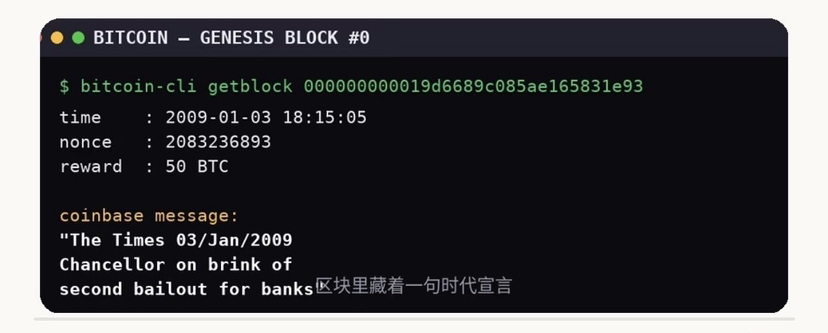
比特币创世:写在区块里的时代宣言
2009年1月3日,比特币创世区块 #0诞生。
中本聪在coinbase字段嵌入《泰晤士报》当日头条:
The Times 03/Jan/2009 Chancellor on brink of second bailout for banks
2009年1月3日,财政大臣濒临第二次银行救助。
2008全球金融危机,银行崩溃、政府动用公共资金救助金融机构。
这句话不只是标记时间,更是比特币诞生的底层注脚:
对抗中心化金融体系的弊病,构建一套无需信任、公开透明的去中心化货币系统。
区块永久不可篡改,这句来自旧时代报纸的文字,永远封存在比特币网络的源头,而创造者中本聪,依旧是加密世界最大的谜题。#BTC☀
$BTC
中本聪在coinbase字段嵌入《泰晤士报》当日头条:
The Times 03/Jan/2009 Chancellor on brink of second bailout for banks
2009年1月3日,财政大臣濒临第二次银行救助。
2008全球金融危机,银行崩溃、政府动用公共资金救助金融机构。
这句话不只是标记时间,更是比特币诞生的底层注脚:
对抗中心化金融体系的弊病,构建一套无需信任、公开透明的去中心化货币系统。
区块永久不可篡改,这句来自旧时代报纸的文字,永远封存在比特币网络的源头,而创造者中本聪,依旧是加密世界最大的谜题。#BTC☀
$BTC
go
CZ_ANUU
·
--
❤🤍❤🤍❤🤍❤🤍❤🤍❤🤍❤🤍❤
❤❤❤❤❤follow me please❤❤❤❤
❤🤍❤🤍❤🤍❤🤍❤🤍❤🤍❤🤍❤
❤❤❤❤❤follow me please❤❤❤❤
❤🤍❤🤍❤🤍❤🤍❤🤍❤🤍❤🤍❤

Dream

Dream Spicer 梦想家
·
--
Some friendships don’t feel like friendships… they feel like family. 🤍
@帮帮Bonnie , you’re not just a friend to me, you’re like the sister I got to choose. 🫶
From random conversations to silent support, every little moment has its own value. Life feels a little lighter when you have someone who genuinely understands you.
So this Red Packet is just a small gesture for a bond that means a lot. 🎁✨
To Bang Bang stay happy, stay blessed and never change. ❤️
For Red Packet
📌Follow
📌 Like
📌 Respost
📌 Comment and claim Reward
#Friendship #SisterBond #BangBang #RedPacket #dream_spicer
@帮帮Bonnie
$ETH $BTC $BNB
@帮帮Bonnie , you’re not just a friend to me, you’re like the sister I got to choose. 🫶
From random conversations to silent support, every little moment has its own value. Life feels a little lighter when you have someone who genuinely understands you.
So this Red Packet is just a small gesture for a bond that means a lot. 🎁✨
To Bang Bang stay happy, stay blessed and never change. ❤️
For Red Packet
📌Follow
📌 Like
📌 Respost
📌 Comment and claim Reward
#Friendship #SisterBond #BangBang #RedPacket #dream_spicer
@帮帮Bonnie
$ETH $BTC $BNB


go

华语财经
·
--
祝朋友们持仓起飞,账户节节走高,抓住风口,财运爆棚,人人暴富💰
发1888U红包🧧
评论区回复888领取
发1888U红包🧧
评论区回复888领取

go
白鲨观点
·
--
BTC昨天直接冲破八万,空头一小时爆仓量也到达了1.4亿美元。
这段行情的催化剂是加息概率从70%降到50%,再加上近期SEC主席说要推进加密法案的通过。
利好信息轰炸,千万别fomo,牛市就算回来了,它也会回踩,82000也只是摸到了前高附近而已,上方还有很多套牢盘,而且今天还有非农数据,那才是真正的大考。
涨了开心归开心,还是要警惕延续熊市复杂调整的可能,不着急上仓位。
#BTC走势分析 #BinanceSquareTalks
这段行情的催化剂是加息概率从70%降到50%,再加上近期SEC主席说要推进加密法案的通过。
利好信息轰炸,千万别fomo,牛市就算回来了,它也会回踩,82000也只是摸到了前高附近而已,上方还有很多套牢盘,而且今天还有非农数据,那才是真正的大考。
涨了开心归开心,还是要警惕延续熊市复杂调整的可能,不着急上仓位。
#BTC走势分析 #BinanceSquareTalks

go

佳佳-融易挣乾
·
--
🧧🧧🧧🧧静观盘面,于喧嚣之中守住一份清醒🍂。
多空博弈加剧,涨跌起伏皆是市场常态📊。
交易的智慧,在于看不懂时选择观望,机会来临时果断出手🕊️。
Everyone, please follow me 🧧🧧🧧🧧🧧🧧🧧🧧🧧🧧🧧
多空博弈加剧,涨跌起伏皆是市场常态📊。
交易的智慧,在于看不懂时选择观望,机会来临时果断出手🕊️。
Everyone, please follow me 🧧🧧🧧🧧🧧🧧🧧🧧🧧🧧🧧

syco

Syco 疯子
·
--
🌹 Hey fam good morning🌞 🎁🧧
In trading every dip is a chance, every spike a
lesson. Trade smart, stay disciplined, and let
Consistency turn moves into profits.
here is your today 🎁🎁
$BNB
$BTC
In trading every dip is a chance, every spike a
lesson. Trade smart, stay disciplined, and let
Consistency turn moves into profits.
here is your today 🎁🎁
$BNB
$BTC

Evie

Evie埃维利里什
·
--
Today, we’re not chasing charts just good vibes!
Crypto is more than profits and losses. It’s the people, friendships, and memories we make along the way. 🤝
Wishing you good health, good luck, and plenty of green candles!
RED PACKET DROP!
Follow
Like
Comment $ACE
Crypto is more than profits and losses. It’s the people, friendships, and memories we make along the way. 🤝
Wishing you good health, good luck, and plenty of green candles!
RED PACKET DROP!
Follow
Like
Comment $ACE

go

九千金-顺势财神
·
--
早上好呀
时光见证,岁月静好,
愿你满载而归,心有所获。
今天也是跟着财神爷走的一天
时光见证,岁月静好,
愿你满载而归,心有所获。
今天也是跟着财神爷走的一天

bilverse

Bilverse
·
--
🧧 BTC RED PACKET GIVEAWAY 🧧₿
A little Bitcoin surprise for the community. 🔥
Want to claim your share of BTC? 👀
3 simple steps:
✅ Follow my account
❤️ Like this post
💬 Comment “BTC” below
That’s it. 🧧₿
Click here to DOUBLE your Rewards! 🧧🚀
Your red packet could be waiting for you. 🔥
#Bitcoin #RedPacketMission #Giveaway #Bilverse #CryptoCommunity
A little Bitcoin surprise for the community. 🔥
Want to claim your share of BTC? 👀
3 simple steps:
✅ Follow my account
❤️ Like this post
💬 Comment “BTC” below
That’s it. 🧧₿
Click here to DOUBLE your Rewards! 🧧🚀
Your red packet could be waiting for you. 🔥
#Bitcoin #RedPacketMission #Giveaway #Bilverse #CryptoCommunity

1688

静心1688
·
--
💥五千言《道德经》,字字珠玑,句句玄机。这部流传两千余年的道家经典,没有晦涩的说教,没有严苛的规训,只是以朴素的文字,道尽天地万物的运行规律,阐释为人处世的人生真谛。通读全书,褪去浮躁心境,窥见大道本源,古老的智慧穿越千年时光,依旧能为当下的我们指引方向、安顿身心。
#美国初请失业金人数升至20.6万 #CLARITY法案2026年立法概率15%
#美国初请失业金人数升至20.6万 #CLARITY法案2026年立法概率15%

najaf

NAJAF_加密 143
·
--
‼️$ETH 🐕 Reward is here ‼️
I’m sharing $ETH rewards with the community as a Bigger thank-you.
✨ Just claim your reward and enjoy! ✨
Claim it. Get rewarded
@Ethereum $ETH #Ethereum
I’m sharing $ETH rewards with the community as a Bigger thank-you.
✨ Just claim your reward and enjoy! ✨
Claim it. Get rewarded
@Ethereum $ETH #Ethereum

king

KING BRO 1
·
--
ສັນຍານກະທິງ3000 Gifts are LIVE.🎉🎁
The Square Family is on fire and the red pockets are flying.💯🎊🎁
FOLLOW LIKE COMMENT PLZ 🎉 🎉 🎉 👏
SHARE REPOST 🎉🎉🎉🎉👈
GOOD NIGHT ALL FRIENDS 😘 💤 💤 💤 💤
#solana #USRedirects55VesselsUnderHormuzBlockade #SouthKoreaLawmakerToDelayCryptoTaxTo2030 #KoreanChipStocksFallAsFundsRotateOut
#kingbro1
$SOL
$BULLA
$BR
The Square Family is on fire and the red pockets are flying.💯🎊🎁
FOLLOW LIKE COMMENT PLZ 🎉 🎉 🎉 👏
SHARE REPOST 🎉🎉🎉🎉👈
GOOD NIGHT ALL FRIENDS 😘 💤 💤 💤 💤
#solana #USRedirects55VesselsUnderHormuzBlockade #SouthKoreaLawmakerToDelayCryptoTaxTo2030 #KoreanChipStocksFallAsFundsRotateOut
#kingbro1
$SOL
$BULLA
$BR

go
ເນື້ອຫາອ້າງອີງຖືກລົບແລ້ວ
ຢືນຢັນແລ້ວ
At first I assumed the two transaction models on Dusk were just a privacy toggle. Public or private. One switch. Simple choice.
The actual difference runs deeper than that.
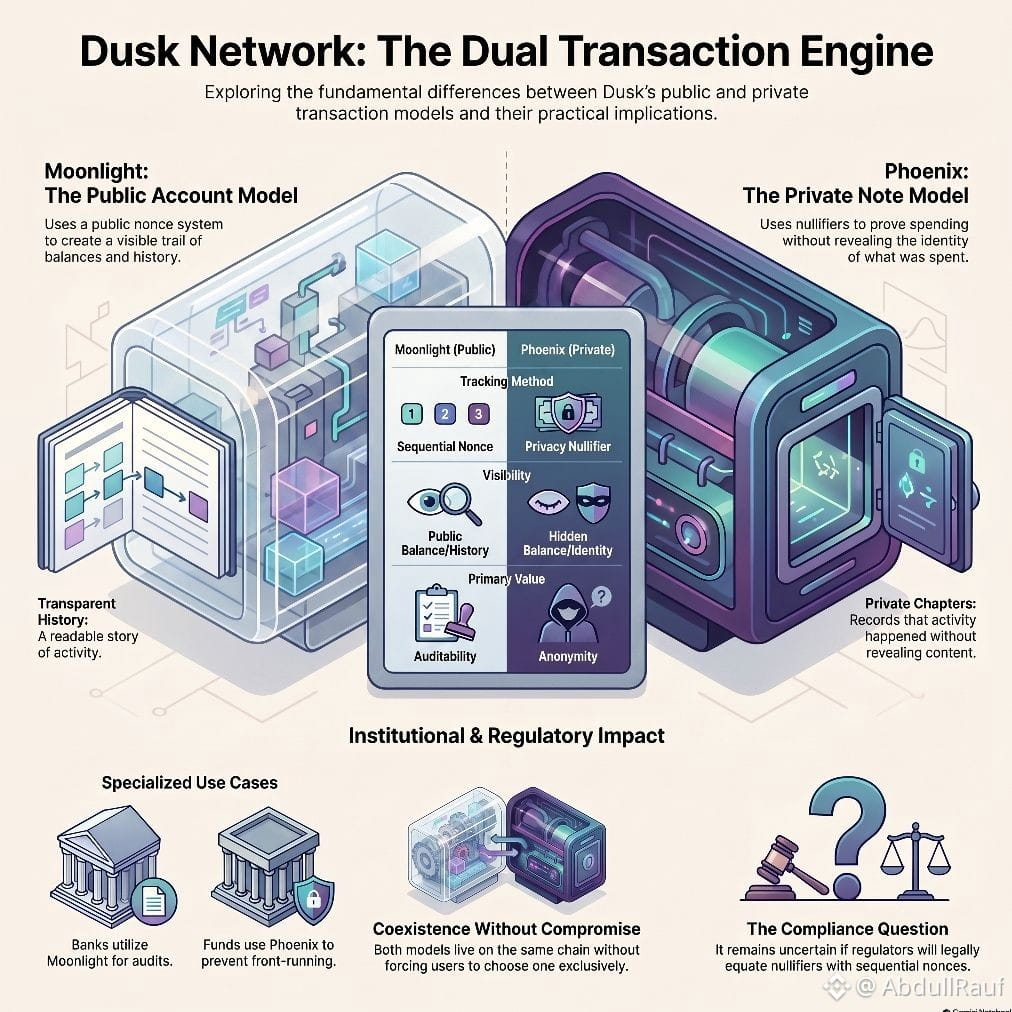
Moonlight works like Ethereum. Your account has a nonce. Every transaction increments it publicly. Anyone can see your balance, your history, your sequence. The nonce is a counter. It is also a trail.
Phoenix works differently. There is no account. No visible balance. No sequential counter. Instead, when you spend a note, you produce a nullifier. The network records that nullifier and knows the note is gone. But it cannot link the nullifier back to the note it came from. The spending is provable. The identity of what was spent is not.
That distinction matters more than it sounds. In Moonlight, your transaction history is a readable story. In Phoenix, the network knows chapters are being written without knowing what they say.
What I keep thinking about is which institutions actually want which model. A bank processing a settlement might need Moonlight for audit trails. A fund executing a strategy might need Phoenix to avoid front-running. Both can live on the same chain. Neither forces the other to compromise.
What I cannot find in the documentation is how regulators treat nullifiers as evidence. A nonce proves sequence. A nullifier proves spending without revealing the note. Are those legally equivalent in a compliance context?
What do you think — when a regulator asks for proof of transaction, does a nullifier satisfy the requirement or does it just raise a harder question?
#dusk $DUSK @Dusk
The actual difference runs deeper than that.
Moonlight works like Ethereum. Your account has a nonce. Every transaction increments it publicly. Anyone can see your balance, your history, your sequence. The nonce is a counter. It is also a trail.
Phoenix works differently. There is no account. No visible balance. No sequential counter. Instead, when you spend a note, you produce a nullifier. The network records that nullifier and knows the note is gone. But it cannot link the nullifier back to the note it came from. The spending is provable. The identity of what was spent is not.
That distinction matters more than it sounds. In Moonlight, your transaction history is a readable story. In Phoenix, the network knows chapters are being written without knowing what they say.
What I keep thinking about is which institutions actually want which model. A bank processing a settlement might need Moonlight for audit trails. A fund executing a strategy might need Phoenix to avoid front-running. Both can live on the same chain. Neither forces the other to compromise.
What I cannot find in the documentation is how regulators treat nullifiers as evidence. A nonce proves sequence. A nullifier proves spending without revealing the note. Are those legally equivalent in a compliance context?
What do you think — when a regulator asks for proof of transaction, does a nullifier satisfy the requirement or does it just raise a harder question?
#dusk $DUSK @Dusk
Privacy bolted onto EVM is not the same as privacy built in from day one.#dusk
AbdullRauf
·
--
At first I assumed adding privacy to an EVM environment was the same as building privacy from the start. From the outside the two look similar. On the inside they are not.
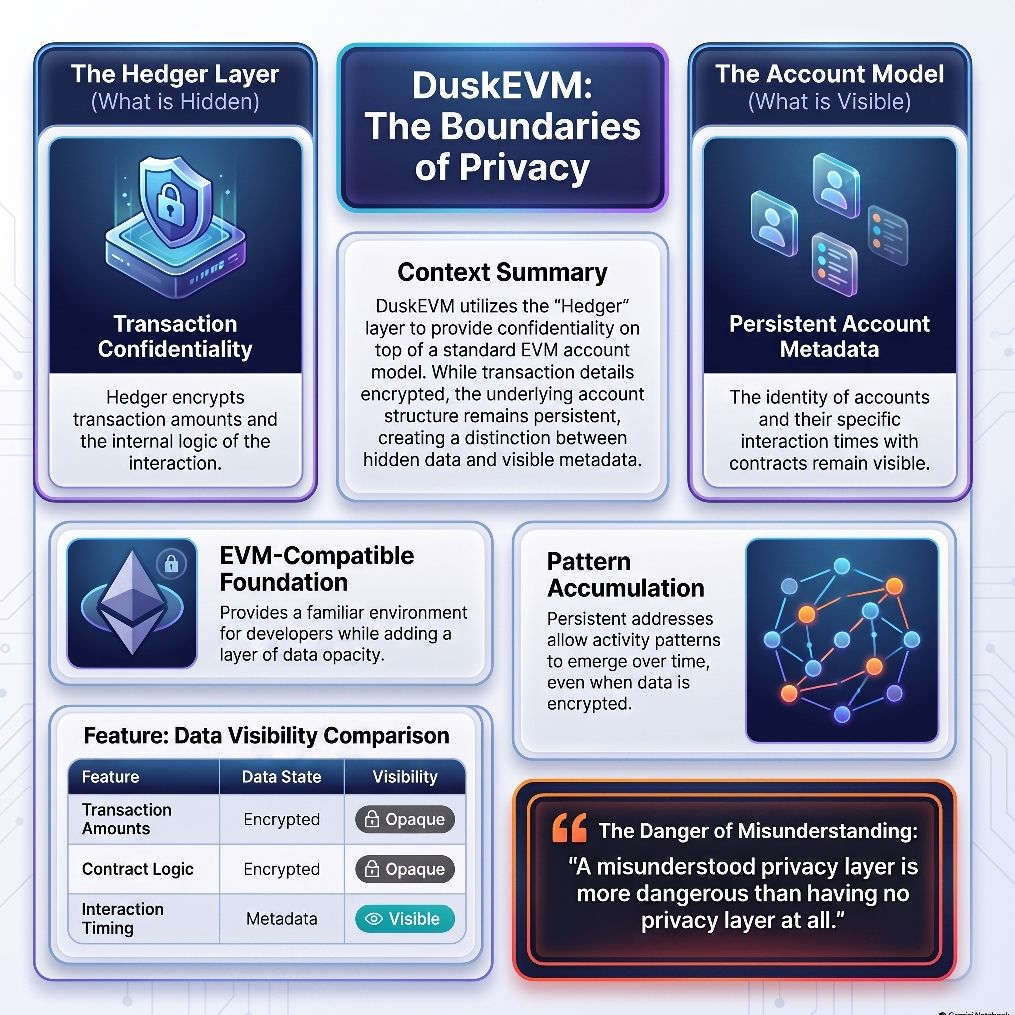
The EVM account model carries a structural assumption. Addresses persist. Activity accumulates. Even when individual transactions are encrypted, the account itself becomes a pattern over time. Hedger adds confidentiality on top of that model. Transaction data can become opaque. The account structure remains visible.
So the real question is narrower. When Hedger encrypts a transaction, what exactly is hidden and what is not? Amounts and internal logic may stay private. The fact that this account interacted with this contract at this time is often still visible. In regulated finance, who traded with whom and when can matter as much as what they traded.
This is not a flaw in the design. Account-based EVM is practical for developers. Hedger is a real privacy layer. The risk is misunderstanding. A privacy layer that people overestimate can be more dangerous than no privacy layer at all.
Does transaction-level confidentiality give institutions enough protection, or does the account model underneath quietly limit the whole promise?
#dusk $DUSK @Dusk
The EVM account model carries a structural assumption. Addresses persist. Activity accumulates. Even when individual transactions are encrypted, the account itself becomes a pattern over time. Hedger adds confidentiality on top of that model. Transaction data can become opaque. The account structure remains visible.
So the real question is narrower. When Hedger encrypts a transaction, what exactly is hidden and what is not? Amounts and internal logic may stay private. The fact that this account interacted with this contract at this time is often still visible. In regulated finance, who traded with whom and when can matter as much as what they traded.
This is not a flaw in the design. Account-based EVM is practical for developers. Hedger is a real privacy layer. The risk is misunderstanding. A privacy layer that people overestimate can be more dangerous than no privacy layer at all.
Does transaction-level confidentiality give institutions enough protection, or does the account model underneath quietly limit the whole promise?
#dusk $DUSK @Dusk
ຢືນຢັນແລ້ວ
I used to look at a new consensus design and ask one question first. How does an attacker break this?
Studying Dusk changed that habit. With Succinct Attestation, a different scenario appears. Imagine you are already selected to generate a block in a later iteration. You are also voting on the current one. Do you help the current block succeed and take the voter reward, or stay quiet so the iteration fails and your future generator position improves?
That is the Future Generator Incentive Problem. It does not come from outside. It comes from the incentives available to a legitimate participant.
Dusk’s response was to reshape those incentives. Separate generator and voter rewards. Exclude the next-iteration generator from current voting. Limit how many iterations can run.
There is a trade-off. Every extra incentive rule adds another assumption that still needs to hold under pressure.
The real game underneath the cryptography is whether the most rational move stays the honest one.
#dusk $DUSK @Dusk
Studying Dusk changed that habit. With Succinct Attestation, a different scenario appears. Imagine you are already selected to generate a block in a later iteration. You are also voting on the current one. Do you help the current block succeed and take the voter reward, or stay quiet so the iteration fails and your future generator position improves?
That is the Future Generator Incentive Problem. It does not come from outside. It comes from the incentives available to a legitimate participant.
Dusk’s response was to reshape those incentives. Separate generator and voter rewards. Exclude the next-iteration generator from current voting. Limit how many iterations can run.
There is a trade-off. Every extra incentive rule adds another assumption that still needs to hold under pressure.
The real game underneath the cryptography is whether the most rational move stays the honest one.
#dusk $DUSK @Dusk

$DUSK Is Down 93%… Yet Holding Partnerships and a €200M+ Issuance Pipeline Most Protocols at This Price Don’t Have
AbdullRauf
·
--
Spent time trying to read two signals that point in different directions. The price is down ninety-three percent from its all-time high. The NPEX partnership is live. A confirmed issuance pipeline of over two hundred million euros exists. The Boreas upgrade shipped in May. Those two pictures do not belong to the same narrative. One suggests a project that failed to hold its launch momentum. The other suggests a project that kept building while the price declined. Infrastructure tokens have a timing problem that equity markets do not. A company's stock price and its revenue usually move in the same direction over time. A protocol's token price and its actual usage can diverge for years. The price reflects what traders think today. The usage reflects what institutions decided months ago. What I cannot reconcile is the gap between the confirmed issuance number and the daily trading volume. Two hundred million euros in pipeline against three and a half million in daily volume is a wide distance. Either the issuance has not reached the chain yet or volume is not the right measure. @Dusk has partnerships that most protocols at this price would not. Whether that eventually shows up in the price or just in the history books is the question price charts were never designed to answer. When price and adoption diverge this far, which one is lying?
#dusk $DUSK @Dusk
#dusk $DUSK @Dusk
ເຂົ້າສູ່ລະບົບເພື່ອສຳຫຼວດເນື້ອຫາເພີ່ມເຕີມ