
Executive Summary
Tria represents a paradigm shift in crypto UX through genuine chain abstraction, delivering a self-custodial neobank that processes $20M+ in volume with 300,000+ users in its first three months. Built on BestPath AVS—an EigenLayer-powered intent marketplace—Tria eliminates bridges, gas tokens, and chain-switching while maintaining full user custody via Threshold Signature Schemes. The protocol demonstrates exceptional early traction (13x faster growth than EtherFi's card) and sustainable revenue generation ($1.2M early revenue) through swap spreads, interchange fees, and yield products. While dependency on the unproven AVS model introduces execution risk, Tria's technical architecture, team pedigree, and market positioning warrant serious institutional consideration for both investment and integration opportunities.
1. Project Overview
Tria is a production-stage self-custodial neobank operating at the intersection of traditional finance accessibility and crypto-native sovereignty. The protocol has achieved remarkable early traction with 300,000+ users and $20M+ processed volume in its first three months of closed beta, outpacing early competitors by 13x. Crypto.news
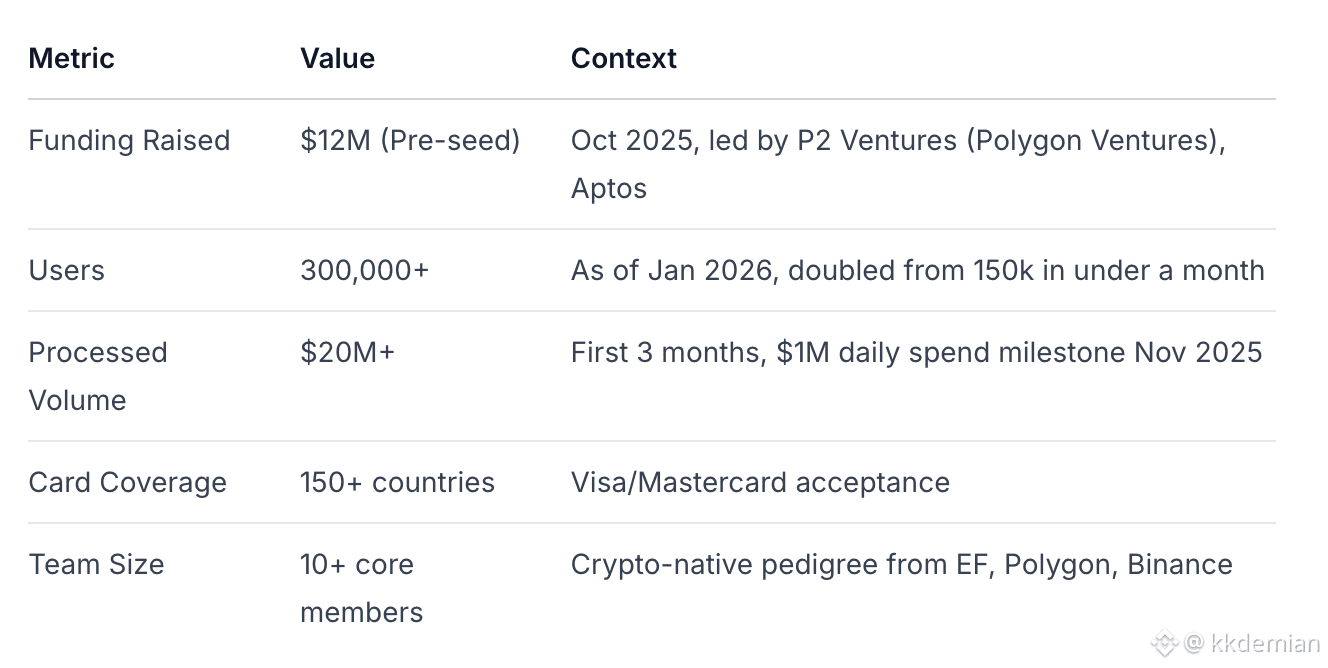
Founding Team Expertise: CEO Vijit Katta (ex-Polygon Labs Head of Accelerator, built $3B+ Web3 ecosystem) and CTO Parth Bhalla (Ethereum miner since 2014, contributed to Litecoin protocol, built India's largest national DID blockchain for 16M+ users) bring complementary infrastructure and growth expertise. The team includes former Binance Head of Research Stefan Piech and ex-Polygon program lead Avi Gupta, creating a balanced blend of technical depth and commercial execution capability. Thesis.io
Protocol Stage: Tria is in active public expansion phase with functional mobile applications (iOS/Android), physical card issuance, and growing enterprise partnerships. The protocol has moved beyond MVP to scale execution, focusing on global regulatory compliance and user acquisition.
2. System Architecture & Chain Abstraction Design
BestPath AVS: The Intent Marketplace Core
BestPath operates as an EigenLayer Actively Validated Service that creates a permissionless marketplace for cross-chain intent execution. The architecture employs a novel three-tier system:
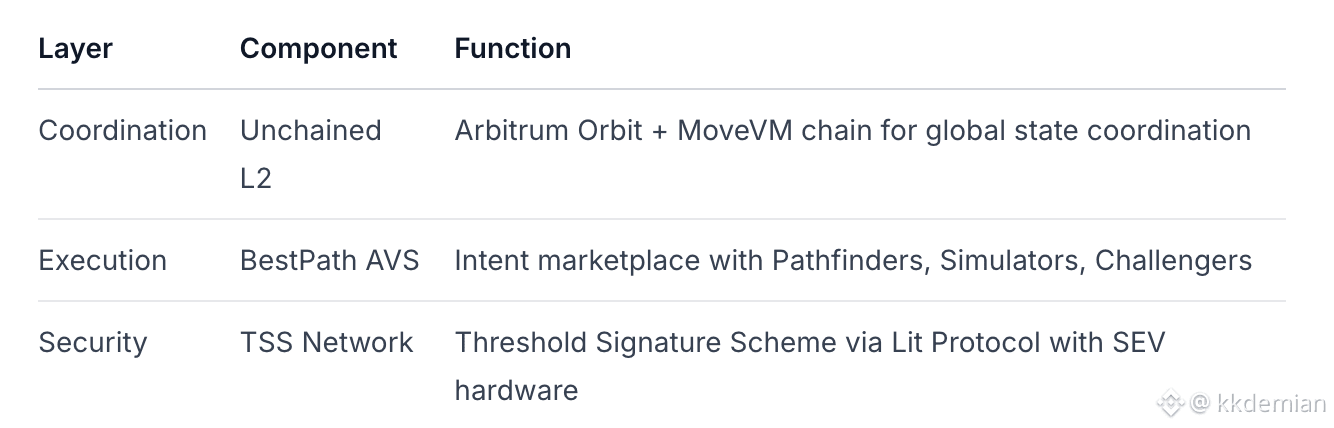
Pathfinder Mechanism: Solver entities compete in micro-markets to propose optimal execution routes across EVM, SVM, Cosmos, and Move-based chains. Routes are ranked in real-time by cost, speed, and reliability, with Pathfinders compensated based on verifiable execution efficiency (Pareto-optimal incentivization). Tria Documentation
Simulator Validation: Independent simulator pairs verify Pathfinder proposals in near-real-time, creating a trust-minimized execution environment. Challengers monitor for malicious behavior with slashing mechanisms for dishonest participants.
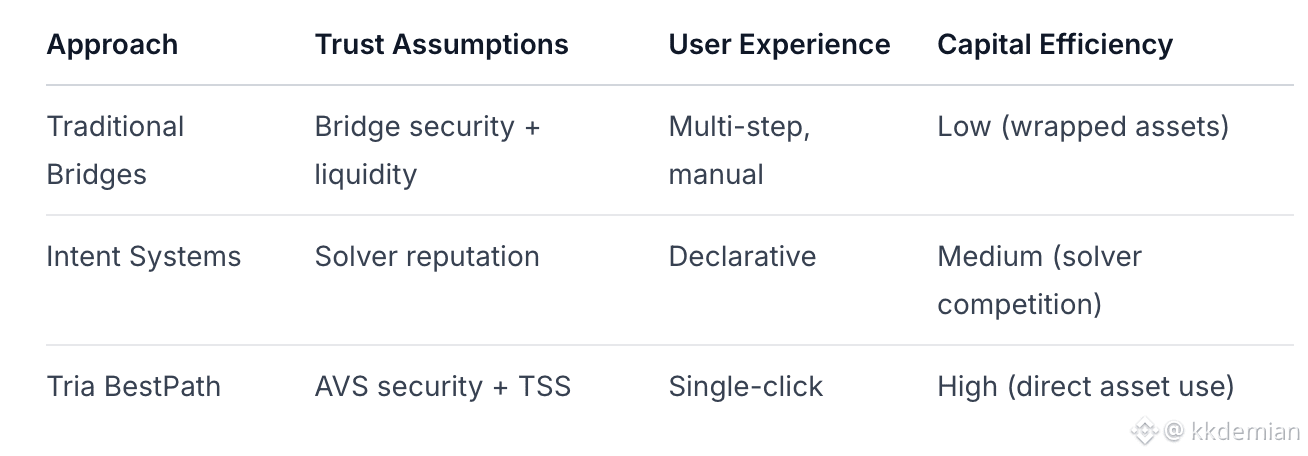
Technical Differentiation: Unlike traditional bridges that create wrapped assets or require manual chain switching, BestPath enables direct asset utilization across chains without abstraction layers. The system uses TSS-based execution so users never touch bridges, gas, or token approvals while maintaining full self-custody.
Architecture Comparison
3. Self-Custody, Asset Model & Financial Primitives
Custody Implementation
True Self-Custody via Threshold Signature Schemes: Tria implements TSS through Lit Protocol's network, utilizing Asynchronous Decentralized Key Generation (ADKG) where no single node ever possesses or reconstructs an entire private key. This surpasses conventional Multi-Party Computation (MPC) where key reconstruction occurs during creation and signing. Tria Documentation
Hardware-Level Security: AMD's Secure Encrypted Virtualization (SEV) provides additional protection, ensuring node operators never access key shares directly nor the computation processed inside each node.
Asset Model: Users maintain assets in their native chains without wrapping or bridging. When spending BTC on a Visa card, BestPath routes the transaction through optimal liquidity venues without creating synthetic representations or intermediate tokens.
Trust Assumption Analysis
4. Spend, Trade & Earn Modules
Spend Module: Crypto-Native Banking
Tria Card Implementation: Visa-powered card operating in 150+ countries with 0% fees from Tria (users pay only network interchange). The system hit $1M daily spend in November 2025, demonstrating real-world utility beyond speculative crypto use cases. Crypto.news
Settlement Flow:
User initiates payment with any of 1,000+ supported assets
BestPath computes optimal cross-chain execution path
Pathfinders compete to fulfill the intent
Settlement occurs through traditional Visa rails
User maintains self-custody throughout process
Key Insight: Japanese users particularly value transaction history exports for record-keeping and reconciliation, indicating adoption beyond crypto-natives to traditional finance users with compliance needs. ChainCatcher
Trade Module: AI-Optimized Execution
Cross-Chain Swaps: BestPath's AI routing evaluates liquidity depth, price impact, and execution latency across all connected virtual machines. The system supports perpetual futures trading with cross-margin capabilities using assets from any chain.
Execution Quality: Pathfinders specialize in different execution strategies (fast finality, low slippage, privacy-preserving), creating a competitive marketplace that theoretically drives execution quality toward optimal efficiency.
Earn Module: Gasless Staking
Cross-Chain Yield Generation: Users can stake assets from any supported chain without managing gas fees or chain-specific staking interfaces. BestPath automatically routes to optimal yield opportunities based on risk-adjusted returns.
Risk Management: The system incorporates validator diversification and slashing protection mechanisms, though specific implementation details remain proprietary.
5. Protocol Economics & Incentive Structure
Revenue Model
Sustainable Multi-Source Revenue: Despite 0% card fees, Tria generates revenue through:
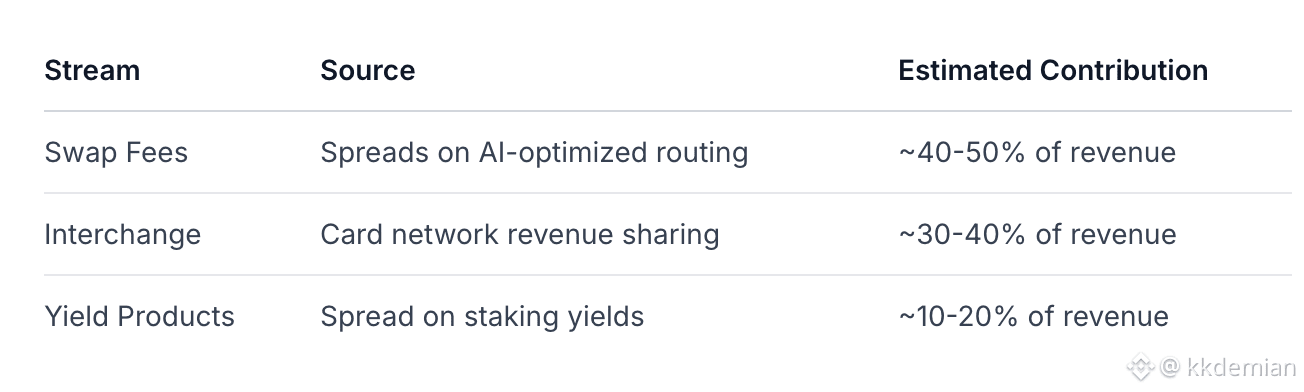
Early revenue reached $1.2M during beta, indicating strong unit economics and scalability. The business model aligns with volume growth rather than rent-seeking behavior. Medium
Value Accrual
Application Layer Capture: Currently, value accrues primarily at the Tria application layer rather than the BestPath infrastructure layer. However, the architecture suggests potential for:
AVS Fee Model: BestPath could implement transaction fees for routing services
Token Utility: Potential governance and fee discount token (no current plans)
Enterprise Licensing: SDK licensing for developers using Mazerunner/Inception
Scalability Assessment: The revenue model appears highly scalable with marginal cost approaching zero for additional users. The main constraints are regulatory compliance costs and liquidity provisioning for less liquid cross-chain routes.
6. Governance, Security & Risk Analysis
Governance Structure
Current Centralization: Tria maintains operational control over BestPath parameters, simulator eligibility, and ecosystem partnerships. The team has not disclosed decentralization roadmap details, representing a key dependency risk.
Upgrade Mechanisms: Unchained L2 likely serves as a governance coordination layer, but specific upgrade mechanisms and community participation structures remain undefined.
Risk Surface Analysis
Technical Risks:
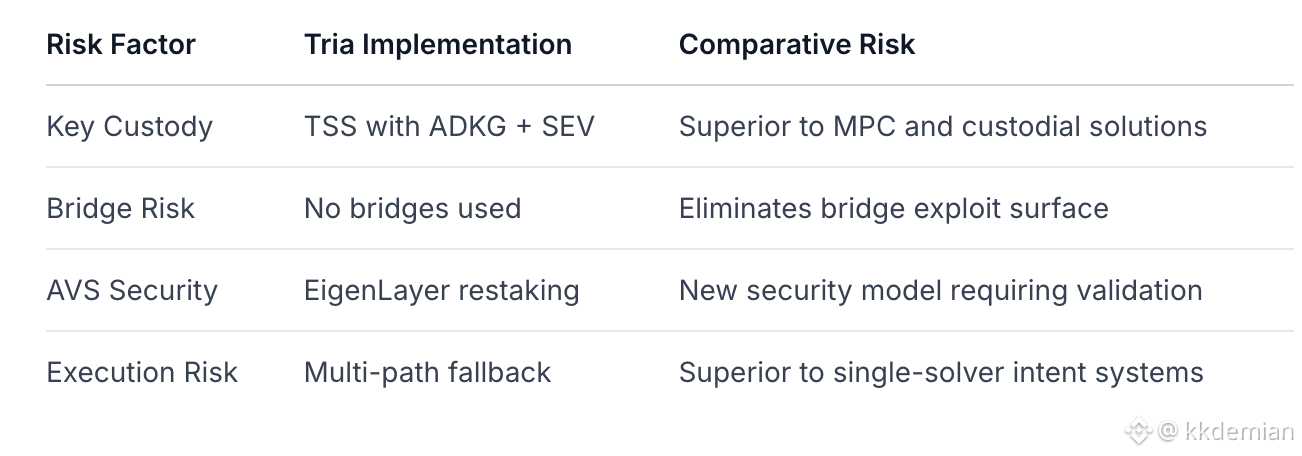
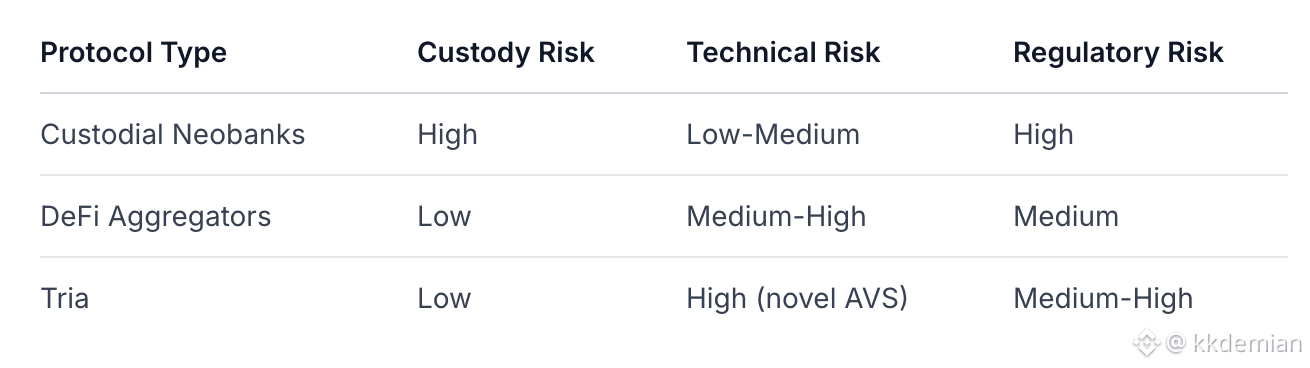
AVS Security: BestPath's security depends on EigenLayer's novel restaking model, which lacks long-term battle testing
TSS Implementation: While theoretically sound, complex TSS implementations present attack surfaces
Cross-Chain Execution: Synchronization failures between heterogeneous chains could lead to settlement issues
Financial Risks:
Liquidity Fragmentation: Optimal routing requires deep liquidity across all connected chains
Regulatory Uncertainty: Operating in 150+ countries creates complex compliance overhead
Competition: Traditional finance incumbents and well-funded crypto competitors emerging
Comparative Risk Assessment:
7. Adoption Signals & Ecosystem Positioning
Growth Metrics
Exponential User Acquisition: Tria doubled from 150,000 to 300,000+ users in under a month, demonstrating exceptional product-market fit. The protocol processed $20M+ volume in its first three months—13x more than EtherFi's card over the same period. Crypto.news
Geographic Distribution: Strong adoption in Japan (requiring sophisticated transaction exports) and emerging markets where "digital dollars and on-chain rails have become part of everyday financial life." ChainCatcher
Competitive Landscape
Tria vs. Key Competitors:
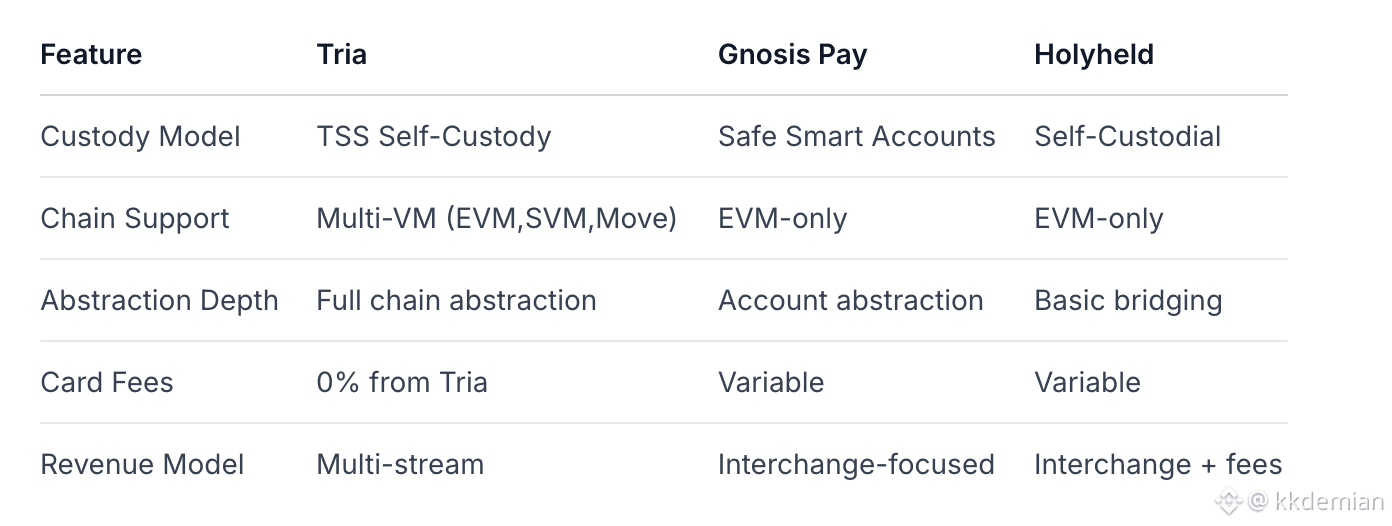
Ecosystem Partnerships: Tria collaborates with Polygon, Arbitrum, Solana, and Berachain, indicating broad ecosystem support rather than chain-specific alignment.
8. Strategic Trajectory & Market Fit
Problem-Solution Fit
Tria addresses three structural inefficiencies:
Fragmented UX: Unifies spending, trading, and earning across chains
Custody-Spend Paradox: Enables real-world spending without sacrificing self-custody
Capital Inefficiency: Allows assets to work across applications without constant bridging
Market Opportunity: The global neobanking market is projected to grow from ~$210B (2025) to ~$3.4T by 2032, with crypto-focused neobanks representing ~$143B of that opportunity. Medium
Future Milestones (12-24 Months)
Global Expansion: Additional regulatory licensing for broader fiat integration
AVS Decentralization: Progressive decentralization of BestPath governance and operations
Enterprise Adoption: SDK rollout for developers to integrate chain abstraction
AI Enhancement: More sophisticated routing algorithms incorporating predictive liquidity
9. Final Investment Assessment
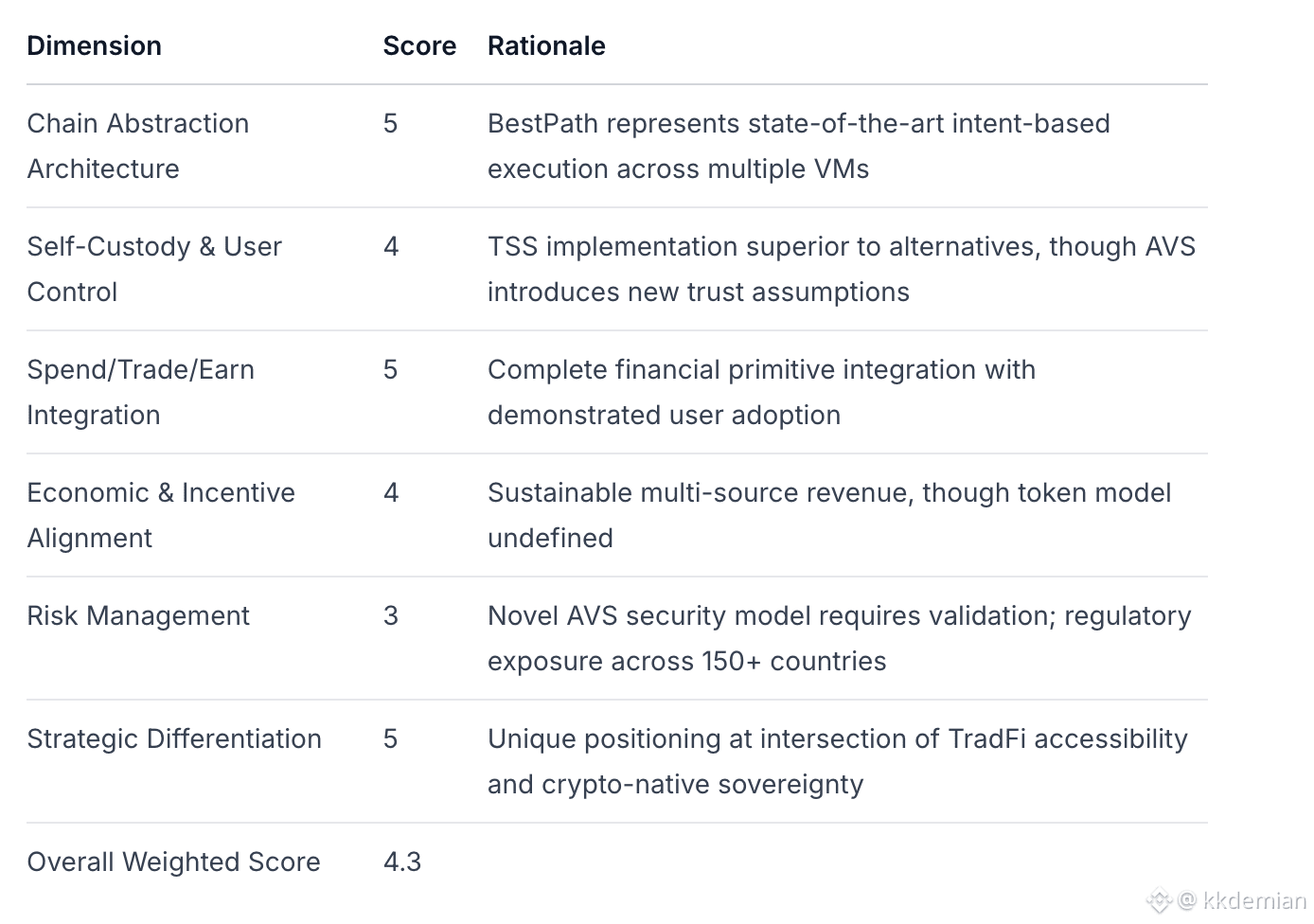
Dimension Scoring (1-5 Scale)
Investment Recommendation
Tria warrants serious institutional investment consideration for funds focused on infrastructure and financial primitives. The protocol demonstrates exceptional technical innovation through BestPath AVS, genuine product-market fit with rapid user adoption, and sustainable economic models beyond token speculation.
Key Strengths:
Technical architecture superior to competing abstraction approaches
Experienced team with crypto-native pedigree and execution capability
Multiple revenue streams with demonstrated early traction
Addresses fundamental UX problems hindering mass adoption
Key Risks:
Dependency on unproven AVS security model
Regulatory complexity across 150+ jurisdictions
Execution risk in scaling complex technical infrastructure
Verdict: Invest with staged deployment based on technical milestone achievement. The combination of technical innovation, market traction, and team capability justifies investment, but the novel AVS architecture requires careful technical due diligence and milestone-based capital deployment.

