Dusk’s architecture doesn’t hide your transactions; it hides the very fact that they’re yours to find.
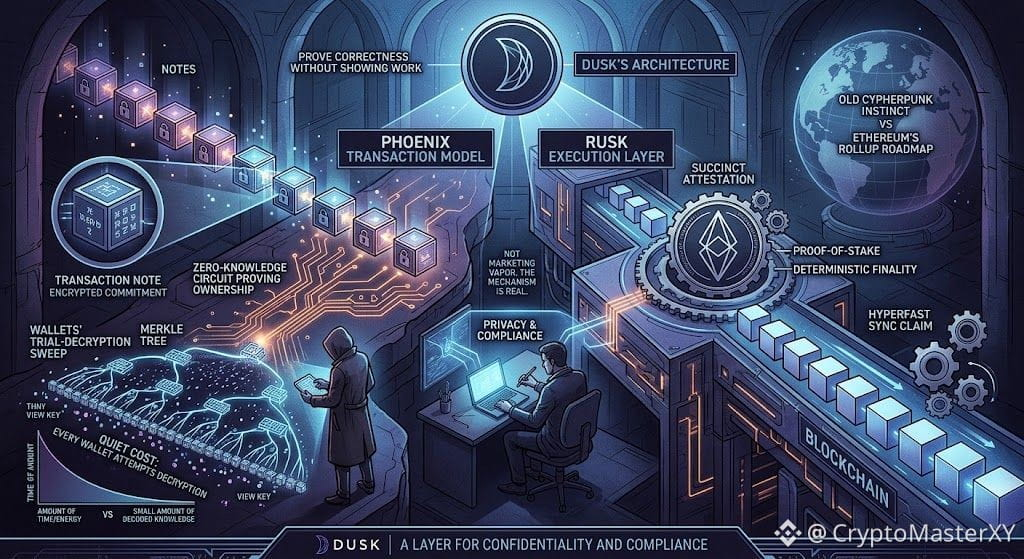
That is the paradox that kept pulling me back to the same question: how does a chain prove correctness without ever showing its work. We kept circling Phoenix, the transaction model where notes exist as encrypted commitments and ownership is proven through zero-knowledge circuits rather than plaintext balances.
I traced the note-discovery path myself, the View Key trial-decryption sweep against the Merkle tree, and what struck me wasn’t the privacy claim—it was the tradeoff nobody markets loudly: every wallet has to attempt decryption against a growing set of notes just to know what it owns. That’s the quiet cost of confidentiality, and Dusk pays it upfront so the chain itself never has to.
Then there’s Rusk, the execution layer wrapping this into something that still has to clear consensus under Succinct Attestation, a proof-of-stake variant built for deterministic finality rather than probabilistic settlement.
We found ourselves comparing it less to Ethereum’s rollup-centric roadmap and more to the older cypherpunk instinct, that privacy and compliance aren’t opposites if the zero-knowledge layer is expressive enough to prove regulatory constraints without revealing the underlying data.
I’m not convinced the throughput claims hold under real institutional load yet, and I said as much when a colleague pushed back on the “hyperfast sync” language. But the mechanism is real, not marketing vapor, and that distinction is what kept me writing instead of walking away.
@Dusk #dusk $DUSK $PORTAL $VELVET
That is the paradox that kept pulling me back to the same question: how does a chain prove correctness without ever showing its work. We kept circling Phoenix, the transaction model where notes exist as encrypted commitments and ownership is proven through zero-knowledge circuits rather than plaintext balances.
I traced the note-discovery path myself, the View Key trial-decryption sweep against the Merkle tree, and what struck me wasn’t the privacy claim—it was the tradeoff nobody markets loudly: every wallet has to attempt decryption against a growing set of notes just to know what it owns. That’s the quiet cost of confidentiality, and Dusk pays it upfront so the chain itself never has to.
Then there’s Rusk, the execution layer wrapping this into something that still has to clear consensus under Succinct Attestation, a proof-of-stake variant built for deterministic finality rather than probabilistic settlement.
We found ourselves comparing it less to Ethereum’s rollup-centric roadmap and more to the older cypherpunk instinct, that privacy and compliance aren’t opposites if the zero-knowledge layer is expressive enough to prove regulatory constraints without revealing the underlying data.
I’m not convinced the throughput claims hold under real institutional load yet, and I said as much when a colleague pushed back on the “hyperfast sync” language. But the mechanism is real, not marketing vapor, and that distinction is what kept me writing instead of walking away.
@Dusk #dusk $DUSK $PORTAL $VELVET