
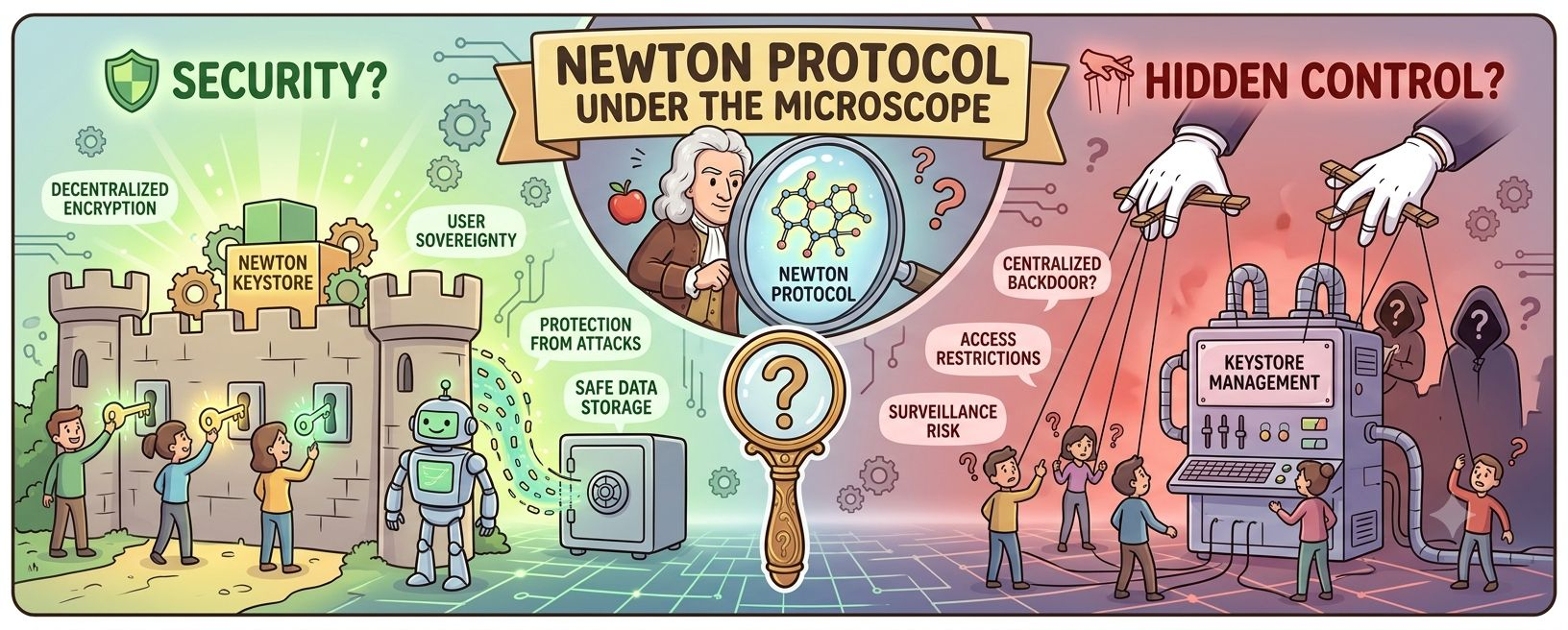

Web3 has spent nearly a decade chanting "code is law," and anyone who's been around long enough knows it’s more of a campfire story than a binding principle. Watching endless hacks, drains, and rug pulls makes it painfully obvious: that so-called law is riddled with loopholes. Lately, the chatter in the space has zeroed in on @NewtonProtocol and its freshly unveiled Newton Mainnet Beta. The timeline is full of snippets celebrating its pre-transaction interception and the VaultKit rule engine—a mechanism that, in theory, slams the door shut before an attacker can even get a finger in.
Sounds impressive. It’s the DeFi equivalent of bolting an autonomous collision-avoidance system onto a race car running flat out. But after digesting the whitepaper, the part that genuinely grabbed my attention—and the part almost nobody talks about—is the scaffolding underneath it all, called Newton Keystore.
Everyone’s fixated on how a rule engine written in Rego can step in and manage risk in real time. Yet they're ignoring a much more uncomfortable question: if a front-running interception network gets to veto your transaction before it ever hits a block, doesn’t that very network become the ultimate centralised censor? AI agents and automated vaults are going to be making hundreds or thousands of calls every day on behalf of users—what reason do we have to trust that the interception layer itself contains no hidden trapdoors?
This is where the logic behind Newton Keystore demands a closer look. It’s not merely a private key wrapper. It’s a distributed identity and permission isolation layer built on multi-party secure computation. The whitepaper makes it clear that policy formation and key execution are cleanly decoupled through threshold signatures and hardware-enforced separation. In plain language: the power to decide whether to hit the brakes is ripped away from the hands gripping the steering wheel. Even if the interception engine’s rules are compromised, or an AI agent completely loses the plot, any attempt to alter asset state means nothing without passing the Keystore’s underlying hardware-level attestation.
That kind of design is far more practical than the ambulance-chasing projects that only wake up and sound on-chain alarms after the assets have already vanished. DeFi has matured past the point where we’re all chasing absurdly high yields. The real contest now isn’t about who offers the juiciest APY—it’s about who can simply stay alive the longest. Leaning on Ethereum’s economic security through restaking, and then using zero-knowledge proofs to certify every interception, the foundation here is undeniably rigorous. $NEWT
But as a battle-scarred retail degen, I’ve got to be honest: this kind of pre-trade validation won’t excite the average punter. Try telling someone who only wants to ape into the latest meme token about proactive risk controls, and they’ll hear it as you scolding them for not losing their money quickly enough. The market right now is profoundly impatient. People want a pump, not a shield. That means the $NEWT technical path is almost destined to be a lonely one, carved out by B2B infrastructure and professional vault operators, not by the retail crowd.
And there’s no such thing as a perfectly impenetrable shield, anyway. Front-running interception drags the defensive line forward, but it also squeezes the attack surface into the precise instant when strategy logic is parsed. If a pricing oracle is bent inside a tight time window, or if the rules engine stumbles into a logical deadlock, does this supposedly safe system transform into an iron curtain that locks users’ funds in limbo? Only genuine mainnet activity, relentless and unforgiving, can put those scenarios to the test.
For thousands of years humans have been tinkering—from laws and contracts in the physical world, to smart contracts on a blockchain. At bottom, we’re always trying the same trick: replacing human unpredictability with technical determinism. But there’s a sharp irony here. The more we chase total control, the more we dissolve the permissionless freedom that made this whole experiment worth building in the first place. Maybe the end state of on-chain finance is destined to be an uneasy truce, a middle ground between “absolute liberty that births absolute chaos” and “absolute safety that imposes absolute restriction.” And this project? It’s just one more flood barrier being erected by humans on a digital wasteland.
