Binance Square
#verifiablecomputing

verifiablecomputing

907 views
22 ກຳລັງສົນທະນາ
BinaScope Crypto
·
--
PROVE by Succinct: Powering Ethereum’s Era of Verifiable ComputingBlockchain has evolved far beyond payments and tokenization — it’s now about establishing truth without trust. That’s the vision behind $PROVE by @Succinct, the first decentralized prover network. By delivering faster, cheaper, and more accessible zero-knowledge proofs (ZKPs), PROVE represents a turning point in Ethereum’s journey toward scalable, verifiable computing. --- Making Zero-Knowledge Practical 🌐 Zero-knowledge proofs are often called the holy grail of scalability and privacy. Yet adoption has been slowed by cost, complexity, and limited tools. Succinct’s answer is SP1 zkVM, an open-source, Rust-based proving system that enables teams to generate proofs without needing advanced cryptography expertise. With SP1, developers can build zkEVMs, rollups, and on-chain coprocessors more easily — making ZK technology finally usable, practical, and developer-friendly. --- The Role of $PROVE 🔋 At the center of this ecosystem is the $PROVE token (1B supply on Ethereum), designed for utility and alignment: Payments – Developers pay for proofs using PROVE, directly linking token demand to network usage. Staking & Security – Provers must stake PROVE to participate, ensuring honest behavior. Governance – Token holders decide on upgrades, rules, and reward distribution. Provers compete to deliver proofs quickly and cost-effectively. Top performers earn rewards, while inefficient ones are penalized, creating a self-reinforcing cycle of trust, speed, and growth. --- A Decentralized Proof Marketplace ⚙️ Succinct connects developers with hardware providers through an auction-based model, driving competition that lowers costs. By removing centralized control, the system becomes resilient, censorship-resistant, and scalable. The outcome is a decentralized proof marketplace that strengthens as adoption grows. --- Real-World Applications 🌍 Beyond scalability, PROVE expands the frontier of ZKPs into new domains: Private Voting – Confidential yet verifiable elections powered by client-side proofs. Autonomous Onchain Bots – Trustless agents executing tasks without centralized oversight. Verifiable Offchain Data – Real-world computations anchored securely onchain. These use cases point to a future where math replaces trust across industries. --- Why PROVE Matters 🔑 While many tokens chase speculation, PROVE provides infrastructure value: Developers gain faster, cheaper, more reliable tools. Provers are incentivized to secure the system. Token holders help govern a core layer of Web3’s future. By shifting verification from institutions to mathematics, PROVE delivers durability and trust at scale. --- Final Word ✨ E isn’t just another token — it’s a step toward a trustless computing era. Succinct is transforming zero-knowledge from niche cryptography into a universal toolkit for Ethereum and beyond. In this new paradigm, proofs replace promises, and verifiable computing becomes the backbone of decentralized systems. 🚀 #Succinct #ZeroKnowledge #MarketPullback #VerifiableComputing #PROVE

PROVE by Succinct: Powering Ethereum’s Era of Verifiable Computing

Blockchain has evolved far beyond payments and tokenization — it’s now about establishing truth without trust. That’s the vision behind $PROVE by @Succinct, the first decentralized prover network. By delivering faster, cheaper, and more accessible zero-knowledge proofs (ZKPs), PROVE represents a turning point in Ethereum’s journey toward scalable, verifiable computing.
---
Making Zero-Knowledge Practical 🌐
Zero-knowledge proofs are often called the holy grail of scalability and privacy. Yet adoption has been slowed by cost, complexity, and limited tools. Succinct’s answer is SP1 zkVM, an open-source, Rust-based proving system that enables teams to generate proofs without needing advanced cryptography expertise. With SP1, developers can build zkEVMs, rollups, and on-chain coprocessors more easily — making ZK technology finally usable, practical, and developer-friendly.
---
The Role of $PROVE 🔋
At the center of this ecosystem is the $PROVE token (1B supply on Ethereum), designed for utility and alignment:
Payments – Developers pay for proofs using PROVE, directly linking token demand to network usage.
Staking & Security – Provers must stake PROVE to participate, ensuring honest behavior.
Governance – Token holders decide on upgrades, rules, and reward distribution.
Provers compete to deliver proofs quickly and cost-effectively. Top performers earn rewards, while inefficient ones are penalized, creating a self-reinforcing cycle of trust, speed, and growth.
---
A Decentralized Proof Marketplace ⚙️
Succinct connects developers with hardware providers through an auction-based model, driving competition that lowers costs. By removing centralized control, the system becomes resilient, censorship-resistant, and scalable. The outcome is a decentralized proof marketplace that strengthens as adoption grows.
---
Real-World Applications 🌍
Beyond scalability, PROVE expands the frontier of ZKPs into new domains:
Private Voting – Confidential yet verifiable elections powered by client-side proofs.
Autonomous Onchain Bots – Trustless agents executing tasks without centralized oversight.
Verifiable Offchain Data – Real-world computations anchored securely onchain.
These use cases point to a future where math replaces trust across industries.
---
Why PROVE Matters 🔑
While many tokens chase speculation, PROVE provides infrastructure value:
Developers gain faster, cheaper, more reliable tools.
Provers are incentivized to secure the system.
Token holders help govern a core layer of Web3’s future.
By shifting verification from institutions to mathematics, PROVE delivers durability and trust at scale.
---
Final Word ✨
E isn’t just another token — it’s a step toward a trustless computing era. Succinct is transforming zero-knowledge from niche cryptography into a universal toolkit for Ethereum and beyond. In this new paradigm, proofs replace promises, and verifiable computing becomes the backbone of decentralized systems. 🚀
#Succinct #ZeroKnowledge #MarketPullback #VerifiableComputing #PROVE
ບົດຄວາມ
Verifiable Computing Meets Robotics: Inside Fabric Protocol’s Vision @fabric $ROBO #ROBOThe first time I watched a warehouse robot freeze mid-task because its internal model misread a barcode, I felt something most people in tech rarely admit. Not awe. Not excitement. Unease. The machine had done exactly what it was programmed to do, but there was no way to verify why it had made that specific decision in that specific moment. That quiet gap between action and proof is where trust begins to fray. And that gap is exactly what Fabric Protocol is trying to close. On the surface, the idea behind Fabric and its $ROBO token looks simple. Robots generate data. Artificial intelligence models interpret that data. Fabric introduces verifiable computing so that the output of those models can be mathematically proven to be correct without exposing all of the underlying information. In plain language, a robot does something, and you can independently check that its decision followed agreed rules. Underneath, it becomes more technical. Verifiable computing uses cryptographic proofs to confirm that a computation was performed correctly. Instead of replaying every step, you check a compact proof that guarantees the result matches the input and code. That may sound abstract, but its implications are concrete. If a delivery drone reroutes itself, or an industrial arm adjusts torque levels, a proof can confirm that its choice aligns with its programmed constraints. Understanding that helps explain why this matters. Robotics is moving from controlled factory floors into open environments. Warehouses alone are expected to surpass 4 million active robots globally within a few years, and that figure matters not because it is large, but because each additional machine introduces more independent decision points. More decisions mean more opportunities for silent failure. Fabric’s thesis is that those decisions should not be taken on faith. What is happening on the surface is a protocol that anchors robotic computations to a decentralized ledger. Each critical computation produces a proof. That proof is recorded and can be validated by anyone participating in the network. What is happening underneath is a shift in where trust lives. Instead of trusting a single manufacturer’s firmware, stakeholders can verify that a robot followed agreed logic. That momentum creates another effect. If computations can be verified, they can also be monetized with greater confidence. Imagine autonomous agricultural equipment optimizing fertilizer use. If the optimization model produces a yield increase of 12 percent, that number only matters if it can be trusted. Twelve percent is not impressive on its own. It becomes meaningful when you realize that in a farm operating on thin 5 percent profit margins, a verified 12 percent efficiency gain changes survival math. Fabric’s structure allows that claim to be backed by proof rather than marketing. Meanwhile, the $$ROBO oken functions as an incentive layer. Participants who generate proofs, validate them, or provide computational resources are rewarded. Tokens are not interesting because they exist. They are interesting because they align incentives across hardware manufacturers, AI developers, and validators. Without alignment, each actor optimizes locally. With alignment, there is a shared reason to maintain accuracy. When I first looked at this model, I wondered whether robotics really needs blockchain involvement. It is a fair question. Centralized logging systems already exist. Cloud providers offer audit trails. But centralized systems assume a single trusted operator. In multi-stakeholder environments, such as cross-border logistics or shared robot fleets, that assumption breaks down. Verifiable computing reduces the need to trust a single party. The layering becomes clearer in real-world scenarios. On the surface, a delivery robot navigates city streets. Underneath, it runs a neural network interpreting camera feeds in milliseconds. What this enables is dynamic routing around obstacles. What it introduces, however, is opacity. Neural networks are not easily explainable. By generating proofs of constraint adherence, Fabric does not explain the neural network’s reasoning in human language. Instead, it proves that the output respected safety and operational boundaries. That distinction matters. It acknowledges that we may never fully interpret complex models, but we can still constrain them. If a robot is limited to certain geofenced zones and speed thresholds, a proof can confirm compliance without revealing proprietary model details. That balance between privacy and verification is subtle but important. There are trade-offs. Generating cryptographic proofs consumes computational resources. If a robot must produce a proof for every micro-decision, latency increases. In high-speed environments, even a delay of 50 milliseconds is not trivial. Fifty milliseconds is the difference between smooth motion and jitter in certain industrial tasks. Fabric’s challenge is deciding which computations require proofs and which can remain local. Too many proofs and performance suffers. Too few and trust erodes. Fabric’s vision sits at the intersection of these pressures. Robotics demands autonomy. Society demands accountability. Verifiable computing attempts to reconcile those demands without stalling innovation. Instead of slowing robots down with constant human oversight, it provides a mathematical audit trail. What struck me most is how understated the shift feels. There is no dramatic redesign of the robot itself. Motors spin. Sensors scan. Code executes. The difference lies in the proof attached afterward. That proof becomes a kind of digital receipt, quietly anchoring physical action to mathematical certainty. Whether Fabric and $R$ROBO n scale this vision depends on adoption. Protocols do not matter in isolation. They matter when integrated into manufacturing pipelines and AI toolkits. Meanwhile, the robotics sector is moving steadily toward distributed intelligence. Swarms of machines coordinating in real time introduce compounded risk. Still, the trajectory is difficult to ignore. As machines gain autonomy, the demand for verifiable action grows in parallel. Trust in robotics will not be built on polished demos. It will be built on steady, provable behavior over time. And perhaps that is the deeper point. In a world increasingly shaped by autonomous systems, the quiet proof attached to each action may matter more than the action itself. #ROBO #FabricProtocol #VerifiableComputing #RoboticsAI #BlockchainInfrastructure @FabricFND #ROBO

Verifiable Computing Meets Robotics: Inside Fabric Protocol’s Vision @fabric $ROBO #ROBO

The first time I watched a warehouse robot freeze mid-task because its internal model misread a barcode, I felt something most people in tech rarely admit. Not awe. Not excitement. Unease. The machine had done exactly what it was programmed to do, but there was no way to verify why it had made that specific decision in that specific moment. That quiet gap between action and proof is where trust begins to fray. And that gap is exactly what Fabric Protocol is trying to close.
On the surface, the idea behind Fabric and its $ROBO token looks simple. Robots generate data. Artificial intelligence models interpret that data. Fabric introduces verifiable computing so that the output of those models can be mathematically proven to be correct without exposing all of the underlying information. In plain language, a robot does something, and you can independently check that its decision followed agreed rules.
Underneath, it becomes more technical. Verifiable computing uses cryptographic proofs to confirm that a computation was performed correctly. Instead of replaying every step, you check a compact proof that guarantees the result matches the input and code. That may sound abstract, but its implications are concrete. If a delivery drone reroutes itself, or an industrial arm adjusts torque levels, a proof can confirm that its choice aligns with its programmed constraints.
Understanding that helps explain why this matters. Robotics is moving from controlled factory floors into open environments. Warehouses alone are expected to surpass 4 million active robots globally within a few years, and that figure matters not because it is large, but because each additional machine introduces more independent decision points. More decisions mean more opportunities for silent failure. Fabric’s thesis is that those decisions should not be taken on faith.
What is happening on the surface is a protocol that anchors robotic computations to a decentralized ledger. Each critical computation produces a proof. That proof is recorded and can be validated by anyone participating in the network. What is happening underneath is a shift in where trust lives. Instead of trusting a single manufacturer’s firmware, stakeholders can verify that a robot followed agreed logic.
That momentum creates another effect. If computations can be verified, they can also be monetized with greater confidence. Imagine autonomous agricultural equipment optimizing fertilizer use. If the optimization model produces a yield increase of 12 percent, that number only matters if it can be trusted. Twelve percent is not impressive on its own. It becomes meaningful when you realize that in a farm operating on thin 5 percent profit margins, a verified 12 percent efficiency gain changes survival math. Fabric’s structure allows that claim to be backed by proof rather than marketing.
Meanwhile, the $$ROBO oken functions as an incentive layer. Participants who generate proofs, validate them, or provide computational resources are rewarded. Tokens are not interesting because they exist. They are interesting because they align incentives across hardware manufacturers, AI developers, and validators. Without alignment, each actor optimizes locally. With alignment, there is a shared reason to maintain accuracy.
When I first looked at this model, I wondered whether robotics really needs blockchain involvement. It is a fair question. Centralized logging systems already exist. Cloud providers offer audit trails. But centralized systems assume a single trusted operator. In multi-stakeholder environments, such as cross-border logistics or shared robot fleets, that assumption breaks down. Verifiable computing reduces the need to trust a single party.
The layering becomes clearer in real-world scenarios. On the surface, a delivery robot navigates city streets. Underneath, it runs a neural network interpreting camera feeds in milliseconds. What this enables is dynamic routing around obstacles. What it introduces, however, is opacity. Neural networks are not easily explainable. By generating proofs of constraint adherence, Fabric does not explain the neural network’s reasoning in human language. Instead, it proves that the output respected safety and operational boundaries.
That distinction matters. It acknowledges that we may never fully interpret complex models, but we can still constrain them. If a robot is limited to certain geofenced zones and speed thresholds, a proof can confirm compliance without revealing proprietary model details. That balance between privacy and verification is subtle but important.
There are trade-offs. Generating cryptographic proofs consumes computational resources. If a robot must produce a proof for every micro-decision, latency increases. In high-speed environments, even a delay of 50 milliseconds is not trivial. Fifty milliseconds is the difference between smooth motion and jitter in certain industrial tasks. Fabric’s challenge is deciding which computations require proofs and which can remain local. Too many proofs and performance suffers. Too few and trust erodes.
Fabric’s vision sits at the intersection of these pressures. Robotics demands autonomy. Society demands accountability. Verifiable computing attempts to reconcile those demands without stalling innovation. Instead of slowing robots down with constant human oversight, it provides a mathematical audit trail.
What struck me most is how understated the shift feels. There is no dramatic redesign of the robot itself. Motors spin. Sensors scan. Code executes. The difference lies in the proof attached afterward. That proof becomes a kind of digital receipt, quietly anchoring physical action to mathematical certainty.
Whether Fabric and $R$ROBO n scale this vision depends on adoption. Protocols do not matter in isolation. They matter when integrated into manufacturing pipelines and AI toolkits. Meanwhile, the robotics sector is moving steadily toward distributed intelligence. Swarms of machines coordinating in real time introduce compounded risk.
Still, the trajectory is difficult to ignore. As machines gain autonomy, the demand for verifiable action grows in parallel. Trust in robotics will not be built on polished demos. It will be built on steady, provable behavior over time.
And perhaps that is the deeper point. In a world increasingly shaped by autonomous systems, the quiet proof attached to each action may matter more than the action itself.
#ROBO #FabricProtocol #VerifiableComputing #RoboticsAI #BlockchainInfrastructure @Fabric Foundation #ROBO
·
--
ສັນຍານກະທິງ
🚀 $LA by @lagrangedev is fast emerging as the core engine of verifiable computing in Web3. Built with native Zero-Knowledge (ZK) technology and seamless cross-chain compatibility, $LA is powering a new era of trust, speed, and scalability. 🔐 What LA Enables: ✔️ AI integrations with verifiable data inputs ✔️ Secure, composable DeFi applications ✔️ Next-gen on-chain tools that scale without compromise ⸻ As Web3 infrastructure becomes more advanced, LA keeps things fast, trustless, and future-proof. This isn’t just another token — It’s the infrastructure layer Web3 builders are betting on. ⸻ #LA #Lagrange #ZKTech #Web3Infra #DeFi #VerifiableComputing
🚀 $LA by @Lagrange Official is fast emerging as the core engine of verifiable computing in Web3.

Built with native Zero-Knowledge (ZK) technology and seamless cross-chain compatibility, $LA is powering a new era of trust, speed, and scalability.

🔐 What LA Enables:

✔️ AI integrations with verifiable data inputs
✔️ Secure, composable DeFi applications
✔️ Next-gen on-chain tools that scale without compromise


As Web3 infrastructure becomes more advanced, LA keeps things fast, trustless, and future-proof.

This isn’t just another token —
It’s the infrastructure layer Web3 builders are betting on.


#LA #Lagrange #ZKTech #Web3Infra #DeFi #VerifiableComputing
I once watched a warehouse robot pause mid-task - not because it was broken, but because it had no shared context. It could see. It could calculate. But it could not coordinate beyond its own silo. That gap between movement and meaning is where Fabric Protocol quietly fits. Fabric is building a public ledger layer for robotics - not to control machines in real time, but to coordinate them. On the surface, it looks like blockchain infrastructure. Underneath, it functions more like a shared cortex. Robots and AI agents have identities, submit verifiable proofs of what they’ve done, and interact through programmable rules. That matters because robotics at scale creates trust problems. If 1,000 delivery robots claim 98 percent success, what does that really mean? Fabric anchors those claims to cryptographic proof. The number gains context. It becomes earned. Real-time decisions still happen locally. The ledger does not steer motors or process camera frames. Instead, it records commitments, verifies outcomes, and enforces governance after execution. That separation keeps systems fast while making them accountable. The deeper shift is economic. Agents can own keys, stake collateral, build reputation, and even transact for data or computation. Robots stop being isolated tools and start behaving like networked actors. That changes how fleets collaborate, how models improve, and how regulation is enforced. If this model holds, robotics moves from isolated intelligence to shared memory. From code running on a device to cognition distributed across a protocol. And once machines can prove, coordinate, and learn together, autonomy stops being individual - it becomes collective. #FabricProtocol #AgentNative #Robotics #VerifiableComputing #DecentralizedAI @FabricFND $ROBO {future}(ROBOUSDT) #ROBO
I once watched a warehouse robot pause mid-task - not because it was broken, but because it had no shared context. It could see. It could calculate. But it could not coordinate beyond its own silo. That gap between movement and meaning is where Fabric Protocol quietly fits.
Fabric is building a public ledger layer for robotics - not to control machines in real time, but to coordinate them. On the surface, it looks like blockchain infrastructure. Underneath, it functions more like a shared cortex. Robots and AI agents have identities, submit verifiable proofs of what they’ve done, and interact through programmable rules.
That matters because robotics at scale creates trust problems. If 1,000 delivery robots claim 98 percent success, what does that really mean? Fabric anchors those claims to cryptographic proof. The number gains context. It becomes earned.
Real-time decisions still happen locally. The ledger does not steer motors or process camera frames. Instead, it records commitments, verifies outcomes, and enforces governance after execution. That separation keeps systems fast while making them accountable.
The deeper shift is economic. Agents can own keys, stake collateral, build reputation, and even transact for data or computation. Robots stop being isolated tools and start behaving like networked actors. That changes how fleets collaborate, how models improve, and how regulation is enforced.
If this model holds, robotics moves from isolated intelligence to shared memory. From code running on a device to cognition distributed across a protocol.
And once machines can prove, coordinate, and learn together, autonomy stops being individual - it becomes collective.
#FabricProtocol #AgentNative #Robotics #VerifiableComputing #DecentralizedAI @Fabric Foundation $ROBO
#ROBO
·
--
ສັນຍານກະທິງ
I’m genuinely amazed at how much faith we put in AI decisions even though a small mistake could have huge consequences. That’s why I find Fabric Protocol so fascinating. It records every robot action on a public ledger so we’re not just relying on trust every decision can actually be verified. To me if human machine collaboration is truly the future, transparency verification and reliable systems are more than just tech they’re a promise that we can make the future safer and smarter.. #FabricProtocol #BlockchainRobotics #VerifiableComputing $ROBO #ROBO @FabricFND #robo $ROBO {spot}(ROBOUSDT)
I’m genuinely amazed at how much faith we put in AI decisions even though a small mistake could have huge consequences.
That’s why I find Fabric Protocol so fascinating. It records every robot action on a public ledger so we’re not just relying on trust every decision can actually be verified.
To me if human machine collaboration is truly the future, transparency verification and reliable systems are more than just tech they’re a promise that we can make the future safer and smarter.. #FabricProtocol #BlockchainRobotics #VerifiableComputing
$ROBO
#ROBO
@Fabric Foundation #robo $ROBO
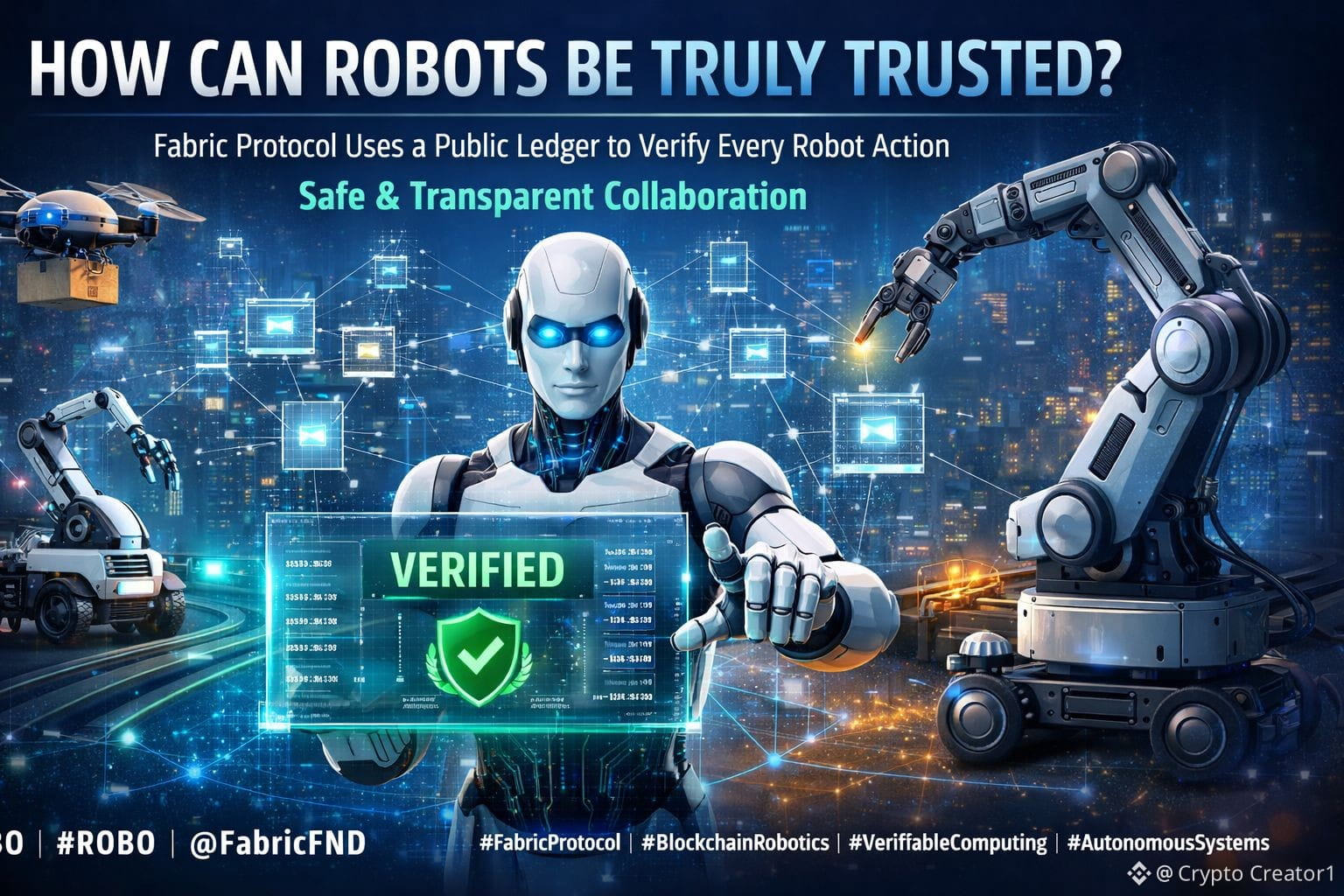
AI Intelligence Without Accountability Is Just Scaled Failure 🚨 The obsession with smarter AI misses the point: intelligence without verifiable accountability is just dangerous automation. Walrus isn't about making AI "smarter"; it's about making AI answerable. Every action must have an auditable trail, every decision traceable to its inputs. This verifiable memory is the key difference between the AI people fear and the AI they will trust to operate autonomously. The future demands AI that can explain itself post-action. Walrus delivers that trust layer. #Aİ #DeFi #VerifiableComputing 🧠
AI Intelligence Without Accountability Is Just Scaled Failure 🚨

The obsession with smarter AI misses the point: intelligence without verifiable accountability is just dangerous automation. Walrus isn't about making AI "smarter"; it's about making AI answerable.

Every action must have an auditable trail, every decision traceable to its inputs. This verifiable memory is the key difference between the AI people fear and the AI they will trust to operate autonomously. The future demands AI that can explain itself post-action. Walrus delivers that trust layer.

#Aİ #DeFi #VerifiableComputing 🧠
AI Intelligence Without Accountability Is Just Scaled Failure 🚨 The obsession with smarter AI misses the point: intelligence without verifiable accountability is just dangerous automation. Walrus isn't about making AI "smarter"; it's about making AI answerable. Every action must have an auditable trail, every decision traceable to its inputs. This verifiable memory is the key difference between the AI people fear and the AI they will trust to operate autonomously. The future demands AI that can explain itself post-action. Walrus delivers that foundation. #Aİ #DeFi #VerifiableComputing 🧠
AI Intelligence Without Accountability Is Just Scaled Failure 🚨

The obsession with smarter AI misses the point: intelligence without verifiable accountability is just dangerous automation. Walrus isn't about making AI "smarter"; it's about making AI answerable.

Every action must have an auditable trail, every decision traceable to its inputs. This verifiable memory is the key difference between the AI people fear and the AI they will trust to operate autonomously. The future demands AI that can explain itself post-action. Walrus delivers that foundation.

#Aİ #DeFi #VerifiableComputing 🧠
ບົດຄວາມ
Fabric Foundation and the Quiet Rise of Coordinated Machine SystemsI’ve been thinking a lot about how technology changes once it stops being just a tool. In the beginning, most systems feel simple. They are built for one clear reason, used in one clear way, and understood through the job they perform. But over time, that simplicity fades. More people start contributing to them. More layers get added. More decisions begin moving through them. And at some point, what once looked like a product starts to feel more like an environment people and machines are living inside together. That shift feels important. Because once a system becomes an environment, the real question is no longer just what it can do. The bigger question is how everything inside it works together. Lately, I keep noticing that this is happening everywhere. Technology is no longer moving in neat, separate lines. Software shapes hardware. Data shapes decisions. Infrastructure shapes behavior. Automated agents, human operators, institutions, and machines are all starting to interact inside the same space. And when that happens, the real challenge becomes coordination. Coordination sounds like a technical word, but it is really about relationships. It is about how different actors share responsibility without the whole system becoming messy or fragile. Some participants are building. Some are verifying. Some are governing. Some are acting in the real world. Each one brings a different kind of power and a different kind of risk. So the strength of the system depends less on any single part and more on how those parts stay connected. That is especially true in robotics. A robot is never just a machine doing a task. Behind every action is a longer chain of decisions, data, permissions, and trust. What information is it using? Who checked that information? What kind of rules shape its behavior? Who is accountable if something goes wrong? The robot may be the part we can see, but what really matters is the system underneath it. That is why Fabric Foundation stands out to me. What makes Fabric Protocol interesting is not simply that it focuses on general-purpose robotics. It is the way it approaches the problem. Supported by the non-profit Fabric Foundation, the protocol describes a global open network where robots can be built, governed, and improved through verifiable computing and agent-native infrastructure. What that suggests is something bigger than a single product. It points to the idea that robotics will need shared systems around it systems that help different contributors work together, verify outcomes, and carry responsibility in a visible way. And that feels like the right direction. Because the future of robotics probably will not come from one isolated breakthrough. It will come from many systems, many builders, many forms of knowledge, and many layers of coordination working together. Hardware, software, governance, data, safety, compliance all of these things are becoming part of the same conversation. When that happens, infrastructure stops being background support. It becomes the thing that makes trust possible. I think that is why verifiable computing matters so much here. In complex systems, it is not enough for something to work. People need to understand why it worked, how it worked, and whether it can be checked. Verification gives a system a kind of memory. It makes action more visible. It helps turn opaque processes into something others can inspect and rely on. That matters even more when machines and agents begin acting with greater autonomy. The more capable a system becomes, the less we can depend on blind trust. We need structures that make behavior legible. We need ways to track contributions, validate computation, and create accountability across participants who may not know each other or fully trust each other. Without that, scale becomes instability. This is where a public ledger begins to make sense not as a trend, but as a coordination layer. A shared ledger cannot solve every problem, but it can provide a common record of what happened, who contributed, and what was verified. In ecosystems with many moving parts, that shared record becomes valuable. It helps reduce confusion. It gives participants something stable to coordinate around. And over time, that kind of structure can matter just as much as intelligence itself. What I find most compelling is that Fabric Protocol seems to understand that robotics is not only about capability. It is also about stewardship. That word matters to me. Stewardship feels different from growth for the sake of growth. It implies care. It implies responsibility. It implies that as systems become more powerful, the way they are managed becomes just as important as the way they are built. And maybe that is exactly where a lot of technological thinking is heading now from invention alone toward the harder question of how complex systems are guided over time. Because once a technology becomes an ecosystem, the conversation changes. You stop asking only whether it is powerful. You start asking whether it is governable. Whether it can stay open without becoming chaotic. Whether responsibility stays visible as more actors enter the system. Whether improvement can happen without losing oversight. These are quieter questions, but they feel like the ones that will decide what actually lasts. The more I sit with it, the more it seems that the future will belong to systems that can hold complexity without losing clarity. Not the loudest systems. Not the most aggressively marketed ones. But the ones that can support many contributors, many agents, and many forms of coordination while still keeping trust intact. That is what makes projects like Fabric Foundation worth reflecting on. They are not only building toward smarter machines. They are pointing toward the infrastructure needed for those machines to exist inside human systems responsibly. And that may be the deeper challenge of this era not simply creating technology that can act, but creating ecosystems that can hold that action wisely. The more I think about it, the more I feel that the future of advanced systems will depend less on intelligence in isolation and more on whether intelligence can live inside structures of trust, verification, and shared responsibility @FabricFND #ROBO $ROBO #FabricFoundation #FabricProtocol #Robotics #VerifiableComputing

Fabric Foundation and the Quiet Rise of Coordinated Machine Systems

I’ve been thinking a lot about how technology changes once it stops being just a tool.

In the beginning, most systems feel simple. They are built for one clear reason, used in one clear way, and understood through the job they perform. But over time, that simplicity fades. More people start contributing to them. More layers get added. More decisions begin moving through them. And at some point, what once looked like a product starts to feel more like an environment people and machines are living inside together.

That shift feels important. Because once a system becomes an environment, the real question is no longer just what it can do. The bigger question is how everything inside it works together.

Lately, I keep noticing that this is happening everywhere. Technology is no longer moving in neat, separate lines. Software shapes hardware. Data shapes decisions. Infrastructure shapes behavior. Automated agents, human operators, institutions, and machines are all starting to interact inside the same space. And when that happens, the real challenge becomes coordination.

Coordination sounds like a technical word, but it is really about relationships. It is about how different actors share responsibility without the whole system becoming messy or fragile. Some participants are building. Some are verifying. Some are governing. Some are acting in the real world. Each one brings a different kind of power and a different kind of risk. So the strength of the system depends less on any single part and more on how those parts stay connected.

That is especially true in robotics.

A robot is never just a machine doing a task. Behind every action is a longer chain of decisions, data, permissions, and trust. What information is it using? Who checked that information? What kind of rules shape its behavior? Who is accountable if something goes wrong? The robot may be the part we can see, but what really matters is the system underneath it.

That is why Fabric Foundation stands out to me.

What makes Fabric Protocol interesting is not simply that it focuses on general-purpose robotics. It is the way it approaches the problem. Supported by the non-profit Fabric Foundation, the protocol describes a global open network where robots can be built, governed, and improved through verifiable computing and agent-native infrastructure. What that suggests is something bigger than a single product. It points to the idea that robotics will need shared systems around it systems that help different contributors work together, verify outcomes, and carry responsibility in a visible way.

And that feels like the right direction.

Because the future of robotics probably will not come from one isolated breakthrough. It will come from many systems, many builders, many forms of knowledge, and many layers of coordination working together. Hardware, software, governance, data, safety, compliance all of these things are becoming part of the same conversation. When that happens, infrastructure stops being background support. It becomes the thing that makes trust possible.

I think that is why verifiable computing matters so much here. In complex systems, it is not enough for something to work. People need to understand why it worked, how it worked, and whether it can be checked. Verification gives a system a kind of memory. It makes action more visible. It helps turn opaque processes into something others can inspect and rely on.

That matters even more when machines and agents begin acting with greater autonomy. The more capable a system becomes, the less we can depend on blind trust. We need structures that make behavior legible. We need ways to track contributions, validate computation, and create accountability across participants who may not know each other or fully trust each other. Without that, scale becomes instability.

This is where a public ledger begins to make sense not as a trend, but as a coordination layer. A shared ledger cannot solve every problem, but it can provide a common record of what happened, who contributed, and what was verified. In ecosystems with many moving parts, that shared record becomes valuable. It helps reduce confusion. It gives participants something stable to coordinate around. And over time, that kind of structure can matter just as much as intelligence itself.

What I find most compelling is that Fabric Protocol seems to understand that robotics is not only about capability. It is also about stewardship.

That word matters to me. Stewardship feels different from growth for the sake of growth. It implies care. It implies responsibility. It implies that as systems become more powerful, the way they are managed becomes just as important as the way they are built. And maybe that is exactly where a lot of technological thinking is heading now from invention alone toward the harder question of how complex systems are guided over time.

Because once a technology becomes an ecosystem, the conversation changes.

You stop asking only whether it is powerful. You start asking whether it is governable. Whether it can stay open without becoming chaotic. Whether responsibility stays visible as more actors enter the system. Whether improvement can happen without losing oversight. These are quieter questions, but they feel like the ones that will decide what actually lasts.

The more I sit with it, the more it seems that the future will belong to systems that can hold complexity without losing clarity. Not the loudest systems. Not the most aggressively marketed ones. But the ones that can support many contributors, many agents, and many forms of coordination while still keeping trust intact.

That is what makes projects like Fabric Foundation worth reflecting on. They are not only building toward smarter machines. They are pointing toward the infrastructure needed for those machines to exist inside human systems responsibly. And that may be the deeper challenge of this era not simply creating technology that can act, but creating ecosystems that can hold that action wisely.

The more I think about it, the more I feel that the future of advanced systems will depend less on intelligence in isolation and more on whether intelligence can live inside structures of trust, verification, and shared responsibility
@Fabric Foundation #ROBO $ROBO #FabricFoundation #FabricProtocol #Robotics #VerifiableComputing
·
--
ສັນຍານກະທິງ
Introducing Fabric Protocol Fabric Protocol is a global open network backed by the Fabric Foundation, designed to power the next generation of general-purpose robots. By combining verifiable computing, agent-native infrastructure, and a public ledger, Fabric Protocol coordinates data, computation, and regulation in a transparent and secure way. 🔹 Build and deploy intelligent robots 🔹 Enable collaborative governance 🔹 Ensure safe human-machine interaction 🔹 Evolve robotics through open, verifiable infrastructure Fabric Protocol brings together modular tools that allow developers, researchers, and organizations to build, govern, and evolve robotics collaboratively—creating a safer and more scalable future for human-machine collaboration. @Square-Creator-314140b9476c FabricProtocol $ROBO AI Crypto Blockchain Binance #Robotics #AI #Web3 #VerifiableComputing #OpenInfrastructure {future}(ROBOUSDT)
Introducing Fabric Protocol

Fabric Protocol is a global open network backed by the Fabric Foundation, designed to power the next generation of general-purpose robots.

By combining verifiable computing, agent-native infrastructure, and a public ledger, Fabric Protocol coordinates data, computation, and regulation in a transparent and secure way.

🔹 Build and deploy intelligent robots
🔹 Enable collaborative governance
🔹 Ensure safe human-machine interaction
🔹 Evolve robotics through open, verifiable infrastructure

Fabric Protocol brings together modular tools that allow developers, researchers, and organizations to build, govern, and evolve robotics collaboratively—creating a safer and more scalable future for human-machine collaboration.

@Fabric FabricProtocol $ROBO AI Crypto Blockchain Binance #Robotics #AI #Web3 #VerifiableComputing #OpenInfrastructure
ບົດຄວາມ
Fabric Protocol Isn’t Just Building Robots It’s Testing Trust at Scale@FabricFND $ROBO One thing I keep asking myself lately is this can we actually coordinate machines in the real world without breaking trust at the human level? Not just technically but socially, economically, and operationally. That’s where Fabric Protocol caught my attention. At a glance it sounds ambitious robotics verifiable computing agent native infrastructure but what made me pause wasn’t the narrative. It was the structure behind it. A public ledger coordinating not just transactions, but data, computation and even regulation. That’s not a small design choice. It signals that the team is thinking beyond demos and into real world orchestration. What I’ve observed so far is a pattern of disciplined execution. Instead of overextending into flashy claims the project seems to be building modularly layer by layer. This matters, especially in a space where robotics Web3 can easily drift into abstraction. Here, the infrastructure is being shaped in a way that suggests actual deployment scenarios, not just theoretical frameworks. The idea of selective privacy also stands out to me but not as a slogan. In practice controlled disclosure is a necessity when machines interact with humans, data and environments. Full transparency doesn’t work, and total privacy doesn’t scale. Fabric seems to be navigating that middle ground, which is where things get complicated but also where real utility lives. That said, there are still friction points. Onboarding for one, feels like it could become a bottleneck. This isn’t a plug and play ecosystem. Builders need to understand multiple layers robotics, coordination logic and verifiable systems. That complexity might slow adoption unless tooling and documentation evolve aggressively. There’s also a deeper tension I keep thinking about: users builders and governance won’t always align. A system coordinating physical machines introduces higher stakes. Governance decisions aren’t just digital they can have real-world consequences. How Fabric balances that over time will define its credibility more than any early traction. Long term, the real test isn’t whether the protocol works in controlled environments it’s how it behaves under pressure. Scale adversarial conditions, conflicting incentives. That’s where most systems start to show cracks. Still I think Fabric Protocol deserves attention right now not because it promises the future but because it’s quietly laying down the infrastructure that could support it. There’s intent in how it’s being built, and that’s rare. I’m watching it closely not with blind optimism but with measured curiosity. #FabricProtocol #Web3 #Robotics @FabricFND #VerifiableComputing #ROBO $ROBO {spot}(ROBOUSDT)

Fabric Protocol Isn’t Just Building Robots It’s Testing Trust at Scale

@Fabric Foundation $ROBO
One thing I keep asking myself lately is this can we actually coordinate machines in the real world without breaking trust at the human level? Not just technically but socially, economically, and operationally.

That’s where Fabric Protocol caught my attention.

At a glance it sounds ambitious robotics verifiable computing agent native infrastructure but what made me pause wasn’t the narrative. It was the structure behind it. A public ledger coordinating not just transactions, but data, computation and even regulation. That’s not a small design choice. It signals that the team is thinking beyond demos and into real world orchestration.

What I’ve observed so far is a pattern of disciplined execution. Instead of overextending into flashy claims the project seems to be building modularly layer by layer. This matters, especially in a space where robotics Web3 can easily drift into abstraction. Here, the infrastructure is being shaped in a way that suggests actual deployment scenarios, not just theoretical frameworks.

The idea of selective privacy also stands out to me but not as a slogan. In practice controlled disclosure is a necessity when machines interact with humans, data and environments. Full transparency doesn’t work, and total privacy doesn’t scale. Fabric seems to be navigating that middle ground, which is where things get complicated but also where real utility lives.

That said, there are still friction points.

Onboarding for one, feels like it could become a bottleneck. This isn’t a plug and play ecosystem. Builders need to understand multiple layers robotics, coordination logic and verifiable systems. That complexity might slow adoption unless tooling and documentation evolve aggressively.

There’s also a deeper tension I keep thinking about: users builders and governance won’t always align. A system coordinating physical machines introduces higher stakes. Governance decisions aren’t just digital they can have real-world consequences. How Fabric balances that over time will define its credibility more than any early traction.

Long term, the real test isn’t whether the protocol works in controlled environments it’s how it behaves under pressure. Scale adversarial conditions, conflicting incentives. That’s where most systems start to show cracks.

Still I think Fabric Protocol deserves attention right now not because it promises the future but because it’s quietly laying down the infrastructure that could support it. There’s intent in how it’s being built, and that’s rare.

I’m watching it closely not with blind optimism but with measured curiosity.

#FabricProtocol #Web3 #Robotics @Fabric Foundation #VerifiableComputing #ROBO $ROBO
عصر الروبوتات بدأ.. إنت "صاحب كورس" ولا مجرد "متفرج"؟ 🤖 المفتاح معاك! 🗝️ بينما الناس عمالة تتخانق في "خيال علمي" والآلات هتسيطر علينا ولا لأ، مشروع Fabric Protocol شغال بجد وبيبني "الدستور" اللي هيحكم الليلة دي كلها. إحنا مش بنتكلم عن حديد ومسامير، إحنا بنتكلم عن "نظام سيادة" (Agent-native infrastructure) يضمن إن الذكاء الاصطناعي يمشي على العجين ما يلخبطوش تحت رقابة البشر وعبر "السجل العام". 🌐✨ طيب وإيه لزمة $ROBO في الزيطة دي؟ ببساطة، دي العملة اللي بتديك "حق الكلام" وتخليك شريك في حوكمة النظام العالمي ده. الموضوع مش "مضاربة" وخلاص، ده استثمار في "الأساس" اللي هيقوم عليه اقتصاد الروبوتات، وبدعم تقيل وراس مال ضخم من @FabricFND اللي رصدت ميزانيات بملايين الدولارات عشان تضمن إن المشروع ده يكون هو القائد في السوق. 🛡️💎💰 السؤال بقى للناس اللي دماغها شغال: تحب في المستقبل تكون مجرد "يوزر" بيستخدم الآلة، ولا تكون "شريك" في النظام اللي بيديرها؟ 🎯⚖️ الاختيار في إيدك، والمستقبل بيتبني دلوقتي بـ Fabric. @FabricFND #ROBO #Robotics #VerifiableComputing #TechRevolution #كريبتو
عصر الروبوتات بدأ.. إنت "صاحب كورس" ولا مجرد "متفرج"؟ 🤖 المفتاح معاك! 🗝️

بينما الناس عمالة تتخانق في "خيال علمي" والآلات هتسيطر علينا ولا لأ، مشروع Fabric Protocol شغال بجد وبيبني "الدستور" اللي هيحكم الليلة دي كلها. إحنا مش بنتكلم عن حديد ومسامير، إحنا بنتكلم عن "نظام سيادة" (Agent-native infrastructure) يضمن إن الذكاء الاصطناعي يمشي على العجين ما يلخبطوش تحت رقابة البشر وعبر "السجل العام". 🌐✨

طيب وإيه لزمة $ROBO في الزيطة دي؟
ببساطة، دي العملة اللي بتديك "حق الكلام" وتخليك شريك في حوكمة النظام العالمي ده. الموضوع مش "مضاربة" وخلاص، ده استثمار في "الأساس" اللي هيقوم عليه اقتصاد الروبوتات، وبدعم تقيل وراس مال ضخم من @Fabric Foundation اللي رصدت ميزانيات بملايين الدولارات عشان تضمن إن المشروع ده يكون هو القائد في السوق. 🛡️💎💰

السؤال بقى للناس اللي دماغها شغال:
تحب في المستقبل تكون مجرد "يوزر" بيستخدم الآلة، ولا تكون "شريك" في النظام اللي بيديرها؟ 🎯⚖️

الاختيار في إيدك، والمستقبل بيتبني دلوقتي بـ Fabric.

@Fabric Foundation #ROBO #Robotics #VerifiableComputing #TechRevolution #كريبتو
ບົດຄວາມ
Fabric Protocol The Trust Layer for the Future of Robotics.For a long time, I kept hearing about robots AI systems, public ledgers, and something called verifiable computing. Honestly, it all sounded too technical and far away from real life. I thought it was only for engineers or big tech companies. But the day I truly understood what Fabric Protocol is trying to do, everything became simple. I realized it is not just about robots. It is about trust. It is about safety. It is about how humans and machines can work together without fear. In this article I will explain Fabric Protocol in very simple English from a beginner’s point of view. I will share what the project is, how it works, and why it could change the way we build and control robots in the future. What Is Fabric Protocol. Fabric Protocol is a global open network. It is supported by a non profit organization called the Fabric Foundation. The main goal of this network is to help people build, manage, and improve general purpose robots in a safe and transparent way. When we say general purpose robots, we mean robots that can do many different tasks. Not just one small job in a factory, but robots that can move, learn, adapt, and work in the real world with humans. Fabric Protocol gives developers a shared system where they can coordinate data, computing power, and rules. All of this is recorded on a public ledger. A public ledger is like a shared digital notebook that everyone can see and verify. It helps make sure nothing is hidden or secretly changed. So in simple words, Fabric Protocol is a system that helps people build smart robots together, while making sure everything is safe, fair, and transparent. Why Do We Even Need Something Like This At first, I used to think robots are already smart enough. We see videos online of robots walking, talking, and even doing simple tasks. But when I started reading more, I understood the real problem. Robots and AI systems can make mistakes. They can misunderstand instructions. They can act in unexpected ways. If a robot is working in a hospital, a home, or on the road, even a small mistake can become dangerous. If different companies build robots in closed systems, there is no shared standard for safety and governance. If something goes wrong, it becomes hard to check what happened and who is responsible. This is where Fabric Protocol becomes important. It tries to create a common infrastructure. It connects robots and systems through a public ledger. This means actions, data, and decisions can be verified. If something happens, we can trace it back and understand it. We are seeing a world where robots are slowly moving from labs into daily life. If we do not build trust now, it will become harder later. What Is Verifiable Computing in Simple Words Verifiable computing sounds complex, but when I finally understood it, it felt very logical. Normally, when a machine does a calculation or makes a decision, we just trust it. We assume it did the right thing. But what if we could mathematically prove that the result is correct? Verifiable computing allows a system to show proof that its computation was done correctly. It is like showing your full working in a math exam instead of only writing the final answer. In Fabric Protocol, this idea is very important. Robots and AI agents can prove that their actions or decisions followed certain rules. If they say they checked a safety condition, there is proof. If they say they followed a regulation, there is proof. This builds trust not only between humans and machines, but also between different machines. What Does Agent Native Infrastructure Mean When I first heard the term agent native infrastructure, I was confused. But then I thought about it differently. Today, most digital systems are built for humans. We click buttons. We log in. We send messages. But in the future, AI agents and robots will also interact directly with digital systems. Agent native infrastructure means the system is designed from the start for AI agents and robots. They can communicate, make agreements, share data, and follow rules automatically. If a robot needs to access certain data, it can do it through the network in a secure and verified way. If it needs permission, it can check rules recorded on the ledger. It becomes a world where machines are not just tools, but active participants in a digital ecosystem. How Governance Works in Fabric Protocol Governance simply means who makes the rules and how decisions are made. Fabric Protocol uses a public ledger to coordinate regulation. This means rules can be written into the system. They are visible. They are transparent. They cannot be secretly changed. The Fabric Foundation supports the development of the network, but the idea of an open protocol means that many people and organizations can participate. If we think about the future, robots might work in public spaces, homes, hospitals, and factories. We need shared rules. We need a way to update those rules as technology evolves. If governance is built into the infrastructure itself, it becomes easier to adapt safely. Why This Matters for Beginners Like Us When I first looked at Fabric Protocol, I thought it was only for developers. But then I realized something important. If robots become part of daily life, this affects all of us. It affects how safe our workplaces are. It affects how our data is used. It affects how decisions are made around us. Understanding projects like Fabric Protocol helps us see the bigger picture. We are not just watching technology grow. We are part of a society that must decide how it grows. If systems are built with transparency and verifiable proofs, it becomes easier to trust them. And trust is the foundation of any new technology. A Simple Example to Imagine Imagine a robot working in a hospital. It delivers medicine to patients. Without a system like Fabric Protocol, we only hope the robot follows the correct instructions. If something goes wrong, it may be hard to check what happened. With a verifiable and ledger based system, every step can be recorded. The robot can prove it received the right instruction. It can prove it checked the correct patient ID. It can prove it followed safety rules. If there is a mistake, we can trace it clearly. If everything works well, we have confidence. This is how human machine collaboration becomes safer and more reliable. The Bigger Vision When I step back and look at the full picture, I see that Fabric Protocol is not just about robots. It is about building an open and shared infrastructure for the next generation of intelligent machines. It connects data, computation, and regulation in one coordinated system. It uses a public ledger to create transparency. It supports modular infrastructure so developers can build flexible and adaptable robots. We are slowly moving toward a world where machines will not only assist us but also act independently in many situations. If we want that world to be safe, we need strong foundations. Fabric Protocol is trying to build that foundation. Conclusion The day I finally understood Fabric Protocol, I stopped seeing it as a complicated technical idea. I started seeing it as a trust layer for robots. It is a global open network supported by the Fabric Foundation. It enables the construction, governance, and evolution of general purpose robots. It uses verifiable computing and a public ledger to coordinate data, computation, and regulation. In simple words, it helps humans and machines work together safely. If we are entering a future where robots are everywhere, then systems like Fabric Protocol are not optional. They are necessary. Now I am not just watching this space with confusion. I am watching it with curiosity and hope. If you are new to this topic, take your time, read slowly, and ask questions. The future of robotics is not only for engineers. It is for all of us. Let us learn together and stay informed as this technology evolves. @FabricFND #Mira #RoboticsFuture #VerifiableComputing #OpenInfrastructure $ROBO

Fabric Protocol The Trust Layer for the Future of Robotics.

For a long time, I kept hearing about robots AI systems, public ledgers, and something called verifiable computing. Honestly, it all sounded too technical and far away from real life. I thought it was only for engineers or big tech companies. But the day I truly understood what Fabric Protocol is trying to do, everything became simple. I realized it is not just about robots. It is about trust. It is about safety. It is about how humans and machines can work together without fear.

In this article I will explain Fabric Protocol in very simple English from a beginner’s point of view. I will share what the project is, how it works, and why it could change the way we build and control robots in the future.

What Is Fabric Protocol.

Fabric Protocol is a global open network. It is supported by a non profit organization called the Fabric Foundation. The main goal of this network is to help people build, manage, and improve general purpose robots in a safe and transparent way.

When we say general purpose robots, we mean robots that can do many different tasks. Not just one small job in a factory, but robots that can move, learn, adapt, and work in the real world with humans.

Fabric Protocol gives developers a shared system where they can coordinate data, computing power, and rules. All of this is recorded on a public ledger. A public ledger is like a shared digital notebook that everyone can see and verify. It helps make sure nothing is hidden or secretly changed.

So in simple words, Fabric Protocol is a system that helps people build smart robots together, while making sure everything is safe, fair, and transparent.

Why Do We Even Need Something Like This

At first, I used to think robots are already smart enough. We see videos online of robots walking, talking, and even doing simple tasks. But when I started reading more, I understood the real problem.

Robots and AI systems can make mistakes. They can misunderstand instructions. They can act in unexpected ways. If a robot is working in a hospital, a home, or on the road, even a small mistake can become dangerous.

If different companies build robots in closed systems, there is no shared standard for safety and governance. If something goes wrong, it becomes hard to check what happened and who is responsible.

This is where Fabric Protocol becomes important. It tries to create a common infrastructure. It connects robots and systems through a public ledger. This means actions, data, and decisions can be verified. If something happens, we can trace it back and understand it.

We are seeing a world where robots are slowly moving from labs into daily life. If we do not build trust now, it will become harder later.

What Is Verifiable Computing in Simple Words

Verifiable computing sounds complex, but when I finally understood it, it felt very logical.

Normally, when a machine does a calculation or makes a decision, we just trust it. We assume it did the right thing. But what if we could mathematically prove that the result is correct?

Verifiable computing allows a system to show proof that its computation was done correctly. It is like showing your full working in a math exam instead of only writing the final answer.

In Fabric Protocol, this idea is very important. Robots and AI agents can prove that their actions or decisions followed certain rules. If they say they checked a safety condition, there is proof. If they say they followed a regulation, there is proof.

This builds trust not only between humans and machines, but also between different machines.

What Does Agent Native Infrastructure Mean

When I first heard the term agent native infrastructure, I was confused. But then I thought about it differently.

Today, most digital systems are built for humans. We click buttons. We log in. We send messages. But in the future, AI agents and robots will also interact directly with digital systems.

Agent native infrastructure means the system is designed from the start for AI agents and robots. They can communicate, make agreements, share data, and follow rules automatically.

If a robot needs to access certain data, it can do it through the network in a secure and verified way. If it needs permission, it can check rules recorded on the ledger.

It becomes a world where machines are not just tools, but active participants in a digital ecosystem.

How Governance Works in Fabric Protocol

Governance simply means who makes the rules and how decisions are made.

Fabric Protocol uses a public ledger to coordinate regulation. This means rules can be written into the system. They are visible. They are transparent. They cannot be secretly changed.

The Fabric Foundation supports the development of the network, but the idea of an open protocol means that many people and organizations can participate.

If we think about the future, robots might work in public spaces, homes, hospitals, and factories. We need shared rules. We need a way to update those rules as technology evolves.

If governance is built into the infrastructure itself, it becomes easier to adapt safely.

Why This Matters for Beginners Like Us

When I first looked at Fabric Protocol, I thought it was only for developers. But then I realized something important.

If robots become part of daily life, this affects all of us. It affects how safe our workplaces are. It affects how our data is used. It affects how decisions are made around us.

Understanding projects like Fabric Protocol helps us see the bigger picture. We are not just watching technology grow. We are part of a society that must decide how it grows.

If systems are built with transparency and verifiable proofs, it becomes easier to trust them. And trust is the foundation of any new technology.

A Simple Example to Imagine

Imagine a robot working in a hospital. It delivers medicine to patients.

Without a system like Fabric Protocol, we only hope the robot follows the correct instructions. If something goes wrong, it may be hard to check what happened.

With a verifiable and ledger based system, every step can be recorded. The robot can prove it received the right instruction. It can prove it checked the correct patient ID. It can prove it followed safety rules.

If there is a mistake, we can trace it clearly. If everything works well, we have confidence.

This is how human machine collaboration becomes safer and more reliable.

The Bigger Vision

When I step back and look at the full picture, I see that Fabric Protocol is not just about robots. It is about building an open and shared infrastructure for the next generation of intelligent machines.

It connects data, computation, and regulation in one coordinated system. It uses a public ledger to create transparency. It supports modular infrastructure so developers can build flexible and adaptable robots.

We are slowly moving toward a world where machines will not only assist us but also act independently in many situations. If we want that world to be safe, we need strong foundations.

Fabric Protocol is trying to build that foundation.

Conclusion

The day I finally understood Fabric Protocol, I stopped seeing it as a complicated technical idea. I started seeing it as a trust layer for robots.

It is a global open network supported by the Fabric Foundation. It enables the construction, governance, and evolution of general purpose robots. It uses verifiable computing and a public ledger to coordinate data, computation, and regulation.

In simple words, it helps humans and machines work together safely.

If we are entering a future where robots are everywhere, then systems like Fabric Protocol are not optional. They are necessary.

Now I am not just watching this space with confusion. I am watching it with curiosity and hope.

If you are new to this topic, take your time, read slowly, and ask questions. The future of robotics is not only for engineers. It is for all of us.

Let us learn together and stay informed as this technology evolves.
@Fabric Foundation
#Mira
#RoboticsFuture
#VerifiableComputing
#OpenInfrastructure
$ROBO
为何@SuccinctLabs 正用零知识证明重构区块链信任 SuccinctLabs绝非普通基建项目——它正在构建去中心化证明者网络,用加密真相取代传统信任模型。通过整合零知识证明供应链,开发者可为Rollup、协处理器和dApp规模化生成ZK证明,显著降低成本并增强可验证安全性。 其SP1 zkVM使证明生成如传统计算般无缝,而证明者网络通过规模效应进一步优化效率。凭借@Paradigm与Robot Ventures等机构注资的5500万美元,@SuccinctLabs致力于让ZK技术实现民主化应用。 未来愿景?一个所有区块链交互都由数学而非中介背书的时代🚀 #SuccinctLabs #ZKProofs #VerifiableComputing $PROVE
为何@Succinct 正用零知识证明重构区块链信任
SuccinctLabs绝非普通基建项目——它正在构建去中心化证明者网络,用加密真相取代传统信任模型。通过整合零知识证明供应链,开发者可为Rollup、协处理器和dApp规模化生成ZK证明,显著降低成本并增强可验证安全性。
其SP1 zkVM使证明生成如传统计算般无缝,而证明者网络通过规模效应进一步优化效率。凭借@Paradigm与Robot Ventures等机构注资的5500万美元,@SuccinctLabs致力于让ZK技术实现民主化应用。
未来愿景?一个所有区块链交互都由数学而非中介背书的时代🚀
#SuccinctLabs #ZKProofs #VerifiableComputing $PROVE
ບົດຄວາມ
Fabric Protocol: Rethinking Trust in the Age of Autonomous Machines.#ROBO @FabricFND $ROBO Introduction We are entering an era in which machines are no longer confined to factory lines or research labs. They are beginning to move among us — assisting in hospitals, navigating warehouses, supporting infrastructure, and even entering our homes. As robotics becomes more autonomous and more integrated into daily life, a quiet but profound question emerges: Can we truly trust the systems we are building? Fabric Foundation proposes an answer through Fabric Protocol, a global open network designed to coordinate the construction, governance, and collaborative evolution of general-purpose robots. Rather than treating trust as an afterthought, the protocol attempts to embed it directly into infrastructure — through verifiable computing, public ledger coordination, and agent-native systems. This article reflects on what that means — not only technically, but philosophically and socially — as we design the foundations of human-machine collaboration. 1. The Quiet Shift: From Intelligence to Accountability For years, innovation in robotics has focused on intelligence better models, better sensors, better autonomy. Yet intelligence alone does not guarantee safety or alignment. In fact, as systems grow more capable, opacity grows alongside them. Fabric Protocol reframes the problem. It asks: What if the true bottleneck is not intelligence but accountability? By introducing verifiable computing and transparent coordination mechanisms, the protocol suggests that robotic systems should be auditable, governable, and continuously aligned with shared standards. It shifts the emphasis from what robots can do to how their actions can be verified. This shift feels subtle yet it may prove foundational. 2. Architecture as a Philosophy of Trust When we look at Fabric Protocol’s architecture, we see more than technical layers. We see a philosophy expressed in infrastructure. Verifiable Computing Instead of asking society to trust opaque algorithms, the protocol enables computations to be cryptographically proven. In doing so, it replaces assumption with evidence. Public Ledger Coordination By coordinating data, computation, and regulation through a public ledger, the system creates a shared record of robotic identity, updates, and compliance. It introduces institutional memory — something autonomous systems will increasingly require. Modular Governance Governance is not imposed; it is structured to evolve. Communities, regulators, and contributors can adapt standards as technology advances, without compromising safety. Together, these layers suggest a broader insight: Trust is not a feature it is an architecture. 3. Agent-Native Infrastructure: Machines as Participants Traditionally, infrastructure has been designed for humans. Machines were tools endpoints in a system built around people. Fabric Protocol introduces the idea of agent-native infrastructure, where robots possess identity, follow enforceable rules, and participate directly in coordination frameworks. This is a meaningful evolution. It suggests a future where machines are not merely controlled but are integrated into structured ecosystems of accountability. A robot is not just a device; it becomes a network participant governed by transparent protocols. That shift carries both promise and responsibility. 4. Governance in a Fragmented World One of the most pressing challenges in robotics is regulatory fragmentation. Standards differ across industries and nations. Innovation moves quickly; policy moves carefully. Fabric Protocol attempts to bridge this divide by embedding compliance and governance mechanisms into a shared coordination layer. Instead of treating regulation as an external constraint, it becomes part of the system’s design. This approach raises a thoughtful possibility: What if governance could evolve at the speed of software without sacrificing rigor? In that sense, the protocol does not merely support robots; it supports the institutions that must oversee them. 5. Human-Machine Collaboration: Safety by Construction. As robots work alongside humans in warehouses, hospitals, or public spaces collaboration must be predictable. Not just technically functional, but socially acceptable. Through verifiable constraints, transparent updates, and shared behavioral standards, Fabric Protocol attempts to make safety intrinsic rather than reactive. It acknowledges a reality we often overlook: Trust is built slowly, but it can be broken quickly. Embedding accountability at the protocol level may help ensure that as robotic capabilities expand, public confidence does not erode. Conclusion: Engineering Trust for the Long Term. Fabric Protocol represents more than a technological proposal. It represents a perspective on the future of autonomy. By combining: Verifiable computation Public ledger coordination Modular governance Agent-native infrastructure it frames robotics not just as a field of innovation, but as a domain requiring durable trust systems. As we reflect on the accelerating pace of automation, one thing becomes clear: intelligence alone will not define the next era. Infrastructure will. Governance will. Transparency will. If robotics is to become truly general-purpose and globally integrated, then the foundations must be as thoughtful as the machines themselves. Fabric Protocol invites us to consider that trust is not something we grant to technology it is something we must deliberately design into it. Support technologies that build trust through transparency and accountability. The future of robotics depends on responsible infrastructure — and informed voices like yours. #ROBO #FabricProtocol #RoboticsGovernance #VerifiableComputing

Fabric Protocol: Rethinking Trust in the Age of Autonomous Machines.

#ROBO @Fabric Foundation $ROBO
Introduction

We are entering an era in which machines are no longer confined to factory lines or research labs. They are beginning to move among us — assisting in hospitals, navigating warehouses, supporting infrastructure, and even entering our homes. As robotics becomes more autonomous and more integrated into daily life, a quiet but profound question emerges:

Can we truly trust the systems we are building?

Fabric Foundation proposes an answer through Fabric Protocol, a global open network designed to coordinate the construction, governance, and collaborative evolution of general-purpose robots. Rather than treating trust as an afterthought, the protocol attempts to embed it directly into infrastructure — through verifiable computing, public ledger coordination, and agent-native systems.

This article reflects on what that means — not only technically, but philosophically and socially — as we design the foundations of human-machine collaboration.

1. The Quiet Shift: From Intelligence to Accountability

For years, innovation in robotics has focused on intelligence better models, better sensors, better autonomy. Yet intelligence alone does not guarantee safety or alignment. In fact, as systems grow more capable, opacity grows alongside them.

Fabric Protocol reframes the problem. It asks:

What if the true bottleneck is not intelligence but accountability?

By introducing verifiable computing and transparent coordination mechanisms, the protocol suggests that robotic systems should be auditable, governable, and continuously aligned with shared standards. It shifts the emphasis from what robots can do to how their actions can be verified.

This shift feels subtle yet it may prove foundational.

2. Architecture as a Philosophy of Trust

When we look at Fabric Protocol’s architecture, we see more than technical layers. We see a philosophy expressed in infrastructure.

Verifiable Computing

Instead of asking society to trust opaque algorithms, the protocol enables computations to be cryptographically proven. In doing so, it replaces assumption with evidence.

Public Ledger Coordination

By coordinating data, computation, and regulation through a public ledger, the system creates a shared record of robotic identity, updates, and compliance. It introduces institutional memory — something autonomous systems will increasingly require.

Modular Governance

Governance is not imposed; it is structured to evolve. Communities, regulators, and contributors can adapt standards as technology advances, without compromising safety.

Together, these layers suggest a broader insight:
Trust is not a feature it is an architecture.

3. Agent-Native Infrastructure: Machines as Participants

Traditionally, infrastructure has been designed for humans. Machines were tools endpoints in a system built around people.

Fabric Protocol introduces the idea of agent-native infrastructure, where robots possess identity, follow enforceable rules, and participate directly in coordination frameworks.

This is a meaningful evolution.

It suggests a future where machines are not merely controlled but are integrated into structured ecosystems of accountability. A robot is not just a device; it becomes a network participant governed by transparent protocols.

That shift carries both promise and responsibility.

4. Governance in a Fragmented World

One of the most pressing challenges in robotics is regulatory fragmentation. Standards differ across industries and nations. Innovation moves quickly; policy moves carefully.

Fabric Protocol attempts to bridge this divide by embedding compliance and governance mechanisms into a shared coordination layer. Instead of treating regulation as an external constraint, it becomes part of the system’s design.

This approach raises a thoughtful possibility:

What if governance could evolve at the speed of software without sacrificing rigor?

In that sense, the protocol does not merely support robots; it supports the institutions that must oversee them.

5. Human-Machine Collaboration: Safety by Construction.

As robots work alongside humans in warehouses, hospitals, or public spaces collaboration must be predictable. Not just technically functional, but socially acceptable.

Through verifiable constraints, transparent updates, and shared behavioral standards, Fabric Protocol attempts to make safety intrinsic rather than reactive.

It acknowledges a reality we often overlook:
Trust is built slowly, but it can be broken quickly.

Embedding accountability at the protocol level may help ensure that as robotic capabilities expand, public confidence does not erode.

Conclusion: Engineering Trust for the Long Term.

Fabric Protocol represents more than a technological proposal. It represents a perspective on the future of autonomy.

By combining:

Verifiable computation

Public ledger coordination

Modular governance

Agent-native infrastructure

it frames robotics not just as a field of innovation, but as a domain requiring durable trust systems.

As we reflect on the accelerating pace of automation, one thing becomes clear: intelligence alone will not define the next era. Infrastructure will. Governance will. Transparency will.

If robotics is to become truly general-purpose and globally integrated, then the foundations must be as thoughtful as the machines themselves.

Fabric Protocol invites us to consider that trust is not something we grant to technology it is something we must deliberately design into it.
Support technologies that build trust through transparency and accountability.
The future of robotics depends on responsible infrastructure — and informed voices like yours.

#ROBO
#FabricProtocol
#RoboticsGovernance
#VerifiableComputing
Brevis: Scaling Blockchains to Infinity with Verifiable Computing 🚀 | $BREV {future}(BREVUSDT) Blockchains were never meant to stay small — but scaling without trust has always been the challenge. That’s where Brevis steps in. Brevis introduces verifiable computing that lets blockchains scale far beyond current limits without sacrificing security or decentralization. Instead of pushing all computation on-chain, Brevis verifies complex off-chain computations with cryptographic proofs — fast, efficient, and trust-minimized. Why this matters 👇 • Massive scalability without bloated gas costs • Trustless verification of off-chain data • Powerful support for DeFi, AI, gaming, and data-heavy dApps • Built for the next generation of modular blockchains With $BREV , Brevis is unlocking a future where developers can build freely, users get smoother experiences, and blockchains scale toward infinity — securely. Scalability isn’t just about speed. It’s about verifiable truth at scale. #Brevis #BREV #VerifiableComputing
Brevis: Scaling Blockchains to Infinity with Verifiable Computing 🚀 | $BREV

Blockchains were never meant to stay small — but scaling without trust has always been the challenge.
That’s where Brevis steps in.

Brevis introduces verifiable computing that lets blockchains scale far beyond current limits without sacrificing security or decentralization. Instead of pushing all computation on-chain, Brevis verifies complex off-chain computations with cryptographic proofs — fast, efficient, and trust-minimized.

Why this matters 👇
• Massive scalability without bloated gas costs
• Trustless verification of off-chain data
• Powerful support for DeFi, AI, gaming, and data-heavy dApps
• Built for the next generation of modular blockchains

With $BREV , Brevis is unlocking a future where developers can build freely, users get smoother experiences, and blockchains scale toward infinity — securely.

Scalability isn’t just about speed.
It’s about verifiable truth at scale.

#Brevis #BREV #VerifiableComputing
🚨 $ROBO: VERIFIABLE COMPUTING IS LIVE. 🚨 Entry: 0.45 🔥 Target: 0.62 🚀 Stop Loss: 0.40 ⚠️ Accumulate $ROBO aggressively on the Top-tier exchange. Whale activity detected coordinating off-chain compute with on-chain verification. Fabric Protocol isn’t about speed; it’s about certainty. Expect volatility as agent networks scale. This is programmable trust between machines – anticipate a paradigm shift in how systems are built. Liquidity is building. Don’t hesitate. Not financial advice. Manage your risk. #ROBO #VerifiableComputing #DePIN #Aİ 🤖 {future}(ROBOUSDT)
🚨 $ROBO : VERIFIABLE COMPUTING IS LIVE. 🚨

Entry: 0.45 🔥
Target: 0.62 🚀
Stop Loss: 0.40 ⚠️

Accumulate $ROBO aggressively on the Top-tier exchange. Whale activity detected coordinating off-chain compute with on-chain verification. Fabric Protocol isn’t about speed; it’s about certainty. Expect volatility as agent networks scale. This is programmable trust between machines – anticipate a paradigm shift in how systems are built. Liquidity is building. Don’t hesitate.

Not financial advice. Manage your risk.

#ROBO #VerifiableComputing #DePIN #Aİ 🤖
🚨 $ROBO: VERIFIABLE COMPUTING IS LIVE. 🚨 Entry: 0.45 🔥 Target: 0.62 🚀 Stop Loss: 0.40 ⚠️ Accumulate $ROBO aggressively on the Top-tier exchange. Whale activity detected coordinating off-chain compute with on-chain verification. Fabric Protocol isn’t about speed; it’s about certainty. Expect volatility as agent networks scale. This is programmable trust between machines – anticipate a paradigm shift in how systems are built. Liquidity is building. Don’t hesitate. Not financial advice. Manage your risk. #ROBO #VerifiableComputing #DePIN #Aİ 🤖 {future}(ROBOUSDT)
🚨 $ROBO : VERIFIABLE COMPUTING IS LIVE. 🚨

Entry: 0.45 🔥
Target: 0.62 🚀
Stop Loss: 0.40 ⚠️

Accumulate $ROBO aggressively on the Top-tier exchange. Whale activity detected coordinating off-chain compute with on-chain verification. Fabric Protocol isn’t about speed; it’s about certainty. Expect volatility as agent networks scale. This is programmable trust between machines – anticipate a paradigm shift in how systems are built. Liquidity is building. Don’t hesitate.

Not financial advice. Manage your risk.

#ROBO #VerifiableComputing #DePIN #Aİ 🤖
Fabric Protocol is redefining the future of robotics through a decentralized and transparent infrastructure. By integrating verifiable computing with agent-based systems, it ensures that every robotic action is secure, auditable, and trustworthy. This innovative network empowers developers and organizations to collaboratively build and govern intelligent machines. As human-robot interaction evolves, Fabric Protocol sets a new standard for safe, scalable, and ethical automation worldwide #robo $ROBO @FabricFND #FabricProtocol #Robotics #ArtificialIntelligence #VerifiableComputing
Fabric Protocol is redefining the future of robotics through a decentralized and transparent infrastructure. By integrating verifiable computing with agent-based systems, it ensures that every robotic action is secure, auditable, and trustworthy. This innovative network empowers developers and organizations to collaboratively build and govern intelligent machines. As human-robot interaction evolves, Fabric Protocol sets a new standard for safe, scalable, and ethical automation worldwide

#robo $ROBO @Fabric Foundation
#FabricProtocol #Robotics #ArtificialIntelligence
#VerifiableComputing
ເຂົ້າສູ່ລະບົບເພື່ອສຳຫຼວດເນື້ອຫາເພີ່ມເຕີມ
ເຂົ້າຮ່ວມກຸ່ມຜູ້ໃຊ້ຄຣິບໂຕທົ່ວໂລກໃນ Binance Square.
⚡️ ໄດ້ຮັບຂໍ້ມູນຫຼ້າສຸດ ແລະ ທີ່ມີປະໂຫຍດກ່ຽວກັບຄຣິບໂຕ.
💬 ໄດ້ຮັບຄວາມໄວ້ວາງໃຈຈາກຕະຫຼາດແລກປ່ຽນຄຣິບໂຕທີ່ໃຫຍ່ທີ່ສຸດໃນໂລກ.
👍 ຄົ້ນຫາຂໍ້ມູນເຊີງເລິກທີ່ແທ້ຈາກນັກສ້າງທີ່ໄດ້ຮັບການຢືນຢັນ.
ອີເມວ / ເບີໂທລະສັບ