

#onchainanalysis
onchainanalysis
863,101 ຄັ້ງທີ່ເບິ່ງ
2,533 ກຳລັງສົນທະນາ
ມາແຮງ
ຫຼ້າສຸດ

📊 $BITCOIN in Market Insight: 230,000 BTC Moved — But Is It Selling Pressure?
$BTC latest on-chain activity highlights an important distinction: large transactions do not automatically mean a market sell-off.
More than 230,000 BTC reportedly moved on October 23, representing approximately $21 billion in on-chain activity. Yet, according to the shared report, no corresponding surge in exchange inflows followed.
🔍 What does this mean for the market?
• On-chain movement: Significant BTC transfers can reflect wallet restructuring, custody changes, or other activity — not necessarily selling.
• Key price zone: The $80,000–$85,000 range remains an important area to watch.
• Market sentiment: Persistent uncertainty and macroeconomic pressure could continue influencing investor behavior.
• What comes next: Exchange inflows, trading volume, and price reactions may provide better clues about Bitcoin’s next major move.
💡 My perspective: Smart investors focus on what the data actually reveals, not just the size of a headline number. Until stronger confirmation emerges, it’s worth avoiding assumptions about Bitcoin’s next direction.
The real question isn’t how much BTC moved — it’s where it moved, why it moved, and how the market responds.
₿ Are we seeing simple wallet repositioning, or could this activity signal a bigger move ahead?
Share your thoughts below. 👇
#bitcoin.” #BTC☀️ #CryptoMarkets #BinanceSquareFamily #OnChainAnalysis
📊 $BITCOIN in Market Insight: 230,000 BTC Moved — But Is It Selling Pressure?
$BTC latest on-chain activity highlights an important distinction: large transactions do not automatically mean a market sell-off.
More than 230,000 BTC reportedly moved on October 23, representing approximately $21 billion in on-chain activity. Yet, according to the shared report, no corresponding surge in exchange inflows followed.
🔍 What does this mean for the market?
• On-chain movement: Significant BTC transfers can reflect wallet restructuring, custody changes, or other activity — not necessarily selling.
• Key price zone: The $80,000–$85,000 range remains an important area to watch.
• Market sentiment: Persistent uncertainty and macroeconomic pressure could continue influencing investor behavior.
• What comes next: Exchange inflows, trading volume, and price reactions may provide better clues about Bitcoin’s next major move.
💡 My perspective: Smart investors focus on what the data actually reveals, not just the size of a headline number. Until stronger confirmation emerges, it’s worth avoiding assumptions about Bitcoin’s next direction.
The real question isn’t how much BTC moved — it’s where it moved, why it moved, and how the market responds.
₿ Are we seeing simple wallet repositioning, or could this activity signal a bigger move ahead?
Share your thoughts below. 👇
#bitcoin.” #BTC☀️ #CryptoMarkets #BinanceSquareFamily #OnChainAnalysis
$BTC latest on-chain activity highlights an important distinction: large transactions do not automatically mean a market sell-off.
More than 230,000 BTC reportedly moved on October 23, representing approximately $21 billion in on-chain activity. Yet, according to the shared report, no corresponding surge in exchange inflows followed.
🔍 What does this mean for the market?
• On-chain movement: Significant BTC transfers can reflect wallet restructuring, custody changes, or other activity — not necessarily selling.
• Key price zone: The $80,000–$85,000 range remains an important area to watch.
• Market sentiment: Persistent uncertainty and macroeconomic pressure could continue influencing investor behavior.
• What comes next: Exchange inflows, trading volume, and price reactions may provide better clues about Bitcoin’s next major move.
💡 My perspective: Smart investors focus on what the data actually reveals, not just the size of a headline number. Until stronger confirmation emerges, it’s worth avoiding assumptions about Bitcoin’s next direction.
The real question isn’t how much BTC moved — it’s where it moved, why it moved, and how the market responds.
₿ Are we seeing simple wallet repositioning, or could this activity signal a bigger move ahead?
Share your thoughts below. 👇
#bitcoin.” #BTC☀️ #CryptoMarkets #BinanceSquareFamily #OnChainAnalysis
111

🚨 WHALE ALERT: $159 MILLION ROTATION FROM BTC TO ETH! 🐋
Big money is moving — but what does it mean for the crypto market?
According to reports, an unidentified whale rotated approximately 1,917.7 BTC worth $159M into 64,545 ETH over an 11-day period, with activity reported through October 22. No institutional identity has been confirmed.
🔍 Strategic Breakdown
🟠 Bitcoin: Sustained selling by a large holder may add short-term pressure, but it doesn't automatically mean BTC is bearish.
🔵 Ethereum: The rotation suggests increased exposure to ETH from this wallet, not proof of a broader buying trend.
📊 What traders should watch:
• BTC exchange inflows and key support levels
• ETH price strength relative to BTC
• Spot volume and derivatives open interest
• Whether other large wallets follow the same pattern
⚠️ Strategist's Take: Follow the flow, but confirm it with price action. A whale transaction is a clue — not a guaranteed trading signal.
🐋 Your Opinion: Is this a strategic ETH accumulation move or simply portfolio rebalancing?
👇 Comment BTC or ETH!
#WhaleAlert #Bitcoin #Ethereum #CryptoMarket #OnChainAnalysis
Educational content only. Not financial advice. Always DYOR.
$BTC
{future}(BTCUSDT)
$ETH
{future}(ETHUSDT)
🚨 WHALE ALERT: $159 MILLION ROTATION FROM BTC TO ETH! 🐋
Big money is moving — but what does it mean for the crypto market?
According to reports, an unidentified whale rotated approximately 1,917.7 BTC worth $159M into 64,545 ETH over an 11-day period, with activity reported through October 22. No institutional identity has been confirmed.
🔍 Strategic Breakdown
🟠 Bitcoin: Sustained selling by a large holder may add short-term pressure, but it doesn't automatically mean BTC is bearish.
🔵 Ethereum: The rotation suggests increased exposure to ETH from this wallet, not proof of a broader buying trend.
📊 What traders should watch:
• BTC exchange inflows and key support levels
• ETH price strength relative to BTC
• Spot volume and derivatives open interest • Whether other large wallets follow the same pattern
⚠️ Strategist's Take: Follow the flow, but confirm it with price action. A whale transaction is a clue — not a guaranteed trading signal.
🐋 Your Opinion: Is this a strategic ETH accumulation move or simply portfolio rebalancing?
👇 Comment BTC or ETH!
#WhaleAlert #Bitcoin #Ethereum #CryptoMarket #OnChainAnalysis
Educational content only. Not financial advice. Always DYOR.
$BTC
$ETH
Big money is moving — but what does it mean for the crypto market?
According to reports, an unidentified whale rotated approximately 1,917.7 BTC worth $159M into 64,545 ETH over an 11-day period, with activity reported through October 22. No institutional identity has been confirmed.
🔍 Strategic Breakdown
🟠 Bitcoin: Sustained selling by a large holder may add short-term pressure, but it doesn't automatically mean BTC is bearish.
🔵 Ethereum: The rotation suggests increased exposure to ETH from this wallet, not proof of a broader buying trend.
📊 What traders should watch:
• BTC exchange inflows and key support levels
• ETH price strength relative to BTC
• Spot volume and derivatives open interest • Whether other large wallets follow the same pattern
⚠️ Strategist's Take: Follow the flow, but confirm it with price action. A whale transaction is a clue — not a guaranteed trading signal.
🐋 Your Opinion: Is this a strategic ETH accumulation move or simply portfolio rebalancing?
👇 Comment BTC or ETH!
#WhaleAlert #Bitcoin #Ethereum #CryptoMarket #OnChainAnalysis
Educational content only. Not financial advice. Always DYOR.
$BTC
$ETH

77

·
--
ສັນຍານໝີ
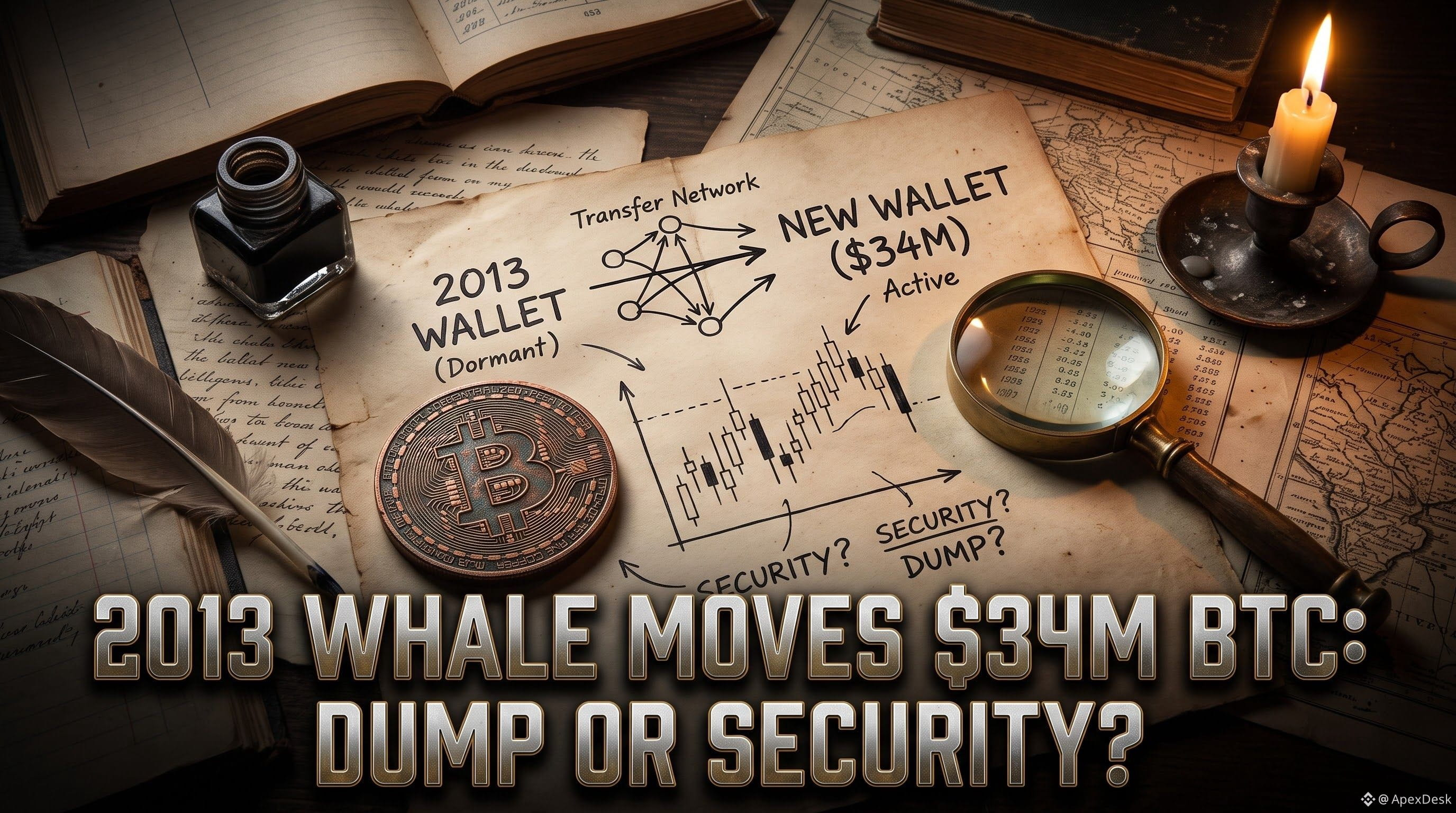
A 2013 Whale Just Moved 34M inBTC. Dump Incoming or Routine Security?
A Bitcoin wallet dormant since September 2013 suddenly transferred all 411.45 $BTC . Bought at $131 per coin for just $54,000, that stash is now sitting at over $34 million.
Retail immediately panicked, expecting an instant crash. Here is what the on-chain data actually reveals:
The Reality Check:
> No Exchange Inflow: The entire balance went directly into a fresh, private native SegWit address.
> Zero Sell Evidence: Not a single satoshi was routed to Binance, Coinbase, or known OTC trading desks.
Why Move Now?
Early 2011–2013 legacy addresses (P2PKH) are frequent targets for dusting and address-poisoning schemes. Migrating to modern SegWit formats is standard long-term security practice, not a market dump.
The Price Scenarios:
> Bullish Case: If $BTC holds its $82,000 demand shelf, the panic gets absorbed as cheap liquidity, clearing a path toward $86,000–$88,000.
> Bearish Case: If broader macro sentiment cools and $80,500 breaks, early-whale FUD could accelerate a fast liquidation flush down to $76,000.
Internal wallet migrations are inventory management, not market sells. Never short an on-chain alert before coins actually land on an exchange order book.
If you held Bitcoin from $131 to $34M, would you be dumping now, or securing it for the next decade?
{future}(BTCUSDT)
$BTC
#bitcoin
#BTC
#OnChainAnalysis
#BinanceSquare
A 2013 Whale Just Moved 34M inBTC. Dump Incoming or Routine Security?
A Bitcoin wallet dormant since September 2013 suddenly transferred all 411.45 $BTC . Bought at $131 per coin for just $54,000, that stash is now sitting at over $34 million.
Retail immediately panicked, expecting an instant crash. Here is what the on-chain data actually reveals:
The Reality Check:
> No Exchange Inflow: The entire balance went directly into a fresh, private native SegWit address.
> Zero Sell Evidence: Not a single satoshi was routed to Binance, Coinbase, or known OTC trading desks.
Why Move Now?
Early 2011–2013 legacy addresses (P2PKH) are frequent targets for dusting and address-poisoning schemes. Migrating to modern SegWit formats is standard long-term security practice, not a market dump.
The Price Scenarios:
> Bullish Case: If $BTC holds its $82,000 demand shelf, the panic gets absorbed as cheap liquidity, clearing a path toward $86,000–$88,000.
> Bearish Case: If broader macro sentiment cools and $80,500 breaks, early-whale FUD could accelerate a fast liquidation flush down to $76,000.
Internal wallet migrations are inventory management, not market sells. Never short an on-chain alert before coins actually land on an exchange order book.
If you held Bitcoin from $131 to $34M, would you be dumping now, or securing it for the next decade?
$BTC
#bitcoin
#BTC
#OnChainAnalysis
#BinanceSquare
A Bitcoin wallet dormant since September 2013 suddenly transferred all 411.45 $BTC . Bought at $131 per coin for just $54,000, that stash is now sitting at over $34 million.
Retail immediately panicked, expecting an instant crash. Here is what the on-chain data actually reveals:
The Reality Check:
> No Exchange Inflow: The entire balance went directly into a fresh, private native SegWit address.
> Zero Sell Evidence: Not a single satoshi was routed to Binance, Coinbase, or known OTC trading desks.
Why Move Now?
Early 2011–2013 legacy addresses (P2PKH) are frequent targets for dusting and address-poisoning schemes. Migrating to modern SegWit formats is standard long-term security practice, not a market dump.
The Price Scenarios:
> Bullish Case: If $BTC holds its $82,000 demand shelf, the panic gets absorbed as cheap liquidity, clearing a path toward $86,000–$88,000.
> Bearish Case: If broader macro sentiment cools and $80,500 breaks, early-whale FUD could accelerate a fast liquidation flush down to $76,000.
Internal wallet migrations are inventory management, not market sells. Never short an on-chain alert before coins actually land on an exchange order book.
If you held Bitcoin from $131 to $34M, would you be dumping now, or securing it for the next decade?
$BTC
#bitcoin
#BTC
#OnChainAnalysis
#BinanceSquare
107

This on-chain reading has matched the last five crypto cycle lows exactly.
Most traders I talk to keep getting burned trying to time these bottoms. They buy too soon and eat more downside or sell the real low out of fear.
The data shows this same print at five previous $BTC cycle lows, each one followed by a recovery that also lifted $ETH and $BNB. The historical match couldn't be clearer this time.
Whether the latest reading actually marks another bottom comes down to price holding the bounce and momentum continuing to pick up. Right now the follow-through is still developing, which means there's a real chance it fails and we see another drop.
If that happens a lot of people who jumped in here will be sitting on losses again.
Where do you think this goes from here if the recovery doesn't hold?
#Bitcoin #OnChainAnalysis #CryptoCycles
This on-chain reading has matched the last five crypto cycle lows exactly.
Most traders I talk to keep getting burned trying to time these bottoms. They buy too soon and eat more downside or sell the real low out of fear.
The data shows this same print at five previous $BTC cycle lows, each one followed by a recovery that also lifted $ETH and $BNB . The historical match couldn't be clearer this time.
Whether the latest reading actually marks another bottom comes down to price holding the bounce and momentum continuing to pick up. Right now the follow-through is still developing, which means there's a real chance it fails and we see another drop.
If that happens a lot of people who jumped in here will be sitting on losses again.
Where do you think this goes from here if the recovery doesn't hold?
#Bitcoin #OnChainAnalysis #CryptoCycles
Most traders I talk to keep getting burned trying to time these bottoms. They buy too soon and eat more downside or sell the real low out of fear.
The data shows this same print at five previous $BTC cycle lows, each one followed by a recovery that also lifted $ETH and $BNB . The historical match couldn't be clearer this time.
Whether the latest reading actually marks another bottom comes down to price holding the bounce and momentum continuing to pick up. Right now the follow-through is still developing, which means there's a real chance it fails and we see another drop.
If that happens a lot of people who jumped in here will be sitting on losses again.
Where do you think this goes from here if the recovery doesn't hold?
#Bitcoin #OnChainAnalysis #CryptoCycles

·
--
Exchange Reserve Drawdowns: The On-Chain Signal Most Traders Ignore
While price charts dominate the conversation, one of the most structurally powerful on-chain signals is consistently overlooked: exchange reserve drawdowns.
When coins leave centralized exchanges and move to self-custody wallets, it removes liquid sell pressure from the market. The inverse is also true — spikes in exchange inflows typically precede increased volatility as holders prepare to sell or margin-trade.
Here is why this matters right now:
• Long-term holders (LTH) who withdraw to cold storage are signaling conviction, not speculation. They are not positioning for a quick trade — they are removing supply from the market.
• The ratio of exchange reserves to circulating supply for $BTC has been on a multi-year structural decline. Each cycle, a smaller percentage of coins sit on exchanges.
• $ETH reserves dropped sharply post-Merge as staking validators locked supply in the consensus layer, stacking two withdrawal barriers simultaneously.
• For altcoins, exchange reserve trends track closely with ecosystem activity — network usage drives self-custody adoption, not just price.
The core thesis: shrinking exchange reserves combined with expanding active addresses is one of the cleanest structural bull signals available. Price follows supply constraints over time — it always has.
Watch the reserves, not just the candles.
$BTC $ETH
#OnChainAnalysis #ExchangeReserves #CryptoInsights #LongTermHolder #MarketStructure
Exchange Reserve Drawdowns: The On-Chain Signal Most Traders Ignore
While price charts dominate the conversation, one of the most structurally powerful on-chain signals is consistently overlooked: exchange reserve drawdowns.
When coins leave centralized exchanges and move to self-custody wallets, it removes liquid sell pressure from the market. The inverse is also true — spikes in exchange inflows typically precede increased volatility as holders prepare to sell or margin-trade.
Here is why this matters right now:
• Long-term holders (LTH) who withdraw to cold storage are signaling conviction, not speculation. They are not positioning for a quick trade — they are removing supply from the market.
• The ratio of exchange reserves to circulating supply for $BTC has been on a multi-year structural decline. Each cycle, a smaller percentage of coins sit on exchanges.
• $ETH reserves dropped sharply post-Merge as staking validators locked supply in the consensus layer, stacking two withdrawal barriers simultaneously.
• For altcoins, exchange reserve trends track closely with ecosystem activity — network usage drives self-custody adoption, not just price.
The core thesis: shrinking exchange reserves combined with expanding active addresses is one of the cleanest structural bull signals available. Price follows supply constraints over time — it always has.
Watch the reserves, not just the candles.
$BTC $ETH
#OnChainAnalysis #ExchangeReserves #CryptoInsights #LongTermHolder #MarketStructure
While price charts dominate the conversation, one of the most structurally powerful on-chain signals is consistently overlooked: exchange reserve drawdowns.
When coins leave centralized exchanges and move to self-custody wallets, it removes liquid sell pressure from the market. The inverse is also true — spikes in exchange inflows typically precede increased volatility as holders prepare to sell or margin-trade.
Here is why this matters right now:
• Long-term holders (LTH) who withdraw to cold storage are signaling conviction, not speculation. They are not positioning for a quick trade — they are removing supply from the market.
• The ratio of exchange reserves to circulating supply for $BTC has been on a multi-year structural decline. Each cycle, a smaller percentage of coins sit on exchanges.
• $ETH reserves dropped sharply post-Merge as staking validators locked supply in the consensus layer, stacking two withdrawal barriers simultaneously.
• For altcoins, exchange reserve trends track closely with ecosystem activity — network usage drives self-custody adoption, not just price.
The core thesis: shrinking exchange reserves combined with expanding active addresses is one of the cleanest structural bull signals available. Price follows supply constraints over time — it always has.
Watch the reserves, not just the candles.
$BTC $ETH
#OnChainAnalysis #ExchangeReserves #CryptoInsights #LongTermHolder #MarketStructure
55

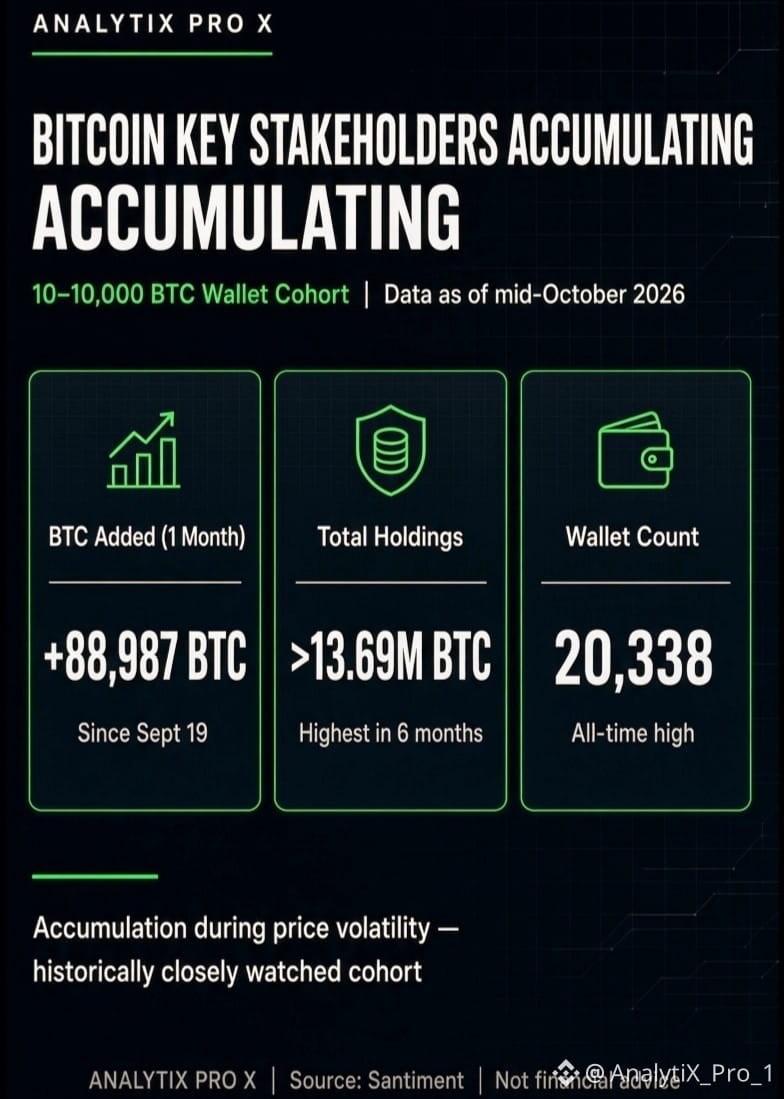
Bitcoin’s 10–10,000 BTC wallet cohort has added ~88,987 BTC since mid-September and now holds over 13.69 million💲 BTC — a six-month high.🗓️
The number of such wallets also hit a record 20,338 in mid-October.
Price has been range-bound, yet these key stakeholders have kept accumulating. Santiment notes the setup looks constructive if the trend continues.
Quiet accumulation while the market chops — worth watching.
🗯️📝Sources: Santiment
#BitcoinETFs #OnChainAnalysis #whales #CryptoNews #BinanceSquare $BTC
{future}(BTCUSDT)
$ETH
{future}(ETHUSDT)
$SOL
{future}(SOLUSDT)
#AnalytixProX
Bitcoin’s 10–10,000 BTC wallet cohort has added ~88,987 BTC since mid-September and now holds over 13.69 million💲 BTC — a six-month high.🗓️
The number of such wallets also hit a record 20,338 in mid-October.
Price has been range-bound, yet these key stakeholders have kept accumulating. Santiment notes the setup looks constructive if the trend continues.
Quiet accumulation while the market chops — worth watching.
🗯️📝Sources: Santiment
#BitcoinETFs #OnChainAnalysis #whales #CryptoNews #BinanceSquare $BTC
$ETH
$SOL
#AnalytixProX
The number of such wallets also hit a record 20,338 in mid-October.
Price has been range-bound, yet these key stakeholders have kept accumulating. Santiment notes the setup looks constructive if the trend continues.
Quiet accumulation while the market chops — worth watching.
🗯️📝Sources: Santiment
#BitcoinETFs #OnChainAnalysis #whales #CryptoNews #BinanceSquare $BTC
$ETH
$SOL
#AnalytixProX
33
·
--
On-Chain Behavior: What Whale Accumulation Patterns Actually Signal
Price action gets all the headlines. But the most reliable early signals live on-chain — in the behavior of large holders before the crowd notices.
Four metrics worth tracking:
1. Exchange Outflows: When $BTC leaves exchanges in sustained volume, it signals holders moving coins to cold storage. Less supply on exchanges means a potential supply squeeze ahead of any demand pickup.
2. Long-Term Holder Supply: Coins that have not moved in 155+ days growing as a share of circulating supply reflects conviction accumulation — not speculation. LTH supply near all-time highs during sideways price action is historically a coiled spring.
3. HODL Waves: Watch the 1-2 year and 2-3 year cohorts. When these bands expand, coins bought in prior cycles are aging — reducing liquid float and compressing sell-side pressure over time.
4. Coin Days Destroyed (CDD): A spike in CDD means old coins are moving — whales waking up. Sustained low CDD combined with price consolidation often precedes major directional moves.
On-chain data does not predict exact timing. But it reveals conviction at scale — the kind that short-term price charts simply cannot show.
Track the behavior. The price will follow.
$BTC $ETH
#Bitcoin #OnChainAnalysis #CryptoInsights #HODLWave #CryptoTrading
On-Chain Behavior: What Whale Accumulation Patterns Actually Signal
Price action gets all the headlines. But the most reliable early signals live on-chain — in the behavior of large holders before the crowd notices.
Four metrics worth tracking:
1. Exchange Outflows: When $BTC leaves exchanges in sustained volume, it signals holders moving coins to cold storage. Less supply on exchanges means a potential supply squeeze ahead of any demand pickup.
2. Long-Term Holder Supply: Coins that have not moved in 155+ days growing as a share of circulating supply reflects conviction accumulation — not speculation. LTH supply near all-time highs during sideways price action is historically a coiled spring.
3. HODL Waves: Watch the 1-2 year and 2-3 year cohorts. When these bands expand, coins bought in prior cycles are aging — reducing liquid float and compressing sell-side pressure over time.
4. Coin Days Destroyed (CDD): A spike in CDD means old coins are moving — whales waking up. Sustained low CDD combined with price consolidation often precedes major directional moves.
On-chain data does not predict exact timing. But it reveals conviction at scale — the kind that short-term price charts simply cannot show.
Track the behavior. The price will follow.
$BTC $ETH
#Bitcoin #OnChainAnalysis #CryptoInsights #HODLWave #CryptoTrading
Price action gets all the headlines. But the most reliable early signals live on-chain — in the behavior of large holders before the crowd notices.
Four metrics worth tracking:
1. Exchange Outflows: When $BTC leaves exchanges in sustained volume, it signals holders moving coins to cold storage. Less supply on exchanges means a potential supply squeeze ahead of any demand pickup.
2. Long-Term Holder Supply: Coins that have not moved in 155+ days growing as a share of circulating supply reflects conviction accumulation — not speculation. LTH supply near all-time highs during sideways price action is historically a coiled spring.
3. HODL Waves: Watch the 1-2 year and 2-3 year cohorts. When these bands expand, coins bought in prior cycles are aging — reducing liquid float and compressing sell-side pressure over time.
4. Coin Days Destroyed (CDD): A spike in CDD means old coins are moving — whales waking up. Sustained low CDD combined with price consolidation often precedes major directional moves.
On-chain data does not predict exact timing. But it reveals conviction at scale — the kind that short-term price charts simply cannot show.
Track the behavior. The price will follow.
$BTC $ETH
#Bitcoin #OnChainAnalysis #CryptoInsights #HODLWave #CryptoTrading
23
·
--
Exchange Reserve Drawdown: The Supply Shock Signal Most Traders Miss
When Bitcoin or any major asset leaves centralized exchanges and moves into cold storage, it quietly removes sell-side pressure from the market. Exchange reserve drawdowns — measured by the net outflow of coins from exchange wallets — are one of the most reliable on-chain indicators of a structural supply shock building in the background.
Here is why it matters:
1. Coins leaving exchanges cannot be instantly market-sold. The friction of moving back on-chain and re-depositing creates a natural holding delay.
2. Sustained drawdowns over weeks signal that large holders are not positioning to sell — they are accumulating and storing conviction.
3. When exchange reserves hit multi-year lows while spot demand stays stable, the available float shrinks. Even modest demand spikes can produce outsized price moves because there is simply less supply to absorb them.
4. The inverse matters too. A sudden spike in exchange inflows — coins moving back onto exchanges — is an early distribution warning before it shows up in price.
For $BTC and $ETH, reserve data is publicly available on-chain. $BNB shows similar patterns but is harder to isolate from operational exchange flows.
The takeaway: price tells you what happened. Exchange reserves tell you what is quietly being set up. Watching supply accumulate off-exchange is not a timing tool — it is a structural condition check.
Build your thesis on structure, not noise.
#Bitcoin #Ethereum #OnChainAnalysis #CryptoInsights #SupplyShock
Exchange Reserve Drawdown: The Supply Shock Signal Most Traders Miss
When Bitcoin or any major asset leaves centralized exchanges and moves into cold storage, it quietly removes sell-side pressure from the market. Exchange reserve drawdowns — measured by the net outflow of coins from exchange wallets — are one of the most reliable on-chain indicators of a structural supply shock building in the background.
Here is why it matters:
1. Coins leaving exchanges cannot be instantly market-sold. The friction of moving back on-chain and re-depositing creates a natural holding delay.
2. Sustained drawdowns over weeks signal that large holders are not positioning to sell — they are accumulating and storing conviction.
3. When exchange reserves hit multi-year lows while spot demand stays stable, the available float shrinks. Even modest demand spikes can produce outsized price moves because there is simply less supply to absorb them.
4. The inverse matters too. A sudden spike in exchange inflows — coins moving back onto exchanges — is an early distribution warning before it shows up in price.
For $BTC and $ETH , reserve data is publicly available on-chain. $BNB shows similar patterns but is harder to isolate from operational exchange flows.
The takeaway: price tells you what happened. Exchange reserves tell you what is quietly being set up. Watching supply accumulate off-exchange is not a timing tool — it is a structural condition check.
Build your thesis on structure, not noise.
#Bitcoin #Ethereum #OnChainAnalysis #CryptoInsights #SupplyShock
When Bitcoin or any major asset leaves centralized exchanges and moves into cold storage, it quietly removes sell-side pressure from the market. Exchange reserve drawdowns — measured by the net outflow of coins from exchange wallets — are one of the most reliable on-chain indicators of a structural supply shock building in the background.
Here is why it matters:
1. Coins leaving exchanges cannot be instantly market-sold. The friction of moving back on-chain and re-depositing creates a natural holding delay.
2. Sustained drawdowns over weeks signal that large holders are not positioning to sell — they are accumulating and storing conviction.
3. When exchange reserves hit multi-year lows while spot demand stays stable, the available float shrinks. Even modest demand spikes can produce outsized price moves because there is simply less supply to absorb them.
4. The inverse matters too. A sudden spike in exchange inflows — coins moving back onto exchanges — is an early distribution warning before it shows up in price.
For $BTC and $ETH , reserve data is publicly available on-chain. $BNB shows similar patterns but is harder to isolate from operational exchange flows.
The takeaway: price tells you what happened. Exchange reserves tell you what is quietly being set up. Watching supply accumulate off-exchange is not a timing tool — it is a structural condition check.
Build your thesis on structure, not noise.
#Bitcoin #Ethereum #OnChainAnalysis #CryptoInsights #SupplyShock
49
·
--
#JapanFSAPublishesOnChainFinanceForumMinutes
Japan’s Financial Services Agency (FSA) has officially published the minutes from the inaugural meeting of its "Forum on On-Chain Finance in the AI Era". [1, 2]
The cross-government initiative, originally convened on September 30, brings together the Digital Agency, Ministry of Finance, Bank of Japan (BOJ), and the Japanese Bankers Association under a unified framework to shift national financial systems onto blockchain rails. The minutes outline how the authorities plan to modernize payment networks, tokenize traditional assets, and handle "agentic commerce" where AI agents transact autonomously 24/7. [1, 2, 3]
$AAPLB
{spot}(AAPLBUSDT)
$YOU.US
{stock_us}(YOU.US)
$TSLA.US
{stock_us}(TSLA.US)
#JapanFSAPublishesOnChainFinanceF
#OnChainAnalysis
#OnChainFinance
#JapanFSAPublishesOnChainFinanceForumMinutes
Japan’s Financial Services Agency (FSA) has officially published the minutes from the inaugural meeting of its "Forum on On-Chain Finance in the AI Era". [1, 2]
The cross-government initiative, originally convened on September 30, brings together the Digital Agency, Ministry of Finance, Bank of Japan (BOJ), and the Japanese Bankers Association under a unified framework to shift national financial systems onto blockchain rails. The minutes outline how the authorities plan to modernize payment networks, tokenize traditional assets, and handle "agentic commerce" where AI agents transact autonomously 24/7. [1, 2, 3]
$AAPLB
$YOU.US
$TSLA.US
#JapanFSAPublishesOnChainFinanceF
#OnChainAnalysis
#OnChainFinance
Japan’s Financial Services Agency (FSA) has officially published the minutes from the inaugural meeting of its "Forum on On-Chain Finance in the AI Era". [1, 2]
The cross-government initiative, originally convened on September 30, brings together the Digital Agency, Ministry of Finance, Bank of Japan (BOJ), and the Japanese Bankers Association under a unified framework to shift national financial systems onto blockchain rails. The minutes outline how the authorities plan to modernize payment networks, tokenize traditional assets, and handle "agentic commerce" where AI agents transact autonomously 24/7. [1, 2, 3]
$AAPLB
$YOU.US
$TSLA.US
#JapanFSAPublishesOnChainFinanceF
#OnChainAnalysis
#OnChainFinance


119
·
--
HODL Waves: The Most Accurate Cycle Compass Nobody Uses
Most traders watch price. Smart money watches the age of supply.
Bitcoin's HODL wave chart — which breaks circulating supply into cohorts by how long coins have been unmoved — is arguably the most honest cycle indicator on-chain. Here's what it tells you that charts don't:
→ When long-term holders (coins unmoved 1yr+) reach peak supply concentration, it marks late-stage accumulation. The coins are off the market — controlled by believers, not renters.
→ When that cohort starts shrinking rapidly, it means LTHs are distributing into strength. Historically, this precedes cycle tops by months, not days.
→ The reverse is equally powerful. When short-term holder supply peaks and then collapses — meaning coins are aging into dormancy — bottoms are forming. Capitulation exhausts itself silently in the supply structure before it shows up in price.
For $BTC this metric is surgical. For $ETH it requires adjusting for staked supply since staked coins don't move but aren't dormant — apply staking-adjusted HODL metrics or watch ETH supply age bands in parallel with staking inflows.
The insight: price is what the market paid last. Supply age is what holders actually believe about the future. One is a quote. The other is a commitment.
Before the next major move, check who's holding — and for how long.
$BTC $ETH #OnChainAnalysis #HODLWaves #CryptoInsights #Bitcoin #MarketCycles
HODL Waves: The Most Accurate Cycle Compass Nobody Uses
Most traders watch price. Smart money watches the age of supply.
Bitcoin's HODL wave chart — which breaks circulating supply into cohorts by how long coins have been unmoved — is arguably the most honest cycle indicator on-chain. Here's what it tells you that charts don't:
→ When long-term holders (coins unmoved 1yr+) reach peak supply concentration, it marks late-stage accumulation. The coins are off the market — controlled by believers, not renters.
→ When that cohort starts shrinking rapidly, it means LTHs are distributing into strength. Historically, this precedes cycle tops by months, not days.
→ The reverse is equally powerful. When short-term holder supply peaks and then collapses — meaning coins are aging into dormancy — bottoms are forming. Capitulation exhausts itself silently in the supply structure before it shows up in price.
For $BTC this metric is surgical. For $ETH it requires adjusting for staked supply since staked coins don't move but aren't dormant — apply staking-adjusted HODL metrics or watch ETH supply age bands in parallel with staking inflows.
The insight: price is what the market paid last. Supply age is what holders actually believe about the future. One is a quote. The other is a commitment.
Before the next major move, check who's holding — and for how long.
$BTC $ETH #OnChainAnalysis #HODLWaves #CryptoInsights #Bitcoin #MarketCycles
Most traders watch price. Smart money watches the age of supply.
Bitcoin's HODL wave chart — which breaks circulating supply into cohorts by how long coins have been unmoved — is arguably the most honest cycle indicator on-chain. Here's what it tells you that charts don't:
→ When long-term holders (coins unmoved 1yr+) reach peak supply concentration, it marks late-stage accumulation. The coins are off the market — controlled by believers, not renters.
→ When that cohort starts shrinking rapidly, it means LTHs are distributing into strength. Historically, this precedes cycle tops by months, not days.
→ The reverse is equally powerful. When short-term holder supply peaks and then collapses — meaning coins are aging into dormancy — bottoms are forming. Capitulation exhausts itself silently in the supply structure before it shows up in price.
For $BTC this metric is surgical. For $ETH it requires adjusting for staked supply since staked coins don't move but aren't dormant — apply staking-adjusted HODL metrics or watch ETH supply age bands in parallel with staking inflows.
The insight: price is what the market paid last. Supply age is what holders actually believe about the future. One is a quote. The other is a commitment.
Before the next major move, check who's holding — and for how long.
$BTC $ETH #OnChainAnalysis #HODLWaves #CryptoInsights #Bitcoin #MarketCycles
14
·
--
On-chain supply dynamics are one of the most underrated cycle timing tools in crypto — and most traders completely ignore them.
When long-term holders (LTHs) — wallets that have sat still for 155+ days — control more than 70–75% of circulating $BTC supply, it has historically signaled deep accumulation phases. These are the cohorts with the lowest probability of panic selling. When their share starts declining, it means coins are transferring to shorter-term hands — a classic late-cycle distribution signal.
HODL wave analysis adds another layer. When 1–3 month and 3–6 month supply bands start swelling simultaneously, it usually means fresh capital entered during a recent rally and is now aging in. If that supply makes it past 6 months without moving, those buyers become conviction holders — structural floor-builders.
Spent Output Age Bands (SOAB) let you see exactly when long-dormant supply reactivates. Old coins moving during price surges = distribution. Old coins staying put during corrections = conviction holding.
$ETH and $SOL show similar patterns. The framework applies across major L1s — though earlier-stage assets carry more noise in their accumulation signals.
The insight: supply age is a sentiment proxy with timestamps. Price tells you what the market thinks right now. Supply age tells you what holders decided months ago — and who actually controls the float.
Read the chain before you read the chart.
#Bitcoin #CryptoInsights #OnChainAnalysis #MarketCycle #CryptoTrading
On-chain supply dynamics are one of the most underrated cycle timing tools in crypto — and most traders completely ignore them.
When long-term holders (LTHs) — wallets that have sat still for 155+ days — control more than 70–75% of circulating $BTC supply, it has historically signaled deep accumulation phases. These are the cohorts with the lowest probability of panic selling. When their share starts declining, it means coins are transferring to shorter-term hands — a classic late-cycle distribution signal.
HODL wave analysis adds another layer. When 1–3 month and 3–6 month supply bands start swelling simultaneously, it usually means fresh capital entered during a recent rally and is now aging in. If that supply makes it past 6 months without moving, those buyers become conviction holders — structural floor-builders.
Spent Output Age Bands (SOAB) let you see exactly when long-dormant supply reactivates. Old coins moving during price surges = distribution. Old coins staying put during corrections = conviction holding.
$ETH and $SOL show similar patterns. The framework applies across major L1s — though earlier-stage assets carry more noise in their accumulation signals.
The insight: supply age is a sentiment proxy with timestamps. Price tells you what the market thinks right now. Supply age tells you what holders decided months ago — and who actually controls the float.
Read the chain before you read the chart.
#Bitcoin #CryptoInsights #OnChainAnalysis #MarketCycle #CryptoTrading
When long-term holders (LTHs) — wallets that have sat still for 155+ days — control more than 70–75% of circulating $BTC supply, it has historically signaled deep accumulation phases. These are the cohorts with the lowest probability of panic selling. When their share starts declining, it means coins are transferring to shorter-term hands — a classic late-cycle distribution signal.
HODL wave analysis adds another layer. When 1–3 month and 3–6 month supply bands start swelling simultaneously, it usually means fresh capital entered during a recent rally and is now aging in. If that supply makes it past 6 months without moving, those buyers become conviction holders — structural floor-builders.
Spent Output Age Bands (SOAB) let you see exactly when long-dormant supply reactivates. Old coins moving during price surges = distribution. Old coins staying put during corrections = conviction holding.
$ETH and $SOL show similar patterns. The framework applies across major L1s — though earlier-stage assets carry more noise in their accumulation signals.
The insight: supply age is a sentiment proxy with timestamps. Price tells you what the market thinks right now. Supply age tells you what holders decided months ago — and who actually controls the float.
Read the chain before you read the chart.
#Bitcoin #CryptoInsights #OnChainAnalysis #MarketCycle #CryptoTrading
94

·
--
📊 BITCOIN ON-CHAIN UPDATE | BTC MARKET WATCH 🟠
Exchange Inflows Hit Unusually Low Levels — Is the Market Preparing for a Shift?
Bitcoin recorded just 342.47 BTC in exchange inflows over the past 24 hours, an unusually low reading that has caught market observers' attention.
🔎 What Does This Mean?
📉 Lower Selling Pressure? Reduced BTC inflows may indicate fewer coins are being transferred to exchanges for potential selling.
⚖️ No Confirmed Trend Reversal: A single low-inflow reading is not enough to confirm a bullish market shift.
👀 What to Watch Next: Monitor exchange inflows over the coming days, BTC price action, trading volume, and key support and resistance levels.
My Market View: This is an interesting on-chain signal, but confirmation matters more than speculation. The next few sessions may provide a clearer picture of Bitcoin's direction.
💬 What do you think? Is this a sign of reduced selling pressure, or simply a temporary anomaly?
Share your analysis in the comments! 👇
#Bitcoin #BTC #CryptoMarket #OnChainAnalysis #BinanceSquare $BTC
📊 BITCOIN ON-CHAIN UPDATE | BTC MARKET WATCH 🟠
Exchange Inflows Hit Unusually Low Levels — Is the Market Preparing for a Shift?
Bitcoin recorded just 342.47 BTC in exchange inflows over the past 24 hours, an unusually low reading that has caught market observers' attention.
🔎 What Does This Mean?
📉 Lower Selling Pressure? Reduced BTC inflows may indicate fewer coins are being transferred to exchanges for potential selling.
⚖️ No Confirmed Trend Reversal: A single low-inflow reading is not enough to confirm a bullish market shift.
👀 What to Watch Next: Monitor exchange inflows over the coming days, BTC price action, trading volume, and key support and resistance levels.
My Market View: This is an interesting on-chain signal, but confirmation matters more than speculation. The next few sessions may provide a clearer picture of Bitcoin's direction.
💬 What do you think? Is this a sign of reduced selling pressure, or simply a temporary anomaly?
Share your analysis in the comments! 👇
#Bitcoin #BTC #CryptoMarket #OnChainAnalysis #BinanceSquare $BTC
Exchange Inflows Hit Unusually Low Levels — Is the Market Preparing for a Shift?
Bitcoin recorded just 342.47 BTC in exchange inflows over the past 24 hours, an unusually low reading that has caught market observers' attention.
🔎 What Does This Mean?
📉 Lower Selling Pressure? Reduced BTC inflows may indicate fewer coins are being transferred to exchanges for potential selling.
⚖️ No Confirmed Trend Reversal: A single low-inflow reading is not enough to confirm a bullish market shift.
👀 What to Watch Next: Monitor exchange inflows over the coming days, BTC price action, trading volume, and key support and resistance levels.
My Market View: This is an interesting on-chain signal, but confirmation matters more than speculation. The next few sessions may provide a clearer picture of Bitcoin's direction.
💬 What do you think? Is this a sign of reduced selling pressure, or simply a temporary anomaly?
Share your analysis in the comments! 👇
#Bitcoin #BTC #CryptoMarket #OnChainAnalysis #BinanceSquare $BTC

83
·
--
On-Chain Behavior Is the Market Intelligence Most Traders Ignore
Price charts tell you what happened. On-chain data tells you why.
When $BTC long-term holders stop moving coins — even as price rises — it signals genuine conviction, not profit-taking. When exchange reserves drop while price consolidates, accumulation is quietly outpacing selling pressure. These are structural signals buried inside raw blockchain data.
A few patterns worth understanding:
📊 Exchange Outflows: When coins consistently leave centralized exchanges, circulating sell supply tightens. Less available inventory means prices become far more sensitive to any demand spike.
📊 MVRV Ratio: Market Value to Realized Value measures aggregate unrealized profit across all holders. MVRV above 3.5 historically signals overheating. Below 1.0 signals deep undervaluation — both are high-conviction zones.
📊 Active Address Growth: For networks like $ETH and $SOL, accelerating active addresses often lead price by 2-4 weeks. It measures real adoption momentum, not speculation noise.
📊 Whale Accumulation Windows: When wallets holding 1,000+ BTC grow during low-volatility sideways markets, it historically precedes major directional moves.
On-chain analysis does not predict exact prices. But it reveals the conviction structure beneath market noise — giving data-literate investors a genuine edge over pure chart-readers.
Learn to read the blockchain itself. It does not lie.
$BTC $ETH $SOL
#OnChainAnalysis #CryptoIntelligence #Bitcoin #BinanceSquare #CryptoInsights
On-Chain Behavior Is the Market Intelligence Most Traders Ignore
Price charts tell you what happened. On-chain data tells you why.
When $BTC long-term holders stop moving coins — even as price rises — it signals genuine conviction, not profit-taking. When exchange reserves drop while price consolidates, accumulation is quietly outpacing selling pressure. These are structural signals buried inside raw blockchain data.
A few patterns worth understanding:
📊 Exchange Outflows: When coins consistently leave centralized exchanges, circulating sell supply tightens. Less available inventory means prices become far more sensitive to any demand spike.
📊 MVRV Ratio: Market Value to Realized Value measures aggregate unrealized profit across all holders. MVRV above 3.5 historically signals overheating. Below 1.0 signals deep undervaluation — both are high-conviction zones.
📊 Active Address Growth: For networks like $ETH and $SOL , accelerating active addresses often lead price by 2-4 weeks. It measures real adoption momentum, not speculation noise.
📊 Whale Accumulation Windows: When wallets holding 1,000+ BTC grow during low-volatility sideways markets, it historically precedes major directional moves.
On-chain analysis does not predict exact prices. But it reveals the conviction structure beneath market noise — giving data-literate investors a genuine edge over pure chart-readers.
Learn to read the blockchain itself. It does not lie.
$BTC $ETH $SOL
#OnChainAnalysis #CryptoIntelligence #Bitcoin #BinanceSquare #CryptoInsights
Price charts tell you what happened. On-chain data tells you why.
When $BTC long-term holders stop moving coins — even as price rises — it signals genuine conviction, not profit-taking. When exchange reserves drop while price consolidates, accumulation is quietly outpacing selling pressure. These are structural signals buried inside raw blockchain data.
A few patterns worth understanding:
📊 Exchange Outflows: When coins consistently leave centralized exchanges, circulating sell supply tightens. Less available inventory means prices become far more sensitive to any demand spike.
📊 MVRV Ratio: Market Value to Realized Value measures aggregate unrealized profit across all holders. MVRV above 3.5 historically signals overheating. Below 1.0 signals deep undervaluation — both are high-conviction zones.
📊 Active Address Growth: For networks like $ETH and $SOL , accelerating active addresses often lead price by 2-4 weeks. It measures real adoption momentum, not speculation noise.
📊 Whale Accumulation Windows: When wallets holding 1,000+ BTC grow during low-volatility sideways markets, it historically precedes major directional moves.
On-chain analysis does not predict exact prices. But it reveals the conviction structure beneath market noise — giving data-literate investors a genuine edge over pure chart-readers.
Learn to read the blockchain itself. It does not lie.
$BTC $ETH $SOL
#OnChainAnalysis #CryptoIntelligence #Bitcoin #BinanceSquare #CryptoInsights
48
·
--
On-Chain Age Bands: The Accumulation Signal Most Charts Miss
Price action gets all the attention. But one of the most reliable accumulation signals in crypto hides in plain sight: UTXO age band analysis.
Every Bitcoin transaction leaves a footprint — when coins last moved. When you segment supply by how long coins have been dormant (1 month, 3 months, 1 year, 2+ years), patterns emerge that price charts simply can't show.
The signal: long-term holder (LTH) supply tends to peak near cycle bottoms and contract near tops. During accumulation phases, experienced holders quietly absorb supply — coin age bands "mature" as fewer coins move, signaling conviction, not fear.
Coin days destroyed (CDD) flips this: high CDD means dormant coins are suddenly moving. Historically, CDD spikes near cycle tops as long-dormant holders distribute. Low CDD during a price rally? LTHs aren't selling — that's a continuation signal.
Watch whether LTH supply is growing or contracting in $BTC. If long-dormant coins are aging further despite price appreciation, distribution hasn't started. The same logic applies to $ETH, where staking lock-up adds layers to dormancy analysis.
$SOL on-chain data shows similar patterns — staking concentration and unstaking events can function as on-chain CDD equivalents for PoS chains.
Price tells you where the market is. Age bands tell you who's holding and whether they believe.
#Bitcoin #OnChainAnalysis #CryptoInsights #LongTermHolder #CryptoMetrics
On-Chain Age Bands: The Accumulation Signal Most Charts Miss
Price action gets all the attention. But one of the most reliable accumulation signals in crypto hides in plain sight: UTXO age band analysis.
Every Bitcoin transaction leaves a footprint — when coins last moved. When you segment supply by how long coins have been dormant (1 month, 3 months, 1 year, 2+ years), patterns emerge that price charts simply can't show.
The signal: long-term holder (LTH) supply tends to peak near cycle bottoms and contract near tops. During accumulation phases, experienced holders quietly absorb supply — coin age bands "mature" as fewer coins move, signaling conviction, not fear.
Coin days destroyed (CDD) flips this: high CDD means dormant coins are suddenly moving. Historically, CDD spikes near cycle tops as long-dormant holders distribute. Low CDD during a price rally? LTHs aren't selling — that's a continuation signal.
Watch whether LTH supply is growing or contracting in $BTC . If long-dormant coins are aging further despite price appreciation, distribution hasn't started. The same logic applies to $ETH , where staking lock-up adds layers to dormancy analysis.
$SOL on-chain data shows similar patterns — staking concentration and unstaking events can function as on-chain CDD equivalents for PoS chains.
Price tells you where the market is. Age bands tell you who's holding and whether they believe.
#Bitcoin #OnChainAnalysis #CryptoInsights #LongTermHolder #CryptoMetrics
Price action gets all the attention. But one of the most reliable accumulation signals in crypto hides in plain sight: UTXO age band analysis.
Every Bitcoin transaction leaves a footprint — when coins last moved. When you segment supply by how long coins have been dormant (1 month, 3 months, 1 year, 2+ years), patterns emerge that price charts simply can't show.
The signal: long-term holder (LTH) supply tends to peak near cycle bottoms and contract near tops. During accumulation phases, experienced holders quietly absorb supply — coin age bands "mature" as fewer coins move, signaling conviction, not fear.
Coin days destroyed (CDD) flips this: high CDD means dormant coins are suddenly moving. Historically, CDD spikes near cycle tops as long-dormant holders distribute. Low CDD during a price rally? LTHs aren't selling — that's a continuation signal.
Watch whether LTH supply is growing or contracting in $BTC . If long-dormant coins are aging further despite price appreciation, distribution hasn't started. The same logic applies to $ETH , where staking lock-up adds layers to dormancy analysis.
$SOL on-chain data shows similar patterns — staking concentration and unstaking events can function as on-chain CDD equivalents for PoS chains.
Price tells you where the market is. Age bands tell you who's holding and whether they believe.
#Bitcoin #OnChainAnalysis #CryptoInsights #LongTermHolder #CryptoMetrics
47

🦈 $BTC SHORT-TERM HOLDERS HIT BREAKEVEN AS CRITICAL ON-CHAIN PIVOT ARRIVES 📊
$BTC trades near 81.6K with daily STH-SOPR sitting squarely at 1.00. 📊 Recent buyers are selling precisely at breakeven rather than taking losses or securing heavy profit, leaving market structure at a neutral equilibrium.
Historically, major accumulation floors formed when metric prints flushed between 0.93 and 0.96, while rallies capped below the 1.05 euphoria zone. 🔍 A sustained defense of 1.00 confirms absorption, whereas a sweep below 0.97 historically signals institutional liquidity capitulation before a reversal.
💡 The raw daily series requires patience, but structural intent will reveal itself soon. 🤔 Do you expect buyers to defend breakeven here, or will we see one final liquidity flush below 0.97?
⚠️ Not financial advice. Always manage your risk. 🛡️
🏷️ #BTC #Bitcoin #MarketStructure #OnChainAnalysis
🎯 🦈
🦈 $BTC SHORT-TERM HOLDERS HIT BREAKEVEN AS CRITICAL ON-CHAIN PIVOT ARRIVES 📊
$BTC trades near 81.6K with daily STH-SOPR sitting squarely at 1.00. 📊 Recent buyers are selling precisely at breakeven rather than taking losses or securing heavy profit, leaving market structure at a neutral equilibrium.
Historically, major accumulation floors formed when metric prints flushed between 0.93 and 0.96, while rallies capped below the 1.05 euphoria zone. 🔍 A sustained defense of 1.00 confirms absorption, whereas a sweep below 0.97 historically signals institutional liquidity capitulation before a reversal.
💡 The raw daily series requires patience, but structural intent will reveal itself soon. 🤔 Do you expect buyers to defend breakeven here, or will we see one final liquidity flush below 0.97?
⚠️ Not financial advice. Always manage your risk. 🛡️
🏷️ #BTC #Bitcoin #MarketStructure #OnChainAnalysis
🎯 🦈
$BTC trades near 81.6K with daily STH-SOPR sitting squarely at 1.00. 📊 Recent buyers are selling precisely at breakeven rather than taking losses or securing heavy profit, leaving market structure at a neutral equilibrium.
Historically, major accumulation floors formed when metric prints flushed between 0.93 and 0.96, while rallies capped below the 1.05 euphoria zone. 🔍 A sustained defense of 1.00 confirms absorption, whereas a sweep below 0.97 historically signals institutional liquidity capitulation before a reversal.
💡 The raw daily series requires patience, but structural intent will reveal itself soon. 🤔 Do you expect buyers to defend breakeven here, or will we see one final liquidity flush below 0.97?
⚠️ Not financial advice. Always manage your risk. 🛡️
🏷️ #BTC #Bitcoin #MarketStructure #OnChainAnalysis
🎯 🦈
13
·
--
Cold Storage Inflows Are the Signal Most Retail Traders Ignore
When large holders move coins off exchanges and into cold storage, it rarely makes headlines. But it is one of the cleanest forward-looking signals in crypto.
Here is why it matters:
Exchange balances represent coins that could be sold. Cold storage balances represent conviction. When $BTC exchange reserves drop consistently while price remains flat or consolidates, supply is quietly being removed from the market. Less available supply means the next demand wave hits a thinner order book — amplifying upside moves.
This pattern repeats across cycles. The smart money accumulation phase looks boring from the outside: sideways price, low volatility, declining exchange balances. Retail only notices when price has already moved 30–50%.
The same logic applies to $ETH. Post-Merge, staking locks supply structurally. But exchange outflows on top of staking drawdowns create a compounding supply squeeze that fundamentally changes how the next rally develops.
$SOL shows similar dynamics with shorter accumulation windows — its ecosystem is more event-driven, so exchange outflows tend to cluster tighter around narrative catalysts.
What to watch:
— Sustained exchange outflows over 2–4 weeks with flat price = accumulation
— Sudden inflow spike with price at highs = distribution warning
— Stablecoin inflows rising while coin reserves fall = dry powder loading
On-chain behavior does not predict exact tops and bottoms. But it consistently shows you whose hands are holding the supply — and that is the information that actually moves markets.
#Bitcoin #OnChainAnalysis #CryptoMetrics #SmartMoney #Binance
Cold Storage Inflows Are the Signal Most Retail Traders Ignore
When large holders move coins off exchanges and into cold storage, it rarely makes headlines. But it is one of the cleanest forward-looking signals in crypto.
Here is why it matters:
Exchange balances represent coins that could be sold. Cold storage balances represent conviction. When $BTC exchange reserves drop consistently while price remains flat or consolidates, supply is quietly being removed from the market. Less available supply means the next demand wave hits a thinner order book — amplifying upside moves.
This pattern repeats across cycles. The smart money accumulation phase looks boring from the outside: sideways price, low volatility, declining exchange balances. Retail only notices when price has already moved 30–50%.
The same logic applies to $ETH . Post-Merge, staking locks supply structurally. But exchange outflows on top of staking drawdowns create a compounding supply squeeze that fundamentally changes how the next rally develops.
$SOL shows similar dynamics with shorter accumulation windows — its ecosystem is more event-driven, so exchange outflows tend to cluster tighter around narrative catalysts.
What to watch:
— Sustained exchange outflows over 2–4 weeks with flat price = accumulation
— Sudden inflow spike with price at highs = distribution warning
— Stablecoin inflows rising while coin reserves fall = dry powder loading
On-chain behavior does not predict exact tops and bottoms. But it consistently shows you whose hands are holding the supply — and that is the information that actually moves markets.
#Bitcoin #OnChainAnalysis #CryptoMetrics #SmartMoney #Binance
When large holders move coins off exchanges and into cold storage, it rarely makes headlines. But it is one of the cleanest forward-looking signals in crypto.
Here is why it matters:
Exchange balances represent coins that could be sold. Cold storage balances represent conviction. When $BTC exchange reserves drop consistently while price remains flat or consolidates, supply is quietly being removed from the market. Less available supply means the next demand wave hits a thinner order book — amplifying upside moves.
This pattern repeats across cycles. The smart money accumulation phase looks boring from the outside: sideways price, low volatility, declining exchange balances. Retail only notices when price has already moved 30–50%.
The same logic applies to $ETH . Post-Merge, staking locks supply structurally. But exchange outflows on top of staking drawdowns create a compounding supply squeeze that fundamentally changes how the next rally develops.
$SOL shows similar dynamics with shorter accumulation windows — its ecosystem is more event-driven, so exchange outflows tend to cluster tighter around narrative catalysts.
What to watch:
— Sustained exchange outflows over 2–4 weeks with flat price = accumulation
— Sudden inflow spike with price at highs = distribution warning
— Stablecoin inflows rising while coin reserves fall = dry powder loading
On-chain behavior does not predict exact tops and bottoms. But it consistently shows you whose hands are holding the supply — and that is the information that actually moves markets.
#Bitcoin #OnChainAnalysis #CryptoMetrics #SmartMoney #Binance
81

XRP Whale Inflows to Binance Hit a 7-Month High — Is Selling Pressure Building?
Summary
Large XRP holders are moving more tokens to Binance, with 30-day whale inflows reaching 1.669 billion XRP, the highest level in seven months. The surge raises questions about potential selling pressure as traders watch XRP’s next move.
Key Points
- 1.669 billion XRP: Reported cumulative whale inflows to Binance over 30 days.
- 7-month high: Large-holder transfers have rebounded after declining earlier in the year.
- Potential supply pressure: Tokens deposited on exchanges may become available for trading.
- Not a confirmed sell-off: Transfers can also reflect wallet reallocations, liquidity management, or derivatives activity.
Market Insight
Rising whale inflows create a signal worth monitoring, but they do not confirm that whales are selling. Watch XRP price action, net exchange flows, trading volume, and ETF flows to determine whether selling pressure is actually increasing.
Key Takeaway: XRP whale activity is rising sharply. The next clue is whether exchange inflows translate into sustained selling—or whether buyers absorb the additional supply.
#xrp #Ripple #CryptoNews #WhaleWatch #OnChainAnalysis $XRP
{future}(XRPUSDT)
XRP Whale Inflows to Binance Hit a 7-Month High — Is Selling Pressure Building?
Summary
Large XRP holders are moving more tokens to Binance, with 30-day whale inflows reaching 1.669 billion XRP, the highest level in seven months. The surge raises questions about potential selling pressure as traders watch XRP’s next move.
Key Points
- 1.669 billion XRP: Reported cumulative whale inflows to Binance over 30 days.
- 7-month high: Large-holder transfers have rebounded after declining earlier in the year.
- Potential supply pressure: Tokens deposited on exchanges may become available for trading.
- Not a confirmed sell-off: Transfers can also reflect wallet reallocations, liquidity management, or derivatives activity.
Market Insight
Rising whale inflows create a signal worth monitoring, but they do not confirm that whales are selling. Watch XRP price action, net exchange flows, trading volume, and ETF flows to determine whether selling pressure is actually increasing.
Key Takeaway: XRP whale activity is rising sharply. The next clue is whether exchange inflows translate into sustained selling—or whether buyers absorb the additional supply.
#xrp #Ripple #CryptoNews #WhaleWatch #OnChainAnalysis $XRP
Summary
Large XRP holders are moving more tokens to Binance, with 30-day whale inflows reaching 1.669 billion XRP, the highest level in seven months. The surge raises questions about potential selling pressure as traders watch XRP’s next move.
Key Points
- 1.669 billion XRP: Reported cumulative whale inflows to Binance over 30 days.
- 7-month high: Large-holder transfers have rebounded after declining earlier in the year.
- Potential supply pressure: Tokens deposited on exchanges may become available for trading.
- Not a confirmed sell-off: Transfers can also reflect wallet reallocations, liquidity management, or derivatives activity.
Market Insight
Rising whale inflows create a signal worth monitoring, but they do not confirm that whales are selling. Watch XRP price action, net exchange flows, trading volume, and ETF flows to determine whether selling pressure is actually increasing.
Key Takeaway: XRP whale activity is rising sharply. The next clue is whether exchange inflows translate into sustained selling—or whether buyers absorb the additional supply.
#xrp #Ripple #CryptoNews #WhaleWatch #OnChainAnalysis $XRP

38

🚨 THE $TRUMP INSIDERS EXTRACTED OVER $1 BILLION AS BUYERS SIT ON BRUTAL 97% DRAWDOWN 📉
On-chain metrics do not lie, and the data surfacing around $TRUMP reveals one of the most aggressive liquidity drains in recent market history. 📊 Analytics confirm between $779 million and $1.16 billion was systematically extracted by the team while market participants absorbed a devastating 97% drop.
When heavy supply unlocks directly into passive bids without organic demand, distribution turns ruthless. 💡 Tracking genuine order flow and wallet positioning remains the ultimate edge to avoid becoming trapped exit liquidity. 💬 Did you catch this distribution on-chain early, or were you caught in the crossfire? 👇
⚠️ Not financial advice. Always manage your risk. 🛡️
🏷️ #TRUMP #OnChainAnalysis #WhaleTracking #OrderFlow #Crypto
🦈 ⚖️
🚨 THE $TRUMP INSIDERS EXTRACTED OVER $1 BILLION AS BUYERS SIT ON BRUTAL 97% DRAWDOWN 📉
On-chain metrics do not lie, and the data surfacing around $TRUMP reveals one of the most aggressive liquidity drains in recent market history. 📊 Analytics confirm between $779 million and $1.16 billion was systematically extracted by the team while market participants absorbed a devastating 97% drop.
When heavy supply unlocks directly into passive bids without organic demand, distribution turns ruthless. 💡 Tracking genuine order flow and wallet positioning remains the ultimate edge to avoid becoming trapped exit liquidity. 💬 Did you catch this distribution on-chain early, or were you caught in the crossfire? 👇
⚠️ Not financial advice. Always manage your risk. 🛡️
🏷️ #TRUMP #OnChainAnalysis #WhaleTracking #OrderFlow #Crypto
🦈 ⚖️
On-chain metrics do not lie, and the data surfacing around $TRUMP reveals one of the most aggressive liquidity drains in recent market history. 📊 Analytics confirm between $779 million and $1.16 billion was systematically extracted by the team while market participants absorbed a devastating 97% drop.
When heavy supply unlocks directly into passive bids without organic demand, distribution turns ruthless. 💡 Tracking genuine order flow and wallet positioning remains the ultimate edge to avoid becoming trapped exit liquidity. 💬 Did you catch this distribution on-chain early, or were you caught in the crossfire? 👇
⚠️ Not financial advice. Always manage your risk. 🛡️
🏷️ #TRUMP #OnChainAnalysis #WhaleTracking #OrderFlow #Crypto
🦈 ⚖️
50
·
--
Most price-based indicators lag the market. Realized Cap and MVRV Z-Score are different -- they read the market from the inside out.
Realized Cap values every coin at the price it last moved on-chain, not the current spot price. It captures the aggregate cost basis of all holders. When market cap runs far above Realized Cap, the network is sitting on large unrealized gains. When it collapses below, the market is in capitulation.
MVRV Z-Score normalizes this gap using standard deviation. Historically, readings above 7 have marked cycle tops -- the 2017 and 2021 peaks both hit that zone. Readings near or below zero have marked generational bottoms. The signal is not perfect, but it is structurally honest in a way that RSI or moving averages simply are not.
The key insight: MVRV Z-Score tells you where the aggregate market stands relative to its own pain threshold. A rising Z-Score in a bull market means profits are accumulating faster than new capital is entering -- distribution risk rises. A falling Z-Score in a bear market means holders are capitulating toward their cost basis -- risk actually decreases as the number willing to sell at a loss shrinks.
This is why on-chain valuation metrics belong in every serious crypto analyst's toolkit. Price tells you what happened. Realized Cap tells you what holders believe it is worth.
$BTC $ETH $SOL
#Bitcoin #OnChainAnalysis #CryptoMarkets #MVRV #MarketCycle
Most price-based indicators lag the market. Realized Cap and MVRV Z-Score are different -- they read the market from the inside out.
Realized Cap values every coin at the price it last moved on-chain, not the current spot price. It captures the aggregate cost basis of all holders. When market cap runs far above Realized Cap, the network is sitting on large unrealized gains. When it collapses below, the market is in capitulation.
MVRV Z-Score normalizes this gap using standard deviation. Historically, readings above 7 have marked cycle tops -- the 2017 and 2021 peaks both hit that zone. Readings near or below zero have marked generational bottoms. The signal is not perfect, but it is structurally honest in a way that RSI or moving averages simply are not.
The key insight: MVRV Z-Score tells you where the aggregate market stands relative to its own pain threshold. A rising Z-Score in a bull market means profits are accumulating faster than new capital is entering -- distribution risk rises. A falling Z-Score in a bear market means holders are capitulating toward their cost basis -- risk actually decreases as the number willing to sell at a loss shrinks.
This is why on-chain valuation metrics belong in every serious crypto analyst's toolkit. Price tells you what happened. Realized Cap tells you what holders believe it is worth.
$BTC $ETH $SOL
#Bitcoin #OnChainAnalysis #CryptoMarkets #MVRV #MarketCycle
Realized Cap values every coin at the price it last moved on-chain, not the current spot price. It captures the aggregate cost basis of all holders. When market cap runs far above Realized Cap, the network is sitting on large unrealized gains. When it collapses below, the market is in capitulation.
MVRV Z-Score normalizes this gap using standard deviation. Historically, readings above 7 have marked cycle tops -- the 2017 and 2021 peaks both hit that zone. Readings near or below zero have marked generational bottoms. The signal is not perfect, but it is structurally honest in a way that RSI or moving averages simply are not.
The key insight: MVRV Z-Score tells you where the aggregate market stands relative to its own pain threshold. A rising Z-Score in a bull market means profits are accumulating faster than new capital is entering -- distribution risk rises. A falling Z-Score in a bear market means holders are capitulating toward their cost basis -- risk actually decreases as the number willing to sell at a loss shrinks.
This is why on-chain valuation metrics belong in every serious crypto analyst's toolkit. Price tells you what happened. Realized Cap tells you what holders believe it is worth.
$BTC $ETH $SOL
#Bitcoin #OnChainAnalysis #CryptoMarkets #MVRV #MarketCycle
30
·
--
Most traders track price. Smarter traders track stablecoin supply — and the difference in outcomes is significant.
Aggregate USDT and USDC supply is one of the clearest macro liquidity signals in crypto. When total stablecoin supply is expanding rapidly, new capital is entering the ecosystem — not rotating between assets. That freshly minted stablecoin capital eventually deploys into $BTC first, then $ETH, then risk-on altcoins. The sequence is almost mechanical.
Conversely, when stablecoin supply contracts or flatlines, it signals net capital withdrawal from the ecosystem. Price might still rise on rotation and leverage, but the structural liquidity foundation is softening. That divergence — rising price, flat stablecoin supply — has historically preceded corrections.
The nuance traders miss: stablecoin growth relative to market cap matters more than absolute supply. If stablecoin supply grows 10% but total crypto market cap grows 40%, dry powder as a proportion of the market is actually shrinking. That compression limits the size of the next leg up.
On-chain stablecoin depth tells you where builders and LPs are actually allocating — and that precedes token price moves by weeks.
Price is the last thing to move. Stablecoin supply is the first.
$BTC $ETH $SOL
#CryptoInvesting #OnChainAnalysis #Stablecoins #Altcoins #BinanceSquare
Most traders track price. Smarter traders track stablecoin supply — and the difference in outcomes is significant.
Aggregate USDT and USDC supply is one of the clearest macro liquidity signals in crypto. When total stablecoin supply is expanding rapidly, new capital is entering the ecosystem — not rotating between assets. That freshly minted stablecoin capital eventually deploys into $BTC first, then $ETH , then risk-on altcoins. The sequence is almost mechanical.
Conversely, when stablecoin supply contracts or flatlines, it signals net capital withdrawal from the ecosystem. Price might still rise on rotation and leverage, but the structural liquidity foundation is softening. That divergence — rising price, flat stablecoin supply — has historically preceded corrections.
The nuance traders miss: stablecoin growth relative to market cap matters more than absolute supply. If stablecoin supply grows 10% but total crypto market cap grows 40%, dry powder as a proportion of the market is actually shrinking. That compression limits the size of the next leg up.
On-chain stablecoin depth tells you where builders and LPs are actually allocating — and that precedes token price moves by weeks.
Price is the last thing to move. Stablecoin supply is the first.
$BTC $ETH $SOL
#CryptoInvesting #OnChainAnalysis #Stablecoins #Altcoins #BinanceSquare
Aggregate USDT and USDC supply is one of the clearest macro liquidity signals in crypto. When total stablecoin supply is expanding rapidly, new capital is entering the ecosystem — not rotating between assets. That freshly minted stablecoin capital eventually deploys into $BTC first, then $ETH , then risk-on altcoins. The sequence is almost mechanical.
Conversely, when stablecoin supply contracts or flatlines, it signals net capital withdrawal from the ecosystem. Price might still rise on rotation and leverage, but the structural liquidity foundation is softening. That divergence — rising price, flat stablecoin supply — has historically preceded corrections.
The nuance traders miss: stablecoin growth relative to market cap matters more than absolute supply. If stablecoin supply grows 10% but total crypto market cap grows 40%, dry powder as a proportion of the market is actually shrinking. That compression limits the size of the next leg up.
On-chain stablecoin depth tells you where builders and LPs are actually allocating — and that precedes token price moves by weeks.
Price is the last thing to move. Stablecoin supply is the first.
$BTC $ETH $SOL
#CryptoInvesting #OnChainAnalysis #Stablecoins #Altcoins #BinanceSquare
56
ເຂົ້າສູ່ລະບົບເພື່ອສຳຫຼວດເນື້ອຫາເພີ່ມເຕີມ
ເຂົ້າຮ່ວມກຸ່ມຜູ້ໃຊ້ຄຣິບໂຕທົ່ວໂລກໃນ Binance Square.
⚡️ ໄດ້ຮັບຂໍ້ມູນຫຼ້າສຸດ ແລະ ທີ່ມີປະໂຫຍດກ່ຽວກັບຄຣິບໂຕ.
💬 ໄດ້ຮັບຄວາມໄວ້ວາງໃຈຈາກຕະຫຼາດແລກປ່ຽນຄຣິບໂຕທີ່ໃຫຍ່ທີ່ສຸດໃນໂລກ.
👍 ຄົ້ນຫາຂໍ້ມູນເຊີງເລິກທີ່ແທ້ຈາກນັກສ້າງທີ່ໄດ້ຮັບການຢືນຢັນ.
ອີເມວ / ເບີໂທລະສັບ
ຫົວຂໍ້ທີ່ກໍາລັງນິຍົມ
1
#CanMicrosoftDeliverOnAI
4,025 ຄັ້ງທີ່ເບິ່ງ
196 ກຳລັງສົນທະນາ
2
#CanGoogleDefindItsCore
2,944 ຄັ້ງທີ່ເບິ່ງ
160 ກຳລັງສົນທະນາ
3
#FOMCWatch
9M ຄັ້ງທີ່ເບິ່ງ
27,363 ກຳລັງສົນທະນາ
4
#EthereumDropsBelow$2300
5,921 ຄັ້ງທີ່ເບິ່ງ
121 ກຳລັງສົນທະນາ
5
#BitcoinSlipsBelow$80KAgain
19,295 ຄັ້ງທີ່ເບິ່ງ
89 ກຳລັງສົນທະນາ
6
#ThailandLaunchesWORPTStablecoinToQRPaymentApp
34,368 ຄັ້ງທີ່ເບິ່ງ
586 ກຳລັງສົນທະນາ
7
#StrategySkipsBitcoinPurchasesSpends$205MOnSTRCBuybacks
8,382 ຄັ້ງທີ່ເບິ່ງ
87 ກຳລັງສົນທະນາ
8
#BitmineAdds10452ETH
73,167 ຄັ້ງທີ່ເບິ່ງ
971 ກຳລັງສົນທະນາ
9
#SouthKoreaConsidersEducationTaxOnCryptoExchanges
39,085 ຄັ້ງທີ່ເບິ່ງ
724 ກຳລັງສົນທະນາ
10
#OCCUrgesCommunityBanksToEnterStablecoinPayments
30,347 ຄັ້ງທີ່ເບິ່ງ
514 ກຳລັງສົນທະນາ