
#geo
geo
170 views
8 ກຳລັງສົນທະນາ
ມາແຮງ
ຫຼ້າສຸດ
ບົດຄວາມ
ເບິ່ງການແປ
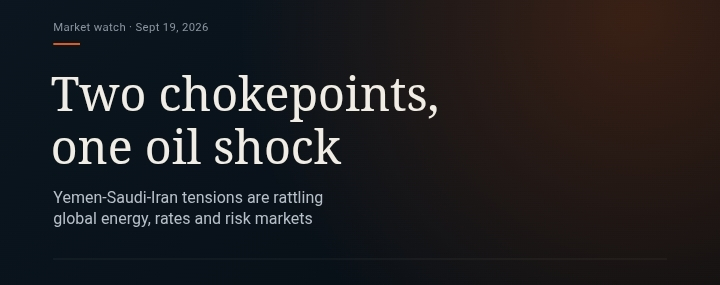
⚠️ Iran-Yemen-Saudi Tensions Rattle Global Markets: What Traders Need to KnowGeopolitical risk is back at the center of global markets. The escalation between Yemen's Iran-backed Houthi movement and Saudi Arabia has emerged as one of the most consequential macro stories of September 2026, with ripple effects reaching energy, equities, and crypto alike.
What's happening
Houthi forces have made their largest territorial advance in years along Yemen's Red Sea coast, tightening their grip on the strategic Bab el-Mandeb strait — one of the world's most critical shipping chokepoints. This land grab reignited Yemen's 12-year civil war and pushed global fuel prices higher, while also handing Iran additional leverage at a moment when Washington has been trying to ease pressure around the Strait of Hormuz on the other side of the Arabian Peninsula. (CSMonitor.com) (Washington Times)
Adding to the disruption, Saudi Arabia closed its East-West oil pipeline as a precaution after drone strikes originating from Iraq damaged energy infrastructure near Riyadh and Medina. That pipeline normally reroutes around 4 million barrels per day — roughly 4% of global oil supply — away from Hormuz, so taking it offline strips away a key safety valve just as Red Sea shipping risk climbs. (Time) (Time)
Why oil is the transmission channel
Analysts now warn that WTI crude could push above $150 in September if the situation deteriorates further. Notably, actual ship traffic through Bab el-Mandeb has stayed relatively stable so far, which has helped cap prices — but it also means Iran and its proxies still have room to escalate pressure on global energy supply if they choose to. (Crypto Briefing) (CBS News)
Zooming out, the broader 2026 Iran war has already left a mark: the conflict triggered the largest supply disruption in oil market history, along with disruptions to natural gas, fertilizer, aviation, and tourism, plus sustained volatility across financial markets. Combined disruptions at Hormuz, Bab el-Mandeb, and the East-West pipeline have knocked out an estimated 39% of global trade flow and 31% of global shipments at various points this year. (Wikipedia) (Wikipedia)
Market and policy fallout
The macro consequences are broad. Interest rate cuts have been pushed back or reversed in several economies as inflation runs hot on supply shortages and speculation, global equity markets have sold off, and there's been a broad bond-market selloff tied to the crisis. Still, some economists argue modern economies are less exposed to oil shocks than in the 1970s thanks to lower oil intensity and more flexible monetary policy, and the IMF has actually revised global growth expectations upward to 3% for 2026, partly because AI-driven demand is offsetting some of the oil shock's drag. (Economic impact of the 2026 Iran war +2)
What it means for crypto
Historically, spikes in Middle East risk premium tend to push capital toward safe-haven assets (gold, USD) first, with risk assets — including crypto — seeing short-term volatility as liquidity tightens and inflation expectations shift. Bitcoin has already been trading in a wide range this year against this exact backdrop of rate uncertainty and energy shocks, so further escalation around Bab el-Mandeb or Hormuz is a variable worth watching closely for anyone positioned in BTC, ETH, or high-beta altcoins.
Bottom line: This isn't a contained regional conflict anymore — it's a two-chokepoint energy risk story (Hormuz + Bab el-Mandeb) with direct lines into inflation, rate policy, and risk sentiment. Traders should watch oil prices and any Hormuz/Bab el-Mandeb headlines as a leading indicator for broader market moves, crypto included.
Not financial advice. DYOR.
#Iran #Yemen #Saudi #OilPrices #Macro #Crypto #Binance #Geo k#HKCompletesFirstHKDStablecoinUseCase #VietnamPlansFirstCryptoLicensesIn2026 $NVDAB politicalRisk $ONE $ARB
⚠️ Iran-Yemen-Saudi Tensions Rattle Global Markets: What Traders Need to Know
Geopolitical risk is back at the center of global markets. The escalation between Yemen's Iran-backed Houthi movement and Saudi Arabia has emerged as one of the most consequential macro stories of September 2026, with ripple effects reaching energy, equities, and crypto alike.
What's happening
Houthi forces have made their largest territorial advance in years along Yemen's Red Sea coast, tightening their grip on the strategic Bab el-Mandeb strait — one of the world's most critical shipping chokepoints. This land grab reignited Yemen's 12-year civil war and pushed global fuel prices higher, while also handing Iran additional leverage at a moment when Washington has been trying to ease pressure around the Strait of Hormuz on the other side of the Arabian Peninsula. (CSMonitor.com) (Washington Times)
Adding to the disruption, Saudi Arabia closed its East-West oil pipeline as a precaution after drone strikes originating from Iraq damaged energy infrastructure near Riyadh and Medina. That pipeline normally reroutes around 4 million barrels per day — roughly 4% of global oil supply — away from Hormuz, so taking it offline strips away a key safety valve just as Red Sea shipping risk climbs. (Time) (Time)
Why oil is the transmission channel
Analysts now warn that WTI crude could push above $150 in September if the situation deteriorates further. Notably, actual ship traffic through Bab el-Mandeb has stayed relatively stable so far, which has helped cap prices — but it also means Iran and its proxies still have room to escalate pressure on global energy supply if they choose to. (Crypto Briefing) (CBS News)
Zooming out, the broader 2026 Iran war has already left a mark: the conflict triggered the largest supply disruption in oil market history, along with disruptions to natural gas, fertilizer, aviation, and tourism, plus sustained volatility across financial markets. Combined disruptions at Hormuz, Bab el-Mandeb, and the East-West pipeline have knocked out an estimated 39% of global trade flow and 31% of global shipments at various points this year. (Wikipedia) (Wikipedia)
Market and policy fallout
The macro consequences are broad. Interest rate cuts have been pushed back or reversed in several economies as inflation runs hot on supply shortages and speculation, global equity markets have sold off, and there's been a broad bond-market selloff tied to the crisis. Still, some economists argue modern economies are less exposed to oil shocks than in the 1970s thanks to lower oil intensity and more flexible monetary policy, and the IMF has actually revised global growth expectations upward to 3% for 2026, partly because AI-driven demand is offsetting some of the oil shock's drag. (Economic impact of the 2026 Iran war +2)
What it means for crypto
Historically, spikes in Middle East risk premium tend to push capital toward safe-haven assets (gold, USD) first, with risk assets — including crypto — seeing short-term volatility as liquidity tightens and inflation expectations shift. Bitcoin has already been trading in a wide range this year against this exact backdrop of rate uncertainty and energy shocks, so further escalation around Bab el-Mandeb or Hormuz is a variable worth watching closely for anyone positioned in BTC, ETH, or high-beta altcoins.
Bottom line: This isn't a contained regional conflict anymore — it's a two-chokepoint energy risk story (Hormuz + Bab el-Mandeb) with direct lines into inflation, rate policy, and risk sentiment. Traders should watch oil prices and any Hormuz/Bab el-Mandeb headlines as a leading indicator for broader market moves, crypto included.
Not financial advice. DYOR.
#Iran #Yemen #Saudi #OilPrices #Macro #Crypto #Binance #Geo k#HKCompletesFirstHKDStablecoinUseCase #VietnamPlansFirstCryptoLicensesIn2026 $NVDAB politicalRisk $ONE $ARB
What's happening
Houthi forces have made their largest territorial advance in years along Yemen's Red Sea coast, tightening their grip on the strategic Bab el-Mandeb strait — one of the world's most critical shipping chokepoints. This land grab reignited Yemen's 12-year civil war and pushed global fuel prices higher, while also handing Iran additional leverage at a moment when Washington has been trying to ease pressure around the Strait of Hormuz on the other side of the Arabian Peninsula. (CSMonitor.com) (Washington Times)
Adding to the disruption, Saudi Arabia closed its East-West oil pipeline as a precaution after drone strikes originating from Iraq damaged energy infrastructure near Riyadh and Medina. That pipeline normally reroutes around 4 million barrels per day — roughly 4% of global oil supply — away from Hormuz, so taking it offline strips away a key safety valve just as Red Sea shipping risk climbs. (Time) (Time)
Why oil is the transmission channel
Analysts now warn that WTI crude could push above $150 in September if the situation deteriorates further. Notably, actual ship traffic through Bab el-Mandeb has stayed relatively stable so far, which has helped cap prices — but it also means Iran and its proxies still have room to escalate pressure on global energy supply if they choose to. (Crypto Briefing) (CBS News)
Zooming out, the broader 2026 Iran war has already left a mark: the conflict triggered the largest supply disruption in oil market history, along with disruptions to natural gas, fertilizer, aviation, and tourism, plus sustained volatility across financial markets. Combined disruptions at Hormuz, Bab el-Mandeb, and the East-West pipeline have knocked out an estimated 39% of global trade flow and 31% of global shipments at various points this year. (Wikipedia) (Wikipedia)
Market and policy fallout
The macro consequences are broad. Interest rate cuts have been pushed back or reversed in several economies as inflation runs hot on supply shortages and speculation, global equity markets have sold off, and there's been a broad bond-market selloff tied to the crisis. Still, some economists argue modern economies are less exposed to oil shocks than in the 1970s thanks to lower oil intensity and more flexible monetary policy, and the IMF has actually revised global growth expectations upward to 3% for 2026, partly because AI-driven demand is offsetting some of the oil shock's drag. (Economic impact of the 2026 Iran war +2)
What it means for crypto
Historically, spikes in Middle East risk premium tend to push capital toward safe-haven assets (gold, USD) first, with risk assets — including crypto — seeing short-term volatility as liquidity tightens and inflation expectations shift. Bitcoin has already been trading in a wide range this year against this exact backdrop of rate uncertainty and energy shocks, so further escalation around Bab el-Mandeb or Hormuz is a variable worth watching closely for anyone positioned in BTC, ETH, or high-beta altcoins.
Bottom line: This isn't a contained regional conflict anymore — it's a two-chokepoint energy risk story (Hormuz + Bab el-Mandeb) with direct lines into inflation, rate policy, and risk sentiment. Traders should watch oil prices and any Hormuz/Bab el-Mandeb headlines as a leading indicator for broader market moves, crypto included.
Not financial advice. DYOR.
#Iran #Yemen #Saudi #OilPrices #Macro #Crypto #Binance #Geo k#HKCompletesFirstHKDStablecoinUseCase #VietnamPlansFirstCryptoLicensesIn2026 $NVDAB politicalRisk $ONE $ARB
1
55

·
--
ເບິ່ງການແປ
🚨 JUST IN: Russian hackers infiltrate US nuclear scientists' systems after honing phishing tactics on Ukrainian targets.
Russia's Star Blizzard hacking group has been linked to a chilling cyber attack on US nuclear scientists, raising alarms about the nation's cybersecurity infrastructure. As tensions between the US and Russia escalate, the stakes are higher than ever – a single mistake could have catastrophic consequences, jeopardizing global stability and the world's most valuable assets, including $BTC and $ETH reserves.
Experts warn that the sophistication of these attacks is increasing, with hackers adapting their tactics to evade detection. The implications are chilling: if even the world's most secure systems can be breached, what hope is there for smaller players in the crypto market, where security is often a distant second to innovation? The risk of a catastrophic cyber attack on a major exchange or wallet is too real to ignore.
Opportunity or risk? What do you see? 🤔 #Geo
🚨 JUST IN: Russian hackers infiltrate US nuclear scientists' systems after honing phishing tactics on Ukrainian targets.
Russia's Star Blizzard hacking group has been linked to a chilling cyber attack on US nuclear scientists, raising alarms about the nation's cybersecurity infrastructure. As tensions between the US and Russia escalate, the stakes are higher than ever – a single mistake could have catastrophic consequences, jeopardizing global stability and the world's most valuable assets, including $BTC and $ETH reserves.
Experts warn that the sophistication of these attacks is increasing, with hackers adapting their tactics to evade detection. The implications are chilling: if even the world's most secure systems can be breached, what hope is there for smaller players in the crypto market, where security is often a distant second to innovation? The risk of a catastrophic cyber attack on a major exchange or wallet is too real to ignore.
Opportunity or risk? What do you see? 🤔 #Geo
Russia's Star Blizzard hacking group has been linked to a chilling cyber attack on US nuclear scientists, raising alarms about the nation's cybersecurity infrastructure. As tensions between the US and Russia escalate, the stakes are higher than ever – a single mistake could have catastrophic consequences, jeopardizing global stability and the world's most valuable assets, including $BTC and $ETH reserves.
Experts warn that the sophistication of these attacks is increasing, with hackers adapting their tactics to evade detection. The implications are chilling: if even the world's most secure systems can be breached, what hope is there for smaller players in the crypto market, where security is often a distant second to innovation? The risk of a catastrophic cyber attack on a major exchange or wallet is too real to ignore.
Opportunity or risk? What do you see? 🤔 #Geo
65
ເຂົ້າສູ່ລະບົບເພື່ອສຳຫຼວດເນື້ອຫາເພີ່ມເຕີມ
ເຂົ້າຮ່ວມກຸ່ມຜູ້ໃຊ້ຄຣິບໂຕທົ່ວໂລກໃນ Binance Square.
⚡️ ໄດ້ຮັບຂໍ້ມູນຫຼ້າສຸດ ແລະ ທີ່ມີປະໂຫຍດກ່ຽວກັບຄຣິບໂຕ.
💬 ໄດ້ຮັບຄວາມໄວ້ວາງໃຈຈາກຕະຫຼາດແລກປ່ຽນຄຣິບໂຕທີ່ໃຫຍ່ທີ່ສຸດໃນໂລກ.
👍 ຄົ້ນຫາຂໍ້ມູນເຊີງເລິກທີ່ແທ້ຈາກນັກສ້າງທີ່ໄດ້ຮັບການຢືນຢັນ.
ອີເມວ / ເບີໂທລະສັບ
ຫົວຂໍ້ທີ່ກໍາລັງນິຍົມ
1
#BOJRaisesRatesTo31YearHigh
29,834 views
707 ກຳລັງສົນທະນາ
2
#BuffettStepsDownAsBerkshireChairman
9,031 views
289 ກຳລັງສົນທະນາ
3
#XRPExchangeReservesHitSevenYearLow
13,853 views
309 ກຳລັງສົນທະນາ
4
#HKCompletesFirstHKDStablecoinUseCase
43,955 views
834 ກຳລັງສົນທະນາ
5
#VietnamPlansFirstCryptoLicensesIn2026
32,022 views
579 ກຳລັງສົນທະນາ
6
#BTCBreaks80K
296,515 views
4,149 ກຳລັງສົນທະນາ
7
#比特币突破8万
146,094 views
452 ກຳລັງສົນທະນາ
8
#BitcoinMarketCapTopsTesla
49,163 views
882 ກຳລັງສົນທະນາ
9
#SOLJumpsAbout10%
61,123 views
891 ກຳລັງສົນທະນາ
10
#EthereumReclaims$2600
5,386 views
102 ກຳລັງສົນທະນາ