

#cryptoairevolution
cryptoairevolution
300,731 ຄັ້ງທີ່ເບິ່ງ
161 ກຳລັງສົນທະນາ
ມາແຮງ
ຫຼ້າສຸດ

·
--
ຢືນຢັນແລ້ວ
ບົດຄວາມ
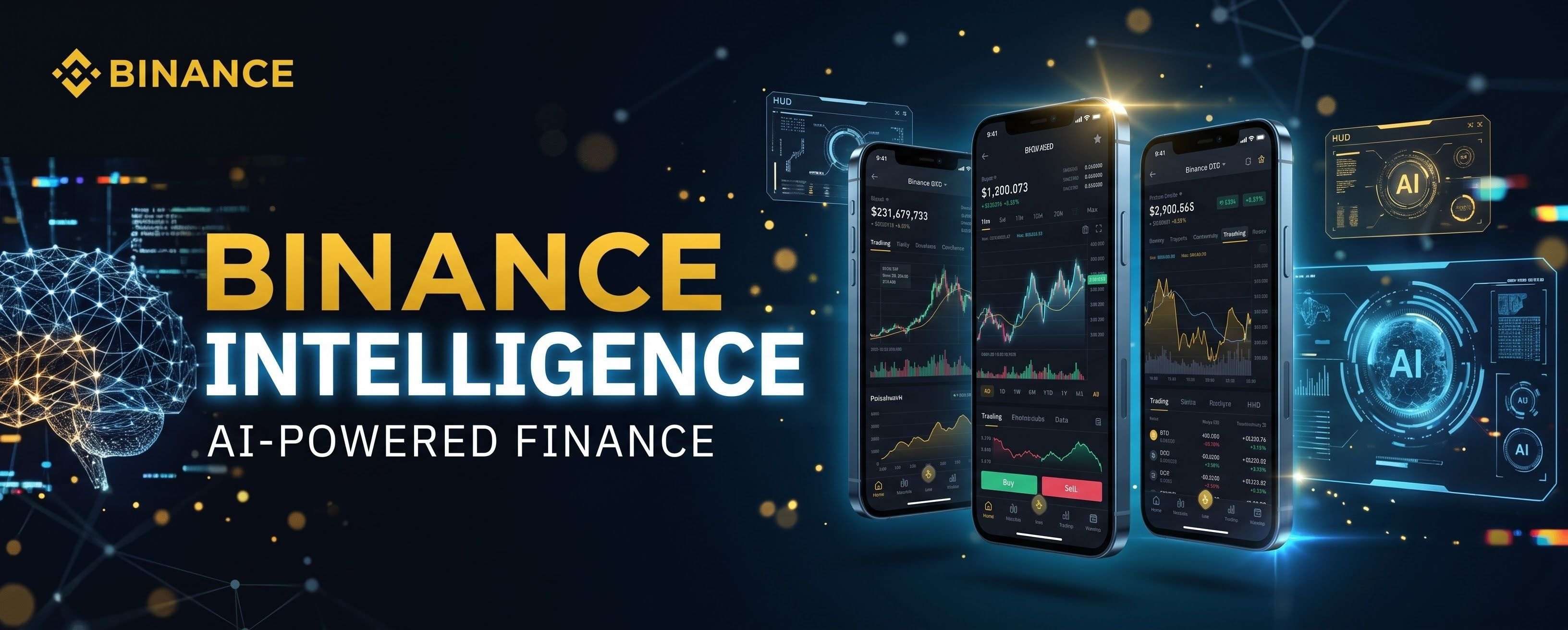
Era Baru Trading Sudah Dimulai! 3 Fitur AI Baru Binance Intelegent Pernahkah Anda membayangkan memiliki asisten pintar sekelas institusi keuangan besar yang selalu siaga 24/7 di ujung jari Anda? Industri kripto dan keuangan sedang mengalami evolusi besar, dan kecerdasan buatan (AI) kini bukan sekadar chatbot biasa yang hanya bisa menjawab pertanyaan sederhana. AI kini mulai terintegrasi secara mendalam ke dalam cara kita berinteraksi dengan pasar keuangan.
Hari ini, Binance secara resmi memperkenalkan "Binance Intelligence", yang merupakan serangkaian produk paling ambisius dari Binance yang dirancang khusus untuk menghadirkan teknologi AI tingkat institusional ke tangan setiap trader. Melalui sesi livestream khusus, Co-CEO Richard Teng dan VP of Product Jeff Li mempresentasikan bagaimana ketiga produk AI ini akan menata ulang cara kerja keuangan agar lebih berpihak kepada pengguna. Binance membangun lapisan AI ini langsung ke dalam pengalaman finansial Anda, memastikan bahwa informasi pasar yang kompleks menjadi lebih terpersonalisasi, lebih mudah diakses, dan siap dieksekusi.
Binance Intelligence membawa kapabilitas AI canggih ke dalam pengalaman finansial sehari-hari melalui tiga tingkatan produk utama:
1️⃣ Binance AI (AI Built Around You)
🔹 Produk ini adalah asisten AI yang selalu aktif, disediakan secara gratis, dan terintegrasi langsung di dalam aplikasi Binance.
🔹 Binance AI dirancang dengan tujuan utama untuk membuat kondisi pasar menjadi jauh lebih mudah dipahami serta dinavigasi oleh penggunanya.
🔹 Alih-alih menampilkan informasi pasar yang seragam untuk semua orang, asisten cerdas ini mengubah tampilan pasar menjadi pengalaman yang sangat terpersonalisasi untuk setiap individu.
🔹 Fitur unggulannya mencakup Ringkasan Pasar (Market Briefs) yang disesuaikan secara personal dan dapat dinikmati dalam bentuk teks maupun audio.
🔹 Terdapat juga fitur Smart Tracker yang secara khusus memantau pergerakan apa saja yang terjadi pada koin favorit Anda.
🔹 Selain itu, fitur Smart Alerts akan memberikan notifikasi seketika apabila terjadi pergerakan yang penting.
🔹 Menariknya lagi, Binance AI turut menghadirkan analisis pasar berbasis AI yang menggabungkan informasi kripto, saham, dan ETF dalam satu layar terpadu.
🔹 Binance AI diluncurkan hari ini secara gratis untuk pengguna yang memenuhi syarat di wilayah Selandia Baru, dengan peluncuran global dalam beberapa hari ke depan.
2️⃣ Binance AI Pro (Prompt. Test. Trade.)
🔹 Produk ini ditujukan secara khusus bagi para trader yang ingin mendeskripsikan, menguji, dan menjalankan alur kerja keuangan mereka sendiri.
🔹 Pengguna dapat mendeskripsikan sebuah strategi perdagangan menggunakan bahasa sehari-hari yang sederhana, mengujinya, lalu membiarkannya berjalan secara otomatis.
🔹 Sistem ini mengutamakan keamanan melalui gerbang pengujian (test-before-live), di mana setiap strategi dapat diuji kembali (backtested), disimulasikan, atau diuji secara virtual sebelum benar-benar diaktifkan.
🔹 Tidak ada satu pun alur kerja yang akan berjalan tanpa adanya persetujuan eksplisit dari Anda sebagai pengguna.
🔹 Versi yang telah mendapatkan peningkatan besar ini akan diluncurkan dalam beberapa minggu mendatang dan akan memiliki opsi gratis pada tahap awal peluncuran.
3️⃣ Binance Agent OS (Your Agents. Your Rules. Your Finance.)
🔹 Ini merupakan solusi inovatif bagi para pengembang (builders) yang ingin mengintegrasikan Binance langsung ke dalam alat AI eksternal yang sudah rutin mereka gunakan.
🔹 Pengguna memegang kendali penuh atas izin yang diberikan kepada agen AI tersebut.
🔹 Agen mandiri ini mampu mengawasi posisi aset Anda sepanjang waktu di dalam sebuah kotak pasir (sandbox) yang sepenuhnya Anda kendalikan.
🔹 Sistem ini dilengkapi kontrol keamanan yang ketat, meliputi ruang lingkup izin, sub-akun yang terisolasi, serta fitur Pemberhentian Darurat (Emergency Stop).
Satu pergeseran paling menarik dari inisiatif ini adalah bagaimana teknologi AI tidak lagi hanya difokuskan pada aktivitas perdagangan aktif semata. Data awal justru menunjukkan bahwa peran besar pertama AI dalam sektor keuangan adalah mengawasi serta memantau pergerakan pasar untuk Anda.
🔹 Para pengguna saat ini lebih banyak memanfaatkan AI untuk keperluan membaca, memantau, dan memahami kondisi pasar secara komprehensif sebelum mereka meminta AI tersebut mengambil tindakan.
🔹 Pada platform Agent OS, tercatat ada sekitar 50 panggilan pembacaan data (read calls) untuk setiap satu pesanan perdagangan yang dieksekusi.
🔹 Di sisi Binance AI Pro, sebanyak 18% pengguna telah menjalankan setidaknya satu tugas pemantauan yang dijadwalkan secara rutin.
Lebih dari sekadar asisten, ekosistem AI ini juga terbukti mampu meningkatkan keterlibatan pengguna secara signifikan berdasarkan statistik beta awal yang sangat menjanjikan:
🔹 Tingkat klik pada tab Pasar mencatatkan peningkatan sebesar 6,6% jika dibandingkan dengan kelompok kontrol.
🔹 Tingkat konversi untuk melakukan perdagangan pada hari yang sama juga mengalami kenaikan sebesar 3,6%.
🔹 Secara akumulatif, seorang pengguna versi beta tercatat memiliki kemungkinan sekitar 40% lebih besar untuk langsung melakukan perdagangan pada hari mereka membuka aplikasi.
Ketika berbicara tentang inovasi finansial, keamanan selalu menjadi prioritas utama. Inisiatif Binance Intelligence ini bukanlah sebuah perubahan arah bisnis yang terjadi tiba-tiba, melainkan kelanjutan pengembangan dari infrastruktur kecerdasan buatan milik Binance yang sudah sangat matang.
🔹 Saat ini, Binance telah mengoperasikan lebih dari 100 model AI secara aktif di berbagai divisi kepatuhan dan operasi manajemen risiko.
🔹 Penerapan model-model AI tersebut telah terbukti sukses mencegah potensi kerugian pengguna dengan nilai mencapai lebih dari $10 miliar sejak awal tahun 2025.
🔹 Seluruh sistem ini berjalan sepenuhnya di dalam kerangka kerja keamanan dan kepatuhan milik Binance, sehingga Anda berhak untuk mencabut izin akses kapan saja.
Dengan hadirnya Binance Intelligence, kesenjangan antara teknologi investasi canggih ala hedge fund dan kemudahan akses bagi pengguna awam kini telah sepenuhnya dijembatani. Jelajahi pengalaman bursa yang ditenagai oleh kecerdasan buatan baru dari Binance dan rasakan sendiri bagaimana masa depan industri keuangan dibentuk!
#BinanceAI #CryptoAIRevolution
[Daftar Binance dan dapatkan token ENSO senilai 7 USDT](https://www.binance.com/join?ref=849170143)
Era Baru Trading Sudah Dimulai! 3 Fitur AI Baru Binance Intelegent
Pernahkah Anda membayangkan memiliki asisten pintar sekelas institusi keuangan besar yang selalu siaga 24/7 di ujung jari Anda? Industri kripto dan keuangan sedang mengalami evolusi besar, dan kecerdasan buatan (AI) kini bukan sekadar chatbot biasa yang hanya bisa menjawab pertanyaan sederhana. AI kini mulai terintegrasi secara mendalam ke dalam cara kita berinteraksi dengan pasar keuangan.
Hari ini, Binance secara resmi memperkenalkan "Binance Intelligence", yang merupakan serangkaian produk paling ambisius dari Binance yang dirancang khusus untuk menghadirkan teknologi AI tingkat institusional ke tangan setiap trader. Melalui sesi livestream khusus, Co-CEO Richard Teng dan VP of Product Jeff Li mempresentasikan bagaimana ketiga produk AI ini akan menata ulang cara kerja keuangan agar lebih berpihak kepada pengguna. Binance membangun lapisan AI ini langsung ke dalam pengalaman finansial Anda, memastikan bahwa informasi pasar yang kompleks menjadi lebih terpersonalisasi, lebih mudah diakses, dan siap dieksekusi.
Binance Intelligence membawa kapabilitas AI canggih ke dalam pengalaman finansial sehari-hari melalui tiga tingkatan produk utama:
1️⃣ Binance AI (AI Built Around You)
🔹 Produk ini adalah asisten AI yang selalu aktif, disediakan secara gratis, dan terintegrasi langsung di dalam aplikasi Binance.
🔹 Binance AI dirancang dengan tujuan utama untuk membuat kondisi pasar menjadi jauh lebih mudah dipahami serta dinavigasi oleh penggunanya.
🔹 Alih-alih menampilkan informasi pasar yang seragam untuk semua orang, asisten cerdas ini mengubah tampilan pasar menjadi pengalaman yang sangat terpersonalisasi untuk setiap individu.
🔹 Fitur unggulannya mencakup Ringkasan Pasar (Market Briefs) yang disesuaikan secara personal dan dapat dinikmati dalam bentuk teks maupun audio.
🔹 Terdapat juga fitur Smart Tracker yang secara khusus memantau pergerakan apa saja yang terjadi pada koin favorit Anda.
🔹 Selain itu, fitur Smart Alerts akan memberikan notifikasi seketika apabila terjadi pergerakan yang penting.
🔹 Menariknya lagi, Binance AI turut menghadirkan analisis pasar berbasis AI yang menggabungkan informasi kripto, saham, dan ETF dalam satu layar terpadu.
🔹 Binance AI diluncurkan hari ini secara gratis untuk pengguna yang memenuhi syarat di wilayah Selandia Baru, dengan peluncuran global dalam beberapa hari ke depan.
2️⃣ Binance AI Pro (Prompt. Test. Trade.)
🔹 Produk ini ditujukan secara khusus bagi para trader yang ingin mendeskripsikan, menguji, dan menjalankan alur kerja keuangan mereka sendiri.
🔹 Pengguna dapat mendeskripsikan sebuah strategi perdagangan menggunakan bahasa sehari-hari yang sederhana, mengujinya, lalu membiarkannya berjalan secara otomatis.
🔹 Sistem ini mengutamakan keamanan melalui gerbang pengujian (test-before-live), di mana setiap strategi dapat diuji kembali (backtested), disimulasikan, atau diuji secara virtual sebelum benar-benar diaktifkan.
🔹 Tidak ada satu pun alur kerja yang akan berjalan tanpa adanya persetujuan eksplisit dari Anda sebagai pengguna.
🔹 Versi yang telah mendapatkan peningkatan besar ini akan diluncurkan dalam beberapa minggu mendatang dan akan memiliki opsi gratis pada tahap awal peluncuran.
3️⃣ Binance Agent OS (Your Agents. Your Rules. Your Finance.)
🔹 Ini merupakan solusi inovatif bagi para pengembang (builders) yang ingin mengintegrasikan Binance langsung ke dalam alat AI eksternal yang sudah rutin mereka gunakan.
🔹 Pengguna memegang kendali penuh atas izin yang diberikan kepada agen AI tersebut.
🔹 Agen mandiri ini mampu mengawasi posisi aset Anda sepanjang waktu di dalam sebuah kotak pasir (sandbox) yang sepenuhnya Anda kendalikan.
🔹 Sistem ini dilengkapi kontrol keamanan yang ketat, meliputi ruang lingkup izin, sub-akun yang terisolasi, serta fitur Pemberhentian Darurat (Emergency Stop).
Satu pergeseran paling menarik dari inisiatif ini adalah bagaimana teknologi AI tidak lagi hanya difokuskan pada aktivitas perdagangan aktif semata. Data awal justru menunjukkan bahwa peran besar pertama AI dalam sektor keuangan adalah mengawasi serta memantau pergerakan pasar untuk Anda.
🔹 Para pengguna saat ini lebih banyak memanfaatkan AI untuk keperluan membaca, memantau, dan memahami kondisi pasar secara komprehensif sebelum mereka meminta AI tersebut mengambil tindakan.
🔹 Pada platform Agent OS, tercatat ada sekitar 50 panggilan pembacaan data (read calls) untuk setiap satu pesanan perdagangan yang dieksekusi.
🔹 Di sisi Binance AI Pro, sebanyak 18% pengguna telah menjalankan setidaknya satu tugas pemantauan yang dijadwalkan secara rutin.
Lebih dari sekadar asisten, ekosistem AI ini juga terbukti mampu meningkatkan keterlibatan pengguna secara signifikan berdasarkan statistik beta awal yang sangat menjanjikan:
🔹 Tingkat klik pada tab Pasar mencatatkan peningkatan sebesar 6,6% jika dibandingkan dengan kelompok kontrol.
🔹 Tingkat konversi untuk melakukan perdagangan pada hari yang sama juga mengalami kenaikan sebesar 3,6%.
🔹 Secara akumulatif, seorang pengguna versi beta tercatat memiliki kemungkinan sekitar 40% lebih besar untuk langsung melakukan perdagangan pada hari mereka membuka aplikasi.
Ketika berbicara tentang inovasi finansial, keamanan selalu menjadi prioritas utama. Inisiatif Binance Intelligence ini bukanlah sebuah perubahan arah bisnis yang terjadi tiba-tiba, melainkan kelanjutan pengembangan dari infrastruktur kecerdasan buatan milik Binance yang sudah sangat matang.
🔹 Saat ini, Binance telah mengoperasikan lebih dari 100 model AI secara aktif di berbagai divisi kepatuhan dan operasi manajemen risiko.
🔹 Penerapan model-model AI tersebut telah terbukti sukses mencegah potensi kerugian pengguna dengan nilai mencapai lebih dari $10 miliar sejak awal tahun 2025.
🔹 Seluruh sistem ini berjalan sepenuhnya di dalam kerangka kerja keamanan dan kepatuhan milik Binance, sehingga Anda berhak untuk mencabut izin akses kapan saja.
Dengan hadirnya Binance Intelligence, kesenjangan antara teknologi investasi canggih ala hedge fund dan kemudahan akses bagi pengguna awam kini telah sepenuhnya dijembatani. Jelajahi pengalaman bursa yang ditenagai oleh kecerdasan buatan baru dari Binance dan rasakan sendiri bagaimana masa depan industri keuangan dibentuk!
#BinanceAI #CryptoAIRevolution
Daftar Binance dan dapatkan token ENSO senilai 7 USDT
Hari ini, Binance secara resmi memperkenalkan "Binance Intelligence", yang merupakan serangkaian produk paling ambisius dari Binance yang dirancang khusus untuk menghadirkan teknologi AI tingkat institusional ke tangan setiap trader. Melalui sesi livestream khusus, Co-CEO Richard Teng dan VP of Product Jeff Li mempresentasikan bagaimana ketiga produk AI ini akan menata ulang cara kerja keuangan agar lebih berpihak kepada pengguna. Binance membangun lapisan AI ini langsung ke dalam pengalaman finansial Anda, memastikan bahwa informasi pasar yang kompleks menjadi lebih terpersonalisasi, lebih mudah diakses, dan siap dieksekusi.
Binance Intelligence membawa kapabilitas AI canggih ke dalam pengalaman finansial sehari-hari melalui tiga tingkatan produk utama:
1️⃣ Binance AI (AI Built Around You)
🔹 Produk ini adalah asisten AI yang selalu aktif, disediakan secara gratis, dan terintegrasi langsung di dalam aplikasi Binance.
🔹 Binance AI dirancang dengan tujuan utama untuk membuat kondisi pasar menjadi jauh lebih mudah dipahami serta dinavigasi oleh penggunanya.
🔹 Alih-alih menampilkan informasi pasar yang seragam untuk semua orang, asisten cerdas ini mengubah tampilan pasar menjadi pengalaman yang sangat terpersonalisasi untuk setiap individu.
🔹 Fitur unggulannya mencakup Ringkasan Pasar (Market Briefs) yang disesuaikan secara personal dan dapat dinikmati dalam bentuk teks maupun audio.
🔹 Terdapat juga fitur Smart Tracker yang secara khusus memantau pergerakan apa saja yang terjadi pada koin favorit Anda.
🔹 Selain itu, fitur Smart Alerts akan memberikan notifikasi seketika apabila terjadi pergerakan yang penting.
🔹 Menariknya lagi, Binance AI turut menghadirkan analisis pasar berbasis AI yang menggabungkan informasi kripto, saham, dan ETF dalam satu layar terpadu.
🔹 Binance AI diluncurkan hari ini secara gratis untuk pengguna yang memenuhi syarat di wilayah Selandia Baru, dengan peluncuran global dalam beberapa hari ke depan.
2️⃣ Binance AI Pro (Prompt. Test. Trade.)
🔹 Produk ini ditujukan secara khusus bagi para trader yang ingin mendeskripsikan, menguji, dan menjalankan alur kerja keuangan mereka sendiri.
🔹 Pengguna dapat mendeskripsikan sebuah strategi perdagangan menggunakan bahasa sehari-hari yang sederhana, mengujinya, lalu membiarkannya berjalan secara otomatis.
🔹 Sistem ini mengutamakan keamanan melalui gerbang pengujian (test-before-live), di mana setiap strategi dapat diuji kembali (backtested), disimulasikan, atau diuji secara virtual sebelum benar-benar diaktifkan.
🔹 Tidak ada satu pun alur kerja yang akan berjalan tanpa adanya persetujuan eksplisit dari Anda sebagai pengguna.
🔹 Versi yang telah mendapatkan peningkatan besar ini akan diluncurkan dalam beberapa minggu mendatang dan akan memiliki opsi gratis pada tahap awal peluncuran.
3️⃣ Binance Agent OS (Your Agents. Your Rules. Your Finance.)
🔹 Ini merupakan solusi inovatif bagi para pengembang (builders) yang ingin mengintegrasikan Binance langsung ke dalam alat AI eksternal yang sudah rutin mereka gunakan.
🔹 Pengguna memegang kendali penuh atas izin yang diberikan kepada agen AI tersebut.
🔹 Agen mandiri ini mampu mengawasi posisi aset Anda sepanjang waktu di dalam sebuah kotak pasir (sandbox) yang sepenuhnya Anda kendalikan.
🔹 Sistem ini dilengkapi kontrol keamanan yang ketat, meliputi ruang lingkup izin, sub-akun yang terisolasi, serta fitur Pemberhentian Darurat (Emergency Stop).
Satu pergeseran paling menarik dari inisiatif ini adalah bagaimana teknologi AI tidak lagi hanya difokuskan pada aktivitas perdagangan aktif semata. Data awal justru menunjukkan bahwa peran besar pertama AI dalam sektor keuangan adalah mengawasi serta memantau pergerakan pasar untuk Anda.
🔹 Para pengguna saat ini lebih banyak memanfaatkan AI untuk keperluan membaca, memantau, dan memahami kondisi pasar secara komprehensif sebelum mereka meminta AI tersebut mengambil tindakan.
🔹 Pada platform Agent OS, tercatat ada sekitar 50 panggilan pembacaan data (read calls) untuk setiap satu pesanan perdagangan yang dieksekusi.
🔹 Di sisi Binance AI Pro, sebanyak 18% pengguna telah menjalankan setidaknya satu tugas pemantauan yang dijadwalkan secara rutin.
Lebih dari sekadar asisten, ekosistem AI ini juga terbukti mampu meningkatkan keterlibatan pengguna secara signifikan berdasarkan statistik beta awal yang sangat menjanjikan:
🔹 Tingkat klik pada tab Pasar mencatatkan peningkatan sebesar 6,6% jika dibandingkan dengan kelompok kontrol.
🔹 Tingkat konversi untuk melakukan perdagangan pada hari yang sama juga mengalami kenaikan sebesar 3,6%.
🔹 Secara akumulatif, seorang pengguna versi beta tercatat memiliki kemungkinan sekitar 40% lebih besar untuk langsung melakukan perdagangan pada hari mereka membuka aplikasi.
Ketika berbicara tentang inovasi finansial, keamanan selalu menjadi prioritas utama. Inisiatif Binance Intelligence ini bukanlah sebuah perubahan arah bisnis yang terjadi tiba-tiba, melainkan kelanjutan pengembangan dari infrastruktur kecerdasan buatan milik Binance yang sudah sangat matang.
🔹 Saat ini, Binance telah mengoperasikan lebih dari 100 model AI secara aktif di berbagai divisi kepatuhan dan operasi manajemen risiko.
🔹 Penerapan model-model AI tersebut telah terbukti sukses mencegah potensi kerugian pengguna dengan nilai mencapai lebih dari $10 miliar sejak awal tahun 2025.
🔹 Seluruh sistem ini berjalan sepenuhnya di dalam kerangka kerja keamanan dan kepatuhan milik Binance, sehingga Anda berhak untuk mencabut izin akses kapan saja.
Dengan hadirnya Binance Intelligence, kesenjangan antara teknologi investasi canggih ala hedge fund dan kemudahan akses bagi pengguna awam kini telah sepenuhnya dijembatani. Jelajahi pengalaman bursa yang ditenagai oleh kecerdasan buatan baru dari Binance dan rasakan sendiri bagaimana masa depan industri keuangan dibentuk!
#BinanceAI #CryptoAIRevolution
Daftar Binance dan dapatkan token ENSO senilai 7 USDT
450
·
--
ບົດຄວາມ
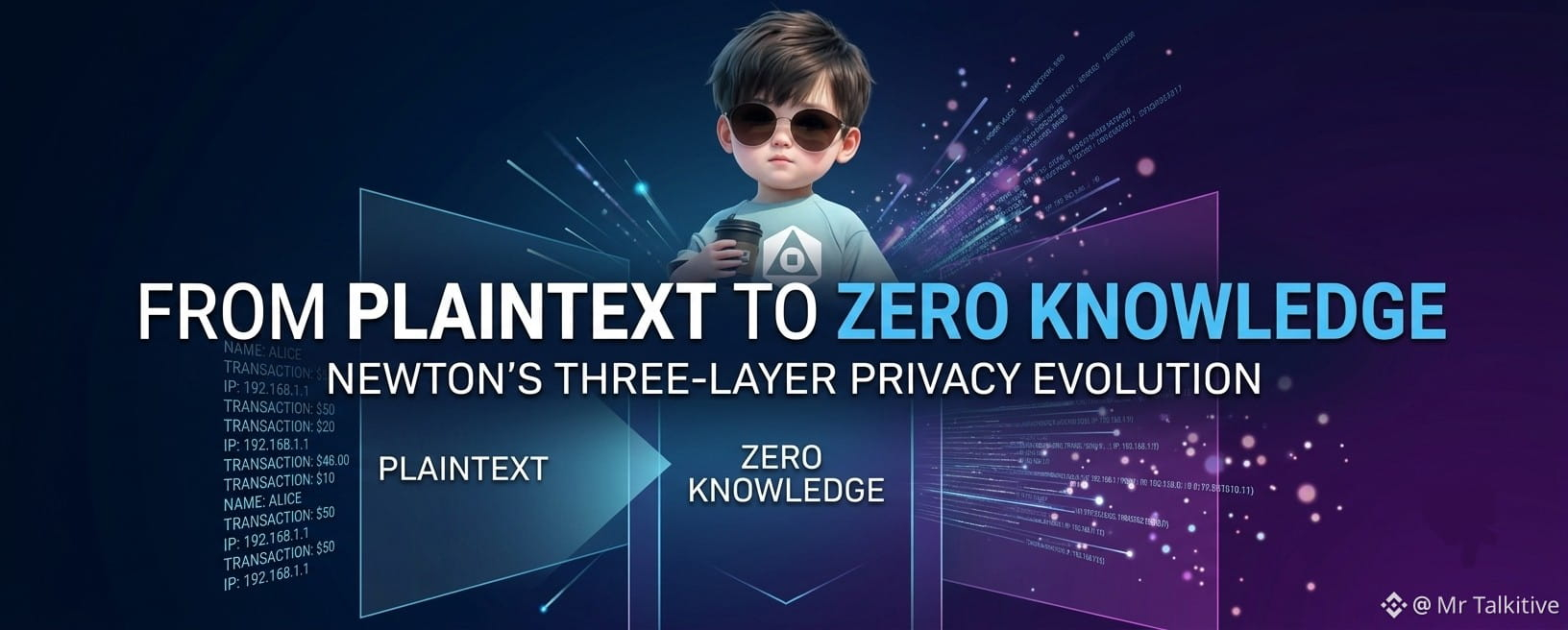
FROM PLAINTEXT TO ZERO KNOWLEDGE NEWTON'S THREE-LAYER PRIVACY EVOLUTIONI have been looking closely at how privacy is discussed across decentralized systems and one pattern keeps standing out to me. Most conversations seem to begin and end with encryption. If data is encrypted it is often assumed that the privacy problem has been solved. The more I have studied different architectures the more I have started questioning that assumption.
I have realized that what interests me most is not just how data is protected while it moves across a network but what happens after that. At some point a system has to evaluate policies verify credentials or make decisions. That stage feels much less visible in public discussions even though it may be where some of the most important privacy tradeoffs exist.
While reading through Newton Protocol's privacy architecture I found myself appreciating that it does not present privacy as a single feature. Instead it treats privacy as something that evolves in layers. That approach felt more realistic to me because it acknowledges that different levels of protection solve different problems.
I noticed that the first layer relies on threshold encryption allowing sensitive information to remain encrypted until a quorum of operators reconstructs it for policy evaluation. I think this is an important improvement over relying on a centralized trusted party but I also appreciate that the design openly recognizes its limitation. During evaluation participating operators still see plaintext. Rather than claiming perfect privacy the architecture clearly defines where trust still exists.
I have also been looking into how the second layer changes that model through Multi-Party Computation (MPC). What stood out to me is that the objective shifts from protecting stored data to protecting computation itself. Operators evaluate policies over secret-shared data without any individual participant seeing the underlying information. I find that transition particularly interesting because it reduces trust assumptions rather than simply adding another security feature. At the same time I do not see MPC as a simple upgrade. It introduces additional complexity coordination and engineering challenges that should not be overlooked.
Something else I have come to appreciate is the way Newton combines complementary privacy techniques instead of depending on one solution. Selective disclosure allows users to reveal only the information required for a particular policy. Trusted Execution Environments isolate sensitive verification while zero-knowledge proofs allow certain facts to be verified without revealing the underlying data. To me, these technologies seem less like competitors and more like pieces of a larger privacy framework.
I have also started questioning another common assumption that stronger privacy always means hiding everything. The more I read the more I think the real challenge is designing systems that reveal only what is necessary only to the right parties and only within clearly defined cryptographic boundaries. That feels much closer to how trust works in the real world.
One thing I have consistently noticed while studying decentralized infrastructure is that meaningful progress usually happens in stages. Moving from threshold encryption toward MPC is not just adding another feature it is gradually reducing how much trust users need to place in individual participants. I find that kind of roadmap more convincing than promises of instant perfection.
As decentralized systems continue expanding into finance, identity and autonomous AI I have become convinced that the quality of privacy will matter far more than short-term performance metrics. Fast execution and scalability are valuable but they do not replace confidence. Over time I think confidence is built by architectures that continue protecting users even as the systems themselves become more capable and interconnected.
That is ultimately what stayed with me after studying Newton's three-layer privacy evolution. I do not see it as a claim that privacy has been solved. I see it as an acknowledgment that trust is something systems earn gradually by reducing unnecessary exposure recognizing tradeoffs honestly and continuously improving how sensitive data is handled.
I have come away thinking that long-term trust won't be built by the strongest marketing claims or the fastest benchmarks. It will be built by protocols that steadily reduce how much users have to trust anyone at all. That is the direction I see @NewtonProtocol exploring through it is layered privacy architecture with $NEWT supporting a network designed to move from protecting data in transit to protecting it throughout computation itself.
#Newt #AI #cryptouniverseofficial #CryptocurrencyWealth #CryptoAIRevolution
{future}(NEWTUSDT)
$TAC
{future}(TACUSDT)
$EVAA
{future}(EVAAUSDT)
FROM PLAINTEXT TO ZERO KNOWLEDGE NEWTON'S THREE-LAYER PRIVACY EVOLUTION
I have been looking closely at how privacy is discussed across decentralized systems and one pattern keeps standing out to me. Most conversations seem to begin and end with encryption. If data is encrypted it is often assumed that the privacy problem has been solved. The more I have studied different architectures the more I have started questioning that assumption.
I have realized that what interests me most is not just how data is protected while it moves across a network but what happens after that. At some point a system has to evaluate policies verify credentials or make decisions. That stage feels much less visible in public discussions even though it may be where some of the most important privacy tradeoffs exist.
While reading through Newton Protocol's privacy architecture I found myself appreciating that it does not present privacy as a single feature. Instead it treats privacy as something that evolves in layers. That approach felt more realistic to me because it acknowledges that different levels of protection solve different problems.
I noticed that the first layer relies on threshold encryption allowing sensitive information to remain encrypted until a quorum of operators reconstructs it for policy evaluation. I think this is an important improvement over relying on a centralized trusted party but I also appreciate that the design openly recognizes its limitation. During evaluation participating operators still see plaintext. Rather than claiming perfect privacy the architecture clearly defines where trust still exists.
I have also been looking into how the second layer changes that model through Multi-Party Computation (MPC). What stood out to me is that the objective shifts from protecting stored data to protecting computation itself. Operators evaluate policies over secret-shared data without any individual participant seeing the underlying information. I find that transition particularly interesting because it reduces trust assumptions rather than simply adding another security feature. At the same time I do not see MPC as a simple upgrade. It introduces additional complexity coordination and engineering challenges that should not be overlooked.
Something else I have come to appreciate is the way Newton combines complementary privacy techniques instead of depending on one solution. Selective disclosure allows users to reveal only the information required for a particular policy. Trusted Execution Environments isolate sensitive verification while zero-knowledge proofs allow certain facts to be verified without revealing the underlying data. To me, these technologies seem less like competitors and more like pieces of a larger privacy framework.
I have also started questioning another common assumption that stronger privacy always means hiding everything. The more I read the more I think the real challenge is designing systems that reveal only what is necessary only to the right parties and only within clearly defined cryptographic boundaries. That feels much closer to how trust works in the real world.
One thing I have consistently noticed while studying decentralized infrastructure is that meaningful progress usually happens in stages. Moving from threshold encryption toward MPC is not just adding another feature it is gradually reducing how much trust users need to place in individual participants. I find that kind of roadmap more convincing than promises of instant perfection.
As decentralized systems continue expanding into finance, identity and autonomous AI I have become convinced that the quality of privacy will matter far more than short-term performance metrics. Fast execution and scalability are valuable but they do not replace confidence. Over time I think confidence is built by architectures that continue protecting users even as the systems themselves become more capable and interconnected.
That is ultimately what stayed with me after studying Newton's three-layer privacy evolution. I do not see it as a claim that privacy has been solved. I see it as an acknowledgment that trust is something systems earn gradually by reducing unnecessary exposure recognizing tradeoffs honestly and continuously improving how sensitive data is handled.
I have come away thinking that long-term trust won't be built by the strongest marketing claims or the fastest benchmarks. It will be built by protocols that steadily reduce how much users have to trust anyone at all. That is the direction I see @NewtonProtocol exploring through it is layered privacy architecture with $NEWT supporting a network designed to move from protecting data in transit to protecting it throughout computation itself.
#Newt #AI #cryptouniverseofficial #CryptocurrencyWealth #CryptoAIRevolution
$TAC
$EVAA
I have realized that what interests me most is not just how data is protected while it moves across a network but what happens after that. At some point a system has to evaluate policies verify credentials or make decisions. That stage feels much less visible in public discussions even though it may be where some of the most important privacy tradeoffs exist.
While reading through Newton Protocol's privacy architecture I found myself appreciating that it does not present privacy as a single feature. Instead it treats privacy as something that evolves in layers. That approach felt more realistic to me because it acknowledges that different levels of protection solve different problems.
I noticed that the first layer relies on threshold encryption allowing sensitive information to remain encrypted until a quorum of operators reconstructs it for policy evaluation. I think this is an important improvement over relying on a centralized trusted party but I also appreciate that the design openly recognizes its limitation. During evaluation participating operators still see plaintext. Rather than claiming perfect privacy the architecture clearly defines where trust still exists.
I have also been looking into how the second layer changes that model through Multi-Party Computation (MPC). What stood out to me is that the objective shifts from protecting stored data to protecting computation itself. Operators evaluate policies over secret-shared data without any individual participant seeing the underlying information. I find that transition particularly interesting because it reduces trust assumptions rather than simply adding another security feature. At the same time I do not see MPC as a simple upgrade. It introduces additional complexity coordination and engineering challenges that should not be overlooked.
Something else I have come to appreciate is the way Newton combines complementary privacy techniques instead of depending on one solution. Selective disclosure allows users to reveal only the information required for a particular policy. Trusted Execution Environments isolate sensitive verification while zero-knowledge proofs allow certain facts to be verified without revealing the underlying data. To me, these technologies seem less like competitors and more like pieces of a larger privacy framework.
I have also started questioning another common assumption that stronger privacy always means hiding everything. The more I read the more I think the real challenge is designing systems that reveal only what is necessary only to the right parties and only within clearly defined cryptographic boundaries. That feels much closer to how trust works in the real world.
One thing I have consistently noticed while studying decentralized infrastructure is that meaningful progress usually happens in stages. Moving from threshold encryption toward MPC is not just adding another feature it is gradually reducing how much trust users need to place in individual participants. I find that kind of roadmap more convincing than promises of instant perfection.
As decentralized systems continue expanding into finance, identity and autonomous AI I have become convinced that the quality of privacy will matter far more than short-term performance metrics. Fast execution and scalability are valuable but they do not replace confidence. Over time I think confidence is built by architectures that continue protecting users even as the systems themselves become more capable and interconnected.
That is ultimately what stayed with me after studying Newton's three-layer privacy evolution. I do not see it as a claim that privacy has been solved. I see it as an acknowledgment that trust is something systems earn gradually by reducing unnecessary exposure recognizing tradeoffs honestly and continuously improving how sensitive data is handled.
I have come away thinking that long-term trust won't be built by the strongest marketing claims or the fastest benchmarks. It will be built by protocols that steadily reduce how much users have to trust anyone at all. That is the direction I see @NewtonProtocol exploring through it is layered privacy architecture with $NEWT supporting a network designed to move from protecting data in transit to protecting it throughout computation itself.
#Newt #AI #cryptouniverseofficial #CryptocurrencyWealth #CryptoAIRevolution
$TAC
$EVAA
22
8
393
·
--
ຢືນຢັນແລ້ວ
#newt NEWTON PROTOCOL TURNING ETHEREUM INTO A UNIVERSAL TRUST LAYER
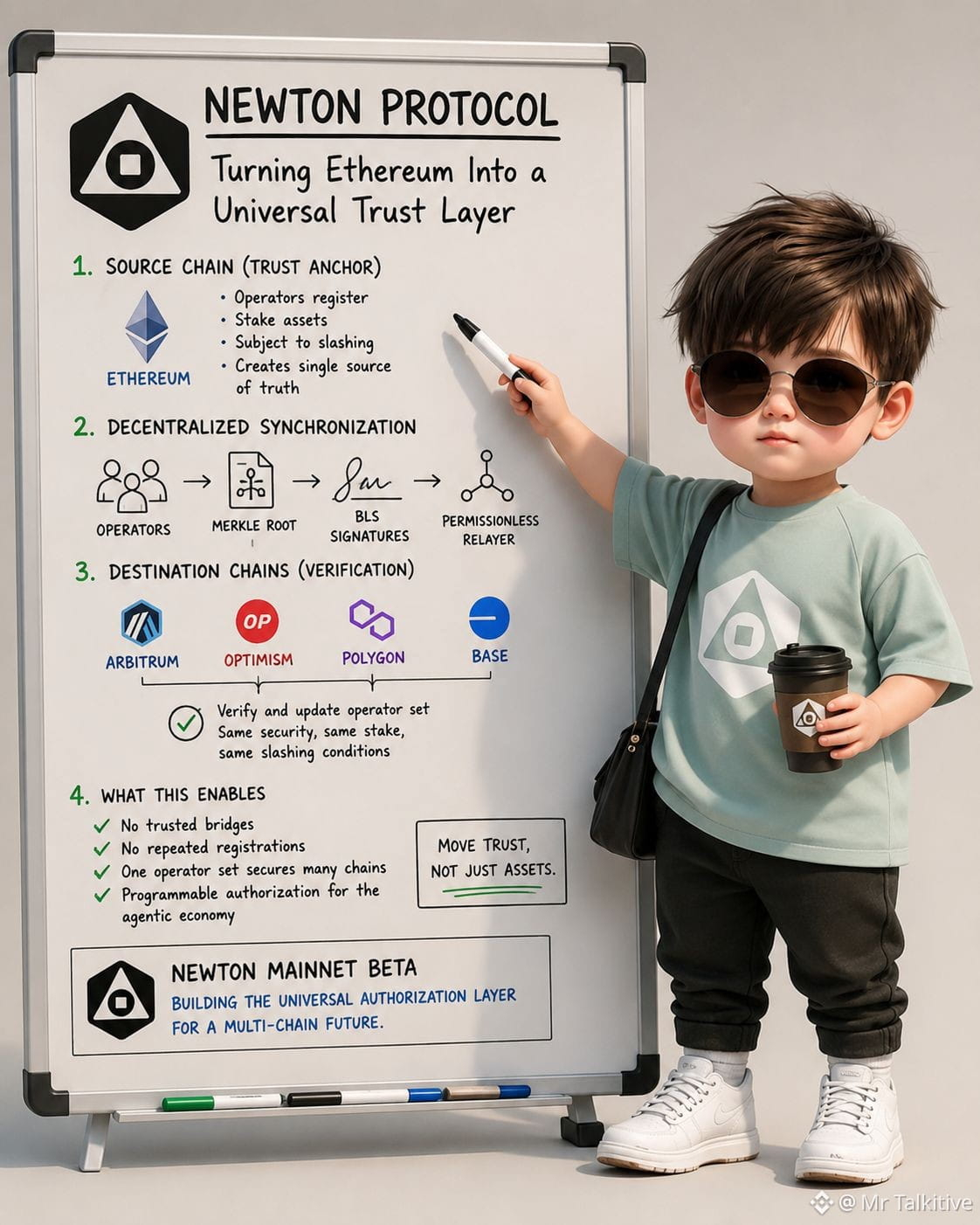
I have been researching cross-chain infrastructure recently and one thing that stands out is how @NewtonProtocol is approaching security differently. Most blockchain discussions focus on moving assets across ecosystems but Newton’s architecture as outlined in its official website and whitepaper focuses on something potentially more important extending trust across chains.
Instead of creating separate security assumptions for every ecosystem Newton uses Ethereum as a source chain where operators register stake and remain accountable through slashing mechanisms. Through a source chain, destination chain model supported networks can receive synchronized operator data and shared security guarantees without requiring repeated registrations across multiple chains.
What makes this interesting is that the protocol is not simply trying to connect networks. It is attempting to create a universal trust layer where the same operator set economic stake and security conditions can extend across different environments. Through decentralized synchronization using BLS signatures and Merkle-root verification trust can move without relying on centralized bridges.
With Newton Mainnet Beta progressing this vision is moving beyond theory and toward practical implementation. The future may not only be multi-chain it may also be secured by shared trust infrastructure.
$NEWT $VANRY $LAB
#cryptouniverseofficial
#CryptoAIRevolution #AI
{future}(NEWTUSDT)
{future}(VANRYUSDT)
{future}(LABUSDT)
#newt NEWTON PROTOCOL TURNING ETHEREUM INTO A UNIVERSAL TRUST LAYER
I have been researching cross-chain infrastructure recently and one thing that stands out is how @NewtonProtocol is approaching security differently. Most blockchain discussions focus on moving assets across ecosystems but Newton’s architecture as outlined in its official website and whitepaper focuses on something potentially more important extending trust across chains.
Instead of creating separate security assumptions for every ecosystem Newton uses Ethereum as a source chain where operators register stake and remain accountable through slashing mechanisms. Through a source chain, destination chain model supported networks can receive synchronized operator data and shared security guarantees without requiring repeated registrations across multiple chains.
What makes this interesting is that the protocol is not simply trying to connect networks. It is attempting to create a universal trust layer where the same operator set economic stake and security conditions can extend across different environments. Through decentralized synchronization using BLS signatures and Merkle-root verification trust can move without relying on centralized bridges.
With Newton Mainnet Beta progressing this vision is moving beyond theory and toward practical implementation. The future may not only be multi-chain it may also be secured by shared trust infrastructure.
$NEWT $VANRY $LAB
#cryptouniverseofficial
#CryptoAIRevolution #AI
I have been researching cross-chain infrastructure recently and one thing that stands out is how @NewtonProtocol is approaching security differently. Most blockchain discussions focus on moving assets across ecosystems but Newton’s architecture as outlined in its official website and whitepaper focuses on something potentially more important extending trust across chains.
Instead of creating separate security assumptions for every ecosystem Newton uses Ethereum as a source chain where operators register stake and remain accountable through slashing mechanisms. Through a source chain, destination chain model supported networks can receive synchronized operator data and shared security guarantees without requiring repeated registrations across multiple chains.
What makes this interesting is that the protocol is not simply trying to connect networks. It is attempting to create a universal trust layer where the same operator set economic stake and security conditions can extend across different environments. Through decentralized synchronization using BLS signatures and Merkle-root verification trust can move without relying on centralized bridges.
With Newton Mainnet Beta progressing this vision is moving beyond theory and toward practical implementation. The future may not only be multi-chain it may also be secured by shared trust infrastructure.
$NEWT $VANRY $LAB
#cryptouniverseofficial
#CryptoAIRevolution #AI
32
9
334
·
--
#newt I have been looking at how stablecoin infrastructure is evolving and I remember watching a stablecoin transfer settle while assuming the issuer's responsibility ended once the token contract executed exactly as designed.
What caught my attention was what the contract might not know.
Was the recipient located in an approved jurisdiction? Had either wallet appeared on a sanctions list? Did the transaction exceed a transfer limit or trigger an internal risk policy?
The more I studied decentralized systems the more that assumption started to feel incomplete. A contract can execute perfectly while still missing the policy checks an issuer expects. Application-level controls are useful but they can sometimes be bypassed if someone interacts directly with the smart contract.
That is what led me to Newton's authorization architecture.
I have been looking through Newton's documentation and I found that its model allows protected actions to require authorization before execution. Instead of trusting every interface to enforce compliance the smart contract itself can verify that an approval has been issued under the configured policy.
Newton describes policies that include sanctions screening jurisdiction verification transfer limits velocity checks and blocklists. A user signs an intent operators evaluate the policy BLS signatures are aggregated until quorum is reached and the contract validates that authorization before allowing the transaction to proceed.
This is where I think many people miss the bigger picture. The value is not another compliance dashboard. The value is making a protected action unable to ignore the issuer's policy simply because it arrived through a different interface.
@NewtonProtocol $NEWT $EVAA $NVDAB
#cryptouniverseofficial #AI
#CryptocurrencyWealth #CryptoAIRevolution
{spot}(NVDABUSDT)
{future}(EVAAUSDT)
{future}(NEWTUSDT)
What matters more for stablecoin compliance?
#newt I have been looking at how stablecoin infrastructure is evolving and I remember watching a stablecoin transfer settle while assuming the issuer's responsibility ended once the token contract executed exactly as designed.
What caught my attention was what the contract might not know.
Was the recipient located in an approved jurisdiction? Had either wallet appeared on a sanctions list? Did the transaction exceed a transfer limit or trigger an internal risk policy?
The more I studied decentralized systems the more that assumption started to feel incomplete. A contract can execute perfectly while still missing the policy checks an issuer expects. Application-level controls are useful but they can sometimes be bypassed if someone interacts directly with the smart contract.
That is what led me to Newton's authorization architecture.
I have been looking through Newton's documentation and I found that its model allows protected actions to require authorization before execution. Instead of trusting every interface to enforce compliance the smart contract itself can verify that an approval has been issued under the configured policy.
Newton describes policies that include sanctions screening jurisdiction verification transfer limits velocity checks and blocklists. A user signs an intent operators evaluate the policy BLS signatures are aggregated until quorum is reached and the contract validates that authorization before allowing the transaction to proceed.
This is where I think many people miss the bigger picture. The value is not another compliance dashboard. The value is making a protected action unable to ignore the issuer's policy simply because it arrived through a different interface.
@NewtonProtocol $NEWT $EVAA $NVDAB
#cryptouniverseofficial #AI
#CryptocurrencyWealth #CryptoAIRevolution
What matters more for stablecoin compliance?
What caught my attention was what the contract might not know.
Was the recipient located in an approved jurisdiction? Had either wallet appeared on a sanctions list? Did the transaction exceed a transfer limit or trigger an internal risk policy?
The more I studied decentralized systems the more that assumption started to feel incomplete. A contract can execute perfectly while still missing the policy checks an issuer expects. Application-level controls are useful but they can sometimes be bypassed if someone interacts directly with the smart contract.
That is what led me to Newton's authorization architecture.
I have been looking through Newton's documentation and I found that its model allows protected actions to require authorization before execution. Instead of trusting every interface to enforce compliance the smart contract itself can verify that an approval has been issued under the configured policy.
Newton describes policies that include sanctions screening jurisdiction verification transfer limits velocity checks and blocklists. A user signs an intent operators evaluate the policy BLS signatures are aggregated until quorum is reached and the contract validates that authorization before allowing the transaction to proceed.
This is where I think many people miss the bigger picture. The value is not another compliance dashboard. The value is making a protected action unable to ignore the issuer's policy simply because it arrived through a different interface.
@NewtonProtocol $NEWT $EVAA $NVDAB
#cryptouniverseofficial #AI
#CryptocurrencyWealth #CryptoAIRevolution
What matters more for stablecoin compliance?
On-chain enforcement ⛓️
25%
Better compliance policies 🤔
50%
Reliable identity data 😎
0%
All of the above 👍
25%
4 ຄະແນນສຽງ • ປິດລົງຄະແນນສຽງ
17
10
488
·
--
ບົດຄວາມ
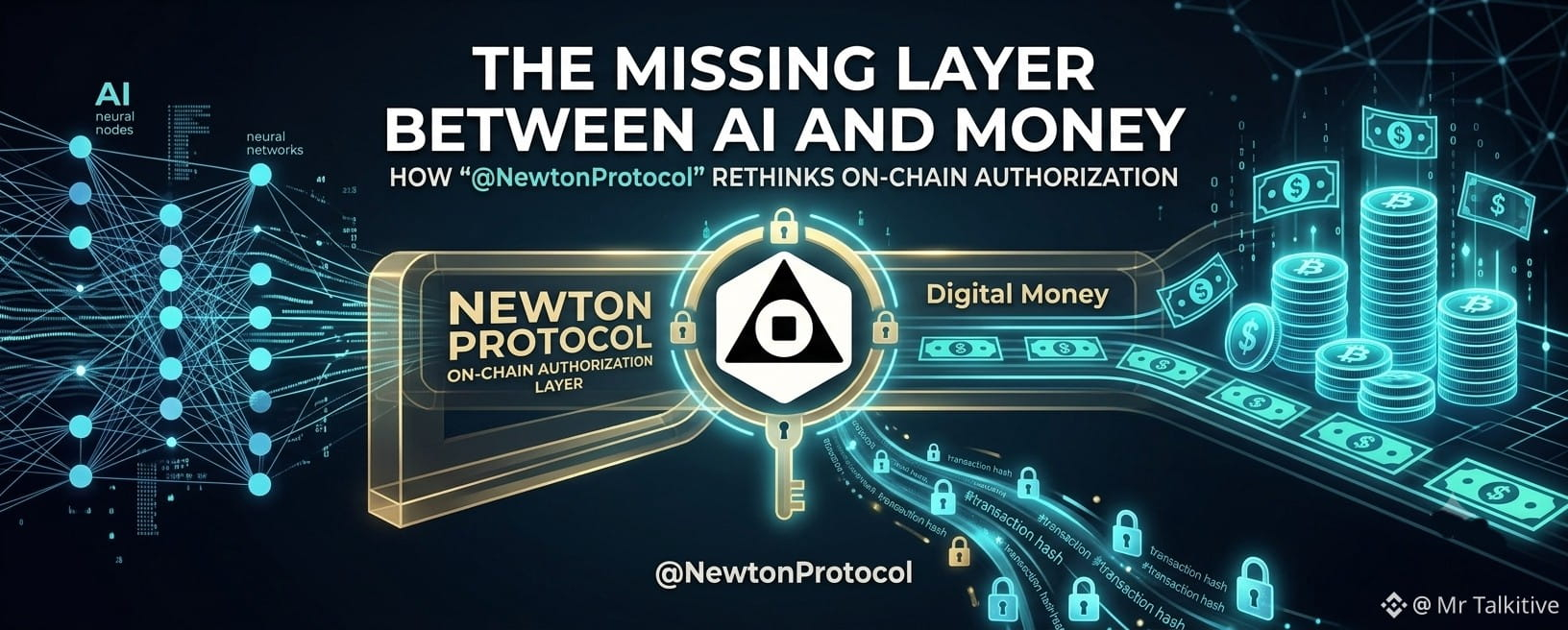
THE MISSING LAYER BETWEEN AI AND MONEY: HOW " @NewtonProtocol " RETHINKS ON-CHAIN AUTHORIZATIONI have been looking at the rapid progress of AI agents in crypto, and the more I study the space the more I keep returning to one question.
If AI is eventually trusted to move assets, negotiate payments and execute financial decisions on our behalf what should stand between the agent and the transaction?
That question is what first drew my attention to @NewtonProtocol
The concept itself is not difficult to understand. Rather than allowing an AI agent to sign transactions with broad authority, @NewtonProtocol introduces programmable authorization policies that determine exactly what an agent is allowed to do before any transaction reaches the blockchain. Spending limits, time restrictions, approved counterparties, and human approval thresholds become part of the execution process instead of an afterthought. The architecture feels less focused on replacing trust and more focused on defining it.
The part I have been thinking about most, however is not whether the technology works. It is whether the market is ready for it.
Today, most crypto activity is still remarkably manual. People review wallet prompts, approve transactions themselves and rely on familiar security practices. Even teams building AI-powered applications often use centralized backend services or permission lists because they are straightforward and already fit existing workflows. Those solutions may not be ideal but they are widely understood and relatively easy to deploy.
That raises an important question. Is decentralized authorization solving an urgent problem today or is it preparing for a problem that becomes obvious only after autonomous finance reaches a much larger scale?
I do not think that is an easy question to answer.
For @NewtonProtocol to succeed the protocol has to offer more than elegant engineering. Developers must believe that cryptographically enforced policies reduce operational risk enough to justify integrating another infrastructure layer. Institutions must see the measurable benefits in transparency auditability and compliance. Without those incentives technical sophistication alone is unlikely to drive widespread adoption.
I have also been reflecting on another distinction that often gets overlooked.
People sometimes describe decentralized authorization as removing trust but I do not see it that way. Instead it changes where trust exists. Rather than trusting an AI agent with unrestricted authority or depending entirely on centralized servers trust shifts toward transparent policy logic and decentralized validation. That does not eliminate trust it distributes it differently. Whether that represents an improvement depends entirely on the application's security requirements and threat model.
Timing may ultimately be the most important variable.
Technology history is filled with infrastructure that arrived years before demand caught up. Cloud computing, zero-knowledge proofs and even smart contract platforms all spent years searching for the right market conditions before their value became obvious. Looking at @NewtonProtocol through that lens makes me wonder whether it is following a similar path.
If autonomous AI systems begin managing treasuries, executing payments or coordinating machine-to-machine commerce an authorization layer like this could become essential infrastructure rather than an optional enhancement. On the other hand if autonomous finance develops more slowly than expected Newton may spend years waiting for the ecosystem to grow into the problem it was designed to solve.
That is why I find @NewtonProtocol worth studying.
The protocol is not simply introducing another blockchain feature. It is asking whether the future of on-chain finance requires transactions to be authorized by programmable policies rather than individual signatures. I do not think the answer depends solely on technology. It depends on whether human behavior, developer expectations and autonomous AI evolve to the point where the old model of trust is no longer sufficient.
If that transition happens the missing layer between AI and money may turn out to be authorization itself and that is exactly where Newton is positioning.
#Newt #cryptouniverseofficial #AI
#CryptocurrencyWealth #CryptoAIRevolution
$NEWT
{future}(NEWTUSDT)
$EVAA
{future}(EVAAUSDT)
$EDGE
{future}(EDGEUSDT)
THE MISSING LAYER BETWEEN AI AND MONEY: HOW " @NewtonProtocol " RETHINKS ON-CHAIN AUTHORIZATION
I have been looking at the rapid progress of AI agents in crypto, and the more I study the space the more I keep returning to one question.
If AI is eventually trusted to move assets, negotiate payments and execute financial decisions on our behalf what should stand between the agent and the transaction?
That question is what first drew my attention to @NewtonProtocol
The concept itself is not difficult to understand. Rather than allowing an AI agent to sign transactions with broad authority, @NewtonProtocol introduces programmable authorization policies that determine exactly what an agent is allowed to do before any transaction reaches the blockchain. Spending limits, time restrictions, approved counterparties, and human approval thresholds become part of the execution process instead of an afterthought. The architecture feels less focused on replacing trust and more focused on defining it.
The part I have been thinking about most, however is not whether the technology works. It is whether the market is ready for it.
Today, most crypto activity is still remarkably manual. People review wallet prompts, approve transactions themselves and rely on familiar security practices. Even teams building AI-powered applications often use centralized backend services or permission lists because they are straightforward and already fit existing workflows. Those solutions may not be ideal but they are widely understood and relatively easy to deploy.
That raises an important question. Is decentralized authorization solving an urgent problem today or is it preparing for a problem that becomes obvious only after autonomous finance reaches a much larger scale?
I do not think that is an easy question to answer.
For @NewtonProtocol to succeed the protocol has to offer more than elegant engineering. Developers must believe that cryptographically enforced policies reduce operational risk enough to justify integrating another infrastructure layer. Institutions must see the measurable benefits in transparency auditability and compliance. Without those incentives technical sophistication alone is unlikely to drive widespread adoption.
I have also been reflecting on another distinction that often gets overlooked.
People sometimes describe decentralized authorization as removing trust but I do not see it that way. Instead it changes where trust exists. Rather than trusting an AI agent with unrestricted authority or depending entirely on centralized servers trust shifts toward transparent policy logic and decentralized validation. That does not eliminate trust it distributes it differently. Whether that represents an improvement depends entirely on the application's security requirements and threat model.
Timing may ultimately be the most important variable.
Technology history is filled with infrastructure that arrived years before demand caught up. Cloud computing, zero-knowledge proofs and even smart contract platforms all spent years searching for the right market conditions before their value became obvious. Looking at @NewtonProtocol through that lens makes me wonder whether it is following a similar path.
If autonomous AI systems begin managing treasuries, executing payments or coordinating machine-to-machine commerce an authorization layer like this could become essential infrastructure rather than an optional enhancement. On the other hand if autonomous finance develops more slowly than expected Newton may spend years waiting for the ecosystem to grow into the problem it was designed to solve.
That is why I find @NewtonProtocol worth studying.
The protocol is not simply introducing another blockchain feature. It is asking whether the future of on-chain finance requires transactions to be authorized by programmable policies rather than individual signatures. I do not think the answer depends solely on technology. It depends on whether human behavior, developer expectations and autonomous AI evolve to the point where the old model of trust is no longer sufficient.
If that transition happens the missing layer between AI and money may turn out to be authorization itself and that is exactly where Newton is positioning.
#Newt #cryptouniverseofficial #AI
#CryptocurrencyWealth #CryptoAIRevolution
$NEWT
$EVAA
$EDGE
If AI is eventually trusted to move assets, negotiate payments and execute financial decisions on our behalf what should stand between the agent and the transaction?
That question is what first drew my attention to @NewtonProtocol
The concept itself is not difficult to understand. Rather than allowing an AI agent to sign transactions with broad authority, @NewtonProtocol introduces programmable authorization policies that determine exactly what an agent is allowed to do before any transaction reaches the blockchain. Spending limits, time restrictions, approved counterparties, and human approval thresholds become part of the execution process instead of an afterthought. The architecture feels less focused on replacing trust and more focused on defining it.
The part I have been thinking about most, however is not whether the technology works. It is whether the market is ready for it.
Today, most crypto activity is still remarkably manual. People review wallet prompts, approve transactions themselves and rely on familiar security practices. Even teams building AI-powered applications often use centralized backend services or permission lists because they are straightforward and already fit existing workflows. Those solutions may not be ideal but they are widely understood and relatively easy to deploy.
That raises an important question. Is decentralized authorization solving an urgent problem today or is it preparing for a problem that becomes obvious only after autonomous finance reaches a much larger scale?
I do not think that is an easy question to answer.
For @NewtonProtocol to succeed the protocol has to offer more than elegant engineering. Developers must believe that cryptographically enforced policies reduce operational risk enough to justify integrating another infrastructure layer. Institutions must see the measurable benefits in transparency auditability and compliance. Without those incentives technical sophistication alone is unlikely to drive widespread adoption.
I have also been reflecting on another distinction that often gets overlooked.
People sometimes describe decentralized authorization as removing trust but I do not see it that way. Instead it changes where trust exists. Rather than trusting an AI agent with unrestricted authority or depending entirely on centralized servers trust shifts toward transparent policy logic and decentralized validation. That does not eliminate trust it distributes it differently. Whether that represents an improvement depends entirely on the application's security requirements and threat model.
Timing may ultimately be the most important variable.
Technology history is filled with infrastructure that arrived years before demand caught up. Cloud computing, zero-knowledge proofs and even smart contract platforms all spent years searching for the right market conditions before their value became obvious. Looking at @NewtonProtocol through that lens makes me wonder whether it is following a similar path.
If autonomous AI systems begin managing treasuries, executing payments or coordinating machine-to-machine commerce an authorization layer like this could become essential infrastructure rather than an optional enhancement. On the other hand if autonomous finance develops more slowly than expected Newton may spend years waiting for the ecosystem to grow into the problem it was designed to solve.
That is why I find @NewtonProtocol worth studying.
The protocol is not simply introducing another blockchain feature. It is asking whether the future of on-chain finance requires transactions to be authorized by programmable policies rather than individual signatures. I do not think the answer depends solely on technology. It depends on whether human behavior, developer expectations and autonomous AI evolve to the point where the old model of trust is no longer sufficient.
If that transition happens the missing layer between AI and money may turn out to be authorization itself and that is exactly where Newton is positioning.
#Newt #cryptouniverseofficial #AI
#CryptocurrencyWealth #CryptoAIRevolution
$NEWT
$EVAA
$EDGE
33
12
334

·
--
ສັນຍານກະທິງ
🚀 ¡UNIFAI (UAI) YA ESTÁ EN BINANCE!
La unión entre IA y blockchain acaba de subir de nivel.
El token $UAI de UnifAI ya fue listado oficialmente en Binance — tanto en spot como en futuros UAI/USDT$.
Esto no es hype, es adopción real. 🔥
🧠 ¿Por qué todos están hablando de UnifAI?
💡 Combina inteligencia artificial + Web3, una de las temáticas con más crecimiento del 2025.
📊 Binance le da visibilidad global, liquidez instantánea y confianza al proyecto.
⚙️ Tecnología diseñada para que los modelos de IA operen en entornos descentralizados y seguros.
Proyectos de IA como $RNDR, $FET o $AGIX ya mostraron lo que puede pasar cuando la IA llega al mundo cripto…
👉 UnifAI podría ser el siguiente gran salto.
💥 ¿Y vos? ¿Vas a mirar desde afuera o vas a ser parte?
Los que llegan temprano son los que escriben la historia.
El mercado apenas empieza a reaccionar y la oportunidad está abierta.
🔗 Buscá UAI/USDT en Binance
📈 Evaluá tu entrada antes de que el FOMO sea real
💬 Contanos: ¿creés que la IA será la próxima ola en cripto?
#UnifAI #UAI #BinanceLatam #CryptoAIRevolution #Blockchain #IARevolution #CriptoArgentina #CryptoLatino #FOMO #BinanceSquare
🚀 ¡UNIFAI (UAI) YA ESTÁ EN BINANCE!
La unión entre IA y blockchain acaba de subir de nivel.
El token $UAI de UnifAI ya fue listado oficialmente en Binance — tanto en spot como en futuros UAI/USDT$.
Esto no es hype, es adopción real. 🔥
🧠 ¿Por qué todos están hablando de UnifAI?
💡 Combina inteligencia artificial + Web3, una de las temáticas con más crecimiento del 2025.
📊 Binance le da visibilidad global, liquidez instantánea y confianza al proyecto.
⚙️ Tecnología diseñada para que los modelos de IA operen en entornos descentralizados y seguros.
Proyectos de IA como $RNDR, $FET o $AGIX ya mostraron lo que puede pasar cuando la IA llega al mundo cripto…
👉 UnifAI podría ser el siguiente gran salto.
💥 ¿Y vos? ¿Vas a mirar desde afuera o vas a ser parte?
Los que llegan temprano son los que escriben la historia.
El mercado apenas empieza a reaccionar y la oportunidad está abierta.
🔗 Buscá UAI/USDT en Binance
📈 Evaluá tu entrada antes de que el FOMO sea real
💬 Contanos: ¿creés que la IA será la próxima ola en cripto?
#UnifAI #UAI #BinanceLatam #CryptoAIRevolution #Blockchain #IARevolution #CriptoArgentina #CryptoLatino #FOMO #BinanceSquare
La unión entre IA y blockchain acaba de subir de nivel.
El token $UAI de UnifAI ya fue listado oficialmente en Binance — tanto en spot como en futuros UAI/USDT$.
Esto no es hype, es adopción real. 🔥
🧠 ¿Por qué todos están hablando de UnifAI?
💡 Combina inteligencia artificial + Web3, una de las temáticas con más crecimiento del 2025.
📊 Binance le da visibilidad global, liquidez instantánea y confianza al proyecto.
⚙️ Tecnología diseñada para que los modelos de IA operen en entornos descentralizados y seguros.
Proyectos de IA como $RNDR, $FET o $AGIX ya mostraron lo que puede pasar cuando la IA llega al mundo cripto…
👉 UnifAI podría ser el siguiente gran salto.
💥 ¿Y vos? ¿Vas a mirar desde afuera o vas a ser parte?
Los que llegan temprano son los que escriben la historia.
El mercado apenas empieza a reaccionar y la oportunidad está abierta.
🔗 Buscá UAI/USDT en Binance
📈 Evaluá tu entrada antes de que el FOMO sea real
💬 Contanos: ¿creés que la IA será la próxima ola en cripto?
#UnifAI #UAI #BinanceLatam #CryptoAIRevolution #Blockchain #IARevolution #CriptoArgentina #CryptoLatino #FOMO #BinanceSquare
225
·
--
ສັນຍານກະທິງ
ຢືນຢັນແລ້ວ
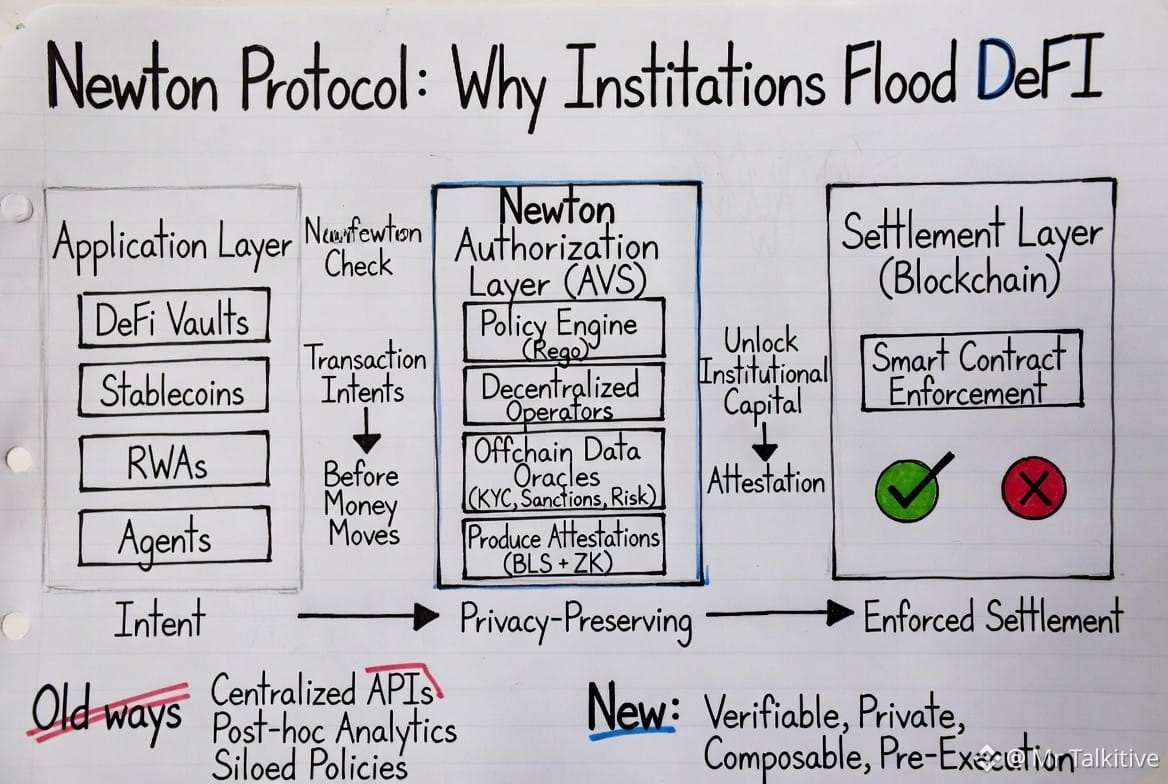
#newt Why Institutions Are About to Flood DeFi: Newton’s Verifiable Policy Layer Changes Everything
DeFi has long promised trillions in liquidity but institutions have largely stayed on the sidelines. The reason? Missing infrastructure for compliance risk management and verifiable controls in a permissionless world. Newton Protocol is changing that fast.
Traditional onchain compliance falls short centralized APIs create single points of failure and opaque decisions soulbound tokens expose sensitive identity data analytics platforms only detect problems after the fact and per-app policy logic leads to inconsistent non-composable enforcement. Permissioned chains sacrifice the very composability and liquidity that make DeFi powerful.
Newton solves this as a decentralized authorization layer. It sits between applications and settlement evaluating transaction intents in real time using programmable policies written in Rego. A neutral operator network (secured as an EigenLayer AVS) checks conditions sanctions screening, KYC, spending limits, risk thresholds, investor eligibility and produces cryptographic attestations. Smart contracts then enforce these attestations before execution. No UX friction. Full onchain verifiability via the Newton Explorer.
Privacy is preserved through zero-knowledge proofs and verifiable credentials. Policies are composable and reusable across vaults, stablecoins, RWAs and agentic systems. Write once enforce everywhere.
For institutions this means institutional-grade guardrails without silos or centralized intermediaries. Stablecoin issuers and RWA platforms gain compliant issuance and transfers that regulators can trust.
The result? Safer capital inflows into public DeFi. Newton bridges programmable policy with permissionless innovation turning compliance from a barrier into infrastructure.
@NewtonProtocol #Newt #AI #CryptoAIRevolution #CryptocurrencyWealth
$NEWT
{future}(NEWTUSDT)
$ARPA
{future}(ARPAUSDT)
$THE
{future}(THEUSDT)
#newt Why Institutions Are About to Flood DeFi: Newton’s Verifiable Policy Layer Changes Everything
DeFi has long promised trillions in liquidity but institutions have largely stayed on the sidelines. The reason? Missing infrastructure for compliance risk management and verifiable controls in a permissionless world. Newton Protocol is changing that fast.
Traditional onchain compliance falls short centralized APIs create single points of failure and opaque decisions soulbound tokens expose sensitive identity data analytics platforms only detect problems after the fact and per-app policy logic leads to inconsistent non-composable enforcement. Permissioned chains sacrifice the very composability and liquidity that make DeFi powerful.
Newton solves this as a decentralized authorization layer. It sits between applications and settlement evaluating transaction intents in real time using programmable policies written in Rego. A neutral operator network (secured as an EigenLayer AVS) checks conditions sanctions screening, KYC, spending limits, risk thresholds, investor eligibility and produces cryptographic attestations. Smart contracts then enforce these attestations before execution. No UX friction. Full onchain verifiability via the Newton Explorer.
Privacy is preserved through zero-knowledge proofs and verifiable credentials. Policies are composable and reusable across vaults, stablecoins, RWAs and agentic systems. Write once enforce everywhere.
For institutions this means institutional-grade guardrails without silos or centralized intermediaries. Stablecoin issuers and RWA platforms gain compliant issuance and transfers that regulators can trust.
The result? Safer capital inflows into public DeFi. Newton bridges programmable policy with permissionless innovation turning compliance from a barrier into infrastructure.
@NewtonProtocol #Newt #AI #CryptoAIRevolution #CryptocurrencyWealth
$NEWT
$ARPA
$THE
DeFi has long promised trillions in liquidity but institutions have largely stayed on the sidelines. The reason? Missing infrastructure for compliance risk management and verifiable controls in a permissionless world. Newton Protocol is changing that fast.
Traditional onchain compliance falls short centralized APIs create single points of failure and opaque decisions soulbound tokens expose sensitive identity data analytics platforms only detect problems after the fact and per-app policy logic leads to inconsistent non-composable enforcement. Permissioned chains sacrifice the very composability and liquidity that make DeFi powerful.
Newton solves this as a decentralized authorization layer. It sits between applications and settlement evaluating transaction intents in real time using programmable policies written in Rego. A neutral operator network (secured as an EigenLayer AVS) checks conditions sanctions screening, KYC, spending limits, risk thresholds, investor eligibility and produces cryptographic attestations. Smart contracts then enforce these attestations before execution. No UX friction. Full onchain verifiability via the Newton Explorer.
Privacy is preserved through zero-knowledge proofs and verifiable credentials. Policies are composable and reusable across vaults, stablecoins, RWAs and agentic systems. Write once enforce everywhere.
For institutions this means institutional-grade guardrails without silos or centralized intermediaries. Stablecoin issuers and RWA platforms gain compliant issuance and transfers that regulators can trust.
The result? Safer capital inflows into public DeFi. Newton bridges programmable policy with permissionless innovation turning compliance from a barrier into infrastructure.
@NewtonProtocol #Newt #AI #CryptoAIRevolution #CryptocurrencyWealth
$NEWT
$ARPA
$THE
42
12
397

·
--
Sitting on 2,355 TXENE 👀
Time to circulate it.
Need testnet $TXENE?
Drop address + follow 👇
I’m sending to grinders only.
Let’s stress test XENEA Testnet together 🛠️
#CryptoAIRevolution #cryptoairdrop2026
Sitting on 2,355 TXENE 👀
Time to circulate it.
Need testnet $TXENE?
Drop address + follow 👇
I’m sending to grinders only.
Let’s stress test XENEA Testnet together 🛠️
#CryptoAIRevolution #cryptoairdrop2026
Time to circulate it.
Need testnet $TXENE?
Drop address + follow 👇
I’m sending to grinders only.
Let’s stress test XENEA Testnet together 🛠️
#CryptoAIRevolution #cryptoairdrop2026
9
·
--
#newt I have been looking at crypto infrastructure long enough to realize that most discussions focus on the wrong metrics. People ask how fast a transaction settles or how low the fees are. I am more interested in what happens when things go wrong when oracles lag risk scores return null or compliance rules change overnight. That is where @NewtonProtocol caught my attention.
What stands out about @NewtonProtocol is its authorization layer between intent and execution. Instead of hardcoding every policy into smart contracts it evaluates transactions before they settle. Identity checks, jurisdiction rules, spending limits, collateral requirements and real-time oracle data all become part of the decision-making process. If the policy passes the transaction is authorized. If not it stops before execution.
I think the biggest advantage of @NewtonProtocol is flexibility. Policies can evolve without the redeploying smart contracts making the system far more adaptable for institutions operating under the changing regulations. There is a trade-off though. Adding an authorization layer introduces for more architectural complexity and additional components that must remain secure.
The feature I find most compelling is how @NewtonProtocol handles uncertainty. A missing risk score is not automatically treated as safe or dangerous. Instead of simply allowing or denying a transaction it can reduce limits, request secondary verification, or place the transaction under review. That distinction between “high risk” and “insufficient evidence” reflects thoughtful infrastructure design.
As AI agents begin making autonomous financial decisions I believe the most important question is no longer how quickly a transaction executes but whether it should execute at all. Execution is becoming expected. Authorization is where the next wave of innovation begins.
$NEWT $EVAA $SYN
{future}(EVAAUSDT)
{future}(NEWTUSDT)
{future}(SYNUSDT)
#cryptouniverseofficial #CryptoAIRevolution
#AI #CryptocurrencyWealth
As crypto infrastructure evolves, what will matter most?
#newt I have been looking at crypto infrastructure long enough to realize that most discussions focus on the wrong metrics. People ask how fast a transaction settles or how low the fees are. I am more interested in what happens when things go wrong when oracles lag risk scores return null or compliance rules change overnight. That is where @NewtonProtocol caught my attention.
What stands out about @NewtonProtocol is its authorization layer between intent and execution. Instead of hardcoding every policy into smart contracts it evaluates transactions before they settle. Identity checks, jurisdiction rules, spending limits, collateral requirements and real-time oracle data all become part of the decision-making process. If the policy passes the transaction is authorized. If not it stops before execution.
I think the biggest advantage of @NewtonProtocol is flexibility. Policies can evolve without the redeploying smart contracts making the system far more adaptable for institutions operating under the changing regulations. There is a trade-off though. Adding an authorization layer introduces for more architectural complexity and additional components that must remain secure.
The feature I find most compelling is how @NewtonProtocol handles uncertainty. A missing risk score is not automatically treated as safe or dangerous. Instead of simply allowing or denying a transaction it can reduce limits, request secondary verification, or place the transaction under review. That distinction between “high risk” and “insufficient evidence” reflects thoughtful infrastructure design.
As AI agents begin making autonomous financial decisions I believe the most important question is no longer how quickly a transaction executes but whether it should execute at all. Execution is becoming expected. Authorization is where the next wave of innovation begins.
$NEWT $EVAA $SYN
#cryptouniverseofficial #CryptoAIRevolution
#AI #CryptocurrencyWealth
As crypto infrastructure evolves, what will matter most?
What stands out about @NewtonProtocol is its authorization layer between intent and execution. Instead of hardcoding every policy into smart contracts it evaluates transactions before they settle. Identity checks, jurisdiction rules, spending limits, collateral requirements and real-time oracle data all become part of the decision-making process. If the policy passes the transaction is authorized. If not it stops before execution.
I think the biggest advantage of @NewtonProtocol is flexibility. Policies can evolve without the redeploying smart contracts making the system far more adaptable for institutions operating under the changing regulations. There is a trade-off though. Adding an authorization layer introduces for more architectural complexity and additional components that must remain secure.
The feature I find most compelling is how @NewtonProtocol handles uncertainty. A missing risk score is not automatically treated as safe or dangerous. Instead of simply allowing or denying a transaction it can reduce limits, request secondary verification, or place the transaction under review. That distinction between “high risk” and “insufficient evidence” reflects thoughtful infrastructure design.
As AI agents begin making autonomous financial decisions I believe the most important question is no longer how quickly a transaction executes but whether it should execute at all. Execution is becoming expected. Authorization is where the next wave of innovation begins.
$NEWT $EVAA $SYN
#cryptouniverseofficial #CryptoAIRevolution
#AI #CryptocurrencyWealth
As crypto infrastructure evolves, what will matter most?
Faster transaction execution⬆️
50%
Lower transaction fees 〽️
0%
Smart execution authorization
50%
Real-time compliance ⭕️
0%
2 ຄະແນນສຽງ • ປິດລົງຄະແນນສຽງ
30
10
661
·
--
ຢືນຢັນແລ້ວ
ບົດຄວາມ
WHY NEWTON PROTOCOL COULD KILL THE NEED FOR TRADITIONAL CROSS-CHAIN BRIDGESI have been noticing that one of crypto’s biggest promises has also become one of its biggest weaknesses interoperability. Blockchains became more scalable ecosystems expanded and users moved across networks such as Ethereum Layer-2s and application specific chains. But moving value and trust between chains often introduced a new problem bridges.
Traditional bridges were supposed to connect ecosystems. Instead many became additional trust assumptions security risks and points of failure. Users often had to rely on multisigs external validators, or centralized intermediaries to move information and assets across networks. As Web3 grows into AI agents institutional finance stablecoins and RWAs that model begins to look increasingly outdated.
This is where @NewtonProtocol presents an interesting architectural shift.
According to the Newton Protocol framework official documentation and whitepaper the project is not simply building another bridge. Instead it introduces a decentralized policy and authorization layer designed for programmable compliance and the emerging agentic economy. Rather than asking “How do we move assets across chains?” Newton asks a different question “How do we move trust?”
The difference matters.
Newton uses a source chain and destination chain model. Ethereum acts as the source of truth where operators register stake assets and become subject to slashing conditions. Destination chains such as Arbitrum Optimism Polygon and Base do not require operators to repeatedly register across every ecosystem.
Instead Newton synchronizes operator information through a decentralized mechanism using BLS signatures and Merkle-root based verification. When operator status changes whether through registration updates stake changes or slashing events operators collectively generate a signed state of the network. Permissionless relayers deliver this information to destination chains where verification occurs on-chain.
The most important detail is what does not exist in this model.
There is no centralized bridge controlling trust.
There is no privileged intermediary deciding which chain should be trusted.
There is no duplicated security model for every ecosystem.
Instead the same operator set, the same economic stake and the same security assumptions can extend across multiple chains.
This becomes even more relevant in the context of Newton Mainnet Beta. The authorization layer concept is moving beyond theory and into practical deployment. As on-chain finance evolves transaction execution alone is no longer enough. The next challenge is transaction authorization.
Smart contracts are powerful but they are often blind to real-world context. They cannot naturally understand whether an AI agent exceeds spending limits whether a compliance rule has been violated or whether off-chain conditions should prevent execution. Newton attempts to solve that gap through programmable policies enforced by decentralized operators.
The long-term implication may be larger than interoperability itself.
Crypto originally focused on moving assets across chains. The next phase could focus on moving verifiable intent and trusted authorization across chains.
If that vision succeeds traditional bridges may no longer be the center of cross-chain infrastructure.
Instead authorization layers could become the foundation.
Keep an eye on $NEWT as the ecosystem develops because the conversation may eventually shift from “Which chain are you using?” to “Which trust layer secures it?”
#Newt #AI #CryptoAIRevolution
{future}(NEWTUSDT)
$VANRY
{future}(VANRYUSDT)
$BEL
{future}(BELUSDT)
#crypto #cryptouniverseofficial
WHY NEWTON PROTOCOL COULD KILL THE NEED FOR TRADITIONAL CROSS-CHAIN BRIDGES
I have been noticing that one of crypto’s biggest promises has also become one of its biggest weaknesses interoperability. Blockchains became more scalable ecosystems expanded and users moved across networks such as Ethereum Layer-2s and application specific chains. But moving value and trust between chains often introduced a new problem bridges.
Traditional bridges were supposed to connect ecosystems. Instead many became additional trust assumptions security risks and points of failure. Users often had to rely on multisigs external validators, or centralized intermediaries to move information and assets across networks. As Web3 grows into AI agents institutional finance stablecoins and RWAs that model begins to look increasingly outdated.
This is where @NewtonProtocol presents an interesting architectural shift.
According to the Newton Protocol framework official documentation and whitepaper the project is not simply building another bridge. Instead it introduces a decentralized policy and authorization layer designed for programmable compliance and the emerging agentic economy. Rather than asking “How do we move assets across chains?” Newton asks a different question “How do we move trust?”
The difference matters.
Newton uses a source chain and destination chain model. Ethereum acts as the source of truth where operators register stake assets and become subject to slashing conditions. Destination chains such as Arbitrum Optimism Polygon and Base do not require operators to repeatedly register across every ecosystem.
Instead Newton synchronizes operator information through a decentralized mechanism using BLS signatures and Merkle-root based verification. When operator status changes whether through registration updates stake changes or slashing events operators collectively generate a signed state of the network. Permissionless relayers deliver this information to destination chains where verification occurs on-chain.
The most important detail is what does not exist in this model.
There is no centralized bridge controlling trust.
There is no privileged intermediary deciding which chain should be trusted.
There is no duplicated security model for every ecosystem.
Instead the same operator set, the same economic stake and the same security assumptions can extend across multiple chains.
This becomes even more relevant in the context of Newton Mainnet Beta. The authorization layer concept is moving beyond theory and into practical deployment. As on-chain finance evolves transaction execution alone is no longer enough. The next challenge is transaction authorization.
Smart contracts are powerful but they are often blind to real-world context. They cannot naturally understand whether an AI agent exceeds spending limits whether a compliance rule has been violated or whether off-chain conditions should prevent execution. Newton attempts to solve that gap through programmable policies enforced by decentralized operators.
The long-term implication may be larger than interoperability itself.
Crypto originally focused on moving assets across chains. The next phase could focus on moving verifiable intent and trusted authorization across chains.
If that vision succeeds traditional bridges may no longer be the center of cross-chain infrastructure.
Instead authorization layers could become the foundation.
Keep an eye on $NEWT as the ecosystem develops because the conversation may eventually shift from “Which chain are you using?” to “Which trust layer secures it?”
#Newt #AI #CryptoAIRevolution
$VANRY
$BEL
#crypto #cryptouniverseofficial
Traditional bridges were supposed to connect ecosystems. Instead many became additional trust assumptions security risks and points of failure. Users often had to rely on multisigs external validators, or centralized intermediaries to move information and assets across networks. As Web3 grows into AI agents institutional finance stablecoins and RWAs that model begins to look increasingly outdated.
This is where @NewtonProtocol presents an interesting architectural shift.
According to the Newton Protocol framework official documentation and whitepaper the project is not simply building another bridge. Instead it introduces a decentralized policy and authorization layer designed for programmable compliance and the emerging agentic economy. Rather than asking “How do we move assets across chains?” Newton asks a different question “How do we move trust?”
The difference matters.
Newton uses a source chain and destination chain model. Ethereum acts as the source of truth where operators register stake assets and become subject to slashing conditions. Destination chains such as Arbitrum Optimism Polygon and Base do not require operators to repeatedly register across every ecosystem.
Instead Newton synchronizes operator information through a decentralized mechanism using BLS signatures and Merkle-root based verification. When operator status changes whether through registration updates stake changes or slashing events operators collectively generate a signed state of the network. Permissionless relayers deliver this information to destination chains where verification occurs on-chain.
The most important detail is what does not exist in this model.
There is no centralized bridge controlling trust.
There is no privileged intermediary deciding which chain should be trusted.
There is no duplicated security model for every ecosystem.
Instead the same operator set, the same economic stake and the same security assumptions can extend across multiple chains.
This becomes even more relevant in the context of Newton Mainnet Beta. The authorization layer concept is moving beyond theory and into practical deployment. As on-chain finance evolves transaction execution alone is no longer enough. The next challenge is transaction authorization.
Smart contracts are powerful but they are often blind to real-world context. They cannot naturally understand whether an AI agent exceeds spending limits whether a compliance rule has been violated or whether off-chain conditions should prevent execution. Newton attempts to solve that gap through programmable policies enforced by decentralized operators.
The long-term implication may be larger than interoperability itself.
Crypto originally focused on moving assets across chains. The next phase could focus on moving verifiable intent and trusted authorization across chains.
If that vision succeeds traditional bridges may no longer be the center of cross-chain infrastructure.
Instead authorization layers could become the foundation.
Keep an eye on $NEWT as the ecosystem develops because the conversation may eventually shift from “Which chain are you using?” to “Which trust layer secures it?”
#Newt #AI #CryptoAIRevolution
$VANRY
$BEL
#crypto #cryptouniverseofficial
37
8
297
ເຂົ້າສູ່ລະບົບເພື່ອສຳຫຼວດເນື້ອຫາເພີ່ມເຕີມ
ເຂົ້າຮ່ວມກຸ່ມຜູ້ໃຊ້ຄຣິບໂຕທົ່ວໂລກໃນ Binance Square.
⚡️ ໄດ້ຮັບຂໍ້ມູນຫຼ້າສຸດ ແລະ ທີ່ມີປະໂຫຍດກ່ຽວກັບຄຣິບໂຕ.
💬 ໄດ້ຮັບຄວາມໄວ້ວາງໃຈຈາກຕະຫຼາດແລກປ່ຽນຄຣິບໂຕທີ່ໃຫຍ່ທີ່ສຸດໃນໂລກ.
👍 ຄົ້ນຫາຂໍ້ມູນເຊີງເລິກທີ່ແທ້ຈາກນັກສ້າງທີ່ໄດ້ຮັບການຢືນຢັນ.
ອີເມວ / ເບີໂທລະສັບ
ຫົວຂໍ້ທີ່ກໍາລັງນິຍົມ
1
#BinancePick
3.2M ຄັ້ງທີ່ເບິ່ງ
159,096 ກຳລັງສົນທະນາ
2
#EarningsSeason
5.4M ຄັ້ງທີ່ເບິ່ງ
26,353 ກຳລັງສົນທະນາ
3
#BitmineAdds10452ETH
862 ຄັ້ງທີ່ເບິ່ງ
38 ກຳລັງສົນທະນາ
4
#SouthKoreaConsidersEducationTaxOnCryptoExchanges
1,193 ຄັ້ງທີ່ເບິ່ງ
57 ກຳລັງສົນທະນາ
5
#OCCUrgesCommunityBanksToEnterStablecoinPayments
661 ຄັ້ງທີ່ເບິ່ງ
36 ກຳລັງສົນທະນາ
6
#RippleWinsFullApprovalAsNationalTrustBank
696 ຄັ້ງທີ່ເບິ່ງ
36 ກຳລັງສົນທະນາ
7
#AkashSelectsSolanaAsMigrationTarget
428 ຄັ້ງທີ່ເບິ່ງ
8 ກຳລັງສົນທະນາ
8
#OndoToOpenSubscriptionsForOpenAIPreIPOTokenizedNotes
43 ຄັ້ງທີ່ເບິ່ງ
4 ກຳລັງສົນທະນາ
9
#AnthropicTTMRevenueGrewAbout1200%
45,868 ຄັ້ງທີ່ເບິ່ງ
522 ກຳລັງສົນທະນາ
10
#AnthropicS1ExpectedToday
37,268 ຄັ້ງທີ່ເບິ່ງ
408 ກຳລັງສົນທະນາ