

Techno BNB
16.8k Жариялаулар

Techno BNB
 «Square расталған+» белгісі
Хабарлау
Пайдаланушыны блоктау
Content Creator | Researcher | Strategy Architect 🌟

XPL ұстаушы
Жиі сауда жасайтын трейдер
4.7 жыл
1.6K+ Жазылым
55.3K+ Жазылушылар
36.6K+ лайк басылған
Жазбалар
Барлығы
Баға ұсыныстары
Тікелей эфир
PINNED

·
--
YZ
YZ

奕泽YIZZE
·
--
Follow, like, and share to get a red envelope🧧🧧🧧🧧
关注点赞分享,领取红包!🧧🧧🧧🧧
LUCiC,价值始于共识,未来始于坚持。
关注点赞分享,领取红包!🧧🧧🧧🧧
LUCiC,价值始于共识,未来始于坚持。

106

·
--
Wolf
Wolf

WOLF 狼
·
--
Жоғары (өспелі)Alert Claim BNB Reward Fast Claim 🎉 🧧
The yellow check mark is officially back after 2 months today is a double win because of all of you.🎉
Two months is a long time to wait, but patience always pays off. Having the yellow check mark back today has me feeling pumped up and ready for what's next.⚡️🔥
Success is always better when it's shared. To celebrate today's incredible vibe, a reward is waiting for you all! Grab yours before it runs out.✨
Go claim your red packet now and celebrate with the family.🧧🎁
$BNB
The yellow check mark is officially back after 2 months today is a double win because of all of you.🎉
Two months is a long time to wait, but patience always pays off. Having the yellow check mark back today has me feeling pumped up and ready for what's next.⚡️🔥
Success is always better when it's shared. To celebrate today's incredible vibe, a reward is waiting for you all! Grab yours before it runs out.✨
Go claim your red packet now and celebrate with the family.🧧🎁
$BNB

101
·
--
TR
TR

TradeMaster_PK
·
--
Жоғары (өспелі)Received USDT Rewards Gift 🎁🎁🎁🎁🎁🎁🎁🧧🧧🧧🧧🧧🎁🎁🎁🎁
1 follow me
2 like
3 repos
#Ether ETFs extend inflow streak today
#USStrikesTargetsNearHormuzAndJask
1 follow me
2 like
3 repos
#Ether ETFs extend inflow streak today
#USStrikesTargetsNearHormuzAndJask

43
·
--
KG
KG
king Gulfam
·
--
Жоғары (өспелі)#EarningsSeason
@ZEC @BNC @NEAR
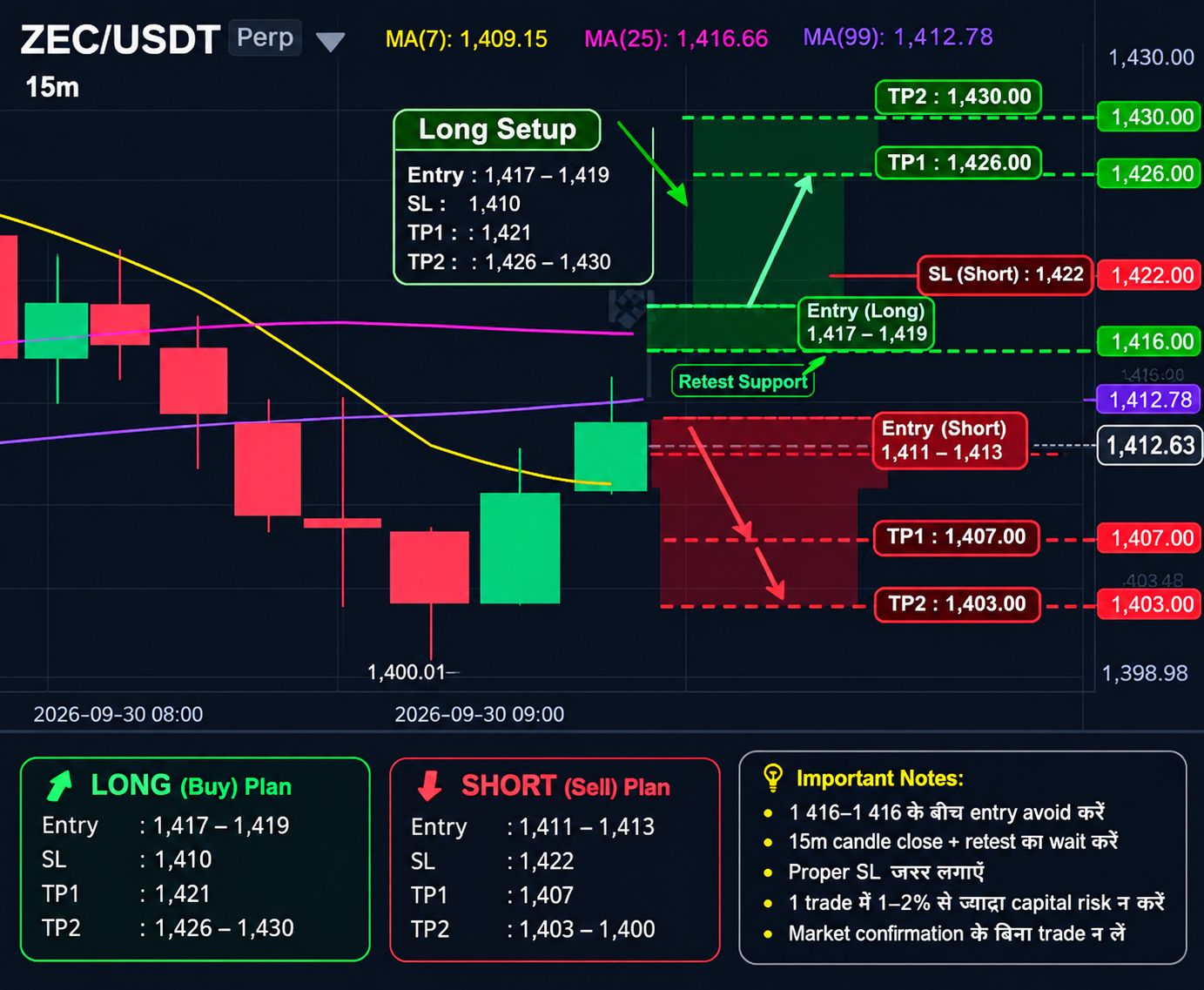
$ZEC
🟢 Long setup:
1416.7 ke upar 15m candle close ho aur retest hold kare →
Entry: 1417–1419
SL: 1410
TP1: 1421
TP2: 1426–1430
🔴 Short setup:
1416–1421 zone se strong rejection aaye aur price 1412 ke neeche close kare →
Entry: 1411–1413
SL: 1422
TP1: 1407
TP2: 1403–1400
Abhi 1412–1416 ke beech mein entry avoid karna better hai, kyunki price moving averages ke beech फँसा हुआ है.
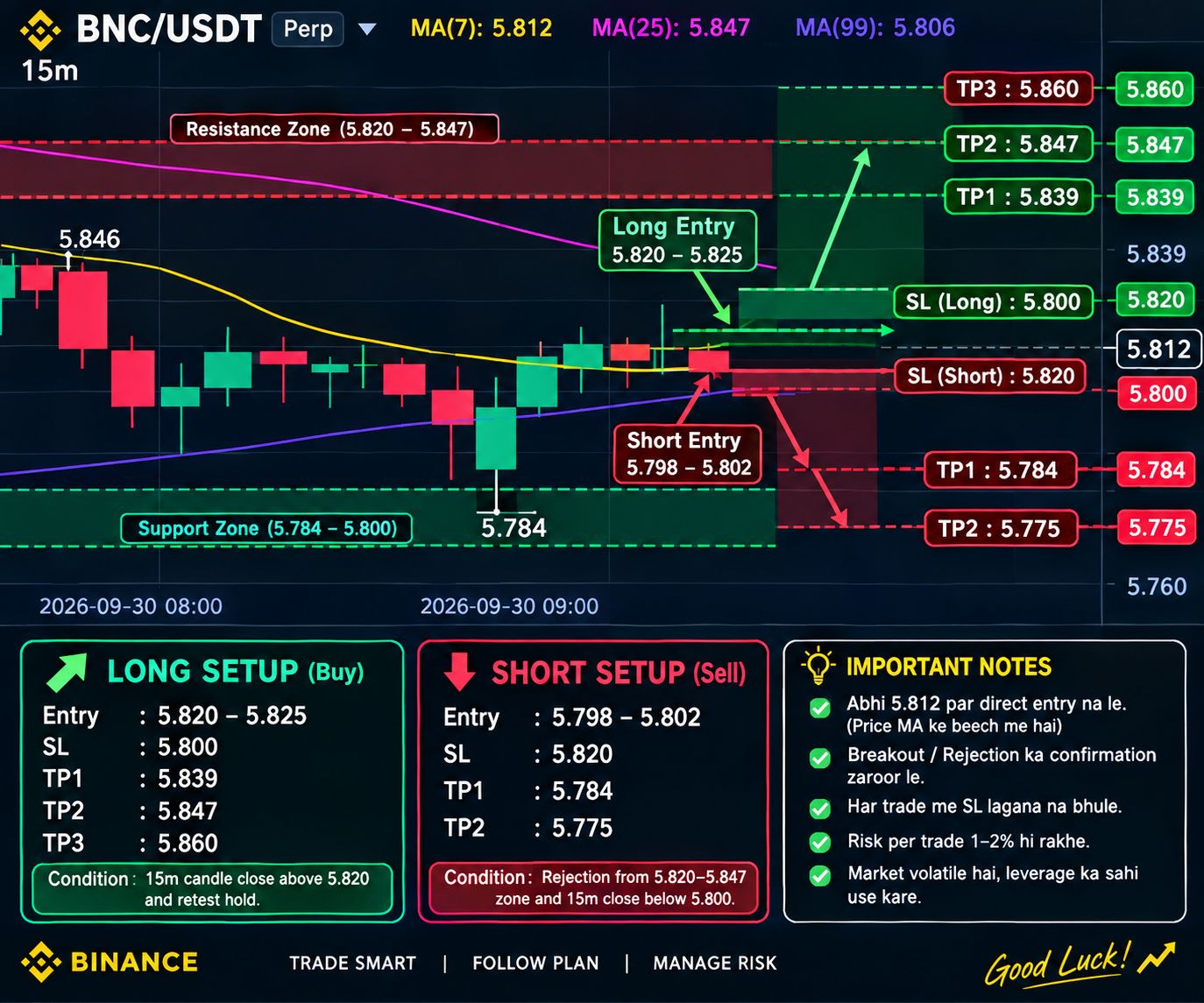
$BNC
🟢 LONG — confirmation ke baad
Agar 15m candle 5.820 ke upar close kare aur retest hold kare:
Entry: 5.820–5.825
SL: 5.800
TP1: 5.839
TP2: 5.847
TP3: 5.860
🔴 SHORT — rejection ke baad
Agar 5.820–5.847 zone se rejection aaye aur price 5.800 ke neeche 15m close kare:
Entry: 5.798–5.802
SL: 5.820
TP1: 5.784
TP2: 5.775
$NEAR
LONG setup:
Entry: 5.00 ke upar 15m candle close + retest
SL: 4.94
TP1: 5.03
TP2: 5.08–5.12
SHORT setup:
Agar 4.98–5.00 se strong rejection mile
Entry: 4.96–4.98
SL: 5.04
TP1: 4.93
TP2: 4.89
@ZEC @BNC @NEAR
$ZEC
🟢 Long setup:
1416.7 ke upar 15m candle close ho aur retest hold kare →
Entry: 1417–1419
SL: 1410
TP1: 1421
TP2: 1426–1430
🔴 Short setup:
1416–1421 zone se strong rejection aaye aur price 1412 ke neeche close kare →
Entry: 1411–1413
SL: 1422
TP1: 1407
TP2: 1403–1400
Abhi 1412–1416 ke beech mein entry avoid karna better hai, kyunki price moving averages ke beech फँसा हुआ है.
$BNC
🟢 LONG — confirmation ke baad
Agar 15m candle 5.820 ke upar close kare aur retest hold kare:
Entry: 5.820–5.825
SL: 5.800
TP1: 5.839
TP2: 5.847
TP3: 5.860
🔴 SHORT — rejection ke baad
Agar 5.820–5.847 zone se rejection aaye aur price 5.800 ke neeche 15m close kare:
Entry: 5.798–5.802
SL: 5.820
TP1: 5.784
TP2: 5.775
$NEAR
LONG setup:
Entry: 5.00 ke upar 15m candle close + retest
SL: 4.94
TP1: 5.03
TP2: 5.08–5.12
SHORT setup:
Agar 4.98–5.00 se strong rejection mile
Entry: 4.96–4.98
SL: 5.04
TP1: 4.93
TP2: 4.89
92
·
--
Расталды
$INJ has recovered from its recent consolidation around the $3 to $4 range, climbing toward $8.40 before settling near $7.93.
The immediate technical focus is around $8.40 to $8.59, with $10 representing a potential technical target if buyers can sustain the breakout... On the downside, $6.62 remains an important support reference.
Momentum indicators remain constructive, although the MACD histogram is showing signs of slowing momentum, suggesting volatility could remain elevated.
Beyond price action, Injective has reported more than dollar 1 billion in tokenized assets across its ecosystem, highlighting continued activity around real-world asset tokenization.
Injective has also submitted its MiCA whitepaper for inclusion in the European regulatory framework, marking another development in its broader ecosystem expansion.
For now, traders are watching whether INJ can hold above the $8.40 to $8.59 area while ecosystem development continues.
$INJ
{future}(INJUSDT)
#INJ
$INJ has recovered from its recent consolidation around the $3 to $4 range, climbing toward $8.40 before settling near $7.93.
The immediate technical focus is around $8.40 to $8.59, with $10 representing a potential technical target if buyers can sustain the breakout... On the downside, $6.62 remains an important support reference.
Momentum indicators remain constructive, although the MACD histogram is showing signs of slowing momentum, suggesting volatility could remain elevated.
Beyond price action, Injective has reported more than dollar 1 billion in tokenized assets across its ecosystem, highlighting continued activity around real-world asset tokenization.
Injective has also submitted its MiCA whitepaper for inclusion in the European regulatory framework, marking another development in its broader ecosystem expansion.
For now, traders are watching whether INJ can hold above the $8.40 to $8.59 area while ecosystem development continues.
$INJ
#INJ
The immediate technical focus is around $8.40 to $8.59, with $10 representing a potential technical target if buyers can sustain the breakout... On the downside, $6.62 remains an important support reference.
Momentum indicators remain constructive, although the MACD histogram is showing signs of slowing momentum, suggesting volatility could remain elevated.
Beyond price action, Injective has reported more than dollar 1 billion in tokenized assets across its ecosystem, highlighting continued activity around real-world asset tokenization.
Injective has also submitted its MiCA whitepaper for inclusion in the European regulatory framework, marking another development in its broader ecosystem expansion.
For now, traders are watching whether INJ can hold above the $8.40 to $8.59 area while ecosystem development continues.
$INJ
#INJ
2
920
·
--
Расталды
$ONDO has moved above the $0.43 to $0.44 resistance zone after repeatedly finding support around $0.32. The breakout has shifted attention toward whether the token can hold above the previous resistance.
Technical analysis points to $0.55 as a potential upside target if the breakout remains intact. However, a move back below $0.43 to $0.44 could send ONDO back into its previous consolidation range.
Beyond price action, Ondo is expanding its tokenization infrastructure, including a system designed to bring traditional equities onto blockchain-based markets for eligible institutions.
Ondo Finance's total value locked has also reached around $967.7 million, up approximately 3% over seven days. The combination of ecosystem growth and the technical breakout keeps ONDO in focus, although sustained adoption and price support remain important.
$ONDO
{future}(ONDOUSDT)
#ONDO
$ONDO has moved above the $0.43 to $0.44 resistance zone after repeatedly finding support around $0.32. The breakout has shifted attention toward whether the token can hold above the previous resistance.
Technical analysis points to $0.55 as a potential upside target if the breakout remains intact. However, a move back below $0.43 to $0.44 could send ONDO back into its previous consolidation range.
Beyond price action, Ondo is expanding its tokenization infrastructure, including a system designed to bring traditional equities onto blockchain-based markets for eligible institutions.
Ondo Finance's total value locked has also reached around $967.7 million, up approximately 3% over seven days. The combination of ecosystem growth and the technical breakout keeps ONDO in focus, although sustained adoption and price support remain important.
$ONDO
#ONDO
Technical analysis points to $0.55 as a potential upside target if the breakout remains intact. However, a move back below $0.43 to $0.44 could send ONDO back into its previous consolidation range.
Beyond price action, Ondo is expanding its tokenization infrastructure, including a system designed to bring traditional equities onto blockchain-based markets for eligible institutions.
Ondo Finance's total value locked has also reached around $967.7 million, up approximately 3% over seven days. The combination of ecosystem growth and the technical breakout keeps ONDO in focus, although sustained adoption and price support remain important.
$ONDO
#ONDO
940
·
--
$XRP is back in focus after EasyA co-founder Dom Kwok renewed his long-term projection that the token could reach $1,000 by 2030. Digital Asset Investor has also publicly expressed support for the projection.
Kwok's latest comments followed meetings in Washington involving crypto policy discussions, but there is no indication that any government body endorsed the $1,000 valuation. The projection remains Kwok's personal view.
At XRP's reported price near $1.40 on September 20, a $1,000 valuation would represent a substantial increase from current levels and imply a market capitalization of roughly $62.9 trillion based on the circulating supply at that time.
For now, the $1,000 level should be viewed as a long-term personal projection rather than a confirmed price target.
$XRP
{future}(XRPUSDT)
#xrp
$XRP is back in focus after EasyA co-founder Dom Kwok renewed his long-term projection that the token could reach $1,000 by 2030. Digital Asset Investor has also publicly expressed support for the projection.
Kwok's latest comments followed meetings in Washington involving crypto policy discussions, but there is no indication that any government body endorsed the $1,000 valuation. The projection remains Kwok's personal view.
At XRP's reported price near $1.40 on September 20, a $1,000 valuation would represent a substantial increase from current levels and imply a market capitalization of roughly $62.9 trillion based on the circulating supply at that time.
For now, the $1,000 level should be viewed as a long-term personal projection rather than a confirmed price target.
$XRP
#xrp
Kwok's latest comments followed meetings in Washington involving crypto policy discussions, but there is no indication that any government body endorsed the $1,000 valuation. The projection remains Kwok's personal view.
At XRP's reported price near $1.40 on September 20, a $1,000 valuation would represent a substantial increase from current levels and imply a market capitalization of roughly $62.9 trillion based on the circulating supply at that time.
For now, the $1,000 level should be viewed as a long-term personal projection rather than a confirmed price target.
$XRP
#xrp
1
1.1k
·
--
$DOGE reached an intraday high of $0.1059 before retracting, briefly breaking the significant $0.10 psychological level...
The result was a sharp reversal after the pulse, with DOGE closing at about $0.0992. And, open interest on derivatives also grew by approximately 10 percent in an hour from to approximately 350 million, which indicates the presence of used activity in the move.
Still mixed on the indicators. RSI has moved to 69.4, still approaching overbought levels. An ADX of 32.5 suggests a relatively strong trend; yet 50 day EMA is still below 200 day EMA, keeping longer term technical anile under pressure.
In the short-term, the key for DOGE is whether it can stay above the $0.10 mark, though its ongoing ability to have some leverage will be key in the future.
$DOGE
{future}(DOGEUSDT)
#DOGE
$DOGE reached an intraday high of $0.1059 before retracting, briefly breaking the significant $0.10 psychological level...
The result was a sharp reversal after the pulse, with DOGE closing at about $0.0992. And, open interest on derivatives also grew by approximately 10 percent in an hour from to approximately 350 million, which indicates the presence of used activity in the move.
Still mixed on the indicators. RSI has moved to 69.4, still approaching overbought levels. An ADX of 32.5 suggests a relatively strong trend; yet 50 day EMA is still below 200 day EMA, keeping longer term technical anile under pressure.
In the short-term, the key for DOGE is whether it can stay above the $0.10 mark, though its ongoing ability to have some leverage will be key in the future.
$DOGE
#DOGE
The result was a sharp reversal after the pulse, with DOGE closing at about $0.0992. And, open interest on derivatives also grew by approximately 10 percent in an hour from to approximately 350 million, which indicates the presence of used activity in the move.
Still mixed on the indicators. RSI has moved to 69.4, still approaching overbought levels. An ADX of 32.5 suggests a relatively strong trend; yet 50 day EMA is still below 200 day EMA, keeping longer term technical anile under pressure.
In the short-term, the key for DOGE is whether it can stay above the $0.10 mark, though its ongoing ability to have some leverage will be key in the future.
$DOGE
#DOGE
447
·
--
Gold has slightly declined from its recent high of near $4,340 up to the near $4,368-4,370 resistance zone. This is where gold has failed to make a further upward move during recent short-term rally.
The first support level is between $4,350 to $4,355; but stronger support exists in the region of $4,340 to $4,345. A close below this area may further test the short-term structure.
A few other technicals have also defined a bearish scenario down near the 4250 level, with 4390 seen as the point of invalidation for that scenario.
Gold meanwhile remains caught between the key support and resistance areas, and the reaction at around 4,370 is critical for the next short-term step.
$XAU
{future}(XAUUSDT)
#XAU
Gold has slightly declined from its recent high of near $4,340 up to the near $4,368-4,370 resistance zone. This is where gold has failed to make a further upward move during recent short-term rally.
The first support level is between $4,350 to $4,355; but stronger support exists in the region of $4,340 to $4,345. A close below this area may further test the short-term structure.
A few other technicals have also defined a bearish scenario down near the 4250 level, with 4390 seen as the point of invalidation for that scenario.
Gold meanwhile remains caught between the key support and resistance areas, and the reaction at around 4,370 is critical for the next short-term step.
$XAU
#XAU
The first support level is between $4,350 to $4,355; but stronger support exists in the region of $4,340 to $4,345. A close below this area may further test the short-term structure.
A few other technicals have also defined a bearish scenario down near the 4250 level, with 4390 seen as the point of invalidation for that scenario.
Gold meanwhile remains caught between the key support and resistance areas, and the reaction at around 4,370 is critical for the next short-term step.
$XAU
#XAU
1
952
·
--
The $SOL token is gaining attention following technical analyst Peter Brandt showing off a possible long-term on its weekly chart.
TL was acquired after creation during the 2022 meltdown of the markets and Next spent a long period of time consolidating. As Brandt's analysis hints, the pattern may be in the process of heading towards the area around $240 if previous resistance levels are broken.
Initial resistance area is around 240 to 260 area. Staying above that range would strengthen the technical picture and breaking below the 80 to 85 area would weaken or invalidate it.
Maintaining that SOL has not been broken for the moment still keeps the response of SOL around these support and resistance levels relevant until the overall structure appears.
$SOL
{future}(SOLUSDT)
#solana
The $SOL token is gaining attention following technical analyst Peter Brandt showing off a possible long-term on its weekly chart.
TL was acquired after creation during the 2022 meltdown of the markets and Next spent a long period of time consolidating. As Brandt's analysis hints, the pattern may be in the process of heading towards the area around $240 if previous resistance levels are broken.
Initial resistance area is around 240 to 260 area. Staying above that range would strengthen the technical picture and breaking below the 80 to 85 area would weaken or invalidate it.
Maintaining that SOL has not been broken for the moment still keeps the response of SOL around these support and resistance levels relevant until the overall structure appears.
$SOL
#solana
TL was acquired after creation during the 2022 meltdown of the markets and Next spent a long period of time consolidating. As Brandt's analysis hints, the pattern may be in the process of heading towards the area around $240 if previous resistance levels are broken.
Initial resistance area is around 240 to 260 area. Staying above that range would strengthen the technical picture and breaking below the 80 to 85 area would weaken or invalidate it.
Maintaining that SOL has not been broken for the moment still keeps the response of SOL around these support and resistance levels relevant until the overall structure appears.
$SOL
#solana
1
1.3k
·
--
$XRP whale inflows to Binance have reportedly reached a six-month high, with cumulative inflows over the past 30 days estimated at around 1.6 billion XRP.
The increase shows that larger amounts of XRP have been moving onto exchanges, which can increase short-term available supply. However, exchange inflows alone do not confirm that whales intend to sell, as tokens can also be moved for trading, liquidity management or other purposes.
XRP has also seen stronger buying activity across exchanges, while the token recently traded around $1.44 after gaining more than 5% over 24 hours...
The combination of rising whale inflows and stronger buying pressure creates a mixed market picture, making exchange flows, trading volume and price action important indicators to watch.
$XRP
{future}(XRPUSDT)
#xrp
$XRP whale inflows to Binance have reportedly reached a six-month high, with cumulative inflows over the past 30 days estimated at around 1.6 billion XRP.
The increase shows that larger amounts of XRP have been moving onto exchanges, which can increase short-term available supply. However, exchange inflows alone do not confirm that whales intend to sell, as tokens can also be moved for trading, liquidity management or other purposes.
XRP has also seen stronger buying activity across exchanges, while the token recently traded around $1.44 after gaining more than 5% over 24 hours...
The combination of rising whale inflows and stronger buying pressure creates a mixed market picture, making exchange flows, trading volume and price action important indicators to watch.
$XRP
#xrp
The increase shows that larger amounts of XRP have been moving onto exchanges, which can increase short-term available supply. However, exchange inflows alone do not confirm that whales intend to sell, as tokens can also be moved for trading, liquidity management or other purposes.
XRP has also seen stronger buying activity across exchanges, while the token recently traded around $1.44 after gaining more than 5% over 24 hours...
The combination of rising whale inflows and stronger buying pressure creates a mixed market picture, making exchange flows, trading volume and price action important indicators to watch.
$XRP
#xrp
1
481
·
--
$BTC sharp August rally was driven largely by short positions being closed rather than a broad wave of new bullish positions.
Over five days, Bitcoin gained 24.6% while open interest fell 12.6%. Around 64,000 BTC in open interest was eliminated, with short positions accounting for 89% of liquidated positions by value.
Options and futures activity also pointed to a rapid shift in market positioning. Bitcoin's volatility surged, while shorter-dated futures repriced more sharply than longer-dated contracts.
More recently, another wave of liquidations accompanied Bitcoin's move above $80,000, with roughly $230 million in BTC shorts and more than $445 million across the broader crypto market closed in a single session.
The key question now is whether bullish positioning can remain strong after the short squeeze fades.
$BTC
{future}(BTCUSDT)
#BTC
$BTC sharp August rally was driven largely by short positions being closed rather than a broad wave of new bullish positions.
Over five days, Bitcoin gained 24.6% while open interest fell 12.6%. Around 64,000 BTC in open interest was eliminated, with short positions accounting for 89% of liquidated positions by value.
Options and futures activity also pointed to a rapid shift in market positioning. Bitcoin's volatility surged, while shorter-dated futures repriced more sharply than longer-dated contracts.
More recently, another wave of liquidations accompanied Bitcoin's move above $80,000, with roughly $230 million in BTC shorts and more than $445 million across the broader crypto market closed in a single session.
The key question now is whether bullish positioning can remain strong after the short squeeze fades.
$BTC
#BTC
Over five days, Bitcoin gained 24.6% while open interest fell 12.6%. Around 64,000 BTC in open interest was eliminated, with short positions accounting for 89% of liquidated positions by value.
Options and futures activity also pointed to a rapid shift in market positioning. Bitcoin's volatility surged, while shorter-dated futures repriced more sharply than longer-dated contracts.
More recently, another wave of liquidations accompanied Bitcoin's move above $80,000, with roughly $230 million in BTC shorts and more than $445 million across the broader crypto market closed in a single session.
The key question now is whether bullish positioning can remain strong after the short squeeze fades.
$BTC
#BTC
207
·
--
1
291
·
--
460
·
--
479
·
--
1
424
Көбірек контент көру үшін кіріңіз
Binance Square платформасында әлемдік криптоқоғамдастыққа қосылыңыз
⚡️ Криптовалюта туралы ең соңғы және пайдалы ақпаратты алыңыз.
💬 Әлемдегі ең ірі криптобиржаның сеніміне ие.
👍 Расталған авторлардың нақты пікірлерін табыңыз.
Электрондық пошта/телефон нөмірі
Трендтегі тақырыптар
BitcoinParesGainsAfterRallyTo$86.5K
880 рет көрілді
31 адам талқылап жатыр
$BTC sitting right on the knife edge at $86k. Bulls stacked 1,436 BTC defending that level, bears loaded 1,008 BTC as a wall at $86.5k. This is pure liquidation fuel—whoever loses this fight is getting absolutely nuked.
Short-term scalp territory. If bulls punch through $86.5k with volume, we're probably running to $88k fast. If bears hold and push down, $84k is the next stop and longs get flushed.
Watch the tape closely. One side's about to get destroyed, and the move will be violent either way.
AI Market Brief
·4 лайк
·5.7k рет көрілді
CerebrasSinksNearly20%OnReportNvidiaToPowerOpenAI
4,585 рет көрілді
111 адам талқылап жатыр
SECProposesCryptoCustodyRules
26,354 рет көрілді
261 адам талқылап жатыр