𝗕.𝗔𝗜 𝗔𝗡𝗗 𝗠𝗨𝗟𝗧𝗜-𝗔𝗚𝗘𝗡𝗧 𝗖𝗢𝗟𝗟𝗔𝗕𝗢𝗥𝗔𝗧𝗜𝗢𝗡: 𝗪𝗛𝗬 𝗧𝗛𝗘 𝗙𝗨𝗧𝗨𝗥𝗘 𝗢𝗙 𝗔𝗜 𝗕𝗘𝗟𝗢𝗡𝗚𝗦 𝗧𝗢 𝗜𝗡𝗧𝗘𝗟𝗟𝗜𝗚𝗘𝗡𝗧 𝗧𝗘𝗔𝗠𝗦, 𝗡𝗢𝗧 𝗜𝗡𝗗𝗜𝗩𝗜𝗗𝗨𝗔𝗟 𝗠𝗢𝗗𝗘𝗟𝗦
The next major breakthrough in artificial intelligence may not come exclusively from building a more powerful language model. It may emerge from engineering systems in which multiple specialized AI agents collaborate, challenge assumptions, execute tasks and independently verify results.
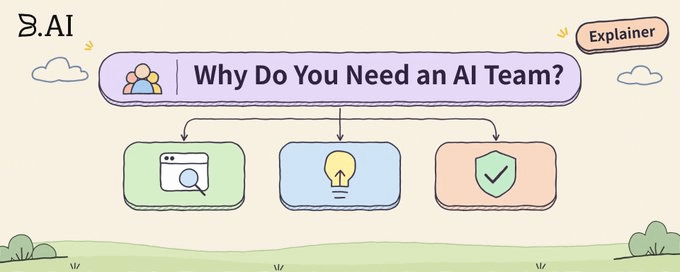
B.AI's latest technical explainer introduces an important distinction between conventional chatbot interactions and structured multi-agent workflows.
A single AI model can produce a convincing business proposal, but convincing language does not necessarily establish market demand, factual accuracy or commercial feasibility.
A coordinated team of specialized agents can approach the same problem through multiple perspectives, combining research, creative reasoning and critical evaluation.
The objective is not simply generating more responses.
It is creating a system capable of transforming incomplete information into traceable, actionable and independently examinable deliverables.
In my assessment, this transition from individual intelligence to coordinated intelligence represents an important opportunity for B.AI's unified model access infrastructure.
𝗙𝗥𝗢𝗠 𝗖𝗛𝗔𝗧𝗚𝗣𝗧 𝗩𝗦. 𝗚𝗘𝗠𝗜𝗡𝗜 𝗧𝗢 𝗔 𝗙𝗨𝗡𝗖𝗧𝗜𝗢𝗡𝗔𝗟 𝗔𝗜 𝗧𝗘𝗔𝗠
B.AI's technical explainer begins with an illustrative debate between ChatGPT and Gemini about whether artificial intelligence should understand users or challenge their assumptions.
The two perspectives highlight complementary strengths:
• Understanding user intentions can reduce creative friction and improve execution efficiency.
• Challenging existing assumptions can expose blind spots and encourage alternative approaches.
• Combining both perspectives can reveal questions that a single reasoning process might overlook.
However, the debate is illustrative rather than a controlled comparison of actual model performance.
The more significant development occurs when these different perspectives become specialized operational roles.
Consider B.AI's example of developing an AI-powered study application for university students.
Agent 1 — Competitor Research:
• Collects information through external search tools.
• Examines existing products and user feedback.
• Produces a structured competitor comparison.
• Documents supporting evidence and information gaps.
Agent 2 — Product Design:
• Evaluates the research findings.
• Identifies potentially underserved requirements.
• Revises the original product concept.
• Produces a focused prototype proposal.
Agent 3 — Independent Review:
• Examines the quality of supporting evidence.
• Challenges unsupported market assumptions.
• Identifies questions requiring direct customer research.
• Returns a verdict of pass, reject or insufficient evidence.
The application then coordinates these agents through an orchestration harness responsible for managing context, task states, tool execution, handoffs and stopping conditions.
B.AI contributes the underlying model access infrastructure through support for major API protocols, including:
• OpenAI Chat Completions.
• OpenAI Responses.
• Anthropic Messages.
Its tiered API architecture also provides access through official APIs and third-party providers, allowing developers to evaluate resource allocation according to individual workflow requirements.
Importantly, B.AI provides the model connectivity layer. The application's harness and business logic remain responsible for orchestration, permissions, evidence management and error recovery.
This architectural distinction is essential for understanding what B.AI contributes to multi-agent development.
𝗠𝗬 𝗣𝗘𝗥𝗦𝗢𝗡𝗔𝗟 𝗩𝗜𝗘𝗪: 𝗠𝗨𝗟𝗧𝗜-𝗔𝗚𝗘𝗡𝗧 𝗦𝗬𝗦𝗧𝗘𝗠𝗦 𝗦𝗛𝗢𝗨𝗟𝗗 𝗢𝗣𝗧𝗜𝗠𝗜𝗭𝗘 𝗧𝗛𝗘 𝗖𝗢𝗦𝗧 𝗢𝗙 𝗩𝗘𝗥𝗜𝗙𝗜𝗘𝗗 𝗢𝗨𝗧𝗖𝗢𝗠𝗘𝗦
I believe the economic advantage of multi-agent collaboration should be evaluated through the cost of producing reliable deliverables rather than the cost of individual API requests.
Consider a hypothetical market research business producing 10,000 analytical reports monthly.
Scenario A — Single-model workflow:
• Input consumption per report: 30,000 tokens.
• Output consumption per report: 6,000 tokens.
• Illustrative input price: $3 per million tokens.
• Illustrative output price: $15 per million tokens.
Estimated expenditure:
• Input cost per report: $0.09.
• Output cost per report: $0.09.
• Total cost per report: $0.18.
• Monthly model expenditure: $1,800.
Scenario B — Specialized three-agent workflow:
Research Agent:
• Input: 12,000 tokens.
• Output: 2,000 tokens.
• Illustrative input/output pricing: $0.50/$2 per million tokens.
• Cost: $0.010 per report.
Product Analysis Agent:
• Input: 15,000 tokens.
• Output: 3,000 tokens.
• Illustrative input/output pricing: $3/$15 per million tokens.
• Cost: $0.090 per report.
Review Agent:
• Input: 10,000 tokens.
• Output: 1,000 tokens.
• Illustrative input/output pricing: $1/$5 per million tokens.
• Cost: $0.015 per report.
Combined multi-agent expenditure:
• Total input consumption: 37,000 tokens.
• Total output consumption: 6,000 tokens.
• Combined cost per report: $0.115.
• Monthly model expenditure: $1,150.
• Potential monthly savings: $650.
• Potential annualized savings: $7,800.
• Model expenditure reduction: approximately 36.11%.
Interestingly, the multi-agent workflow consumes more input tokens while producing lower model expenditure under these assumptions.
The difference comes from assigning different computational resources to different stages instead of using a premium-priced model for every task.
Now introduce another important variable: report acceptance rates.
Assume independent human evaluation determines that:
• Single-model workflow acceptance rate: 75%.
• Multi-agent workflow acceptance rate: 90%.
The resulting economics would be:
Single-model workflow:
• Accepted reports: 7,500.
• Model cost per accepted report: $0.24.
Multi-agent workflow:
• Accepted reports: 9,000.
• Model cost per accepted report: approximately $0.128.
Under these assumptions, the multi-agent architecture would reduce model expenditure per accepted report by approximately 46.76%.
All prices, token consumption figures and acceptance rates in this example are hypothetical. They are not actual B.AI pricing, measured model benchmarks or verified customer results.
The calculation also excludes external search fees, orchestration infrastructure, engineering expenditure, retries and human review costs.
Multi-agent workflows can become more expensive when coordination overhead is excessive or agents repeatedly duplicate the same tasks.
Moreover, different models may reproduce the same factual errors because they rely on overlapping information sources. Agreement between agents is not equivalent to independent factual verification.
The objective should therefore be intelligent specialization, not simply increasing the number of agents.
𝗙𝗥𝗢𝗠 𝗨𝗡𝗜𝗙𝗜𝗘𝗗 𝗠𝗢𝗗𝗘𝗟 𝗔𝗖𝗖𝗘𝗦𝗦 𝗧𝗢 𝗔 𝗦𝗨𝗦𝗧𝗔𝗜𝗡𝗔𝗕𝗟𝗘 𝗔𝗜 × 𝗪𝗘𝗕𝟯 𝗘𝗖𝗢𝗡𝗢𝗠𝗬
B.AI's long-term strategic opportunity lies in reducing the engineering complexity associated with building applications that depend on multiple AI models.
Developers traditionally face several infrastructure challenges:
• Different vendor authentication mechanisms.
• Incompatible API protocols.
• Fragmented credit and billing arrangements.
• Model-specific response formats.
• Concurrent request management.
• Error handling and service interruptions.
• Unpredictable computational expenditure.
A unified model access layer can reduce portions of this integration burden while allowing developers to concentrate more effectively on application-specific business logic.
For the broader TRON ecosystem, multi-agent collaboration could eventually support several interesting research and development directions.
DeFi Research:
One agent collects on-chain lending data, another analyzes capital utilization, and a third independently checks calculations and supporting sources.
Stablecoin Risk Monitoring:
Specialized agents examine collateralization, liquidity conditions and peg deviations before generating evidence-backed risk reports.
Blockchain Development:
A coding agent produces candidate smart contract implementations, a security agent examines potential vulnerabilities, and a testing agent evaluates defined functional requirements.
Decentralized Infrastructure:
Research agents could examine distributed storage and AI inference economics, while independent review agents evaluate service reliability and operational expenditure.
These are potential application architectures, not confirmed integrations between B.AI, JustLend, USDD, WINkLink or BTTInferGrid.
For financially sensitive applications, AI-generated recommendations must remain separate from transaction authorization. Deterministic validation, spending limits and appropriate human oversight remain essential.
The indicators I would prioritize when evaluating B.AI's multi-agent infrastructure include:
• Model integration time.
• Successful workflow completion rates.
• Effective cost per accepted deliverable.
• API reliability across providers.
• Structured output compatibility.
• Tool execution success rates.
• Evidence traceability.
• Error recovery effectiveness.
• Computational expenditure predictability.
• Developer retention and recurring API consumption.
Research and development resources:
https://b.ai
https://docs.b.ai
https://chat.b.ai
https://arxiv.org/abs/2210.03629
In my assessment, the most valuable aspect of B.AI's multi-agent strategy is its potential to separate intelligence selection from infrastructure complexity.
Developers should be able to choose models according to the requirements of each task rather than being constrained by the difficulty of integrating multiple vendors.
A language model provides reasoning capabilities.
External tools provide access to information and actions.
An orchestration harness coordinates responsibilities and enforces operational boundaries.
B.AI provides a unified access layer connecting the workflow to supported AI models.
The next generation of AI applications will not necessarily depend on finding one model capable of performing every task.
It will depend on engineering coordinated systems that know which model to use, which evidence to trust, when to challenge an assumption and when to stop because the available information is insufficient.
The future of AI is not merely a conversation with a more intelligent chatbot.
It is the construction of reliable, economically efficient and accountable teams of intelligent agents.
B.AI is positioning its infrastructure to support that transition.
@BAI_AGI @TRON DAO