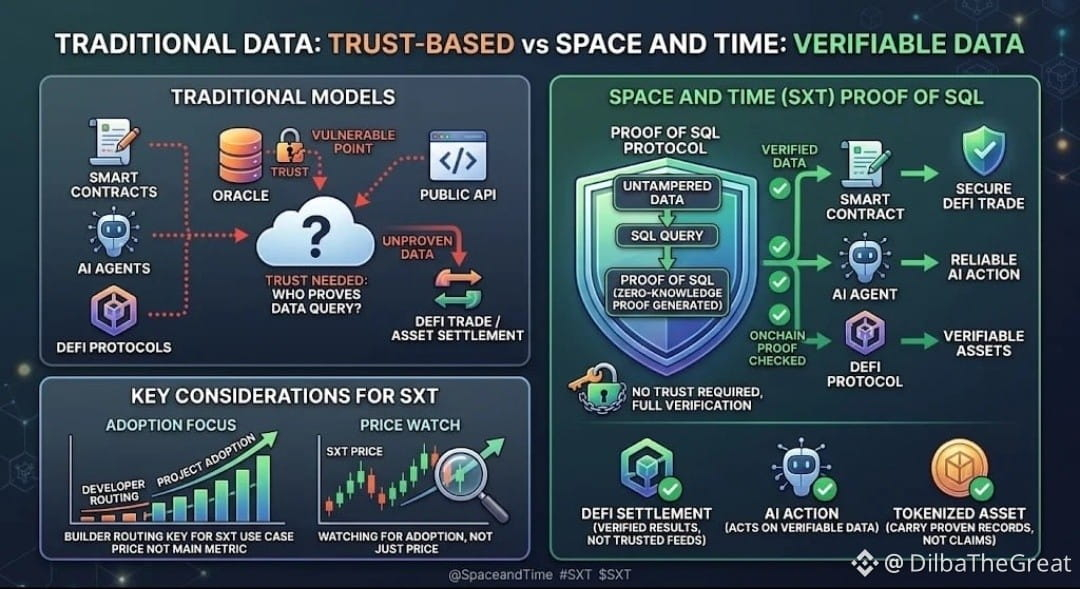
A smart contract can be perfectly honest and still be wrong. It only knows what it is told.
That thought followed me around this week. Code on a blockchain is built to be trustless, yet the data feeding it usually arrives with a quiet “trust me” attached. An oracle says the number is right. An API says the query ran clean. I accepted that for years without asking who checks the checker.
That is why @SpaceandTime caught my attention. Proof of SQL produces a zero knowledge proof that a query ran correctly against untampered data, and the result can be verified onchain. Nobody has to take the output on faith.
It fits the three areas the project targets: AI agents acting on data they can verify, tokenized assets carrying proven records, and DeFi settling on computed results.
My doubt is adoption. Verifiable data only matters if builders route real queries through it, so I’m watching usage more than the chart.
$SXT
#sxt $SXT @SpaceandTime