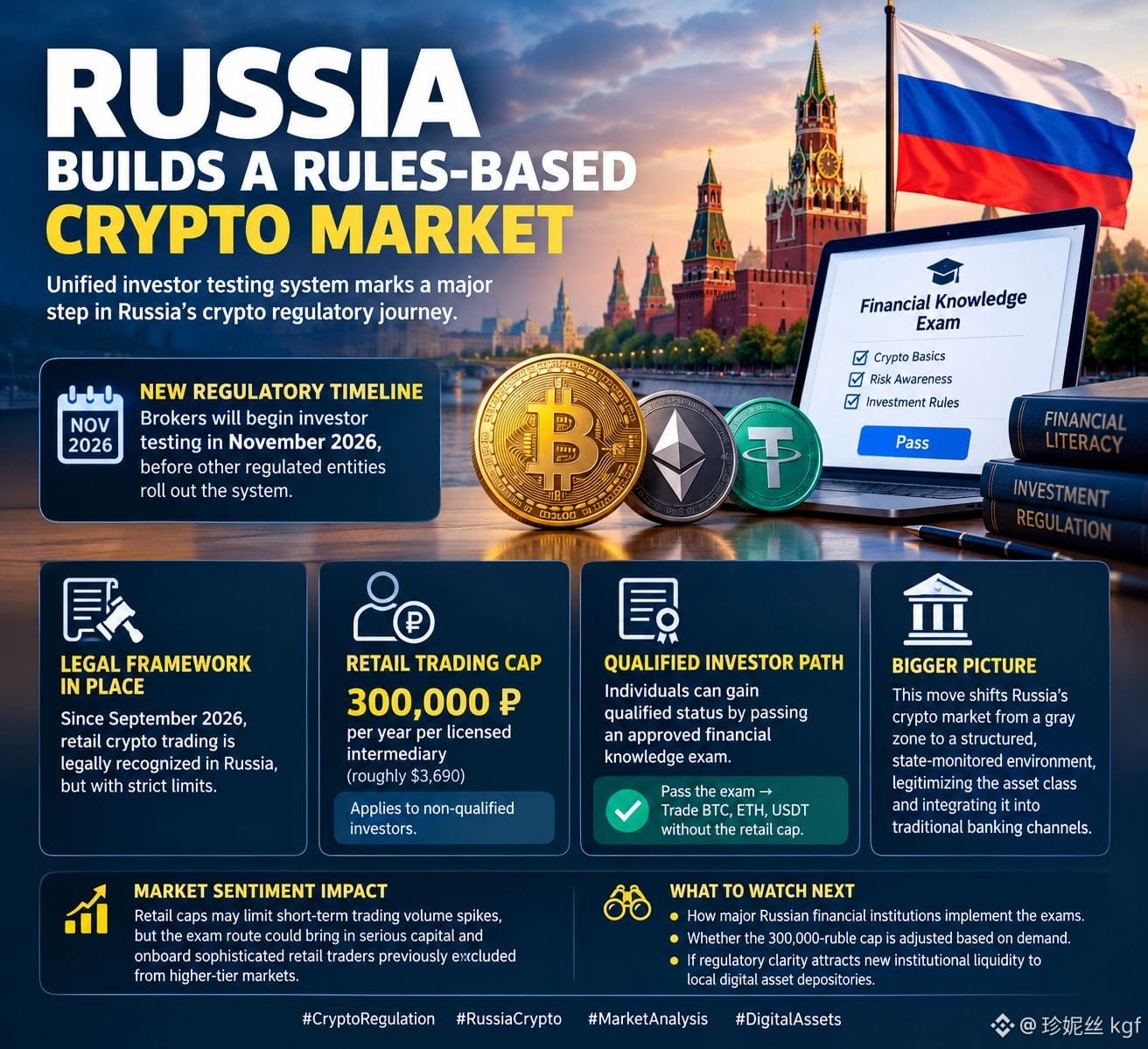
#russiaplansstandardizedtestforcryptoinvestors Russia is formalizing its crypto market with a unified investor testing system, marking a major shift in its regulatory landscape. Brokers are expected to begin these assessments in November, preceding a broader rollout by other regulated entities.
Under the framework effective September 2026, retail crypto trading is legally recognized but strictly capped. Non-qualified investors face an annual limit of 300,000 rubles (roughly $3,690) per licensed intermediary. However, the Bank of Russia has introduced a new pathway: individuals can achieve qualified status by passing an approved financial knowledge exam. Those who pass gain unrestricted access to trade eligible assets like BTC, ETH, and USDT without the retail cap.
Why this matters: This move transitions Russia’s crypto market from a gray zone into a structured, state-monitored environment. While the testing requirement adds friction for casual retail participants, it simultaneously legitimizes the asset class domestically and integrates it into traditional banking channels.
Market sentiment impact: In the short term, strict retail caps may limit domestic trading volume spikes. However, the exam-based qualification route lowers the barrier for serious capital, potentially onboarding sophisticated retail traders who were previously excluded from higher-tier markets.
What to watch next: Monitor how major Russian financial institutions implement these exams and whether the 300,000-ruble cap is adjusted in response to market demand. Traders should also observe if this regulatory clarity attracts new institutional liquidity to local digital asset depositories.
#CryptoRegulation #RussiaCrypto #MarketAnalysis #DigitalAssets
$MVLLB $DUSK $NIL