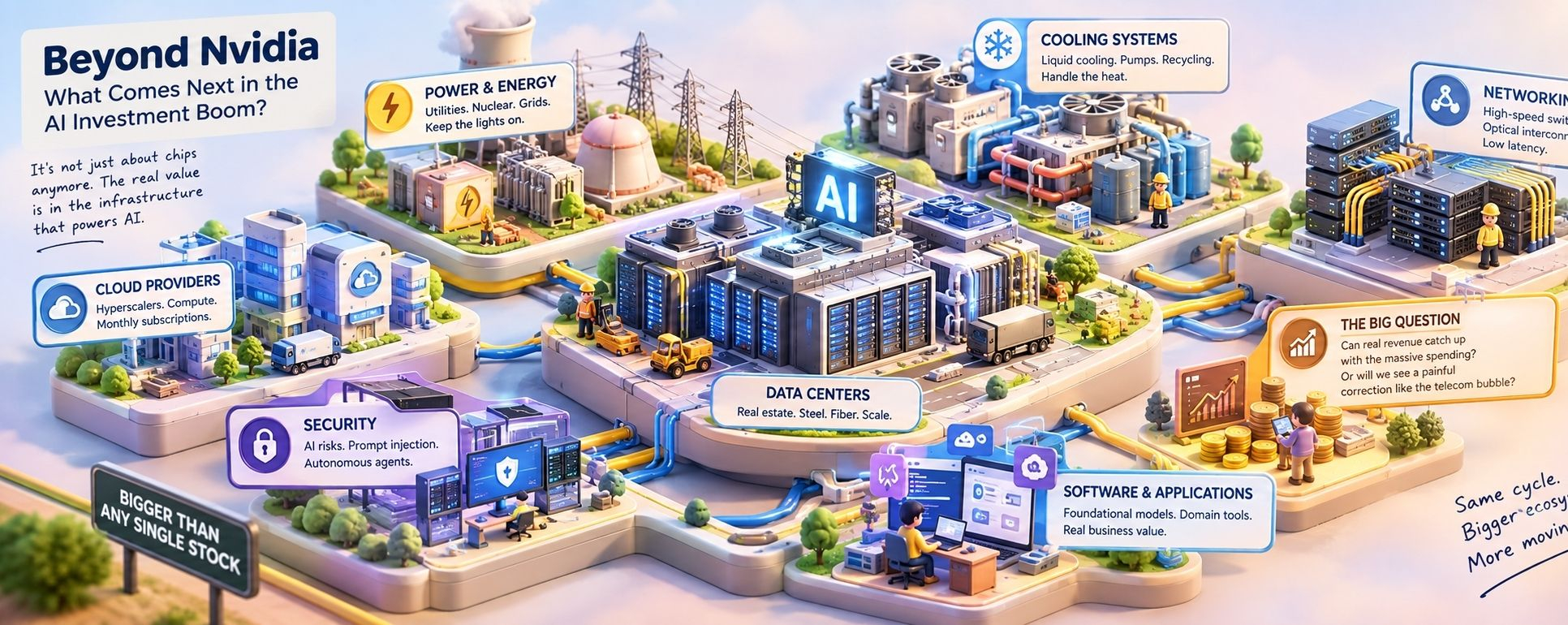

Every time I check my timeline lately, it feels like half of Crypto Twitter has quietly pivoted into semiconductor analysts. We spend hours arguing over GPU supply chains, tracking tech earnings reports like they are token unlocks, and watching Nvidia chart patterns with the exact same nervous energy we usually reserve for Bitcoin liquidations. It is an odd crossover, but it makes a lot of sense. Anyone who has been in this space for more than a couple of cycles recognizes that familiar feeling when a single clear leader starts sucking all the oxygen out of the room.
Nvidia became the mascot of this whole movement because hardware was the obvious first bottleneck. If you wanted to build models, you needed raw compute, and they held the keys to the digital factory. But if you step back and look at how tech infrastructure actually expands over time, the real bottleneck rarely stays in the same spot for long. The hardware rush always ripples outward into quieter, grittier sectors that most retail investors ignore until the prices have already moved.
Take data centers, for instance. A few months ago, I was looking through the physical expansion plans for some of the major cloud providers, and the sheer scale of real estate being snapped up is surreal. We talk about the digital cloud as if it floats in mid-air, but it is made of real concrete, massive steel frames, and absurd amounts of land situated near major fiber line cross-sections. Finding physical space that can actually house these high-density server racks is turning into its own subtle land grab.
Then you run straight into the power problem, which is where things get really fascinating. Running a cluster of modern AI chips is not like running a traditional web server; the energy density requirements are off the charts. I catch myself wondering sometimes if the market is severely underestimating just how much load this puts on legacy electrical grids that were barely designed to handle basic modern needs, let alone gigawatt-scale computing centers.
This has quietly shifted a lot of attention toward utility providers, nuclear energy proposals, and specialized power equipment manufacturers. Companies that produce transformers, grid management systems, and backup power solutions used to be the definition of boring, low-growth dividend stocks. Suddenly, they find themselves sitting right in the middle of a massive technological bottleneck, purely because a server farm cannot process a single prompt without a stable power draw.
And once you get that power into the building, you have to deal with the heat. Air cooling, which worked fine for standard web hosting for decades, simply breaks down when you pack high-output GPUs tightly together. Liquid cooling systems have gone from a niche enthusiast feature for custom gaming rigs into a mandatory architectural layer for modern data centers. The infrastructure required to pump, cool, and recycle liquid across thousands of server racks is complex, expensive, and rapidly growing.
Networking is another piece of the puzzle that often gets lost in the noise. Having thousands of powerful chips does not help much if they cannot talk to each other fast enough to process massive datasets in parallel. Specialized high-speed switches, optical interconnects, and low-latency networking protocols are becoming just as vital as the chips themselves. If the data gets stuck in traffic on the way between nodes, all that expensive compute power just sits there idling.
Further up the stack, cloud providers are attempting to package all this hardware into manageable services for everyday businesses. The hyper-scalers are spending staggering amounts of capital to build out this capacity, betting that every company on Earth will eventually pay a monthly subscription to access AI models. It is a massive arms race, and while the revenue growth is real, the upfront capital expenditure is almost hard to wrap your head around.
Then there is the security aspect, which feels like it is barely being addressed yet. As AI systems take over actual operational workflows, handling sensitive corporate data and executing automated transactions, the attack surface expands dramatically. Cyber security tools designed for traditional database permissions are not necessarily equipped to secure complex neural network inputs, prompt injection vectors, or autonomous AI agents.
On the software layer itself, we are starting to see a split between companies that just wrap generic foundation models in a clean user interface and those building deep, domain-specific applications. I suspect a lot of the initial software wrappers will get wiped out as the underlying models improve, but the tools that sit deeply embedded inside specific industry workflows might hold long-term value that outlasts the initial hype cycle.
What keeps me up a bit at night, though, is the sheer pace of the spending compared to the actual revenue being generated today. Right now, tech giants and startups alike are spending hundreds of billions of dollars on physical infrastructure. That capital expenditure boom is driving stock prices up across the entire supply chain, but at some point, end-user applications have to generate enough practical value to pay for all those data centers, power contracts, and cooling systems.
If the enterprise adoption curve turns out to be slower than the market currently expects, there could be a uncomfortable period of digestions where companies realize they overbuilt capacity. We have seen this movie before in the telecom bubble of the late nineties, where miles of dark fiber were laid down years before the internet traffic actually arrived to justify it. The long-term thesis was right, but the timing was painful for anyone who bought at the peak of the infrastructure buildout.
Valuations across these secondary infrastructure sectors have already expanded significantly over the past year. When every utility company, cooling manufacturer, and networking vendor starts trading at multiples usually reserved for hyper-growth software platforms, the margin for error becomes razor thin. A single missed earnings forecast or a delay in data center construction can trigger sharp corrections, even if the underlying trend remains intact.
Maybe I am overthinking it, but it feels like we are transitioning out of the initial speculative wave into a much harder, more operational phase of the cycle. The easy narrative of just buying the primary chipmaker worked beautifully while compute was the only bottleneck everyone cared about. Now, the market has to figure out how all these moving pieces fit together, who actually generates sustainable cash flows, and how long the capital expenditure wave can keep rolling.
It is going to be a fascinating dynamic to watch unfold over the next few years. Whether the path forward belongs to grid operators, cooling specialists, or security protocols, the broader infrastructure story is clearly way larger than any single ticker symbol on a screen.