

#ethereumvalidatorexitqueuejumps392
ethereumvalidatorexitqueuejumps392
407 рет көрілді
16 адам талқылап жатыр
Қызу саудада
Ең соңғы

·
--
Мақала
ETHEREUM’S VALIDATOR EXIT QUEUE JUMPS 392% PANIC, PROFIT-TAKING, OR SOMETHING BIGGER?Honestly, seeing Ethereum’s validator exit queue jump 392% is one of those things where my first reaction was basically... okay, what the hell is going on here?
Because nearly 850,000 ETH sitting in the exit queue sounds horrible when you just look at the number. That’s a stupid amount of money. And obviously the easy reaction is “people are leaving Ethereum” or “stakers are losing confidence” or whatever the current Twitter panic is.
But then I dug into it a bit more and yeah... it’s not really that simple.
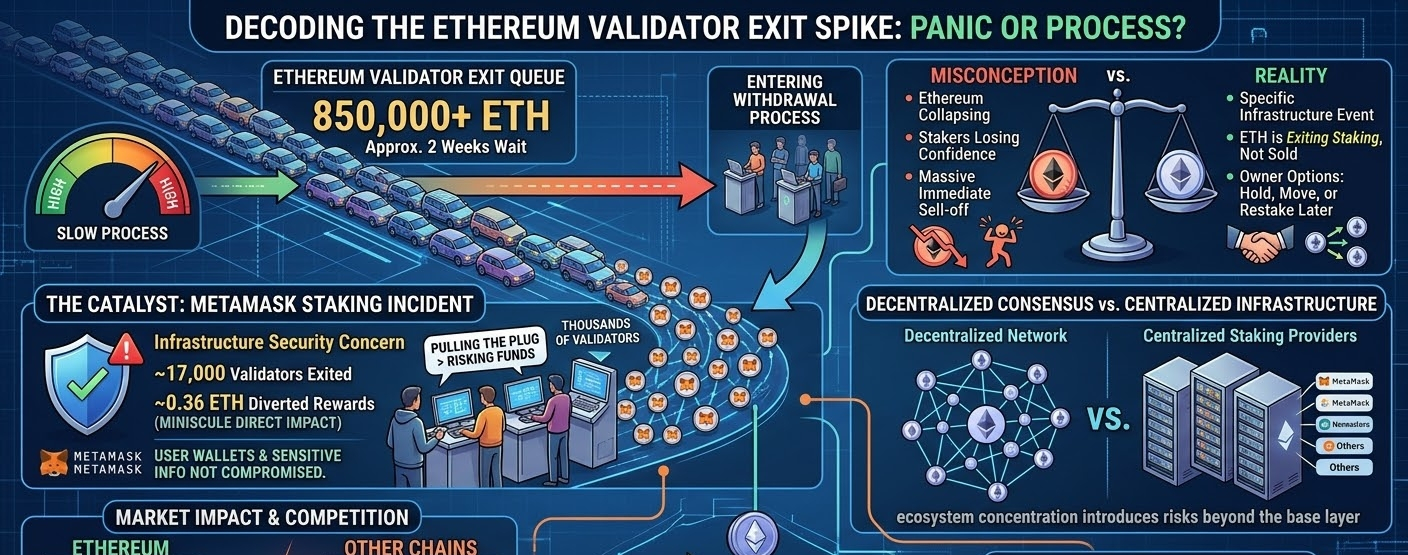
A big chunk of this is connected to MetaMask Staking exiting thousands of Ethereum validators after a security incident involving its staking infrastructure. We’re talking roughly 17,000 validators, with well over half a million ETH involved depending on which estimate you look at.
So no, I don’t think 850,000 ETH suddenly woke up one morning and decided Ethereum was finished.
That’s not what happened.
It’s more like one giant parking lot operator suddenly telling thousands of cars to leave because there’s a security problem at the gate. Of course the exit road is gonna get jammed.
And that’s basically what the Ethereum exit queue is right now.
The security incident itself is kinda weird too. Researchers reported around 0.36 ETH in block-production rewards being diverted across a number of blocks. That’s obviously not something you want happening, but compared with the hundreds of thousands of ETH now caught up in the exit process, it’s tiny.
MetaMask said user wallets and sensitive information weren’t compromised, but it still decided to exit the affected validators.
Honestly, I can understand that.
If you’re sitting on infrastructure handling a ridiculous amount of money and something starts looking wrong, I’d rather you pull the plug than sit there pretending everything is fine.
Still, that decision creates this massive headline around Ethereum.
And this is where I think people are gonna get it wrong.
A validator exiting doesn’t automatically mean the ETH is being dumped.
That’s the part that keeps getting skipped.
The ETH has to go through Ethereum’s withdrawal process first. The owner can sell it later, sure. But they can also hold it, move it, or stake it again somewhere else.
So when I see people saying “850,000 ETH is about to hit the market,” I’m like... are we sure?
Maybe some gets sold. Probably some does. But we don’t know that all this ETH is suddenly heading to exchanges.
Crypto loves taking one piece of information and attaching a whole movie to it.
Validator exits = selling.
Selling = crash.
Crash = ETH is finished.
And then three days later everyone forgets about it.
The funny thing is Ethereum actually has limits on how quickly validators can exit, which is why this giant queue exists in the first place. You can’t just have hundreds of thousands of ETH leave staking instantly.
That sounds annoying if you’re waiting.
But honestly, I’d rather have that restriction than a system where everyone can just disappear from the validator set at the same time.
The queue has reportedly reached around 850,000 ETH and the waiting time has stretched to roughly two weeks. That’s big, no question.
But Ethereum also has tens of millions of ETH staked.
So we’re talking about a relatively small part of the total staking pool, even though the absolute number looks insane.
And yeah, I know... “small percentage” doesn’t magically make 850,000 ETH small.
It’s still 850,000 ETH.
That’s why I’m not dismissing it either.
I think there are two lazy takes here. One is “Ethereum is collapsing because validators are leaving.” The other is “it’s just MetaMask, nothing matters.”
I don’t really buy either one.
MetaMask clearly explains a huge part of the spike, but that doesn’t mean every single validator leaving is connected to the same thing.
Some people might just want liquidity.
Some might be taking profits.
And honestly, I wouldn’t blame them. ETH has moved a lot compared with the lows, and if you’ve got a huge staking position sitting there, eventually you’re gonna think about what else you could do with that capital.
Staking looks great when the market is boring.
Then the market starts moving and suddenly that “yield” doesn’t feel quite as simple.
That’s something I’ve always found funny about crypto. People talk about staking like it’s basically a savings account with a cool logo.
It isn’t.
There are delays. There are infrastructure risks. There are operational risks. Depending on how you stake, there are other risks too.
And this MetaMask thing is a pretty good reminder that sometimes the problem isn’t even Ethereum itself.
It can be the stuff sitting around Ethereum.
That part actually bothers me more than the exit queue.
Because we love saying crypto is decentralized, but then you look closer and there are huge staking providers and infrastructure companies handling massive amounts of ETH.
The blockchain can be decentralized while the ecosystem around it still has concentration.
That’s just reality.
And I don’t mean that as some “Ethereum is secretly centralized” take. That’s too easy. I’m saying decentralization isn’t some magic switch where everything becomes perfectly distributed the second you use a blockchain.
You can have decentralized consensus and still have centralized infrastructure around it.
MetaMask’s situation makes that pretty obvious.
One provider has a security problem, thousands of validators get exited, and suddenly the entire market is staring at Ethereum’s exit queue.
That’s not nothing.
But it also doesn’t mean Ethereum itself has been hacked.
That distinction matters, even if crypto Twitter doesn’t really care about distinctions when there’s a red candle involved.
And the actual incident apparently involved only around 0.36 ETH in diverted block rewards, with no validators reported as slashed.
So the direct financial damage and the operational reaction are two very different things.
That’s kinda crazy when you think about it.
A tiny amount of ETH can trigger a response involving hundreds of thousands of ETH.
It’s like finding one bad wire in a giant building and shutting down half the building just to make absolutely sure the problem doesn’t spread.
Maybe that’s excessive.
Maybe it’s exactly the right thing to do.
I honestly don’t know.
And then there’s the whole time factor.
The ETH leaving staking doesn’t just magically become available instantly. The queue itself can take days, and if the operators want to put that ETH back into staking through new infrastructure, they can face another waiting period.
So this isn’t really “exit today, restake tomorrow.”
It can take weeks.
That’s a long time in crypto.
Two weeks in crypto is basically a different lifetime. You can have three narratives, five fake breakouts and one “ETH is dead” trend before some of that ETH even finishes moving through the system.
That’s why I’m much more interested in what happens after the current wave gets processed.
If the queue starts dropping hard once these MetaMask-related exits move through, then okay... probably a nasty but specific infrastructure event.
If it stays high, or keeps climbing even after that, then I’m paying much more attention.
Because then the MetaMask explanation isn’t enough anymore.
Maybe other stakers are changing their behavior.
Maybe people want more liquidity.
Maybe some large holders are taking profits.
Maybe staking just isn’t as attractive for certain operators anymore.
Or maybe it’s nothing that dramatic and we’re just watching thousands of individual decisions pile up into one giant scary chart.
That happens too.
I think that’s the part people forget. Not every huge on-chain number has some grand hidden meaning.
Sometimes 17,000 validators are just 17,000 validators being moved because one company decided it wasn’t comfortable with its infrastructure.
That can be the whole story.
But I’m also not gonna pretend security issues don’t matter.
They do.
Especially when you’re dealing with this much capital.
Crypto security isn’t just “don’t lose your seed phrase.” There’s validator software, signing systems, infrastructure, cloud services, operational setups, all this boring stuff nobody talks about when ETH is pumping.
Then something breaks and suddenly everyone cares.
And I actually think this is one of those things Ethereum will have to deal with more as it gets bigger.
More money brings bigger operators.
Bigger operators bring more complicated infrastructure.
More complicated infrastructure means more places where something can go wrong.
It’s not an Ethereum-only problem either. It’s just what happens when a financial system gets large enough.
The other thing I keep thinking about is competition.
Ethereum still has an enormous network effect, liquidity, developers, infrastructure and institutional attention. That’s obvious.
But I don’t think “Ethereum is huge” means it can just sleep forever and everyone else waits.
There are plenty of other chains fighting for users and developers.
Some are cheaper.
Some are faster.
Some are aggressively marketed as Ethereum killers.
We’ve seen this movie before... most of those “killers” don’t actually kill Ethereum, but pretending competition doesn’t matter is dumb too.
Ethereum still has to earn its position.
And staking is becoming a bigger part of that whole picture.
If people are gonna lock huge amounts of capital into validators, they need to trust the network and the infrastructure around it.
That’s where this MetaMask incident gets interesting.
Not because I suddenly think Ethereum is doomed.
I don’t.
It just shows that the system is way more complicated than the clean “stake ETH, earn yield” story people throw around.
There are queues.
There are delays.
There are operators.
There are security risks.
There are infrastructure dependencies.
And there’s always the possibility that the person controlling the infrastructure makes a completely reasonable decision that still causes a giant market reaction.
That’s crypto for you.
The weird part is that I actually think Ethereum’s exit mechanism looks pretty decent through all this.
Not exciting.
Not sexy.
Just... doing its job.
Thousands of validators want out, and the system processes them according to rules instead of letting everyone disappear instantly.
That’s probably a good thing.
I just wouldn’t turn that into some heroic Ethereum moment either.
It’s supposed to work.
The real test is what happens next.
Does the queue clear?
Do validators come back?
Does staking participation stabilize?
Does the amount of ETH actually sold turn out to be meaningful?
Those are the things I care about.
Not some giant “392%” number designed to make people click.
Because 392% sounds terrifying until you understand what caused it.
And then it becomes more like... okay, still pretty damn interesting, but maybe not the apocalypse.
I’m not bearish on Ethereum because of this.
I’m not bullish because of it either.
Honestly, I’m just watching.
The MetaMask-related exits explain a huge chunk of what we’re seeing, and that makes me think this could end up being a temporary shock rather than some giant loss of confidence in ETH.
But if the queue keeps growing after these exits are processed?
Yeah, then I’ll start caring a lot more.
Because then we’ve got a different problem.
And I’d rather wait for that data than make up a story now just because the chart looks scary.
That’s the thing with crypto... the first headline gets everyone excited, but the boring follow-up data is usually where the real answer is hiding.
#ethereumvalidatorexitqueuejumps392
ETHEREUM’S VALIDATOR EXIT QUEUE JUMPS 392% PANIC, PROFIT-TAKING, OR SOMETHING BIGGER?
Honestly, seeing Ethereum’s validator exit queue jump 392% is one of those things where my first reaction was basically... okay, what the hell is going on here?
Because nearly 850,000 ETH sitting in the exit queue sounds horrible when you just look at the number. That’s a stupid amount of money. And obviously the easy reaction is “people are leaving Ethereum” or “stakers are losing confidence” or whatever the current Twitter panic is.
But then I dug into it a bit more and yeah... it’s not really that simple.
A big chunk of this is connected to MetaMask Staking exiting thousands of Ethereum validators after a security incident involving its staking infrastructure. We’re talking roughly 17,000 validators, with well over half a million ETH involved depending on which estimate you look at.
So no, I don’t think 850,000 ETH suddenly woke up one morning and decided Ethereum was finished.
That’s not what happened.
It’s more like one giant parking lot operator suddenly telling thousands of cars to leave because there’s a security problem at the gate. Of course the exit road is gonna get jammed.
And that’s basically what the Ethereum exit queue is right now.
The security incident itself is kinda weird too. Researchers reported around 0.36 ETH in block-production rewards being diverted across a number of blocks. That’s obviously not something you want happening, but compared with the hundreds of thousands of ETH now caught up in the exit process, it’s tiny.
MetaMask said user wallets and sensitive information weren’t compromised, but it still decided to exit the affected validators.
Honestly, I can understand that.
If you’re sitting on infrastructure handling a ridiculous amount of money and something starts looking wrong, I’d rather you pull the plug than sit there pretending everything is fine.
Still, that decision creates this massive headline around Ethereum.
And this is where I think people are gonna get it wrong.
A validator exiting doesn’t automatically mean the ETH is being dumped.
That’s the part that keeps getting skipped.
The ETH has to go through Ethereum’s withdrawal process first. The owner can sell it later, sure. But they can also hold it, move it, or stake it again somewhere else.
So when I see people saying “850,000 ETH is about to hit the market,” I’m like... are we sure?
Maybe some gets sold. Probably some does. But we don’t know that all this ETH is suddenly heading to exchanges.
Crypto loves taking one piece of information and attaching a whole movie to it.
Validator exits = selling.
Selling = crash.
Crash = ETH is finished.
And then three days later everyone forgets about it.
The funny thing is Ethereum actually has limits on how quickly validators can exit, which is why this giant queue exists in the first place. You can’t just have hundreds of thousands of ETH leave staking instantly.
That sounds annoying if you’re waiting.
But honestly, I’d rather have that restriction than a system where everyone can just disappear from the validator set at the same time.
The queue has reportedly reached around 850,000 ETH and the waiting time has stretched to roughly two weeks. That’s big, no question.
But Ethereum also has tens of millions of ETH staked.
So we’re talking about a relatively small part of the total staking pool, even though the absolute number looks insane.
And yeah, I know... “small percentage” doesn’t magically make 850,000 ETH small.
It’s still 850,000 ETH.
That’s why I’m not dismissing it either.
I think there are two lazy takes here. One is “Ethereum is collapsing because validators are leaving.” The other is “it’s just MetaMask, nothing matters.”
I don’t really buy either one.
MetaMask clearly explains a huge part of the spike, but that doesn’t mean every single validator leaving is connected to the same thing.
Some people might just want liquidity.
Some might be taking profits.
And honestly, I wouldn’t blame them. ETH has moved a lot compared with the lows, and if you’ve got a huge staking position sitting there, eventually you’re gonna think about what else you could do with that capital.
Staking looks great when the market is boring.
Then the market starts moving and suddenly that “yield” doesn’t feel quite as simple.
That’s something I’ve always found funny about crypto. People talk about staking like it’s basically a savings account with a cool logo.
It isn’t.
There are delays. There are infrastructure risks. There are operational risks. Depending on how you stake, there are other risks too.
And this MetaMask thing is a pretty good reminder that sometimes the problem isn’t even Ethereum itself.
It can be the stuff sitting around Ethereum.
That part actually bothers me more than the exit queue.
Because we love saying crypto is decentralized, but then you look closer and there are huge staking providers and infrastructure companies handling massive amounts of ETH.
The blockchain can be decentralized while the ecosystem around it still has concentration.
That’s just reality.
And I don’t mean that as some “Ethereum is secretly centralized” take. That’s too easy. I’m saying decentralization isn’t some magic switch where everything becomes perfectly distributed the second you use a blockchain.
You can have decentralized consensus and still have centralized infrastructure around it.
MetaMask’s situation makes that pretty obvious.
One provider has a security problem, thousands of validators get exited, and suddenly the entire market is staring at Ethereum’s exit queue.
That’s not nothing.
But it also doesn’t mean Ethereum itself has been hacked.
That distinction matters, even if crypto Twitter doesn’t really care about distinctions when there’s a red candle involved.
And the actual incident apparently involved only around 0.36 ETH in diverted block rewards, with no validators reported as slashed.
So the direct financial damage and the operational reaction are two very different things.
That’s kinda crazy when you think about it.
A tiny amount of ETH can trigger a response involving hundreds of thousands of ETH.
It’s like finding one bad wire in a giant building and shutting down half the building just to make absolutely sure the problem doesn’t spread.
Maybe that’s excessive.
Maybe it’s exactly the right thing to do.
I honestly don’t know.
And then there’s the whole time factor.
The ETH leaving staking doesn’t just magically become available instantly. The queue itself can take days, and if the operators want to put that ETH back into staking through new infrastructure, they can face another waiting period.
So this isn’t really “exit today, restake tomorrow.”
It can take weeks.
That’s a long time in crypto.
Two weeks in crypto is basically a different lifetime. You can have three narratives, five fake breakouts and one “ETH is dead” trend before some of that ETH even finishes moving through the system.
That’s why I’m much more interested in what happens after the current wave gets processed.
If the queue starts dropping hard once these MetaMask-related exits move through, then okay... probably a nasty but specific infrastructure event.
If it stays high, or keeps climbing even after that, then I’m paying much more attention.
Because then the MetaMask explanation isn’t enough anymore.
Maybe other stakers are changing their behavior.
Maybe people want more liquidity.
Maybe some large holders are taking profits.
Maybe staking just isn’t as attractive for certain operators anymore.
Or maybe it’s nothing that dramatic and we’re just watching thousands of individual decisions pile up into one giant scary chart.
That happens too.
I think that’s the part people forget. Not every huge on-chain number has some grand hidden meaning.
Sometimes 17,000 validators are just 17,000 validators being moved because one company decided it wasn’t comfortable with its infrastructure.
That can be the whole story.
But I’m also not gonna pretend security issues don’t matter.
They do.
Especially when you’re dealing with this much capital.
Crypto security isn’t just “don’t lose your seed phrase.” There’s validator software, signing systems, infrastructure, cloud services, operational setups, all this boring stuff nobody talks about when ETH is pumping.
Then something breaks and suddenly everyone cares.
And I actually think this is one of those things Ethereum will have to deal with more as it gets bigger.
More money brings bigger operators.
Bigger operators bring more complicated infrastructure.
More complicated infrastructure means more places where something can go wrong.
It’s not an Ethereum-only problem either. It’s just what happens when a financial system gets large enough.
The other thing I keep thinking about is competition.
Ethereum still has an enormous network effect, liquidity, developers, infrastructure and institutional attention. That’s obvious.
But I don’t think “Ethereum is huge” means it can just sleep forever and everyone else waits.
There are plenty of other chains fighting for users and developers.
Some are cheaper.
Some are faster.
Some are aggressively marketed as Ethereum killers.
We’ve seen this movie before... most of those “killers” don’t actually kill Ethereum, but pretending competition doesn’t matter is dumb too.
Ethereum still has to earn its position.
And staking is becoming a bigger part of that whole picture.
If people are gonna lock huge amounts of capital into validators, they need to trust the network and the infrastructure around it.
That’s where this MetaMask incident gets interesting.
Not because I suddenly think Ethereum is doomed.
I don’t.
It just shows that the system is way more complicated than the clean “stake ETH, earn yield” story people throw around.
There are queues.
There are delays.
There are operators.
There are security risks.
There are infrastructure dependencies.
And there’s always the possibility that the person controlling the infrastructure makes a completely reasonable decision that still causes a giant market reaction.
That’s crypto for you.
The weird part is that I actually think Ethereum’s exit mechanism looks pretty decent through all this.
Not exciting.
Not sexy.
Just... doing its job.
Thousands of validators want out, and the system processes them according to rules instead of letting everyone disappear instantly.
That’s probably a good thing.
I just wouldn’t turn that into some heroic Ethereum moment either.
It’s supposed to work.
The real test is what happens next.
Does the queue clear?
Do validators come back?
Does staking participation stabilize?
Does the amount of ETH actually sold turn out to be meaningful?
Those are the things I care about.
Not some giant “392%” number designed to make people click.
Because 392% sounds terrifying until you understand what caused it.
And then it becomes more like... okay, still pretty damn interesting, but maybe not the apocalypse.
I’m not bearish on Ethereum because of this.
I’m not bullish because of it either.
Honestly, I’m just watching.
The MetaMask-related exits explain a huge chunk of what we’re seeing, and that makes me think this could end up being a temporary shock rather than some giant loss of confidence in ETH.
But if the queue keeps growing after these exits are processed?
Yeah, then I’ll start caring a lot more.
Because then we’ve got a different problem.
And I’d rather wait for that data than make up a story now just because the chart looks scary.
That’s the thing with crypto... the first headline gets everyone excited, but the boring follow-up data is usually where the real answer is hiding.
#ethereumvalidatorexitqueuejumps392
Because nearly 850,000 ETH sitting in the exit queue sounds horrible when you just look at the number. That’s a stupid amount of money. And obviously the easy reaction is “people are leaving Ethereum” or “stakers are losing confidence” or whatever the current Twitter panic is.
But then I dug into it a bit more and yeah... it’s not really that simple.
A big chunk of this is connected to MetaMask Staking exiting thousands of Ethereum validators after a security incident involving its staking infrastructure. We’re talking roughly 17,000 validators, with well over half a million ETH involved depending on which estimate you look at.
So no, I don’t think 850,000 ETH suddenly woke up one morning and decided Ethereum was finished.
That’s not what happened.
It’s more like one giant parking lot operator suddenly telling thousands of cars to leave because there’s a security problem at the gate. Of course the exit road is gonna get jammed.
And that’s basically what the Ethereum exit queue is right now.
The security incident itself is kinda weird too. Researchers reported around 0.36 ETH in block-production rewards being diverted across a number of blocks. That’s obviously not something you want happening, but compared with the hundreds of thousands of ETH now caught up in the exit process, it’s tiny.
MetaMask said user wallets and sensitive information weren’t compromised, but it still decided to exit the affected validators.
Honestly, I can understand that.
If you’re sitting on infrastructure handling a ridiculous amount of money and something starts looking wrong, I’d rather you pull the plug than sit there pretending everything is fine.
Still, that decision creates this massive headline around Ethereum.
And this is where I think people are gonna get it wrong.
A validator exiting doesn’t automatically mean the ETH is being dumped.
That’s the part that keeps getting skipped.
The ETH has to go through Ethereum’s withdrawal process first. The owner can sell it later, sure. But they can also hold it, move it, or stake it again somewhere else.
So when I see people saying “850,000 ETH is about to hit the market,” I’m like... are we sure?
Maybe some gets sold. Probably some does. But we don’t know that all this ETH is suddenly heading to exchanges.
Crypto loves taking one piece of information and attaching a whole movie to it.
Validator exits = selling.
Selling = crash.
Crash = ETH is finished.
And then three days later everyone forgets about it.
The funny thing is Ethereum actually has limits on how quickly validators can exit, which is why this giant queue exists in the first place. You can’t just have hundreds of thousands of ETH leave staking instantly.
That sounds annoying if you’re waiting.
But honestly, I’d rather have that restriction than a system where everyone can just disappear from the validator set at the same time.
The queue has reportedly reached around 850,000 ETH and the waiting time has stretched to roughly two weeks. That’s big, no question.
But Ethereum also has tens of millions of ETH staked.
So we’re talking about a relatively small part of the total staking pool, even though the absolute number looks insane.
And yeah, I know... “small percentage” doesn’t magically make 850,000 ETH small.
It’s still 850,000 ETH.
That’s why I’m not dismissing it either.
I think there are two lazy takes here. One is “Ethereum is collapsing because validators are leaving.” The other is “it’s just MetaMask, nothing matters.”
I don’t really buy either one.
MetaMask clearly explains a huge part of the spike, but that doesn’t mean every single validator leaving is connected to the same thing.
Some people might just want liquidity.
Some might be taking profits.
And honestly, I wouldn’t blame them. ETH has moved a lot compared with the lows, and if you’ve got a huge staking position sitting there, eventually you’re gonna think about what else you could do with that capital.
Staking looks great when the market is boring.
Then the market starts moving and suddenly that “yield” doesn’t feel quite as simple.
That’s something I’ve always found funny about crypto. People talk about staking like it’s basically a savings account with a cool logo.
It isn’t.
There are delays. There are infrastructure risks. There are operational risks. Depending on how you stake, there are other risks too.
And this MetaMask thing is a pretty good reminder that sometimes the problem isn’t even Ethereum itself.
It can be the stuff sitting around Ethereum.
That part actually bothers me more than the exit queue.
Because we love saying crypto is decentralized, but then you look closer and there are huge staking providers and infrastructure companies handling massive amounts of ETH.
The blockchain can be decentralized while the ecosystem around it still has concentration.
That’s just reality.
And I don’t mean that as some “Ethereum is secretly centralized” take. That’s too easy. I’m saying decentralization isn’t some magic switch where everything becomes perfectly distributed the second you use a blockchain.
You can have decentralized consensus and still have centralized infrastructure around it.
MetaMask’s situation makes that pretty obvious.
One provider has a security problem, thousands of validators get exited, and suddenly the entire market is staring at Ethereum’s exit queue.
That’s not nothing.
But it also doesn’t mean Ethereum itself has been hacked.
That distinction matters, even if crypto Twitter doesn’t really care about distinctions when there’s a red candle involved.
And the actual incident apparently involved only around 0.36 ETH in diverted block rewards, with no validators reported as slashed.
So the direct financial damage and the operational reaction are two very different things.
That’s kinda crazy when you think about it.
A tiny amount of ETH can trigger a response involving hundreds of thousands of ETH.
It’s like finding one bad wire in a giant building and shutting down half the building just to make absolutely sure the problem doesn’t spread.
Maybe that’s excessive.
Maybe it’s exactly the right thing to do.
I honestly don’t know.
And then there’s the whole time factor.
The ETH leaving staking doesn’t just magically become available instantly. The queue itself can take days, and if the operators want to put that ETH back into staking through new infrastructure, they can face another waiting period.
So this isn’t really “exit today, restake tomorrow.”
It can take weeks.
That’s a long time in crypto.
Two weeks in crypto is basically a different lifetime. You can have three narratives, five fake breakouts and one “ETH is dead” trend before some of that ETH even finishes moving through the system.
That’s why I’m much more interested in what happens after the current wave gets processed.
If the queue starts dropping hard once these MetaMask-related exits move through, then okay... probably a nasty but specific infrastructure event.
If it stays high, or keeps climbing even after that, then I’m paying much more attention.
Because then the MetaMask explanation isn’t enough anymore.
Maybe other stakers are changing their behavior.
Maybe people want more liquidity.
Maybe some large holders are taking profits.
Maybe staking just isn’t as attractive for certain operators anymore.
Or maybe it’s nothing that dramatic and we’re just watching thousands of individual decisions pile up into one giant scary chart.
That happens too.
I think that’s the part people forget. Not every huge on-chain number has some grand hidden meaning.
Sometimes 17,000 validators are just 17,000 validators being moved because one company decided it wasn’t comfortable with its infrastructure.
That can be the whole story.
But I’m also not gonna pretend security issues don’t matter.
They do.
Especially when you’re dealing with this much capital.
Crypto security isn’t just “don’t lose your seed phrase.” There’s validator software, signing systems, infrastructure, cloud services, operational setups, all this boring stuff nobody talks about when ETH is pumping.
Then something breaks and suddenly everyone cares.
And I actually think this is one of those things Ethereum will have to deal with more as it gets bigger.
More money brings bigger operators.
Bigger operators bring more complicated infrastructure.
More complicated infrastructure means more places where something can go wrong.
It’s not an Ethereum-only problem either. It’s just what happens when a financial system gets large enough.
The other thing I keep thinking about is competition.
Ethereum still has an enormous network effect, liquidity, developers, infrastructure and institutional attention. That’s obvious.
But I don’t think “Ethereum is huge” means it can just sleep forever and everyone else waits.
There are plenty of other chains fighting for users and developers.
Some are cheaper.
Some are faster.
Some are aggressively marketed as Ethereum killers.
We’ve seen this movie before... most of those “killers” don’t actually kill Ethereum, but pretending competition doesn’t matter is dumb too.
Ethereum still has to earn its position.
And staking is becoming a bigger part of that whole picture.
If people are gonna lock huge amounts of capital into validators, they need to trust the network and the infrastructure around it.
That’s where this MetaMask incident gets interesting.
Not because I suddenly think Ethereum is doomed.
I don’t.
It just shows that the system is way more complicated than the clean “stake ETH, earn yield” story people throw around.
There are queues.
There are delays.
There are operators.
There are security risks.
There are infrastructure dependencies.
And there’s always the possibility that the person controlling the infrastructure makes a completely reasonable decision that still causes a giant market reaction.
That’s crypto for you.
The weird part is that I actually think Ethereum’s exit mechanism looks pretty decent through all this.
Not exciting.
Not sexy.
Just... doing its job.
Thousands of validators want out, and the system processes them according to rules instead of letting everyone disappear instantly.
That’s probably a good thing.
I just wouldn’t turn that into some heroic Ethereum moment either.
It’s supposed to work.
The real test is what happens next.
Does the queue clear?
Do validators come back?
Does staking participation stabilize?
Does the amount of ETH actually sold turn out to be meaningful?
Those are the things I care about.
Not some giant “392%” number designed to make people click.
Because 392% sounds terrifying until you understand what caused it.
And then it becomes more like... okay, still pretty damn interesting, but maybe not the apocalypse.
I’m not bearish on Ethereum because of this.
I’m not bullish because of it either.
Honestly, I’m just watching.
The MetaMask-related exits explain a huge chunk of what we’re seeing, and that makes me think this could end up being a temporary shock rather than some giant loss of confidence in ETH.
But if the queue keeps growing after these exits are processed?
Yeah, then I’ll start caring a lot more.
Because then we’ve got a different problem.
And I’d rather wait for that data than make up a story now just because the chart looks scary.
That’s the thing with crypto... the first headline gets everyone excited, but the boring follow-up data is usually where the real answer is hiding.
#ethereumvalidatorexitqueuejumps392
26

·
--
Here is what happened when a sudden spike hit the Ethereum validator exit queue overnight, catching most passive stakers completely off guard.
Most holders treat validator yields like risk-free cash flow, only to realize too late that when everyone rushes for the exit at once, your liquidity evaporates precisely when you need to protect your capital.
The recent 392% jump in validator exit requests isn't just an isolated technical anomaly. While retail traders focus on price chop across assets like $ETC and $FIL, larger entities are quietly de-risking and unstaking their $ETH, triggering a massive bottleneck on the consensus layer. When exit queues congest, withdrawal delays stretch from hours to days, leaving capital entirely frozen during potential volatility spikes.
The real danger here is downstream protocol health. A rapid contraction in active validators paired with trapped liquidity often precedes wider market shifts that secondary markets take days to price in. If large node operators are willing to sit in long exit lines to reclaim liquidity, they likely see structural risks the broader market is ignoring.
Are we seeing early institutional rotation before a broader liquidity squeeze, or is this just routine capital reallocation?
#EthereumValidatorExitQueueJumps392 #SECHaltsCryptoETFReviewsAmidFundingLapse
Here is what happened when a sudden spike hit the Ethereum validator exit queue overnight, catching most passive stakers completely off guard.
Most holders treat validator yields like risk-free cash flow, only to realize too late that when everyone rushes for the exit at once, your liquidity evaporates precisely when you need to protect your capital.
The recent 392% jump in validator exit requests isn't just an isolated technical anomaly. While retail traders focus on price chop across assets like $ETC and $FIL , larger entities are quietly de-risking and unstaking their $ETH , triggering a massive bottleneck on the consensus layer. When exit queues congest, withdrawal delays stretch from hours to days, leaving capital entirely frozen during potential volatility spikes.
The real danger here is downstream protocol health. A rapid contraction in active validators paired with trapped liquidity often precedes wider market shifts that secondary markets take days to price in. If large node operators are willing to sit in long exit lines to reclaim liquidity, they likely see structural risks the broader market is ignoring.
Are we seeing early institutional rotation before a broader liquidity squeeze, or is this just routine capital reallocation?
#EthereumValidatorExitQueueJumps392 #SECHaltsCryptoETFReviewsAmidFundingLapse
Most holders treat validator yields like risk-free cash flow, only to realize too late that when everyone rushes for the exit at once, your liquidity evaporates precisely when you need to protect your capital.
The recent 392% jump in validator exit requests isn't just an isolated technical anomaly. While retail traders focus on price chop across assets like $ETC and $FIL , larger entities are quietly de-risking and unstaking their $ETH , triggering a massive bottleneck on the consensus layer. When exit queues congest, withdrawal delays stretch from hours to days, leaving capital entirely frozen during potential volatility spikes.
The real danger here is downstream protocol health. A rapid contraction in active validators paired with trapped liquidity often precedes wider market shifts that secondary markets take days to price in. If large node operators are willing to sit in long exit lines to reclaim liquidity, they likely see structural risks the broader market is ignoring.
Are we seeing early institutional rotation before a broader liquidity squeeze, or is this just routine capital reallocation?
#EthereumValidatorExitQueueJumps392 #SECHaltsCryptoETFReviewsAmidFundingLapse
8

Everyone thinks a surging validator queue means an instant crash, but actually it is more about capital rotation than outright panic.
Watching the staking exit queue climb makes most retail holders nervous about losing money to sudden market dumps. The real pain comes from panic selling your spot $ETH at the bottom while large operators simply reshuffle their yield strategies.
Think of validator queues like airport security lines before a busy travel weekend. When stakers withdraw their rewards or rebalance into liquidity pools and $USDT reserves, they must wait in line to leave the network safely. A spike in the exit queue does not automatically mean all those coins hit order books immediately; many institutions are just migrating funds to capture different lending rates or rebalancing their exposure alongside assets like $ETC.
Understanding this dynamic helps you distinguish between true network abandonment and routine balance sheet management. The market often overreacts to queue numbers because the raw data looks intimidating on paper, yet actual sell pressure distributes across days or weeks rather than hitting all at once.
Where do you think validator queue dynamics will push liquidity next?
#EthereumValidatorExitQueueJumps392 #FedOctoberRateHikeOddsFallTo17
Everyone thinks a surging validator queue means an instant crash, but actually it is more about capital rotation than outright panic.
Watching the staking exit queue climb makes most retail holders nervous about losing money to sudden market dumps. The real pain comes from panic selling your spot $ETH at the bottom while large operators simply reshuffle their yield strategies.
Think of validator queues like airport security lines before a busy travel weekend. When stakers withdraw their rewards or rebalance into liquidity pools and $USDT reserves, they must wait in line to leave the network safely. A spike in the exit queue does not automatically mean all those coins hit order books immediately; many institutions are just migrating funds to capture different lending rates or rebalancing their exposure alongside assets like $ETC .
Understanding this dynamic helps you distinguish between true network abandonment and routine balance sheet management. The market often overreacts to queue numbers because the raw data looks intimidating on paper, yet actual sell pressure distributes across days or weeks rather than hitting all at once.
Where do you think validator queue dynamics will push liquidity next?
#EthereumValidatorExitQueueJumps392 #FedOctoberRateHikeOddsFallTo17
Watching the staking exit queue climb makes most retail holders nervous about losing money to sudden market dumps. The real pain comes from panic selling your spot $ETH at the bottom while large operators simply reshuffle their yield strategies.
Think of validator queues like airport security lines before a busy travel weekend. When stakers withdraw their rewards or rebalance into liquidity pools and $USDT reserves, they must wait in line to leave the network safely. A spike in the exit queue does not automatically mean all those coins hit order books immediately; many institutions are just migrating funds to capture different lending rates or rebalancing their exposure alongside assets like $ETC .
Understanding this dynamic helps you distinguish between true network abandonment and routine balance sheet management. The market often overreacts to queue numbers because the raw data looks intimidating on paper, yet actual sell pressure distributes across days or weeks rather than hitting all at once.
Where do you think validator queue dynamics will push liquidity next?
#EthereumValidatorExitQueueJumps392 #FedOctoberRateHikeOddsFallTo17

14

·
--
Жоғары (өспелі)
🚨 انفجار طابور خروج مُدقّقي Ethereum بنسبة 392%!
شهد طابور خروج مُدقّقي Ethereum ارتفاعًا بنسبة 392%، ليصل إلى ما يقارب 850,736 ETH مع انتظار مُقدّر بـ 14.77 يومًا. ويرتبط حوالي 523,000 ETH بمخارج مُدقّقين احترازية تم بدءها بواسطة MetaMask عقب حادثة أمنية حديثة في البنية التحتية.
ويمثل ذلك قرابة 2% من إجمالي ETH المرهون، ما قد يؤدي إلى خلق ضغط بيع إضافي على المدى القصير—لكن ETH المُجدول للخروج لا يمكن أن يدخل السوق دفعة واحدة؛ إذ إن Ethereum تُجري عمليات الخروج تدريجيًا. وتُظهر البيانات الحالية أن الطابور لا يزال مرتفعًا عند نحو 836,659 ETH.
🔥 السؤال الرئيسي: هل سيصبح طابور الخروج الضخم للمُدقّقين محفزًا هبوطيًا رئيسيًا لـ ETH، أم أن السوق سيستوعب ضغط البيع؟
#ethereumvalidatorexitqueuejumps392 %
$ETH
{future}(ETHUSDT)
🚨 انفجار طابور خروج مُدقّقي Ethereum بنسبة 392%!
شهد طابور خروج مُدقّقي Ethereum ارتفاعًا بنسبة 392%، ليصل إلى ما يقارب 850,736 ETH مع انتظار مُقدّر بـ 14.77 يومًا. ويرتبط حوالي 523,000 ETH بمخارج مُدقّقين احترازية تم بدءها بواسطة MetaMask عقب حادثة أمنية حديثة في البنية التحتية.
ويمثل ذلك قرابة 2% من إجمالي ETH المرهون، ما قد يؤدي إلى خلق ضغط بيع إضافي على المدى القصير—لكن ETH المُجدول للخروج لا يمكن أن يدخل السوق دفعة واحدة؛ إذ إن Ethereum تُجري عمليات الخروج تدريجيًا. وتُظهر البيانات الحالية أن الطابور لا يزال مرتفعًا عند نحو 836,659 ETH.
🔥 السؤال الرئيسي: هل سيصبح طابور الخروج الضخم للمُدقّقين محفزًا هبوطيًا رئيسيًا لـ ETH، أم أن السوق سيستوعب ضغط البيع؟
#ethereumvalidatorexitqueuejumps392 %
$ETH
شهد طابور خروج مُدقّقي Ethereum ارتفاعًا بنسبة 392%، ليصل إلى ما يقارب 850,736 ETH مع انتظار مُقدّر بـ 14.77 يومًا. ويرتبط حوالي 523,000 ETH بمخارج مُدقّقين احترازية تم بدءها بواسطة MetaMask عقب حادثة أمنية حديثة في البنية التحتية.
ويمثل ذلك قرابة 2% من إجمالي ETH المرهون، ما قد يؤدي إلى خلق ضغط بيع إضافي على المدى القصير—لكن ETH المُجدول للخروج لا يمكن أن يدخل السوق دفعة واحدة؛ إذ إن Ethereum تُجري عمليات الخروج تدريجيًا. وتُظهر البيانات الحالية أن الطابور لا يزال مرتفعًا عند نحو 836,659 ETH.
🔥 السؤال الرئيسي: هل سيصبح طابور الخروج الضخم للمُدقّقين محفزًا هبوطيًا رئيسيًا لـ ETH، أم أن السوق سيستوعب ضغط البيع؟
#ethereumvalidatorexitqueuejumps392 %
$ETH

1
26
AI加密板块九月暴涨百分之五十四,代币化美股突破十亿美元大关:华尔街与区块链的融合正在加速
一、AI赛道领跑加密市场,九月涨幅远超大盘
根据Grayscale最新发布的研究报告,AI加密板块在九月录得百分之五十四的惊人涨幅,远远跑赢加密市场整体百分之二十四的升幅。其中,NEAR Protocol单月飙升百分之一百八十三,TAO也录得显著上涨。尽管AI加密板块总市值仅约一百五十亿美元,是Grayscale六大加密分类中规模最小的一个,但这也意味着未来的增长空间十分广阔。
值得注意的是,马斯克近期关于"超级智能"的言论进一步点燃了市场对AI概念币的热情,SI等 meme 币也受到波及。AI叙事正在从传统科技股蔓延到加密市场,形成跨市场的共振效应。对于投资者而言,AI与区块链的结合不仅是技术层面的创新,更可能成为下一轮牛市的核心驱动力之一。
二、BNB Chain代币化美股突破十亿美元里程碑
BNB Chain成为全球首个代币化股票和ETF总规模突破十亿美元的区块链网络,链上RWA交易量同比暴增百分之一万零一百六十四。这一数据充分说明传统金融资产上链已经从概念验证阶段进入规模化应用阶段。
与此同时,Visa的稳定币关联卡支付交易量同比增长约百分之二百,进一步巩固了BNB Chain作为领先RWA基础设施层的地位。渣打银行的Geoffrey Kendrick将代币化网络列为关键赢家,释放出机构资金持续涌入的强烈信号。目前BNB Chain上已经上线了包括 Moderna、LinkedIn 等在内的多只代币化美股,投资者可以全天候在链上交易这些传统资产,流动性和可及性都得到了极大提升。
三、SEC批准首批三倍杠杆BTC和ETH ETP
美国证券交易委员会批准了Cboe BZX交易所的规则变更申请,允许Volatility Shares推出六只三倍杠杆ETP产品,覆盖比特币、以太坊及相关资产。这是美国市场首次批准此类加密杠杆产品,标志着SEC在主席Paul Atkins领导下对加密金融产品采取了更加开放的态度。
这一批准为机构投资者和散户提供了放大加密资产敞口的工具,有望加速资金流入,但同时也意味着价格波动可能加剧。对于普通投资者来说,杠杆产品虽然放大了潜在收益,但风险同样被放大,需要谨慎评估自身的风险承受能力后再做决策。
四、比特币现货ETF第三季度吸金六十三亿美元
最新数据显示,比特币现货ETF在第三季度共吸引六十三点四亿美元的资金净流入,反映出传统金融投资者对比特币的持续看好。与此同时,以太坊验证者退出队列却激增百分之三百九十二,这一看似矛盾的现象实际上反映了市场结构的深层变化:部分早期验证者选择在价格高位锁定利润,而新的机构资金则通过ETF渠道持续入场。
综合来看,AI与加密的深度融合、传统资产的代币化加速、以及监管环境的逐步宽松,正在共同推动加密市场进入一个新的发展阶段。投资者应密切关注这些结构性趋势,在把握机遇的同时做好风险管理。
#BitcoinSpotETFsDraw$6.34BInflowsInQ3 #EthereumValidatorExitQueueJumps392 #BNBChainTokenizedStocks
AI加密板块九月暴涨百分之五十四,代币化美股突破十亿美元大关:华尔街与区块链的融合正在加速
一、AI赛道领跑加密市场,九月涨幅远超大盘
根据Grayscale最新发布的研究报告,AI加密板块在九月录得百分之五十四的惊人涨幅,远远跑赢加密市场整体百分之二十四的升幅。其中,NEAR Protocol单月飙升百分之一百八十三,TAO也录得显著上涨。尽管AI加密板块总市值仅约一百五十亿美元,是Grayscale六大加密分类中规模最小的一个,但这也意味着未来的增长空间十分广阔。
值得注意的是,马斯克近期关于"超级智能"的言论进一步点燃了市场对AI概念币的热情,SI等 meme 币也受到波及。AI叙事正在从传统科技股蔓延到加密市场,形成跨市场的共振效应。对于投资者而言,AI与区块链的结合不仅是技术层面的创新,更可能成为下一轮牛市的核心驱动力之一。
二、BNB Chain代币化美股突破十亿美元里程碑
BNB Chain成为全球首个代币化股票和ETF总规模突破十亿美元的区块链网络,链上RWA交易量同比暴增百分之一万零一百六十四。这一数据充分说明传统金融资产上链已经从概念验证阶段进入规模化应用阶段。
与此同时,Visa的稳定币关联卡支付交易量同比增长约百分之二百,进一步巩固了BNB Chain作为领先RWA基础设施层的地位。渣打银行的Geoffrey Kendrick将代币化网络列为关键赢家,释放出机构资金持续涌入的强烈信号。目前BNB Chain上已经上线了包括 Moderna、LinkedIn 等在内的多只代币化美股,投资者可以全天候在链上交易这些传统资产,流动性和可及性都得到了极大提升。
三、SEC批准首批三倍杠杆BTC和ETH ETP
美国证券交易委员会批准了Cboe BZX交易所的规则变更申请,允许Volatility Shares推出六只三倍杠杆ETP产品,覆盖比特币、以太坊及相关资产。这是美国市场首次批准此类加密杠杆产品,标志着SEC在主席Paul Atkins领导下对加密金融产品采取了更加开放的态度。
这一批准为机构投资者和散户提供了放大加密资产敞口的工具,有望加速资金流入,但同时也意味着价格波动可能加剧。对于普通投资者来说,杠杆产品虽然放大了潜在收益,但风险同样被放大,需要谨慎评估自身的风险承受能力后再做决策。
四、比特币现货ETF第三季度吸金六十三亿美元
最新数据显示,比特币现货ETF在第三季度共吸引六十三点四亿美元的资金净流入,反映出传统金融投资者对比特币的持续看好。与此同时,以太坊验证者退出队列却激增百分之三百九十二,这一看似矛盾的现象实际上反映了市场结构的深层变化:部分早期验证者选择在价格高位锁定利润,而新的机构资金则通过ETF渠道持续入场。
综合来看,AI与加密的深度融合、传统资产的代币化加速、以及监管环境的逐步宽松,正在共同推动加密市场进入一个新的发展阶段。投资者应密切关注这些结构性趋势,在把握机遇的同时做好风险管理。
#BitcoinSpotETFsDraw$6.34BInflowsInQ3 #EthereumValidatorExitQueueJumps392 #BNBChainTokenizedStocks
一、AI赛道领跑加密市场,九月涨幅远超大盘
根据Grayscale最新发布的研究报告,AI加密板块在九月录得百分之五十四的惊人涨幅,远远跑赢加密市场整体百分之二十四的升幅。其中,NEAR Protocol单月飙升百分之一百八十三,TAO也录得显著上涨。尽管AI加密板块总市值仅约一百五十亿美元,是Grayscale六大加密分类中规模最小的一个,但这也意味着未来的增长空间十分广阔。
值得注意的是,马斯克近期关于"超级智能"的言论进一步点燃了市场对AI概念币的热情,SI等 meme 币也受到波及。AI叙事正在从传统科技股蔓延到加密市场,形成跨市场的共振效应。对于投资者而言,AI与区块链的结合不仅是技术层面的创新,更可能成为下一轮牛市的核心驱动力之一。
二、BNB Chain代币化美股突破十亿美元里程碑
BNB Chain成为全球首个代币化股票和ETF总规模突破十亿美元的区块链网络,链上RWA交易量同比暴增百分之一万零一百六十四。这一数据充分说明传统金融资产上链已经从概念验证阶段进入规模化应用阶段。
与此同时,Visa的稳定币关联卡支付交易量同比增长约百分之二百,进一步巩固了BNB Chain作为领先RWA基础设施层的地位。渣打银行的Geoffrey Kendrick将代币化网络列为关键赢家,释放出机构资金持续涌入的强烈信号。目前BNB Chain上已经上线了包括 Moderna、LinkedIn 等在内的多只代币化美股,投资者可以全天候在链上交易这些传统资产,流动性和可及性都得到了极大提升。
三、SEC批准首批三倍杠杆BTC和ETH ETP
美国证券交易委员会批准了Cboe BZX交易所的规则变更申请,允许Volatility Shares推出六只三倍杠杆ETP产品,覆盖比特币、以太坊及相关资产。这是美国市场首次批准此类加密杠杆产品,标志着SEC在主席Paul Atkins领导下对加密金融产品采取了更加开放的态度。
这一批准为机构投资者和散户提供了放大加密资产敞口的工具,有望加速资金流入,但同时也意味着价格波动可能加剧。对于普通投资者来说,杠杆产品虽然放大了潜在收益,但风险同样被放大,需要谨慎评估自身的风险承受能力后再做决策。
四、比特币现货ETF第三季度吸金六十三亿美元
最新数据显示,比特币现货ETF在第三季度共吸引六十三点四亿美元的资金净流入,反映出传统金融投资者对比特币的持续看好。与此同时,以太坊验证者退出队列却激增百分之三百九十二,这一看似矛盾的现象实际上反映了市场结构的深层变化:部分早期验证者选择在价格高位锁定利润,而新的机构资金则通过ETF渠道持续入场。
综合来看,AI与加密的深度融合、传统资产的代币化加速、以及监管环境的逐步宽松,正在共同推动加密市场进入一个新的发展阶段。投资者应密切关注这些结构性趋势,在把握机遇的同时做好风险管理。
#BitcoinSpotETFsDraw$6.34BInflowsInQ3 #EthereumValidatorExitQueueJumps392 #BNBChainTokenizedStocks
18

📊 المجالات السعرية المقترحة للمضاربة الخاطفة (سكالبينج):
• $NEAR :
🛒 شراء: 4.75 - 4.80 | 💰 بيع: 4.95 - 5.02 |
🛑 وقف: 4.69
{future}(NEARUSDT)
• $QNT :
🛒 شراء: 246 - 251 | 💰 بيع: 262 - 268 |
🛑 وقف: 240
{future}(QNTUSDT)
• $MOVR :
🛒 شراء: 1.76 - 1.81 | 💰 بيع: 1.94 - 2.02 |
🛑 وقف: 1.70
يستغل كبار المتداولين انخفاض السيولة وتراجع طلبات الصناديق المتداولة لضرب نقاط وقف الخسارة، بالتزامن مع اشتعال نقاشات المجتمع حول ترند تجميد مراجعات الصناديق الاستثمارية بهدف إعادة تجميع المراكز بأبخس الأثمان وتدوير الأرباح نحو العملات البديلة الارتدادية. #SECHaltsCryptoETFReviewsAmIdFunding
#EthereumValidatorExitQueueJumps392%
#ethereumvalidatorexitqueuejumps392
📊 المجالات السعرية المقترحة للمضاربة الخاطفة (سكالبينج):
• $NEAR :
🛒 شراء: 4.75 - 4.80 | 💰 بيع: 4.95 - 5.02 |
🛑 وقف: 4.69
• $QNT :
🛒 شراء: 246 - 251 | 💰 بيع: 262 - 268 |
🛑 وقف: 240
• $MOVR :
🛒 شراء: 1.76 - 1.81 | 💰 بيع: 1.94 - 2.02 |
🛑 وقف: 1.70
يستغل كبار المتداولين انخفاض السيولة وتراجع طلبات الصناديق المتداولة لضرب نقاط وقف الخسارة، بالتزامن مع اشتعال نقاشات المجتمع حول ترند تجميد مراجعات الصناديق الاستثمارية بهدف إعادة تجميع المراكز بأبخس الأثمان وتدوير الأرباح نحو العملات البديلة الارتدادية. #SECHaltsCryptoETFReviewsAmIdFunding
#EthereumValidatorExitQueueJumps392%
#ethereumvalidatorexitqueuejumps392
• $NEAR :
🛒 شراء: 4.75 - 4.80 | 💰 بيع: 4.95 - 5.02 |
🛑 وقف: 4.69
• $QNT :
🛒 شراء: 246 - 251 | 💰 بيع: 262 - 268 |
🛑 وقف: 240
• $MOVR :
🛒 شراء: 1.76 - 1.81 | 💰 بيع: 1.94 - 2.02 |
🛑 وقف: 1.70
يستغل كبار المتداولين انخفاض السيولة وتراجع طلبات الصناديق المتداولة لضرب نقاط وقف الخسارة، بالتزامن مع اشتعال نقاشات المجتمع حول ترند تجميد مراجعات الصناديق الاستثمارية بهدف إعادة تجميع المراكز بأبخس الأثمان وتدوير الأرباح نحو العملات البديلة الارتدادية. #SECHaltsCryptoETFReviewsAmIdFunding
#EthereumValidatorExitQueueJumps392%
#ethereumvalidatorexitqueuejumps392

1
1
939
Көбірек контент көру үшін кіріңіз
Binance Square платформасында әлемдік криптоқоғамдастыққа қосылыңыз
⚡️ Криптовалюта туралы ең соңғы және пайдалы ақпаратты алыңыз.
💬 Әлемдегі ең ірі криптобиржаның сеніміне ие.
👍 Расталған авторлардың нақты пікірлерін табыңыз.
Электрондық пошта/телефон нөмірі
Трендтегі тақырыптар
1
#BNBSurpasses$790
11,950 рет көрілді
94 адам талқылап жатыр
2
#ZamaRises15.99%ToIntradayHigh$0.09
6,817 рет көрілді
79 адам талқылап жатыр
3
#BitcoinSpotETFsDraw$6.34BInflowsInQ3
4,087 рет көрілді
68 адам талқылап жатыр
4
#EthereumValidatorExitQueueJumps392%
65,068 рет көрілді
766 адам талқылап жатыр
5
#IMFApprovesElSalvador$138MWithBitcoinWaiver
8,888 рет көрілді
48 адам талқылап жатыр
6
#SECHaltsCryptoETFReviewsAmidFundingLapse
219,268 рет көрілді
1,657 адам талқылап жатыр
7
#ZcashETFPostsFirstWeeklyOutflow$93.6M
90,484 рет көрілді
247 адам талқылап жатыр
8
#GreekPoliceBustCryptoScamRingArrest17
347,497 рет көрілді
2,322 адам талқылап жатыр
9
#BitcoinRejectedAt$87K
209,258 рет көрілді
311 адам талқылап жатыр
10
#FedOctoberRateHikeOddsFallTo17%
346,882 рет көрілді
2,429 адам талқылап жатыр