
#capo
capo
4,183 рет көрілді
9 адам талқылап жатыр
Қызу саудада
Ең соңғы

·
--
CAPUSDT 24h暴力拉了15.76%,刚刚1h杀了5.33%。成交277万刀,量能开始缩了,说明这波杀的是止损不是真抛。4小时周期RSI从80回落至55,回归中性。支撑0.024,跌破大概率去0.022震荡。
#CAPO
CAPUSDT 24h暴力拉了15.76%,刚刚1h杀了5.33%。成交277万刀,量能开始缩了,说明这波杀的是止损不是真抛。4小时周期RSI从80回落至55,回归中性。支撑0.024,跌破大概率去0.022震荡。
#CAPO
#CAPO
85

Мақала
When the Collateral Pays You: Yield, Debt and the Liquidation EngineWhen the Collateral Pays You: Yield, Debt and the Liquidation Engine
I. Two Meters Running
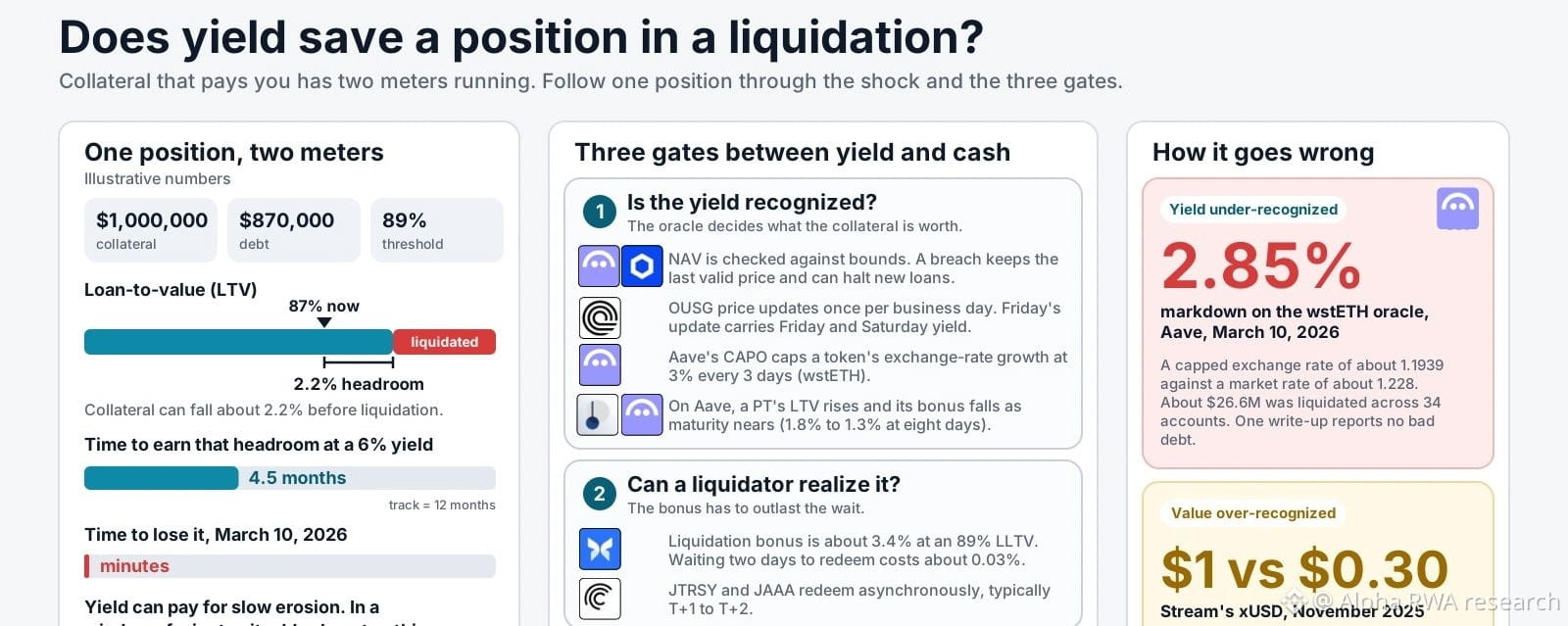
A loan against yield bearing collateral has two meters running. The collateral’s value rises as yield accrues. The debt rises as interest accrues. Health is collateral value times the liquidation threshold, divided by debt, and both sides of that fraction move every day.
This paper argues that the accrual itself is small next to the risks around it. Three questions decide whether yield helps a position: whether the oracle recognizes the yield, whether the liquidator can realize it, and whether the liquidator is allowed to reach it.
The arithmetic shows how small the accrual is. At an illustrative 3.5% yield, a 1% markdown in collateral value takes about 3.4 months of yield to earn back. Take a $JAAA.ETF style market, where a governance proposal lifted the liquidation threshold from 86% to 89%. A borrower at an 87% LTV has about 2.2% of headroom, and at an illustrative 6% yield that headroom is about 4.5 months of income. Yield can compensate for slow erosion. In a liquidation window of minutes it adds almost nothing.
II. Mechanism One: How the Oracle Recognizes Yield
Four designs show different answers.
NAV with bounds (#AAVE Horizon). When an issuer reports a new NAV, the #Chainlink network checks it against preset upper and lower bounds before publishing it onchain. aave.com/docs/aave-v3/h… If the report falls outside the bounds, the update is rejected and the oracle keeps reporting the last valid price. Any breach also prompts the emergency multisig to halt new loan originations until the cause is found. The design chooses to keep a stale price over acting on a bad one.
github-users.yhajoa.workers.dev/aave/aave-v3-h…
aave.com/docs/aave-v3/h…
Discrete issuer cadence (OUSG). #ONDO updates the onchain price once every business day, aiming for 4 to 6 p.m. ET, and says the manual process can run late. The Friday update includes the yield for Friday and Saturday, and whoever holds the token at the update gets the yield. At 3.5% that is roughly one basis point a day, so the oracle’s flat spot between updates costs almost nothing in yield terms. The rest of the weekend is a price shock window with no new NAV.
docs.ondo.finance/qualified-acce…
A cap on growth (#AAVE #CAPO , wstETH). CAPO limits how fast a yield bearing token’s exchange rate can grow. It stores a snapshot ratio and timestamp, and onchain rules cap the snapshot ratio’s increase at 3% every 3 days. This design recognizes yield by modeling its maximum speed.
governance.aave.com/t/post-mortem-…
Accretion to par (#PENDLE PTs on Aave).
Chaos Labs’ framework raises the LTV and liquidation threshold, and lowers the liquidation bonus, as a PT approaches maturity. A June 2026 Risk Steward update for PT $USDE 18JUN2026, eight days from maturity, put the model implied discount near 0.06%, raised LTV and LT by 0.1 point each, and cut the bonus from 1.8% to 1.3%. Here the yield is a schedule, and the risk parameters follow it.
governance.aave.com/t/arfc-pendle-…
III. Mechanism Two: What the Liquidator Receives
A liquidator on #morpho repays debt and seizes collateral plus a fixed incentive. The incentive factor is the smaller of 1.15 and 1 divided by (0.3 × LLTV + 0.7), and the whole amount goes to the liquidator with no protocol fee. At an 89% LLTV that is about 3.4%. docs.morpho.org/learn/concepts… A liquidator who then waits two days to redeem at a 5% funding cost pays about 0.03%. In calm conditions the bonus far exceeds the carry cost. Its job is to cover the case where redemption stalls, which is a gating risk that a price volatility bonus was not built for.
governance.aave.com/t/arfc-horizon…
Reaching the collateral is a second constraint. On #AAVE Horizon, RWA liquidators, typically market makers, must meet issuer defined investor requirements to liquidate collateral or redeem the RWAs. A comparison of tokenized collateral lending quotes @eulerfinance Securitize vaults as failing the collateral transfer if the recipient is not approved. A liquidation can fail at the token’s transfer check, so the accrued yield inside the token is out of reach for most wallets. SentoraHQ research frames the resulting risk as NAV latency, settlement delays and the capacity of approved liquidators, on top of price volatility.
sentora.com/research/artic…
protofire.io/guides/lending…
Redemption timing adds to it. One RWA liquidity guide describes @centrifuge JTRSY and $JAAA.ETF as ERC-7540 products that settle asynchronously, typically at T+1 to T+2.
coinpaprika.com/education/rwa-…
IV. Mechanism Three: Distribution Style Changes What Is “Accrued”
Yield can reach a holder as a rising price, a growing balance, or a monthly or daily airdrop of new tokens. For collateral accounting the distinction decides what sits in the token at the moment of seizure. An accumulating token carries its accrued yield in its price. A token that distributes yield as new tokens leaves the undistributed portion off the balance until the next payment. SteakhouseFi BUIDL overview warns that in kind distributions may cause similar integration issues to rebasing tokens. BUIDL’s move to daily payment, announced in January 2025, shrank that gap from up to a month to about a day.
kitchen.steakhouse.financial/p/blackrock-bu…
V. Cases
Case One: Aave’s CAPO error, March 10, 2026 (yield under-recognized). A newly deployed CAPO Risk Agent pushed a parameter update that depressed the wstETH oracle price by about 2.85% and triggered roughly $26.6 million of liquidations. The oracle reported a capped exchange rate near 1.1939 against a market rate near 1.228, and about 10,938 wstETH was liquidated across 34 accounts. One incident write up reports no attacker and no bad debt. governance.aave.com/t/post-mortem-… The mechanism was a mismatch between two stored values: the ratio was rate limited and the timestamp was not. The model of yield growth fell behind real yield growth, and at tight LT bands a 2.85% error exceeds the headroom.
theblock.co/news/ecosystem…
smartcontractshacking.com/hacks/aave-v3-…
Case Two: StreamDefi xUSD, November 2025 (value over recognized). The opposite failure. On @MorphoLabs , eulerfinance and SiloFinance , vaults priced xUSD at a fixed $1 while its market price collapsed, so the liquidations that should have unwound the loans never triggered. xUSD traded near $0.30 on secondary markets. A yield bearing wrapper backed by an opaque off chain strategy, priced at a hardcoded number, had no liquidation engine looking at its real value. Figures for losses and bad debt differ across sources, so I avoid quoting a total.
pharos.watch/learn/case-stu…
startupfortune.com/sp-global-laun…
Case Three: an issuer side change. @Securitize January 2025 shift to daily BUIDL dividends changed what a collateral lender sees on a given day without any protocol touching its own code. The issuer’s accounting model is part of the lender’s risk model.
VI. The Structural Question: Buffer or Carry?
Yield works as a buffer only over long periods. Over a weekend, a debt rate above the asset yield drifts a position by about one basis point. The practical reasons to model yield are narrower. A stale baseline can create false liquidations, as with CAPO. A schedule can tighten parameters toward maturity, as with PTs. And a hardcoded price removes the engine’s ability to see a loss at all.
The three approaches line up as follows. Horizon style bounded NAV treats the issuer’s number as the truth within a corridor and halts new borrowing on a breach. PT style schedules turn yield into a time based risk parameter. Hardcoded pricing avoids false liquidations at the cost of missing real ones.
Dune analysis of Horizon summarizes the shift: liquidation risk moves from price volatility toward operational factors like NAV timeliness and oracle integrity.
dune.com/blog/dune-dige…
VII. Where the Research Points
This paper’s thesis is that lenders on yield bearing RWAs should price three things next to LTV: how often the NAV updates, how fast the token can be turned into cash by an eligible liquidator, and how the issuer pays yield. Three things to watch:
1.The first sizable liquidation of an RWA position on a permissioned market, and how the liquidator exits.
2.Whether other lenders adopt maturity or cadence aware parameter schedules the way Aave did for PTs.
3.Whether the set of eligible liquidators for issuer-gated collateral widens or stays concentrated in a few market makers.
Independent research. Not financial advice. Always conduct your own due diligence
When the Collateral Pays You: Yield, Debt and the Liquidation Engine
When the Collateral Pays You: Yield, Debt and the Liquidation Engine
I. Two Meters Running
A loan against yield bearing collateral has two meters running. The collateral’s value rises as yield accrues. The debt rises as interest accrues. Health is collateral value times the liquidation threshold, divided by debt, and both sides of that fraction move every day.
This paper argues that the accrual itself is small next to the risks around it. Three questions decide whether yield helps a position: whether the oracle recognizes the yield, whether the liquidator can realize it, and whether the liquidator is allowed to reach it.
The arithmetic shows how small the accrual is. At an illustrative 3.5% yield, a 1% markdown in collateral value takes about 3.4 months of yield to earn back. Take a $JAAA.ETF style market, where a governance proposal lifted the liquidation threshold from 86% to 89%. A borrower at an 87% LTV has about 2.2% of headroom, and at an illustrative 6% yield that headroom is about 4.5 months of income. Yield can compensate for slow erosion. In a liquidation window of minutes it adds almost nothing.
II. Mechanism One: How the Oracle Recognizes Yield
Four designs show different answers.
NAV with bounds (#AAVE Horizon). When an issuer reports a new NAV, the #Chainlink network checks it against preset upper and lower bounds before publishing it onchain. aave.com/docs/aave-v3/h… If the report falls outside the bounds, the update is rejected and the oracle keeps reporting the last valid price. Any breach also prompts the emergency multisig to halt new loan originations until the cause is found. The design chooses to keep a stale price over acting on a bad one.
github-users.yhajoa.workers.dev/aave/aave-v3-h…
aave.com/docs/aave-v3/h…
Discrete issuer cadence (OUSG). #ONDO updates the onchain price once every business day, aiming for 4 to 6 p.m. ET, and says the manual process can run late. The Friday update includes the yield for Friday and Saturday, and whoever holds the token at the update gets the yield. At 3.5% that is roughly one basis point a day, so the oracle’s flat spot between updates costs almost nothing in yield terms. The rest of the weekend is a price shock window with no new NAV.
docs.ondo.finance/qualified-acce…
A cap on growth (#AAVE #CAPO , wstETH). CAPO limits how fast a yield bearing token’s exchange rate can grow. It stores a snapshot ratio and timestamp, and onchain rules cap the snapshot ratio’s increase at 3% every 3 days. This design recognizes yield by modeling its maximum speed.
governance.aave.com/t/post-mortem-…
Accretion to par (#PENDLE PTs on Aave).
Chaos Labs’ framework raises the LTV and liquidation threshold, and lowers the liquidation bonus, as a PT approaches maturity. A June 2026 Risk Steward update for PT $USDE 18JUN2026, eight days from maturity, put the model implied discount near 0.06%, raised LTV and LT by 0.1 point each, and cut the bonus from 1.8% to 1.3%. Here the yield is a schedule, and the risk parameters follow it.
governance.aave.com/t/arfc-pendle-…
III. Mechanism Two: What the Liquidator Receives
A liquidator on #morpho repays debt and seizes collateral plus a fixed incentive. The incentive factor is the smaller of 1.15 and 1 divided by (0.3 × LLTV + 0.7), and the whole amount goes to the liquidator with no protocol fee. At an 89% LLTV that is about 3.4%. docs.morpho.org/learn/concepts… A liquidator who then waits two days to redeem at a 5% funding cost pays about 0.03%. In calm conditions the bonus far exceeds the carry cost. Its job is to cover the case where redemption stalls, which is a gating risk that a price volatility bonus was not built for.
governance.aave.com/t/arfc-horizon…
Reaching the collateral is a second constraint. On #AAVE Horizon, RWA liquidators, typically market makers, must meet issuer defined investor requirements to liquidate collateral or redeem the RWAs. A comparison of tokenized collateral lending quotes @eulerfinance Securitize vaults as failing the collateral transfer if the recipient is not approved. A liquidation can fail at the token’s transfer check, so the accrued yield inside the token is out of reach for most wallets. SentoraHQ research frames the resulting risk as NAV latency, settlement delays and the capacity of approved liquidators, on top of price volatility.
sentora.com/research/artic…
protofire.io/guides/lending…
Redemption timing adds to it. One RWA liquidity guide describes @centrifuge JTRSY and $JAAA.ETF as ERC-7540 products that settle asynchronously, typically at T+1 to T+2.
coinpaprika.com/education/rwa-…
IV. Mechanism Three: Distribution Style Changes What Is “Accrued”
Yield can reach a holder as a rising price, a growing balance, or a monthly or daily airdrop of new tokens. For collateral accounting the distinction decides what sits in the token at the moment of seizure. An accumulating token carries its accrued yield in its price. A token that distributes yield as new tokens leaves the undistributed portion off the balance until the next payment. SteakhouseFi BUIDL overview warns that in kind distributions may cause similar integration issues to rebasing tokens. BUIDL’s move to daily payment, announced in January 2025, shrank that gap from up to a month to about a day.
kitchen.steakhouse.financial/p/blackrock-bu…
V. Cases
Case One: Aave’s CAPO error, March 10, 2026 (yield under-recognized). A newly deployed CAPO Risk Agent pushed a parameter update that depressed the wstETH oracle price by about 2.85% and triggered roughly $26.6 million of liquidations. The oracle reported a capped exchange rate near 1.1939 against a market rate near 1.228, and about 10,938 wstETH was liquidated across 34 accounts. One incident write up reports no attacker and no bad debt. governance.aave.com/t/post-mortem-… The mechanism was a mismatch between two stored values: the ratio was rate limited and the timestamp was not. The model of yield growth fell behind real yield growth, and at tight LT bands a 2.85% error exceeds the headroom.
theblock.co/news/ecosystem…
smartcontractshacking.com/hacks/aave-v3-…
Case Two: StreamDefi xUSD, November 2025 (value over recognized). The opposite failure. On @Morpho Labs 🦋 , eulerfinance and SiloFinance , vaults priced xUSD at a fixed $1 while its market price collapsed, so the liquidations that should have unwound the loans never triggered. xUSD traded near $0.30 on secondary markets. A yield bearing wrapper backed by an opaque off chain strategy, priced at a hardcoded number, had no liquidation engine looking at its real value. Figures for losses and bad debt differ across sources, so I avoid quoting a total.
pharos.watch/learn/case-stu…
startupfortune.com/sp-global-laun…
Case Three: an issuer side change. @Securitize January 2025 shift to daily BUIDL dividends changed what a collateral lender sees on a given day without any protocol touching its own code. The issuer’s accounting model is part of the lender’s risk model.
VI. The Structural Question: Buffer or Carry?
Yield works as a buffer only over long periods. Over a weekend, a debt rate above the asset yield drifts a position by about one basis point. The practical reasons to model yield are narrower. A stale baseline can create false liquidations, as with CAPO. A schedule can tighten parameters toward maturity, as with PTs. And a hardcoded price removes the engine’s ability to see a loss at all.
The three approaches line up as follows. Horizon style bounded NAV treats the issuer’s number as the truth within a corridor and halts new borrowing on a breach. PT style schedules turn yield into a time based risk parameter. Hardcoded pricing avoids false liquidations at the cost of missing real ones.
Dune analysis of Horizon summarizes the shift: liquidation risk moves from price volatility toward operational factors like NAV timeliness and oracle integrity.
dune.com/blog/dune-dige…
VII. Where the Research Points
This paper’s thesis is that lenders on yield bearing RWAs should price three things next to LTV: how often the NAV updates, how fast the token can be turned into cash by an eligible liquidator, and how the issuer pays yield. Three things to watch:
1.The first sizable liquidation of an RWA position on a permissioned market, and how the liquidator exits.
2.Whether other lenders adopt maturity or cadence aware parameter schedules the way Aave did for PTs.
3.Whether the set of eligible liquidators for issuer-gated collateral widens or stays concentrated in a few market makers.
Independent research. Not financial advice. Always conduct your own due diligence
I. Two Meters Running
A loan against yield bearing collateral has two meters running. The collateral’s value rises as yield accrues. The debt rises as interest accrues. Health is collateral value times the liquidation threshold, divided by debt, and both sides of that fraction move every day.
This paper argues that the accrual itself is small next to the risks around it. Three questions decide whether yield helps a position: whether the oracle recognizes the yield, whether the liquidator can realize it, and whether the liquidator is allowed to reach it.
The arithmetic shows how small the accrual is. At an illustrative 3.5% yield, a 1% markdown in collateral value takes about 3.4 months of yield to earn back. Take a $JAAA.ETF style market, where a governance proposal lifted the liquidation threshold from 86% to 89%. A borrower at an 87% LTV has about 2.2% of headroom, and at an illustrative 6% yield that headroom is about 4.5 months of income. Yield can compensate for slow erosion. In a liquidation window of minutes it adds almost nothing.
II. Mechanism One: How the Oracle Recognizes Yield
Four designs show different answers.
NAV with bounds (#AAVE Horizon). When an issuer reports a new NAV, the #Chainlink network checks it against preset upper and lower bounds before publishing it onchain. aave.com/docs/aave-v3/h… If the report falls outside the bounds, the update is rejected and the oracle keeps reporting the last valid price. Any breach also prompts the emergency multisig to halt new loan originations until the cause is found. The design chooses to keep a stale price over acting on a bad one.
github-users.yhajoa.workers.dev/aave/aave-v3-h…
aave.com/docs/aave-v3/h…
Discrete issuer cadence (OUSG). #ONDO updates the onchain price once every business day, aiming for 4 to 6 p.m. ET, and says the manual process can run late. The Friday update includes the yield for Friday and Saturday, and whoever holds the token at the update gets the yield. At 3.5% that is roughly one basis point a day, so the oracle’s flat spot between updates costs almost nothing in yield terms. The rest of the weekend is a price shock window with no new NAV.
docs.ondo.finance/qualified-acce…
A cap on growth (#AAVE #CAPO , wstETH). CAPO limits how fast a yield bearing token’s exchange rate can grow. It stores a snapshot ratio and timestamp, and onchain rules cap the snapshot ratio’s increase at 3% every 3 days. This design recognizes yield by modeling its maximum speed.
governance.aave.com/t/post-mortem-…
Accretion to par (#PENDLE PTs on Aave).
Chaos Labs’ framework raises the LTV and liquidation threshold, and lowers the liquidation bonus, as a PT approaches maturity. A June 2026 Risk Steward update for PT $USDE 18JUN2026, eight days from maturity, put the model implied discount near 0.06%, raised LTV and LT by 0.1 point each, and cut the bonus from 1.8% to 1.3%. Here the yield is a schedule, and the risk parameters follow it.
governance.aave.com/t/arfc-pendle-…
III. Mechanism Two: What the Liquidator Receives
A liquidator on #morpho repays debt and seizes collateral plus a fixed incentive. The incentive factor is the smaller of 1.15 and 1 divided by (0.3 × LLTV + 0.7), and the whole amount goes to the liquidator with no protocol fee. At an 89% LLTV that is about 3.4%. docs.morpho.org/learn/concepts… A liquidator who then waits two days to redeem at a 5% funding cost pays about 0.03%. In calm conditions the bonus far exceeds the carry cost. Its job is to cover the case where redemption stalls, which is a gating risk that a price volatility bonus was not built for.
governance.aave.com/t/arfc-horizon…
Reaching the collateral is a second constraint. On #AAVE Horizon, RWA liquidators, typically market makers, must meet issuer defined investor requirements to liquidate collateral or redeem the RWAs. A comparison of tokenized collateral lending quotes @eulerfinance Securitize vaults as failing the collateral transfer if the recipient is not approved. A liquidation can fail at the token’s transfer check, so the accrued yield inside the token is out of reach for most wallets. SentoraHQ research frames the resulting risk as NAV latency, settlement delays and the capacity of approved liquidators, on top of price volatility.
sentora.com/research/artic…
protofire.io/guides/lending…
Redemption timing adds to it. One RWA liquidity guide describes @centrifuge JTRSY and $JAAA.ETF as ERC-7540 products that settle asynchronously, typically at T+1 to T+2.
coinpaprika.com/education/rwa-…
IV. Mechanism Three: Distribution Style Changes What Is “Accrued”
Yield can reach a holder as a rising price, a growing balance, or a monthly or daily airdrop of new tokens. For collateral accounting the distinction decides what sits in the token at the moment of seizure. An accumulating token carries its accrued yield in its price. A token that distributes yield as new tokens leaves the undistributed portion off the balance until the next payment. SteakhouseFi BUIDL overview warns that in kind distributions may cause similar integration issues to rebasing tokens. BUIDL’s move to daily payment, announced in January 2025, shrank that gap from up to a month to about a day.
kitchen.steakhouse.financial/p/blackrock-bu…
V. Cases
Case One: Aave’s CAPO error, March 10, 2026 (yield under-recognized). A newly deployed CAPO Risk Agent pushed a parameter update that depressed the wstETH oracle price by about 2.85% and triggered roughly $26.6 million of liquidations. The oracle reported a capped exchange rate near 1.1939 against a market rate near 1.228, and about 10,938 wstETH was liquidated across 34 accounts. One incident write up reports no attacker and no bad debt. governance.aave.com/t/post-mortem-… The mechanism was a mismatch between two stored values: the ratio was rate limited and the timestamp was not. The model of yield growth fell behind real yield growth, and at tight LT bands a 2.85% error exceeds the headroom.
theblock.co/news/ecosystem…
smartcontractshacking.com/hacks/aave-v3-…
Case Two: StreamDefi xUSD, November 2025 (value over recognized). The opposite failure. On @Morpho Labs 🦋 , eulerfinance and SiloFinance , vaults priced xUSD at a fixed $1 while its market price collapsed, so the liquidations that should have unwound the loans never triggered. xUSD traded near $0.30 on secondary markets. A yield bearing wrapper backed by an opaque off chain strategy, priced at a hardcoded number, had no liquidation engine looking at its real value. Figures for losses and bad debt differ across sources, so I avoid quoting a total.
pharos.watch/learn/case-stu…
startupfortune.com/sp-global-laun…
Case Three: an issuer side change. @Securitize January 2025 shift to daily BUIDL dividends changed what a collateral lender sees on a given day without any protocol touching its own code. The issuer’s accounting model is part of the lender’s risk model.
VI. The Structural Question: Buffer or Carry?
Yield works as a buffer only over long periods. Over a weekend, a debt rate above the asset yield drifts a position by about one basis point. The practical reasons to model yield are narrower. A stale baseline can create false liquidations, as with CAPO. A schedule can tighten parameters toward maturity, as with PTs. And a hardcoded price removes the engine’s ability to see a loss at all.
The three approaches line up as follows. Horizon style bounded NAV treats the issuer’s number as the truth within a corridor and halts new borrowing on a breach. PT style schedules turn yield into a time based risk parameter. Hardcoded pricing avoids false liquidations at the cost of missing real ones.
Dune analysis of Horizon summarizes the shift: liquidation risk moves from price volatility toward operational factors like NAV timeliness and oracle integrity.
dune.com/blog/dune-dige…
VII. Where the Research Points
This paper’s thesis is that lenders on yield bearing RWAs should price three things next to LTV: how often the NAV updates, how fast the token can be turned into cash by an eligible liquidator, and how the issuer pays yield. Three things to watch:
1.The first sizable liquidation of an RWA position on a permissioned market, and how the liquidator exits.
2.Whether other lenders adopt maturity or cadence aware parameter schedules the way Aave did for PTs.
3.Whether the set of eligible liquidators for issuer-gated collateral widens or stays concentrated in a few market makers.
Independent research. Not financial advice. Always conduct your own due diligence
Trong_Hatachi:
The two-meter framing is useful—yield can help, but debt interest and liquidation thresholds matter just as much. Follow me back if you’d like to keep discussing RWA research.
2
2
894
Көбірек контент көру үшін кіріңіз
Binance Square платформасында әлемдік криптоқоғамдастыққа қосылыңыз
⚡️ Криптовалюта туралы ең соңғы және пайдалы ақпаратты алыңыз.
💬 Әлемдегі ең ірі криптобиржаның сеніміне ие.
👍 Расталған авторлардың нақты пікірлерін табыңыз.
Электрондық пошта/телефон нөмірі
Трендтегі тақырыптар
1
#NvidiaBeatsEstimatesWith$130BQ4Outlook
9,415 рет көрілді
142 адам талқылап жатыр
2
#AnthropicIPOPriceCouldExceed$80
15,397 рет көрілді
129 адам талқылап жатыр
3
#CanNvidia’sDataCenterGrowthContinue?
46,382 рет көрілді
637 адам талқылап жатыр
4
#CanadaAndUSLaunchOperationNiagaraAgainstApprovalPhishing
1,234 рет көрілді
21 адам талқылап жатыр
5
#BankOfEnglandUnveilsClearingHousePathwayCoveringDLTFirms
1,601 рет көрілді
38 адам талқылап жатыр
6
#DBSAndCirclePartnerToExpandAsianInstitutionsUSDCAccess
3,045 рет көрілді
52 адам талқылап жатыр
7
#LedgerHardwareImplantReportsExtendToDubai
14,788 рет көрілді
235 адам талқылап жатыр
8
#NvidiaBoardNotConsideringHuang’sReturnasCEO
209,285 рет көрілді
1,499 адам талқылап жатыр
9
#KOSPIFalls2.59%ToLowestCloseSinceFebruary
60,893 рет көрілді
702 адам талқылап жатыр
10
#AnthropicClearedToListOnNasdaqAsANT
54,245 рет көрілді
569 адам талқылап жатыр