
jinxfi
288 投稿

jinxfi
I'm always with you, even when we're worlds apart.
3 フォロー
4.9K+ フォロワー
311 いいね
投稿
トランザクションモデルにおける最も些細なディテールが、見出しの機能よりも大きな結果につながることがあります。
Duskは送信者アカウントに紐づけられたnonceを使用し、その値はトランザクションが正常に実行されるたびにインクリメントされます。役目はシンプルですが重要です。ネットワークは、同一のリクエストを独立した行動として扱うのではなく、すでに使われたものと新しいトランザクションを区別できます。
この仕組みがあまりに退屈であることが、私は好きです。
優れたトランザクション基盤には、ユーザーが何か問題が起きるまで意識しないようなルールがしばしば必要です。nonceは、アカウントがすでに実行したものに対して明確な順序を提供します。
しかし、その単純さにはもう一つの側面があります。
同一アカウントからのトランザクションが、順序付けられたnonceのシーケンスに依存する場合、独立したアクションが、完全に無関係であるかのように振る舞えるとは限りません。順序付けのルールは実行の構造を与えますが、同時にトランザクションがシステム内をどのように移動するかに制約を課すことにもなり得ます。
では、アカウント単位のnonce順序付けはDuskに適切なトランザクションの規律をもたらすのでしょうか。それとも、厳格なシーケンスは、金融アプリケーションがより多くの並列実行を必要とするときに摩擦になり得るのでしょうか??
#dusk @Dusk $DUSK
Duskは送信者アカウントに紐づけられたnonceを使用し、その値はトランザクションが正常に実行されるたびにインクリメントされます。役目はシンプルですが重要です。ネットワークは、同一のリクエストを独立した行動として扱うのではなく、すでに使われたものと新しいトランザクションを区別できます。
この仕組みがあまりに退屈であることが、私は好きです。
優れたトランザクション基盤には、ユーザーが何か問題が起きるまで意識しないようなルールがしばしば必要です。nonceは、アカウントがすでに実行したものに対して明確な順序を提供します。
しかし、その単純さにはもう一つの側面があります。
同一アカウントからのトランザクションが、順序付けられたnonceのシーケンスに依存する場合、独立したアクションが、完全に無関係であるかのように振る舞えるとは限りません。順序付けのルールは実行の構造を与えますが、同時にトランザクションがシステム内をどのように移動するかに制約を課すことにもなり得ます。
では、アカウント単位のnonce順序付けはDuskに適切なトランザクションの規律をもたらすのでしょうか。それとも、厳格なシーケンスは、金融アプリケーションがより多くの並列実行を必要とするときに摩擦になり得るのでしょうか??
#dusk @Dusk $DUSK
Better discipline
0%
Parallelism matters more
0%
Depends on the app
0%
Too much sequencing friction
0%
0 投票 • 投票は終了しました
翻訳参照
I was thinking about what happens when a transaction reaches Dusk.
At first, it feels like there is only one question:
**“Should the network accept this?”**
But looking closer, there are actually two different questions.
First, does the transaction follow the protocol’s rules?
Then, assuming it does, do participants agree on the state that results from it?
That distinction is easy to miss because, from the outside, both steps lead toward the same outcome: an accepted state.
But architecturally, they are different jobs.
If something goes wrong, separating them makes it easier to ask what actually failed. Was the transaction invalid? Or was it valid, but did participants disagree about the resulting state?
I think that separation is a strong design choice.
But it also creates a new question.
Every boundary between responsibilities is another handoff. And every handoff needs to behave correctly when something unexpected happens.
So I keep coming back to this:
**Does separating validity from consensus make Dusk easier to reason about under failure, or does every additional boundary create another place where the system can break?**
#Dusk @Dusk $DUSK
At first, it feels like there is only one question:
**“Should the network accept this?”**
But looking closer, there are actually two different questions.
First, does the transaction follow the protocol’s rules?
Then, assuming it does, do participants agree on the state that results from it?
That distinction is easy to miss because, from the outside, both steps lead toward the same outcome: an accepted state.
But architecturally, they are different jobs.
If something goes wrong, separating them makes it easier to ask what actually failed. Was the transaction invalid? Or was it valid, but did participants disagree about the resulting state?
I think that separation is a strong design choice.
But it also creates a new question.
Every boundary between responsibilities is another handoff. And every handoff needs to behave correctly when something unexpected happens.
So I keep coming back to this:
**Does separating validity from consensus make Dusk easier to reason about under failure, or does every additional boundary create another place where the system can break?**
#Dusk @Dusk $DUSK
Easier to isolate failures
0%
Clearer system boundaries
0%
More coordination risks
0%
Both equally
0%
0 投票 • 投票は終了しました
翻訳参照
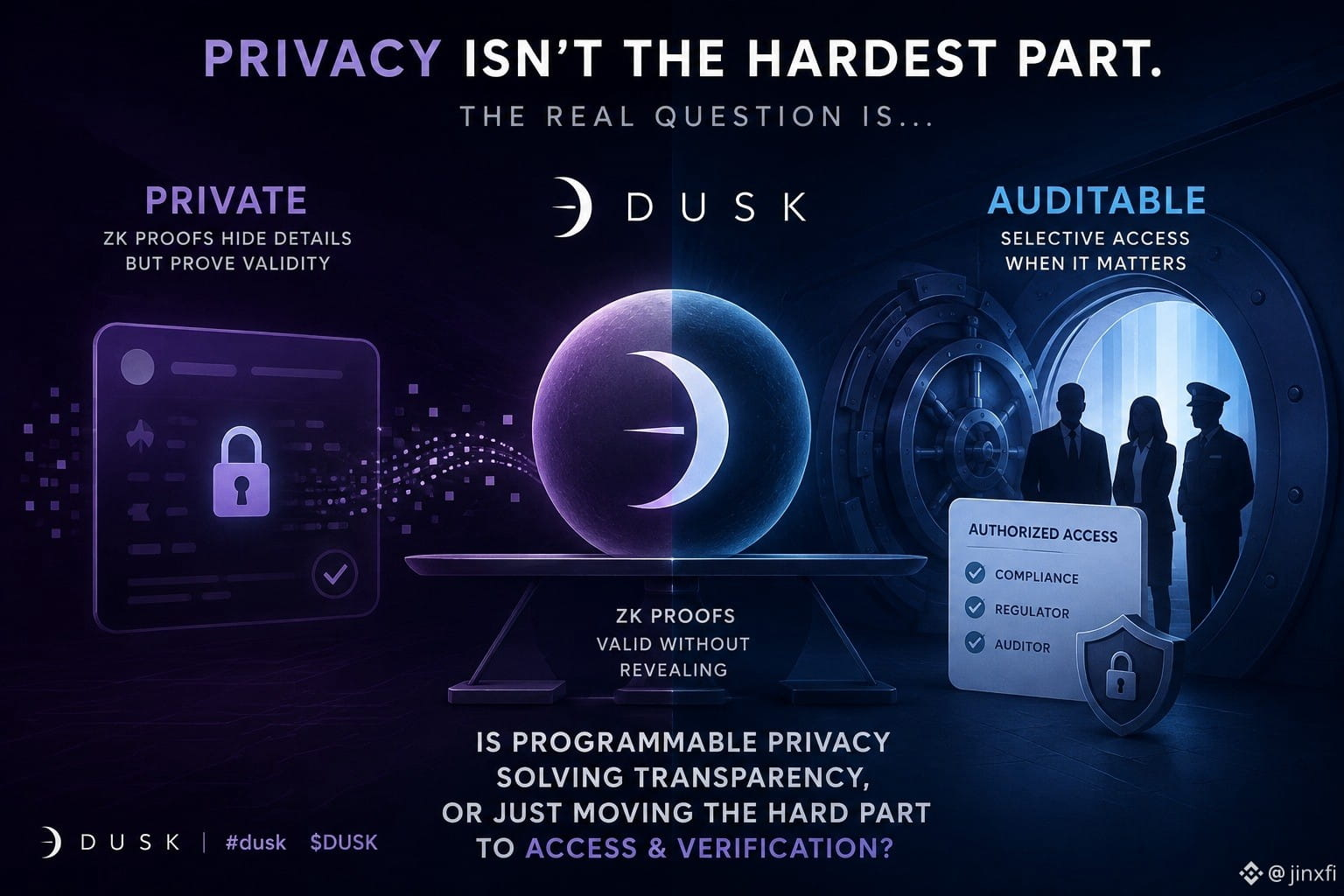
The more I read about @Dusk _Foundation, the more I think privacy itself isn't the hardest part.
Dusk uses ZK proofs to keep transaction details private while still proving that the transaction is valid.
That sounds useful for regulated finance, where you may not want every transaction detail visible to everyone.
But then comes the bigger question:
If the details are hidden, who can see them when they need to?
I like that Dusk treats privacy and auditability as things that can work together.
But the more selective the visibility becomes, the more important the rules around access become.
So I keep wondering:
Is programmable privacy really solving the transparency problem for regulated markets, or is it simply moving the hard part to access and verification?
#dusk @Dusk $DUSK
Dusk uses ZK proofs to keep transaction details private while still proving that the transaction is valid.
That sounds useful for regulated finance, where you may not want every transaction detail visible to everyone.
But then comes the bigger question:
If the details are hidden, who can see them when they need to?
I like that Dusk treats privacy and auditability as things that can work together.
But the more selective the visibility becomes, the more important the rules around access become.
So I keep wondering:
Is programmable privacy really solving the transparency problem for regulated markets, or is it simply moving the hard part to access and verification?
#dusk @Dusk $DUSK
TermMaxについて考え続けていることのひとつが、取引の順序(トランザクション・オーダリング)です。
このプロトコルには、入出借のメカニクスが慎重に定義されている場合でも、取引は順序が問題になり得るブロックチェーン環境を通過する必要があります。
それによって、別種のリスクが生まれます。
MEVは、必ずしも貸付(レンディング)設計そのものの失敗を意味するわけではありません。MEVは、その設計の周りで取引が処理される方法の結果であり、不利な順序やスリッページといったことで実行(エグゼキューション)に影響を及ぼし得ます。
その違いは重要だと思います。つまり、健全な金融メカニクスを備えたプロトコルでも、実行レベルの問題によってユーザーが影響を受ける可能性があるのです。
では、プロトコル分析では、取引の順序をTermMaxの中核となるリスクモデルの一部として扱うべきでしょうか。それとも、周辺の実行環境によって生み出される別のリスクとして扱うべきでしょうか??
@TermMax #TermMax
このプロトコルには、入出借のメカニクスが慎重に定義されている場合でも、取引は順序が問題になり得るブロックチェーン環境を通過する必要があります。
それによって、別種のリスクが生まれます。
MEVは、必ずしも貸付(レンディング)設計そのものの失敗を意味するわけではありません。MEVは、その設計の周りで取引が処理される方法の結果であり、不利な順序やスリッページといったことで実行(エグゼキューション)に影響を及ぼし得ます。
その違いは重要だと思います。つまり、健全な金融メカニクスを備えたプロトコルでも、実行レベルの問題によってユーザーが影響を受ける可能性があるのです。
では、プロトコル分析では、取引の順序をTermMaxの中核となるリスクモデルの一部として扱うべきでしょうか。それとも、周辺の実行環境によって生み出される別のリスクとして扱うべきでしょうか??
@TermMax #TermMax
Core protocol risk
100%
Execution-layer risk
0%
Both matter equally
0%
Depends on the mechanism
0%
1 投票 • 投票は終了しました
翻訳参照
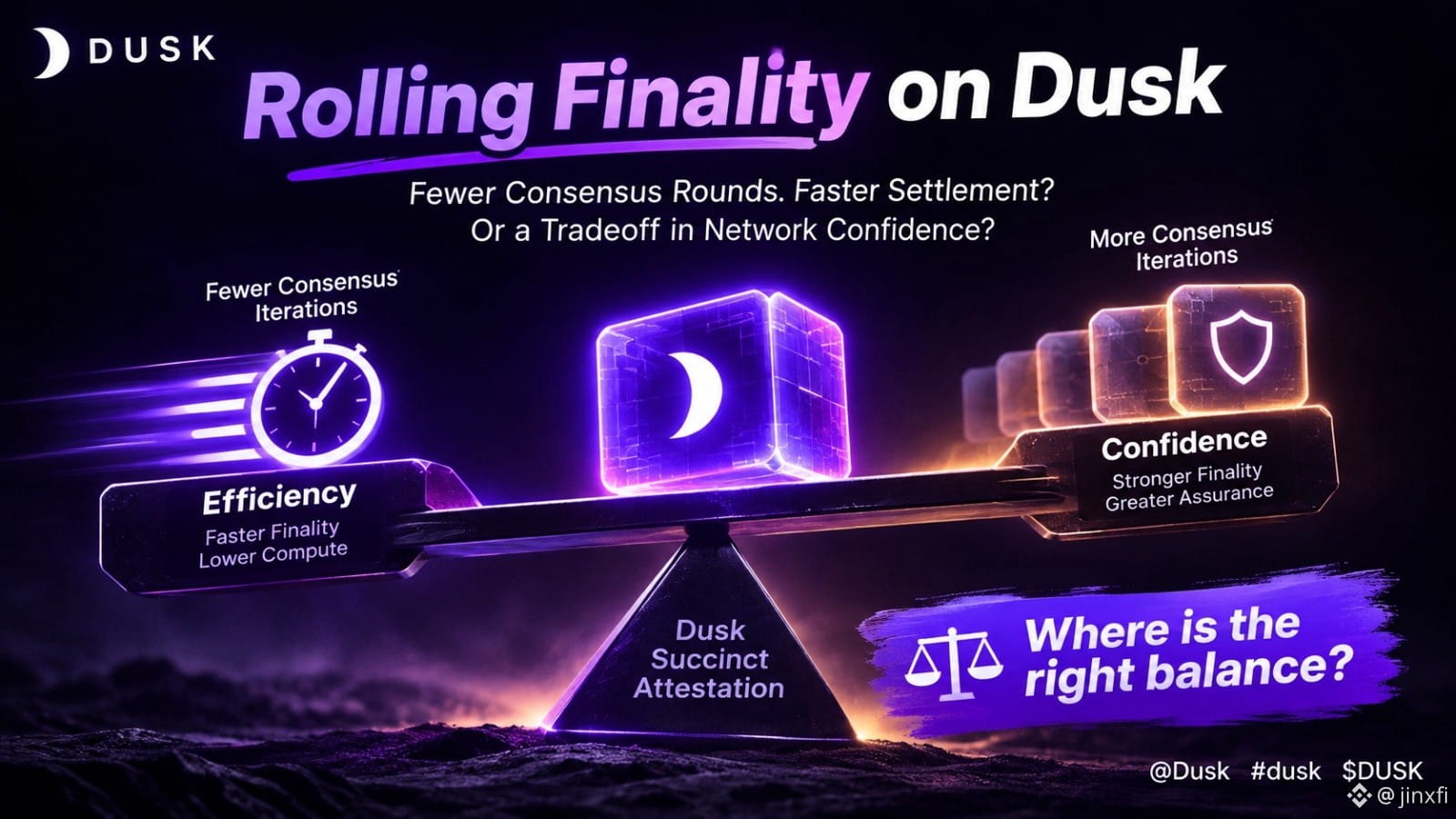
I kept thinking “fast finality” was mostly about getting a block confirmed quicker then I looked at how Dusk describes rolling finality, and thats not really the interesting part.
Dusk's Succinct Attestation consensus doesnt just aim to reach finality in seconds. The whitepaper describes rolling finality as a way to limit how many consensus iterations are needed before a block becomes final.
That small distinction matters.
Instead of repeatedly spending network resources proving the same block final, the process moves forward while keeping the finalization work bounded. I like that design for financial infrastructure because settlement isnt very useful if every extra step adds another layer of waiting and computation.
But theres a question underneath it.
The fewer consensus iterations you need, the more efficient finality becomes. At the same time, those iterations are part of what gives the network confidence that a block should be final.
so where is the right balance??
Does limiting finalization rounds make Dusk better suited to financial settlement, or does efficiency eventually become a tradeoff against how much consensus work is desirable??
@Dusk #dusk $DUSK
Dusk's Succinct Attestation consensus doesnt just aim to reach finality in seconds. The whitepaper describes rolling finality as a way to limit how many consensus iterations are needed before a block becomes final.
That small distinction matters.
Instead of repeatedly spending network resources proving the same block final, the process moves forward while keeping the finalization work bounded. I like that design for financial infrastructure because settlement isnt very useful if every extra step adds another layer of waiting and computation.
But theres a question underneath it.
The fewer consensus iterations you need, the more efficient finality becomes. At the same time, those iterations are part of what gives the network confidence that a block should be final.
so where is the right balance??
Does limiting finalization rounds make Dusk better suited to financial settlement, or does efficiency eventually become a tradeoff against how much consensus work is desirable??
@Dusk #dusk $DUSK
翻訳参照
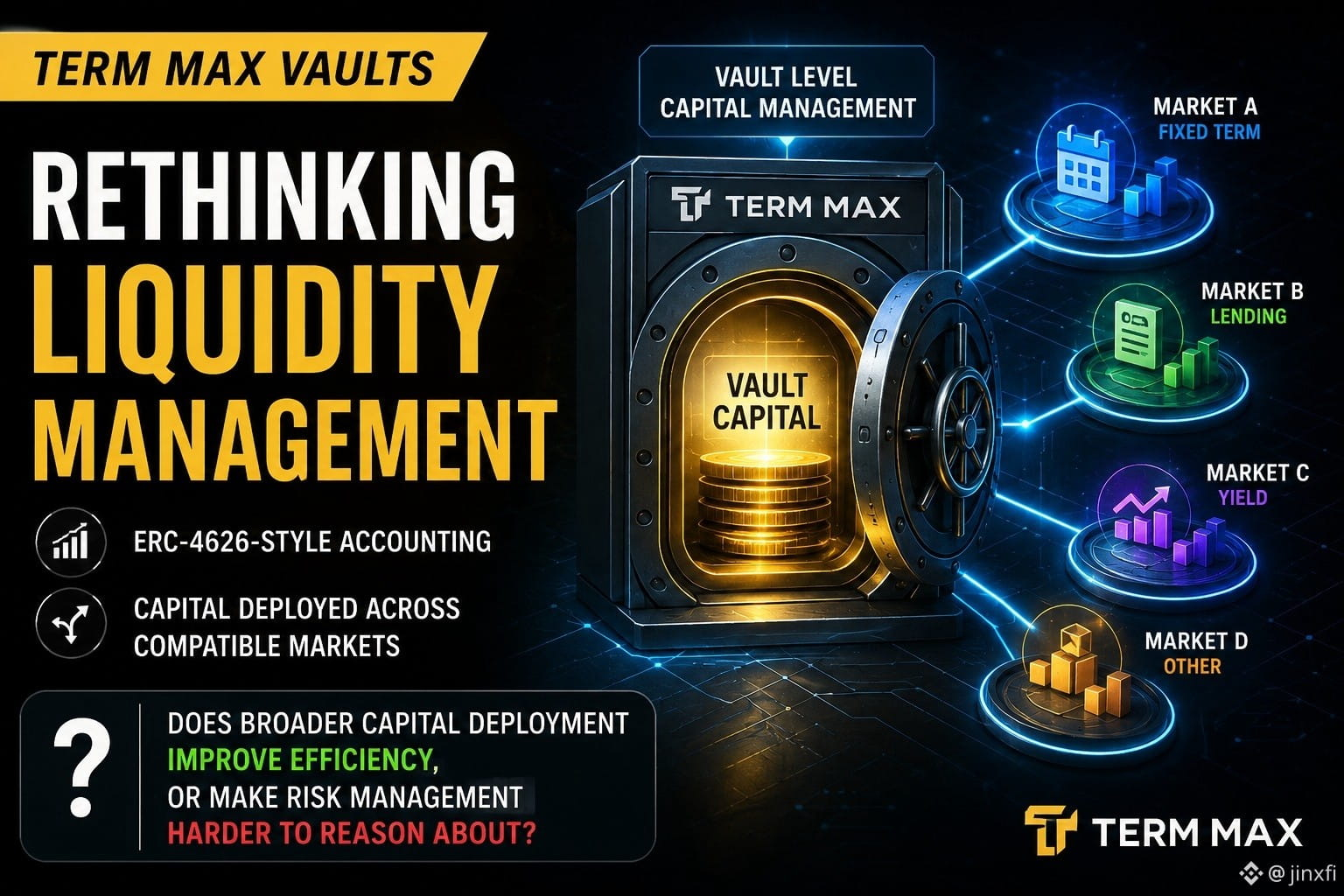
Something about TermMax’s vault structure made me rethink what “liquidity management” actually means.
A vault isnt simply another place to park capital. The design uses ERC-4626-style accounting and allows capital to be deployed across compatible markets instead of treating every market position as completely isolated.
I like that separation because capital management can happen above the individual market level.
But thats also where the question gets harder.
The more markets a vault can interact with, the more useful the capital may become, but the decision about where that capital should sit also becomes more important.
Does broader capital deployment genuinely improve efficiency, or does it make risk management harder to reason about??
@TermMax #TermMax
A vault isnt simply another place to park capital. The design uses ERC-4626-style accounting and allows capital to be deployed across compatible markets instead of treating every market position as completely isolated.
I like that separation because capital management can happen above the individual market level.
But thats also where the question gets harder.
The more markets a vault can interact with, the more useful the capital may become, but the decision about where that capital should sit also becomes more important.
Does broader capital deployment genuinely improve efficiency, or does it make risk management harder to reason about??
@TermMax #TermMax
翻訳参照
I went digging into why Dusk rewards voters for supporting candidates from earlier, failed iterations.
At first, the process looks simple:
Proposal → Validation → Ratification
But the interesting part is what happens when an iteration fails.
Instead of letting the failed block disappear, Dusk gives later committees a reason to bring it back.
What surprised me is that this voter reward was added for a specific reason: to encourage future committees to vote on candidates from previous iterations.
So the protocol added a financial incentive to make recovering a failed block worth doing.
That makes a failed iteration less like a dead end and more like something the network is still willing to recover.
The interesting question is:
iIs Dusk smartly rewarding committees for finishing unfinished work, or does it show that recovery needs a financial push in the first place?
#dusk @Dusk $DUSK
Make it short
At first, the process looks simple:
Proposal → Validation → Ratification
But the interesting part is what happens when an iteration fails.
Instead of letting the failed block disappear, Dusk gives later committees a reason to bring it back.
What surprised me is that this voter reward was added for a specific reason: to encourage future committees to vote on candidates from previous iterations.
So the protocol added a financial incentive to make recovering a failed block worth doing.
That makes a failed iteration less like a dead end and more like something the network is still willing to recover.
The interesting question is:
iIs Dusk smartly rewarding committees for finishing unfinished work, or does it show that recovery needs a financial push in the first place?
#dusk @Dusk $DUSK
Make it short
Smart recovery incentive
0%
Necessary financial push
0%
Better without rewards
0%
depend on incentive
0%
0 投票 • 投票は終了しました
翻訳参照
I started looking at TMX governance differently once i noticed what staking is supposed to change.
TMX holders can participate in governance, but staking can also provide enhanced governance rights around things like market risk parameters and curator whitelisting.
Thats more interesting to me than simply having another voting system.
Those decisions can directly affect how fixed-rate markets are managed, so governance becomes connected to actual protocol configuration rather than just broad proposals.
The positive is obvious: people with longer-term participation can have more influence.
But that creates a harder question. More concentrated decision-making can improve accountability, or it can make the quality of a smaller group’s judgement matter alot more.
Does enhanced governance produce better protocol decisions, or just make governance power more concentrated??
@TermMax #TermMax
TMX holders can participate in governance, but staking can also provide enhanced governance rights around things like market risk parameters and curator whitelisting.
Thats more interesting to me than simply having another voting system.
Those decisions can directly affect how fixed-rate markets are managed, so governance becomes connected to actual protocol configuration rather than just broad proposals.
The positive is obvious: people with longer-term participation can have more influence.
But that creates a harder question. More concentrated decision-making can improve accountability, or it can make the quality of a smaller group’s judgement matter alot more.
Does enhanced governance produce better protocol decisions, or just make governance power more concentrated??
@TermMax #TermMax
Better decisions
100%
More concentrated power
0%
Depends on design
0%
Both can happen
0%
1 投票 • 投票は終了しました
翻訳参照
Something about native issuance on Dusk kept bothering me.
I used to think tokenization and native issuance were basically the same thing with different wording. They arent.
Tokenization starts with an existing asset and creates an onchain representation of it. Native issuance goes further: the security itself can have its lifecycle structured onchain from the point of issuance.
Dusk's Zedger design is interesting here because it isnt limited to holding a tokenized representation. The whitepaper describes support for securities that are either tokenized or natively issued, with lifecycle functions such as minting, burning and corporate actions built into the asset model.
That sounds cleaner to me.
But it also creates a harder question. If more of the security lifecycle moves onto the chain, more of that lifecycle has to fit the rules of the issuer, venue and jurisdiction. The technical capability alone doesnt make the asset native in practice.
thats the part I keep coming back to.
Does moving the security lifecycle closer to the chain make regulated markets genuinely more native, or does it simply move more regulatory complexity into the asset itself??
@Dusk $DUSK #dusk
I used to think tokenization and native issuance were basically the same thing with different wording. They arent.
Tokenization starts with an existing asset and creates an onchain representation of it. Native issuance goes further: the security itself can have its lifecycle structured onchain from the point of issuance.
Dusk's Zedger design is interesting here because it isnt limited to holding a tokenized representation. The whitepaper describes support for securities that are either tokenized or natively issued, with lifecycle functions such as minting, burning and corporate actions built into the asset model.
That sounds cleaner to me.
But it also creates a harder question. If more of the security lifecycle moves onto the chain, more of that lifecycle has to fit the rules of the issuer, venue and jurisdiction. The technical capability alone doesnt make the asset native in practice.
thats the part I keep coming back to.
Does moving the security lifecycle closer to the chain make regulated markets genuinely more native, or does it simply move more regulatory complexity into the asset itself??
@Dusk $DUSK #dusk
More native
0%
More complexity
0%
Both
0%
Too early to tell
0%
0 投票 • 投票は終了しました
翻訳参照
I keep thinking scalability gets described too narrowly in blockchain.
A chain can process more transactions and still be awkward for financial applications if execution becomes unpredictable as activity grows.
What interested me in Dusk is that scalability is treated as a systems problem rather than just a bigger throughput number. The architecture separates concerns across consensus, networking and execution, which gives each layer a more specific job.
That sounds cleaner than simply chasing a headline TPS figure.
But there’s a question underneath it. Financial applications dont just need capacity when demand is low. They need the system to remain predictable when multiple workflows compete for resources at the same time.
Higher theoretical capacity is useful. Predictable capacity is harder.
So is Dusk's layered approach actually a better path toward scalable financial infrastructure, or does separating the system into more specialized components just create more complexity to manage??
#dusk @Dusk $DUSK
A chain can process more transactions and still be awkward for financial applications if execution becomes unpredictable as activity grows.
What interested me in Dusk is that scalability is treated as a systems problem rather than just a bigger throughput number. The architecture separates concerns across consensus, networking and execution, which gives each layer a more specific job.
That sounds cleaner than simply chasing a headline TPS figure.
But there’s a question underneath it. Financial applications dont just need capacity when demand is low. They need the system to remain predictable when multiple workflows compete for resources at the same time.
Higher theoretical capacity is useful. Predictable capacity is harder.
So is Dusk's layered approach actually a better path toward scalable financial infrastructure, or does separating the system into more specialized components just create more complexity to manage??
#dusk @Dusk $DUSK
Better scalability
0%
More complexity
0%
Depends on execution
0%
Too early to tell
0%
0 投票 • 投票は終了しました
翻訳参照
I spent some time looking at @Dusk networking layer and found myself paying more attention to something most users never see: how blocks actually move through the network.
Kadcast uses a structured peer-to-peer design built around Kademlia-style routing rather than simply pushing every message to every connected peer. The idea is to make propagation more targeted and reduce the amount of redundant communication happening across the network.
That sounds like a backend detail.
It probably isnt.
For a chain dealing with financial activity, network efficiency eventually becomes part of the user experience. If nodes spend less effort passing around the same information repeatedly, there’s more room for the network to handle useful work instead of communication overhead.
The part I’m less certain about is the tradeoff. A more structured propagation system can reduce waste, but it also introduces more assumptions about how the network is organized and how nodes reach each other.
So does smarter block propagation meaningfully improve the foundation for financial settlement, or does the added network structure create complexity that becomes harder to manage at scale??
#dusk @Dusk $DUSK
Kadcast uses a structured peer-to-peer design built around Kademlia-style routing rather than simply pushing every message to every connected peer. The idea is to make propagation more targeted and reduce the amount of redundant communication happening across the network.
That sounds like a backend detail.
It probably isnt.
For a chain dealing with financial activity, network efficiency eventually becomes part of the user experience. If nodes spend less effort passing around the same information repeatedly, there’s more room for the network to handle useful work instead of communication overhead.
The part I’m less certain about is the tradeoff. A more structured propagation system can reduce waste, but it also introduces more assumptions about how the network is organized and how nodes reach each other.
So does smarter block propagation meaningfully improve the foundation for financial settlement, or does the added network structure create complexity that becomes harder to manage at scale??
#dusk @Dusk $DUSK
Better efficiency
0%
Stronger settlement
0%
Complexity risk
0%
Both matter
0%
0 投票 • 投票は終了しました
翻訳参照
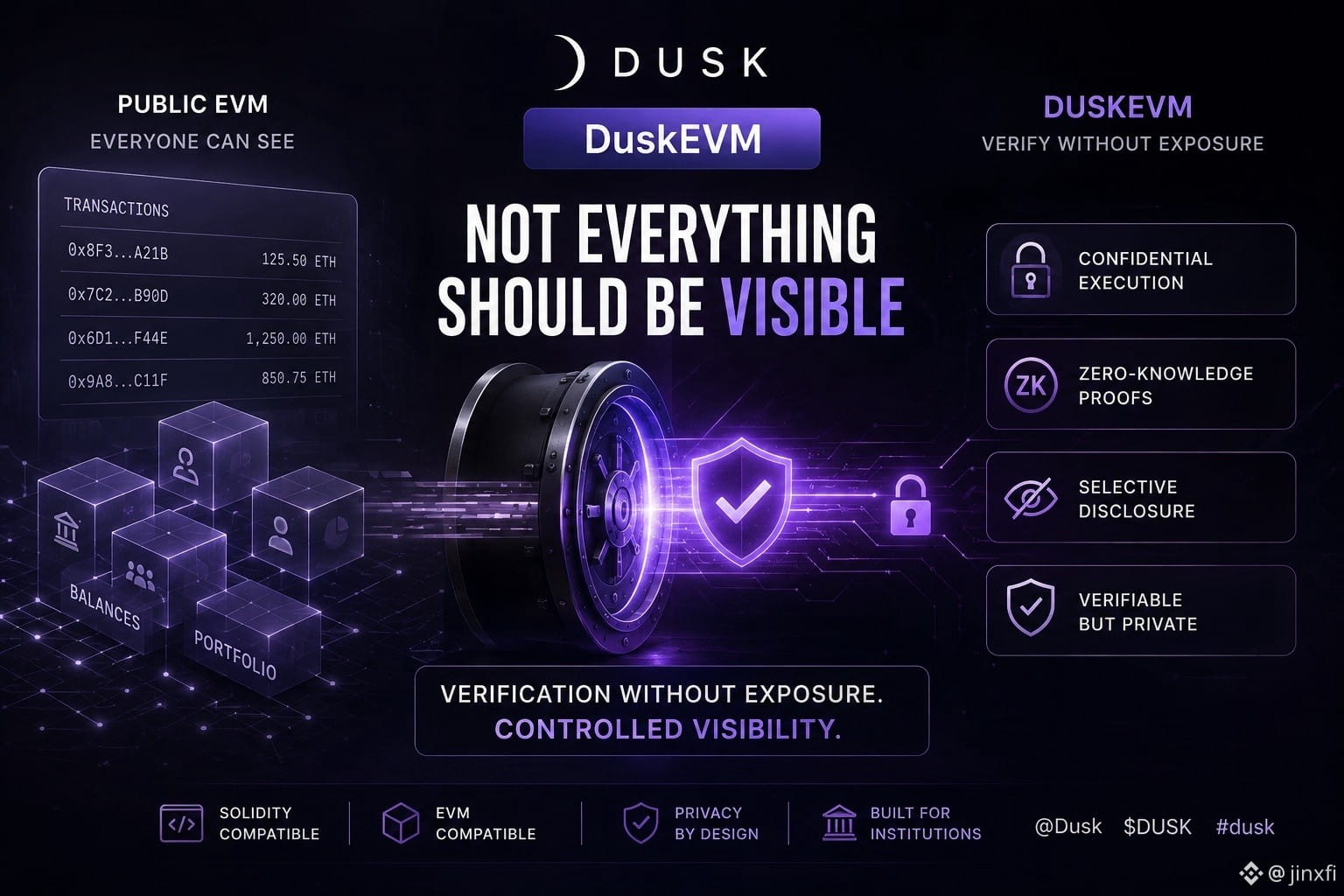
Most EVM applications treat transparency as a feature. But in institutional finance, that assumption starts to break down.
DeFi works well with public balances and transactions. Institutions often need something different: proving a trade is valid without exposing the entire portfolio, balance sheet, or counterparties.
That’s where DuskEVM gets interesting.
Dusk keeps the familiar Solidity and EVM environment while using confidential execution, encryption, and zero-knowledge proofs to separate verification from visibility.
The network can verify that the rules were followed without forcing everyone to see the underlying data.
That distinction matters.
Privacy doesn’t have to mean sacrificing verification. It can mean controlling who sees what while keeping the state provable.
The real challenge is making proof generation, performance, integration, and selective disclosure work reliably at scale.
As tokenized assets and institutional blockchain adoption grow, the question may not be whether financial data should be onchain.
It may be how much of that data actually needs to be visible.
The next EVM design problem might not be execution.
It might be controlled visibility.
@Dusk $DUSK #dusk
DeFi works well with public balances and transactions. Institutions often need something different: proving a trade is valid without exposing the entire portfolio, balance sheet, or counterparties.
That’s where DuskEVM gets interesting.
Dusk keeps the familiar Solidity and EVM environment while using confidential execution, encryption, and zero-knowledge proofs to separate verification from visibility.
The network can verify that the rules were followed without forcing everyone to see the underlying data.
That distinction matters.
Privacy doesn’t have to mean sacrificing verification. It can mean controlling who sees what while keeping the state provable.
The real challenge is making proof generation, performance, integration, and selective disclosure work reliably at scale.
As tokenized assets and institutional blockchain adoption grow, the question may not be whether financial data should be onchain.
It may be how much of that data actually needs to be visible.
The next EVM design problem might not be execution.
It might be controlled visibility.
@Dusk $DUSK #dusk
今日は@Dusk のコンセンサス文書を掘り起こしていたのですが、私の目を引いたのはプライバシー面ではありませんでした。
それは、取引が承認された後に何が起こるかについて、Duskがどれほど重視しているかです。
Succinct Attestationは、ブロックが採択された後にDuskが決定論的なファイナリティ(最終確定性)を提供できるように設計されています。つまり、その取引は、追加のブロックが積み重なるにつれて「そこに残りやすくなる」だけではありません。定義された最終状態に到達します。
それは技術的な細部に聞こえるかもしれませんが、金融資産のことを考えると話は別です。
トークン化された証券や、デリバリー・バーサス・ペイメント(受渡しと引き換え決済)の取引を決済する場合、台帳の状態がまだ変わり得るかどうかの不確実性は、運用上の問題になります。
そこで私は、Duskをプライバシーチェーンというより、決済システムとして見始めました。
私にとって興味深いのは、実際の金融資産がオンチェーンで動き始めたとき、決定論的ファイナリティがプライバシーよりも重要になるのかどうかです。
取引を隠すことは役に立ちます。
しかし、その取引がいつ最終確定するのかを正確に知ることも、同じくらい重要かもしれません。
#dusk $DUSK @Dusk
それは、取引が承認された後に何が起こるかについて、Duskがどれほど重視しているかです。
Succinct Attestationは、ブロックが採択された後にDuskが決定論的なファイナリティ(最終確定性)を提供できるように設計されています。つまり、その取引は、追加のブロックが積み重なるにつれて「そこに残りやすくなる」だけではありません。定義された最終状態に到達します。
それは技術的な細部に聞こえるかもしれませんが、金融資産のことを考えると話は別です。
トークン化された証券や、デリバリー・バーサス・ペイメント(受渡しと引き換え決済)の取引を決済する場合、台帳の状態がまだ変わり得るかどうかの不確実性は、運用上の問題になります。
そこで私は、Duskをプライバシーチェーンというより、決済システムとして見始めました。
私にとって興味深いのは、実際の金融資産がオンチェーンで動き始めたとき、決定論的ファイナリティがプライバシーよりも重要になるのかどうかです。
取引を隠すことは役に立ちます。
しかし、その取引がいつ最終確定するのかを正確に知ることも、同じくらい重要かもしれません。
#dusk $DUSK @Dusk
Deterministic finality
0%
Privacy
0%
Both equally
0%
Fast settlement
0%
0 投票 • 投票は終了しました
翻訳参照
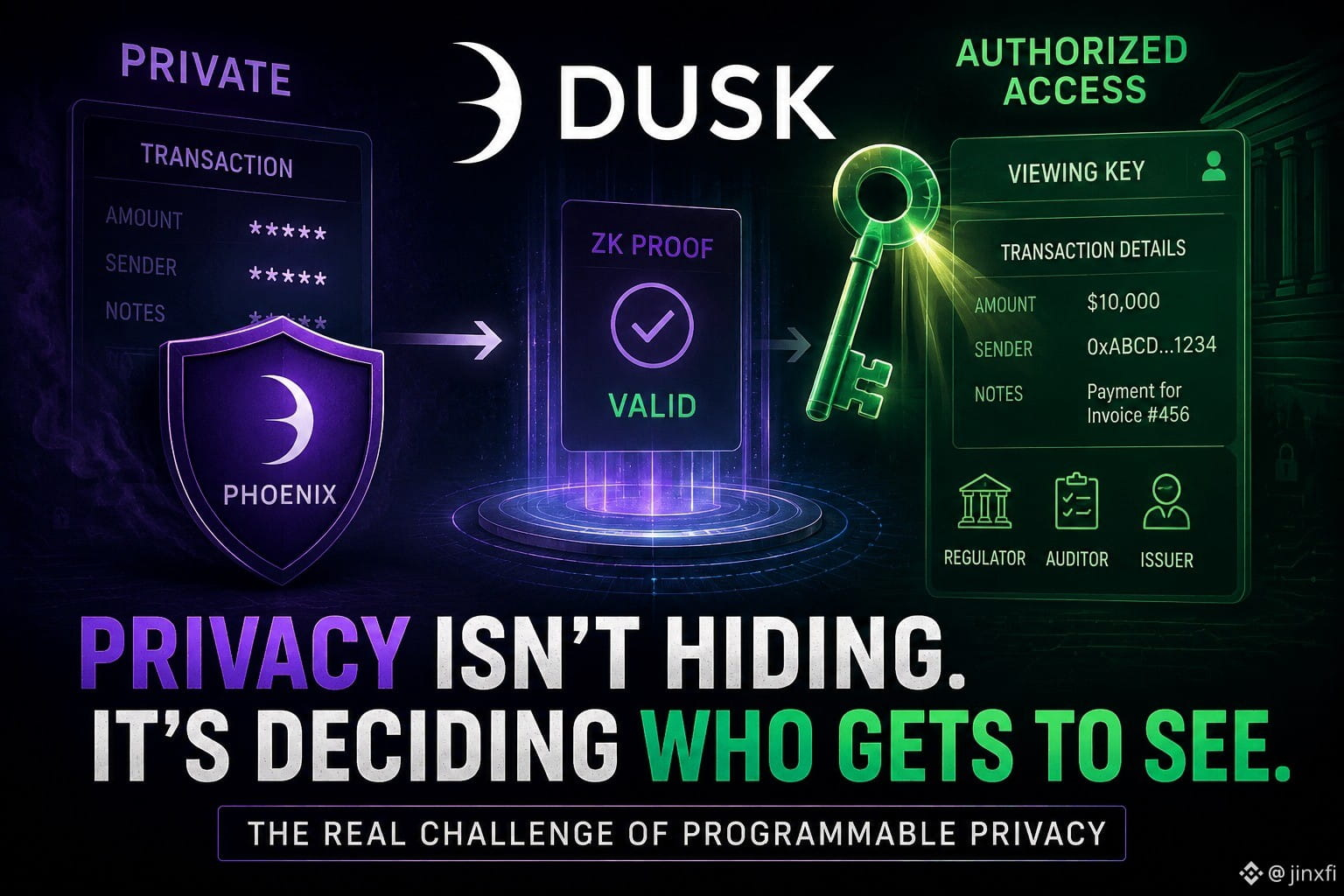
Spent some time going through Dusk’s transaction docs and the part that made me stop wasn't the ZK proof itself.
It was what happens after the transaction becomes private.
Phoenix hides the amount, sender and specific notes from public observers, but Dusk also supports viewing keys and selective disclosure when an authorized party actually needs evidence.
That creates a more interesting model than “privacy = nobody can see anything.”
A regulator, auditor or issuer may need to see something without the rest of the market seeing it.
So the real design problem isn't hiding the transaction.
It's deciding who gets to see the hidden information, and for what reason.
That's where privacy starts looking less like a binary switch and more like an access-control problem.
Makes me wonder how much institutional privacy ultimately depends on the cryptography itself versus the rules governing disclosure.
#dusk $DUSK @Dusk
It was what happens after the transaction becomes private.
Phoenix hides the amount, sender and specific notes from public observers, but Dusk also supports viewing keys and selective disclosure when an authorized party actually needs evidence.
That creates a more interesting model than “privacy = nobody can see anything.”
A regulator, auditor or issuer may need to see something without the rest of the market seeing it.
So the real design problem isn't hiding the transaction.
It's deciding who gets to see the hidden information, and for what reason.
That's where privacy starts looking less like a binary switch and more like an access-control problem.
Makes me wonder how much institutional privacy ultimately depends on the cryptography itself versus the rules governing disclosure.
#dusk $DUSK @Dusk
ログインして、さらにコンテンツを読む