A Spot Grid bot earns the gap between its grid lines. Fees are charged on both legs of every cycle. If the gap is small, fees decide whether the bot makes or loses money, not the market.
▸ DEFINITION
Grid step % = distance between two adjacent grid lines, as a percent of price. Round-trip fee = buy fee + sell fee. Net per completed pair ≈ step % minus round-trip fee %.
▸ WORKED EXAMPLE
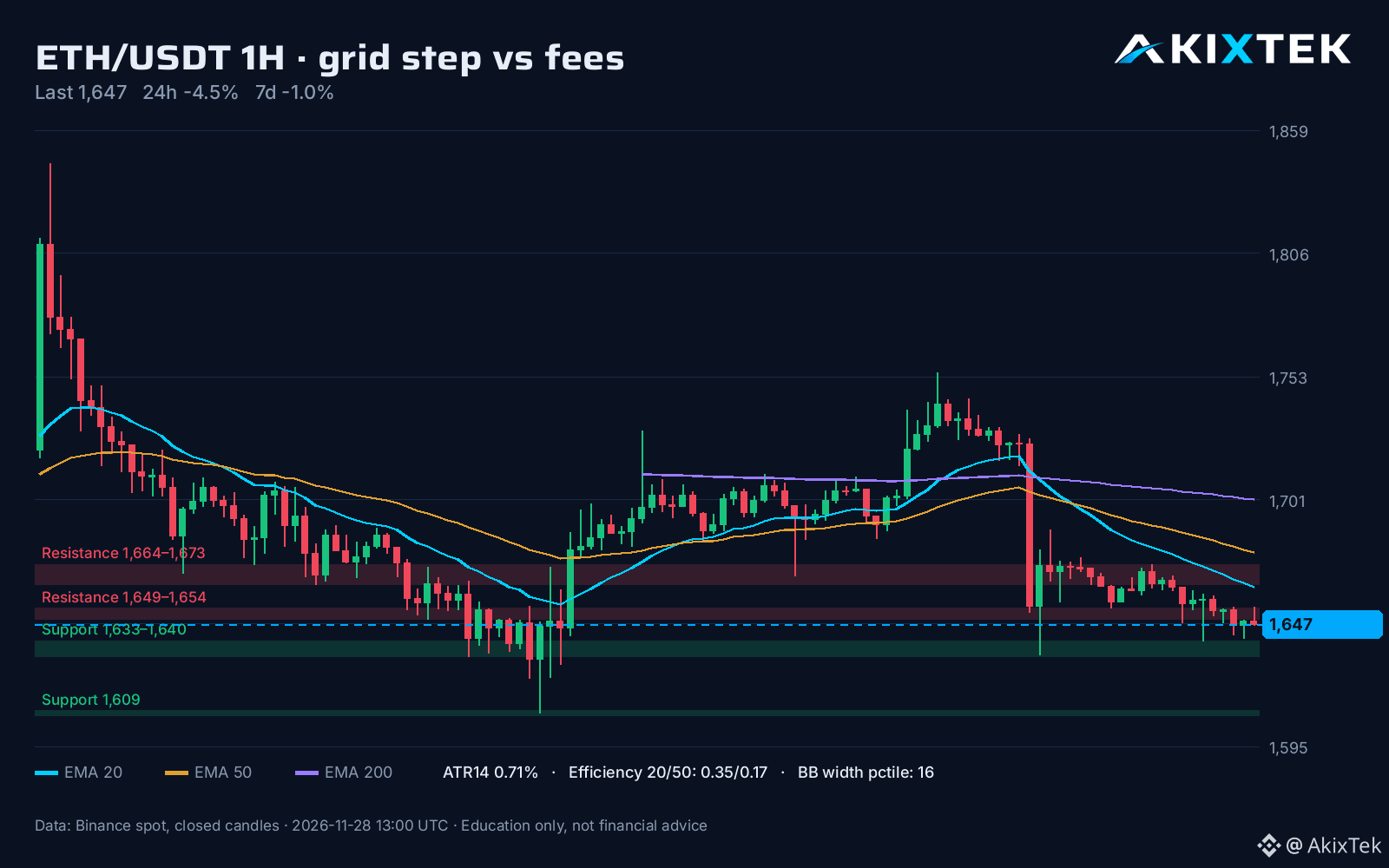
ETH/USDT, 1H candles, closed 2026-11-28 13:00 UTC. Price 1647.05, ATR(14) 11.72 (0.71% of price). A step of 0.5×ATR is 0.36%. With an assumed 0.1% per side, so 0.2% round trip, net per pair is about 0.16%.
That means 0.2 / 0.36 = 56% of the gross step goes to fees. Squeeze the step to 0.25% and net is 0.05%. At 0.20% it is zero, and below that every completed cycle loses money, however busy the bot looks.
Spreading the 1608.86 to 1845.07 window at that step would need about 41 grids. More grids is not more profit: it is more cycles each paying the fee.
▸ CHECK AGAINST THE CHART
ER on 20 bars is 0.35, price is 3.2% below the 1H EMA 200, and at 16% of the window it sits near the lower edge. Resistance 1664.18 to 1672.8 has 5 touches; support 1633.11 to 1640.0 has 3. Bollinger width is at the 16th percentile, so volatility is compressed: ATR can expand, which would widen your step in cash terms, but a tight grid set now stays tight.
▸ CHECKLIST
1. Look up your actual fee tier and add both sides.
2. Compute step % from your range and grid count.
3. Require net after fees to be a clear multiple of the fee, not barely positive.
4. Compare the step with ATR% on the same timeframe; a step far below it fills constantly.
5. Re-check after volatility changes.
▸ COMMON MISTAKES
Using the pair's list fee instead of your own. Adding grids "for more profit". Ignoring that unfilled inventory can lose more than many cycles earn.
Education only, not financial advice. Data: Binance spot, closed 1H candles. Fee of 0.1% per side is an assumption for illustration.
#GridTrading #Fees #BotTrading #RiskManagement