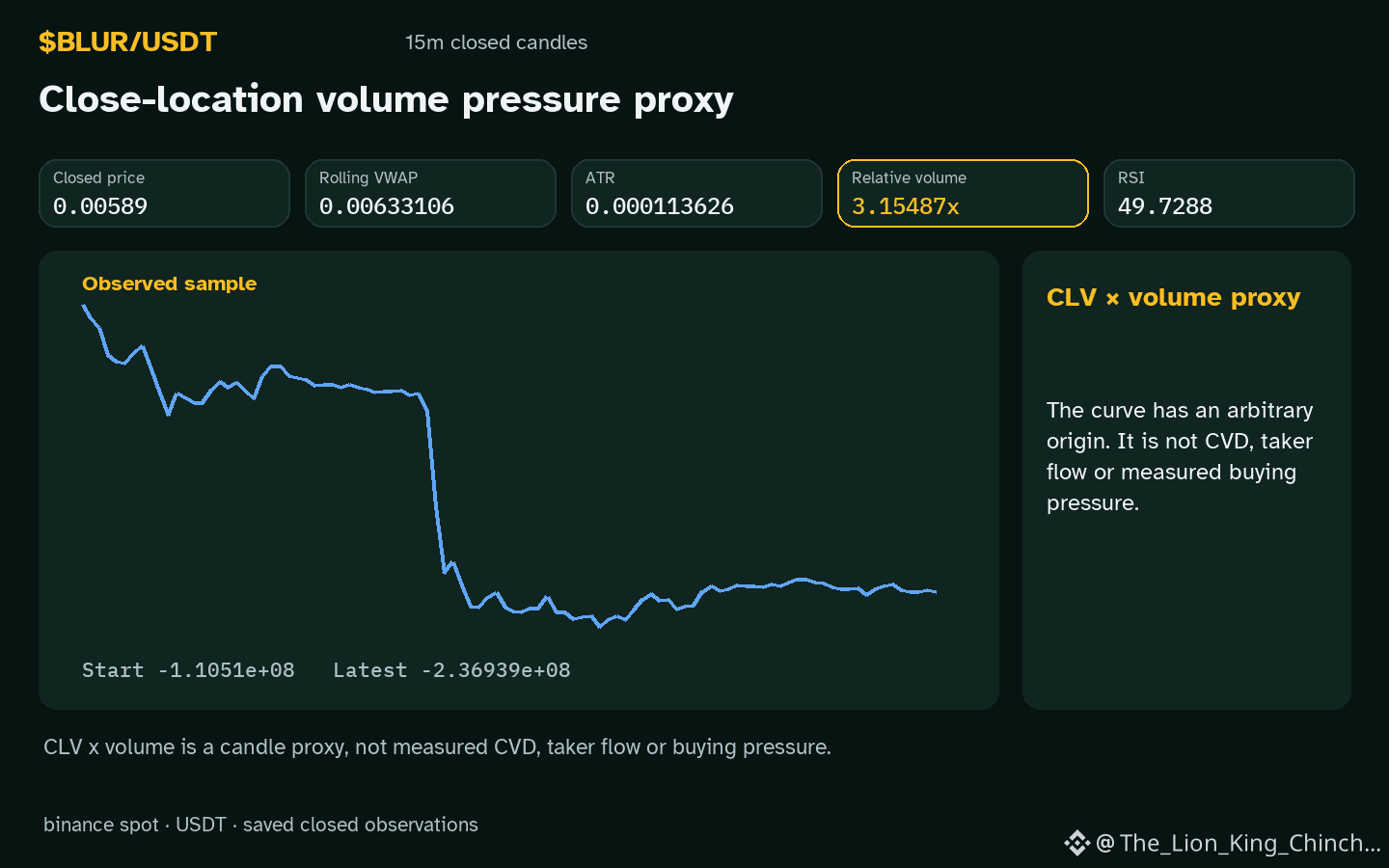
$BLUR : Same move, but volume diverges across peers
Does $BLUR ’s hourly decline match its peers? The data shows a down move while volume expands beyond baseline. ETH moves up but stays near baseline volume; PARTI falls yet also near baseline. This contrast prompts a simple question: can the same price trend appear with different participation?
The mechanism is straightforward. On the same venue, an asset’s hourly price shift does not enforce identical volume behaviour. Even with identical market microstructure, traders may react differently: one asset attracts speculative traders, the other retail, or liquidity providers adjust their thresholds. Thus, price direction alone is insufficient to infer shared momentum.
A counterexample appears when all three tokens show a down move and volume above baseline. In that case, a common underlying factor might be at play, yet the observation still does not confirm causation.
Reassess when a closed‑candle period shows the same direction for all peers while volume simultaneously rises above baseline in each. Only then does the hypothesis gain traction, but still only as a potential, not definitive, link.
Probabilistic market research, not a recommendation or guaranteed return.
Watchlist contrast: $ETH has hourly direction up and volume not above its baseline; $PARTI has hourly direction down and volume not above its baseline. This alone does not establish correlation.
#BLUR #ETH #PARTI