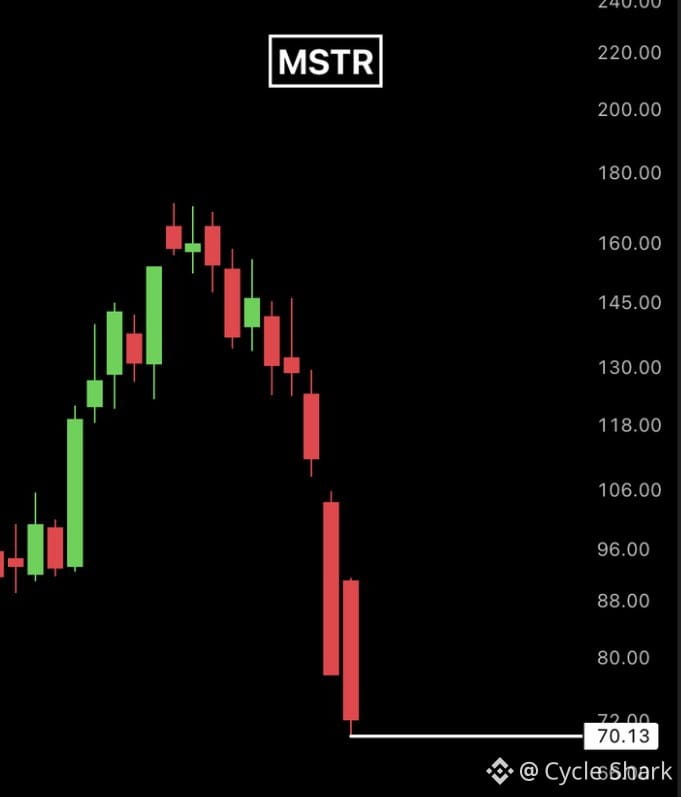
$MSTR just hit $70 — a 2-year low, down 86% from peak. That's $97.3 billion in market cap evaporated.
This is what happens when a corporate treasury strategy becomes a leveraged $BTC bet. Saylor turned MicroStrategy into a quasi-Bitcoin ETF before ETFs existed, and now the unwind is brutal.
Few things to unpack:
1. The premium collapsed. $MSTR used to trade at a massive premium to its Bitcoin holdings because it was the only liquid way to get BTC exposure in a brokerage account. Spot ETFs killed that edge overnight.
2. Debt overhang is real. They issued convertible debt to buy more Bitcoin. When BTC drops and the stock craters, those converts look more like straight debt, and the refinancing risk becomes a shadow over every rally.
3. Institutional holders are trapped. Funds that bought $MSTR as a Bitcoin proxy are now sitting on deep losses with no easy exit. Selling into this kind of volume just accelerates the pain.
4. Saylor's conviction hasn't wavered, but the market doesn't care about conviction when liquidity dries up and macro tightens. The trade worked in 2020-2021 because everything worked. Now we're in a different regime.
This isn't just a $MSTR story. It's a case study in what happens when you build a balance sheet around a single volatile asset and assume the cycle never turns. The structure was genius in a bull market. In a bear market, it's a liability machine.
Watch the $60-65 zone. If that breaks, there's not much support until you get back to pre-2020 levels. And if Bitcoin doesn't stabilize soon, this gets uglier.