$KITE : How Watchlist Rotation Keeps You From Forcing Trades on a Dead Chart
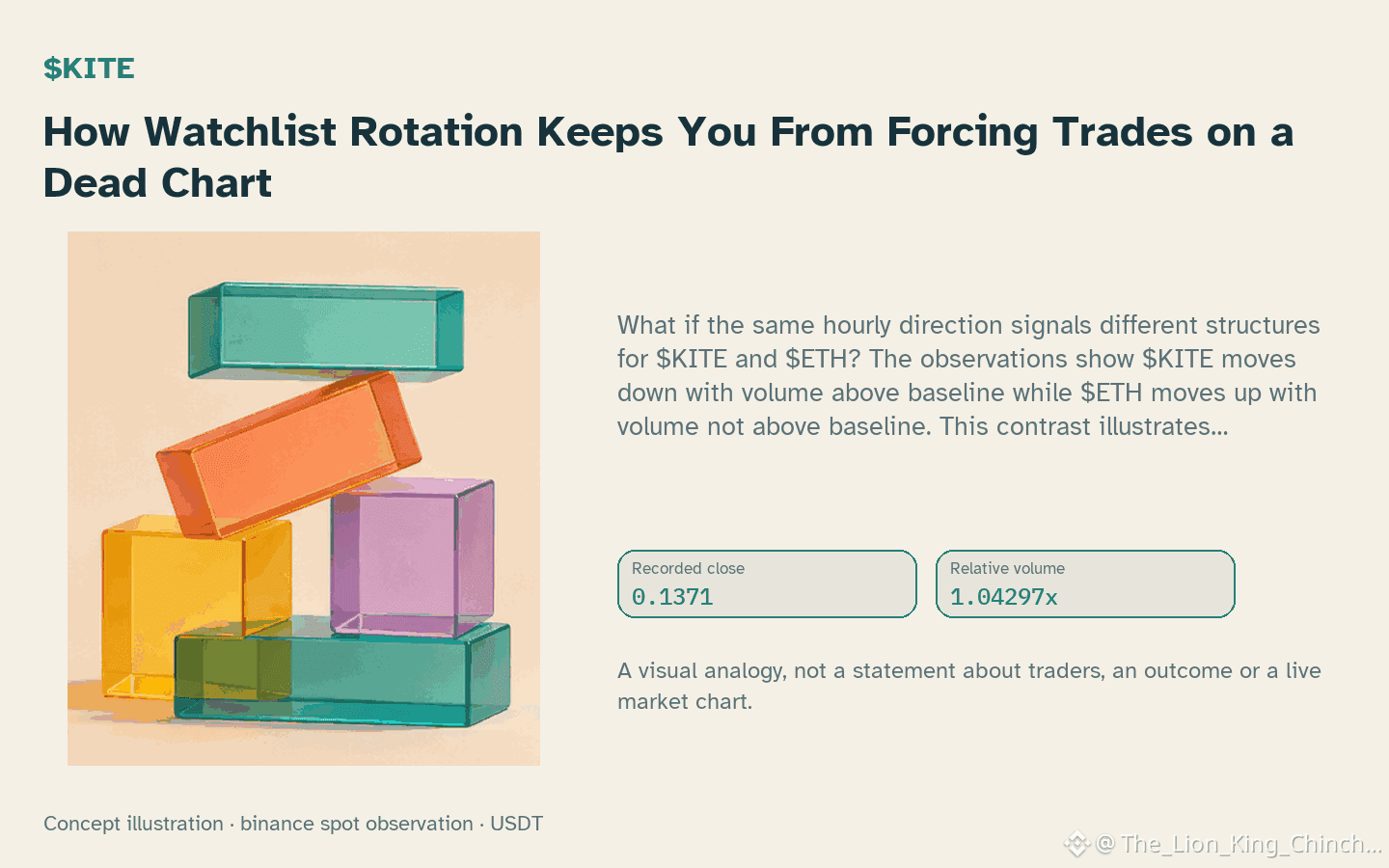
What if the same hourly direction signals different structures for $KITE and $ETH? The observations show $KITE moves down with volume above baseline while $ETH moves up with volume not above baseline. This contrast illustrates constructive variety versus impulsive hopping. A rule worth testing is whether the direction alone defines the structure or if volume relative to baseline provides the key distinction. The trade-off lies in interpreting direction as a signal versus seeing it as a byproduct of underlying structure. In the same venue, hourly direction can diverge because volume patterns differ even when price moves similarly. Limits emerge when assuming correlation from direction alone; a shared direction does not prove common cause or capital rotation. A counterexample appears when $KITE ’s down move coincides with higher volume while $ETH ’s up move shows flat volume, suggesting distinct market microstructures. This self-check confirms that direction without volume context may mislead. Future closed-candle evidence showing volume dropping during $KITE ’s down move could weaken the interpretation that impulsive hopping dominates. The analysis stays grounded in supplied facts, avoids speculation, and respects the editorial brief’s focus on structure rather than price prophecy.
Probabilistic market research, not a recommendation or guaranteed return.
For a wider view: $ETH has hourly direction up and volume not above its baseline; $BIGTIME has hourly direction down and volume not above its baseline. This alone does not establish correlation.
#KITE #ETH