

🌍 $BTC #Bitcoin'sReboundFadesBelow$60K #PositiveMindsGlobalResults
BINANCE SQUARE | INVEST • LEARN • GROW • TOGETHER
NOVEMBER 2026 | SPECIAL EDITION | BITCOIN & DIGITAL ASSET MARKET INTELLIGENCE
WHY IS BITCOIN FALLING?
Bitcoin's November decline is not simply a story about falling prices. It is a story about changing expectations, weakening investor confidence, shrinking liquidity, institutional money moving out, and a highly leveraged market suddenly discovering how quickly risk can turn into losses.
What makes this downturn particularly important is that several pressures have collided at the same time. Rising concerns about US monetary policy, a major crypto security incident, and a sharp retreat in technology stocks have created a difficult environment for digital assets.
Bitcoin is experiencing more than a normal correction in market sentiment. The market is being forced to reconsider how much risk it is willing to carry.
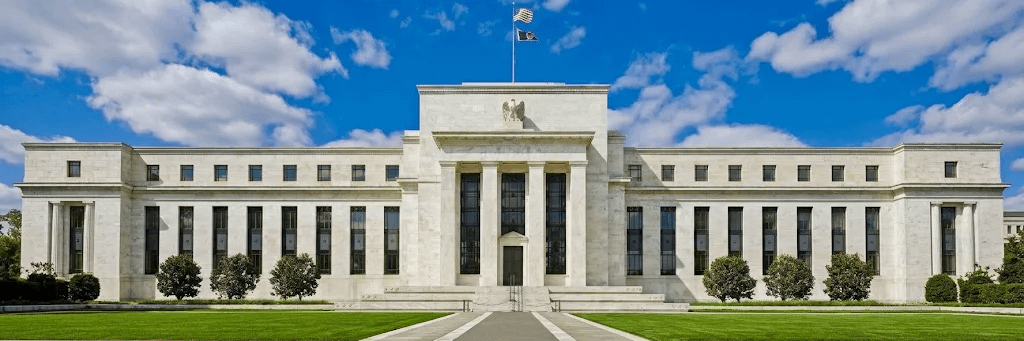
THE FEDERAL RESERVE & THE FEAR OF HIGHER INTEREST RATES
THE MACROECONOMIC PRESSURE
One of the most important reasons Bitcoin is falling is the changing outlook for US interest rates.
The cryptocurrency market is extremely sensitive to monetary policy because Bitcoin does not generate traditional income, dividends, or interest. When investors can earn attractive returns from relatively safer assets, they may become less willing to take aggressive risks in cryptocurrencies.
The Federal Reserve's inflation concerns have made markets reconsider whether monetary policy will remain restrictive for longer—or whether additional rate increases could become necessary.
Why interest rates matter to Bitcoin
When interest rates remain elevated:
Cash and government bonds become more attractive: Investors have more alternatives to highly volatile assets.
Borrowing becomes expensive: Traders, institutions, and businesses have less incentive to borrow money to invest.
Liquidity becomes tighter: Less readily available capital can mean fewer buyers willing to absorb market selling.
Risk appetite weakens: Investors may reduce exposure to Bitcoin, Ethereum, altcoins, speculative stocks, and other high-risk investments.
The problem is not simply whether the Federal Reserve raises rates. Markets react to what investors believe the Fed will do next.
If inflation remains stubbornly high, investors may begin pricing in a longer period of restrictive policy. This can push capital away from speculative assets even before another rate decision is announced.
Bitcoin therefore becomes caught between two powerful forces: its long-term investment narrative and the short-term cost of money.
Why this matters: Even when Bitcoin's fundamentals remain unchanged, a stronger US dollar, elevated yields, inflation uncertainty, and tighter financial conditions can weaken demand and pressure its price.
2. THE BINANCE SECURITY CRISIS & THE SHOCK TO CRYPTO CONFIDENCE

THE CONFIDENCE SHOCK
The second major factor is the enormous security incident involving Binance, which reportedly resulted in more than $6 billion in stolen digital assets.
This event has become one of the most serious confidence shocks in the crypto market—not simply because of the financial amount involved, but because of the scale of the exchange, its importance to the wider crypto ecosystem, and the uncertainty surrounding operational security.
When an incident affects a major trading platform, investors immediately begin asking questions that extend far beyond the original breach.
What makes a major exchange incident dangerous for the market?
A. Investors become concerned about platform risk
Even investors who are not directly affected may begin questioning how securely exchanges protect assets, how withdrawals are handled during emergencies, and whether their own funds are exposed to operational vulnerabilities.
Fear does not need to be confirmed as a financial loss for every investor to influence market behavior.
B. Withdrawals and liquidity pressures increase
During a security crisis, customers may withdraw assets, move funds into self-custody, stablecoins, or other platforms. Large movements can create uncertainty around exchange liquidity, trading activity, and short-term market confidence.
C. Confidence becomes more fragile
Crypto markets depend heavily on trust in infrastructure, custody, exchanges, stablecoins, and trading systems. When a major security event occurs, investors may temporarily reduce exposure to the entire sector rather than carefully distinguishing between individual projects.
D. Institutional investors reassess operational risk
Institutions do not evaluate crypto only through price charts. They also consider custody, counterparty exposure, regulatory protection, settlement infrastructure, liquidity, and operational controls.
A major exchange incident can therefore slow institutional participation or increase risk-management requirements.
Importantly, an exchange security breach is not automatically a blockchain failure. Bitcoin's underlying network, an exchange's internal systems, custody arrangements, and employee security are separate layers of the ecosystem. The failure of one layer does not automatically mean Bitcoin's protocol has been compromised.
The distinction is critical because panic can cause investors to treat an exchange-specific incident as a threat to every cryptocurrency.
The bigger consequence: The damage may extend beyond the stolen funds. It can weaken confidence, discourage new capital, increase withdrawals, and amplify selling pressure throughout the market.
3. THE AI & TECH STOCK SELLOFF, CAPITAL OUTFLOWS AND FORCED LIQUIDATIONS
THE DOMINO EFFECT
The third reason is arguably the most powerful explanation for why the crypto decline accelerated rather than simply stabilized.
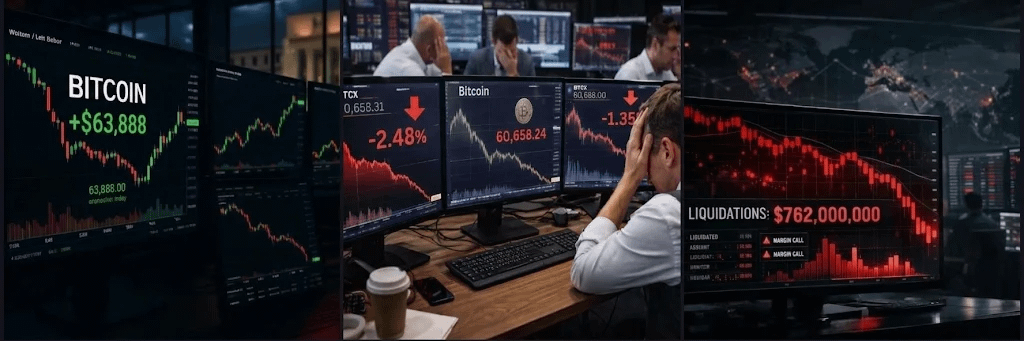
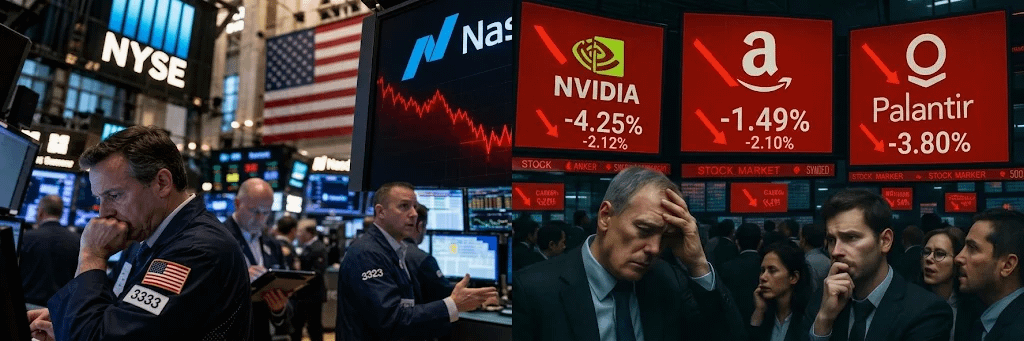
Bitcoin is increasingly traded within a broader global risk environment. When technology stocks, AI companies, growth equities, and other high-valuation assets experience a sharp sell-off, investors may reduce exposure across multiple markets simultaneously.
In November, the weakness in technology stocks added another layer of pressure to an already fragile cryptocurrency market.
Why the technology sell-off matters to Bitcoin
The AI boom has attracted enormous capital into technology companies, semiconductor manufacturers, cloud infrastructure, data centers, and growth stocks.
But when investors begin questioning valuations, future profitability, AI spending, debt, or the sustainability of capital expenditure, they may suddenly become more selective.
The same investors who were willing to take risks during a strong market can quickly shift into capital-preservation mode.
Bitcoin can then become part of a broader portfolio reduction—not necessarily because investors have lost faith in Bitcoin itself, but because they want to reduce overall exposure to volatile assets.
The ETF outflow problem
Spot Bitcoin ETFs have become an important channel through which traditional investors gain exposure to Bitcoin.
When these funds experience sustained outflows, it can remove an important source of buying demand from the market.
During the October–November decline, reported ETF outflows added pressure at a time when investors were already facing macroeconomic uncertainty and market volatility.
At the same time, declining stablecoin supply can indicate that capital available within the crypto ecosystem is contracting. Stablecoins are often used as trading liquidity and as a bridge between cash-like positions and crypto assets.
When stablecoin supply shrinks, it does not automatically mean every dollar has left the market, but it may signal weaker liquidity and less capital waiting to buy cryptocurrencies.
The hidden accelerator: leverage

This is where the decline becomes significantly more dangerous.
Many traders use borrowed capital or leveraged derivatives to amplify their exposure to Bitcoin and other cryptocurrencies.
Leverage can magnify profits when prices rise—but it also magnifies losses when markets move against traders.
As Bitcoin falls:
Leveraged traders begin losing collateral.
Their margin levels approach liquidation thresholds.
Exchanges automatically close positions when margin requirements are no longer satisfied.
Liquidated positions create additional market selling.
The additional selling pushes prices lower.
More leveraged traders are forced out of the market.
This creates a chain reaction known as a liquidation cascade.
Unlike ordinary investors who may decide to sell gradually, leveraged traders can be forced to sell immediately. That is why a market can suddenly experience violent price movements within hours.
The final stage of a crypto sell-off is therefore not always driven by new negative news. Sometimes the market is falling because its own positioning, leverage, and liquidity structure are amplifying the original shock.
This is the critical difference: Bad news may start the decline, but leverage can determine how deep, how fast, and how violently the market falls.
WHEN CAPITAL EXITS AND LEVERAGE UNWINDS, PRICE CAN FALL FASTER THAN INVESTOR EXPECTATIONS.
THE FOURTH FORCE: WHY THE MARKET FALL BECAME A CRASH
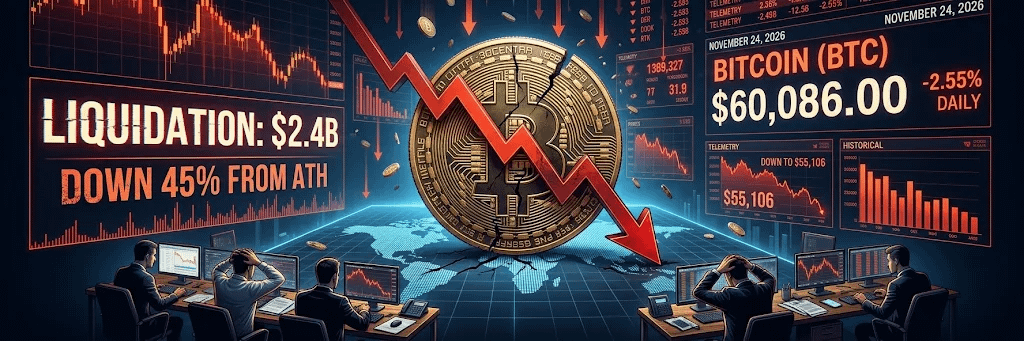
Although the three reasons above explain the major pressures, there is another important element connecting them: the withdrawal of capital.
When investors reduce exposure, ETF investors withdraw capital, stablecoin supply contracts, and leveraged traders are liquidated, the market loses some of the buying power that normally absorbs selling pressure.
This creates an imbalance.
THE CRYPTO MARKET DOMINO EFFECT
1. Inflation fears → higher interest-rate expectations
↓
2. Investors reduce exposure to risky assets
↓
3. Exchange security concerns weaken confidence
↓
4. ETF outflows and declining liquidity reduce buying demand
↓
5. Bitcoin breaks important price levels
↓
6. Leveraged positions are liquidated
↓
7. Forced selling accelerates the market decline
The result is a market in which multiple negative forces reinforce one another.
Investors become defensive. Liquidity weakens. Prices fall. Traders are liquidated. Confidence deteriorates further.
That is how a correction can turn into a much deeper market-wide sell-off.
HOW SEVERE IS THE NOVEMBER CRYPTO DECLINE?
THE NUMBERS BEHIND THE FEAR
According to market data reported in a November 17 analysis, Bitcoin declined from approximately $86,500 on October 5 to $64,800 on November 17, while touching $62,112 on November 15.
Ethereum also suffered a substantial decline, falling from approximately $2,730 to $1,820 over the same period.
BITCOIN DECLINE ETHEREUM DECLINE
≈ −25% ≈ −33%
Oct 5 – Nov 17 Over the same period
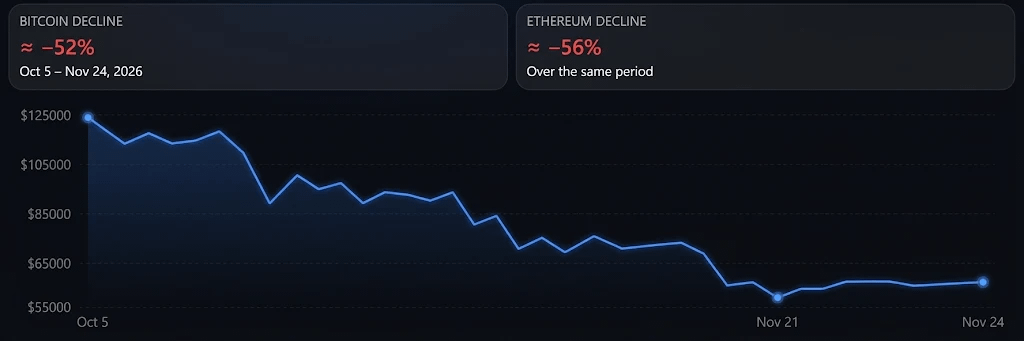
These numbers illustrate the scale of the decline, not a complete real-time market snapshot. The November low was particularly significant because it demonstrated how quickly sentiment and market structure could change when multiple pressures aligned.
A 25% decline is painful for long-term holders. For leveraged traders, however, a much smaller price move can be enough to wipe out an entire position.
The market was not merely repricing Bitcoin. It was repricing risk, liquidity, leverage, confidence, and expectations simultaneously.
WHAT HAPPENS NEXT? THREE POSSIBLE SCENARIOS

The next phase of the market will depend less on headlines alone and more on whether the financial conditions that caused the decline begin to improve.
🟢 SCENARIO 1 — A RECOVERY AND STABILIZATION
Bitcoin may begin recovering if inflation data improves, expectations of additional rate increases weaken, ETF outflows slow, institutional demand returns, and the crypto market begins absorbing selling pressure.
The most important confirmation would not be a single green candle. It would be a combination of:
Sustained spot buying.
Improving ETF flows.
Reduced leverage and lower liquidation risk.
Stronger market liquidity.
Bitcoin reclaiming important price levels and holding them as support.
A healthy recovery requires demand—not just short-term traders buying a temporary dip.
🟡 SCENARIO 2 — A LONGER CONSOLIDATION
Bitcoin could remain volatile within a wide trading range while the market attempts to rebuild confidence.
This scenario could develop if:
Inflation remains elevated.
The Federal Reserve maintains restrictive policy.
ETF flows remain inconsistent.
Investors remain cautious about technology valuations.
Crypto liquidity recovers slowly.
A prolonged consolidation may frustrate investors, but it can also allow excessive leverage to unwind and the market to establish a more sustainable foundation.
🔴 SCENARIO 3 — ANOTHER LEG LOWER
The bearish scenario becomes more concerning if inflation surprises to the upside, interest-rate expectations become more hawkish, technology stocks experience another major decline, ETF outflows accelerate, or Bitcoin loses important support zones with increasing volume.
A renewed breakdown could trigger another round of forced liquidations, potentially pushing prices below levels investors previously considered strong support.
However, further downside is not guaranteed. Markets can reverse sharply when negative expectations become excessive, sellers become exhausted, or new capital enters.
WHAT INVESTORS SHOULD UNDERSTAND DURING THIS CRASH
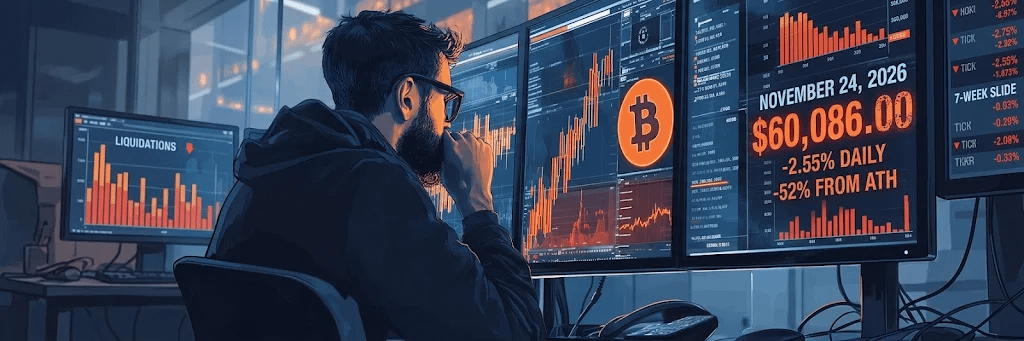
Market crashes often create two dangerous emotional responses: panic selling and blind buying.
Neither is a reliable investment strategy.
When Bitcoin falls sharply, investors should separate price movement from fundamental developments and ask the right questions:
Is the decline caused by temporary market fear or a structural problem?
Is institutional capital leaving temporarily, or is the demand structure deteriorating?
Are liquidations responsible for the speed of the decline?
Is the Federal Reserve outlook changing the investment environment?
Is the market stabilizing, or are sellers still controlling price action?
Am I investing with money I can afford to keep exposed to volatility?
A falling price does not automatically mean an asset is cheap. Equally, a major correction does not automatically mean its long-term future is over.
The difference between a disciplined investor and an emotional trader is often the ability to wait for evidence rather than react to fear.
THE BIGGER PICTURE: IS BITCOIN'S LONG-TERM STORY BROKEN?
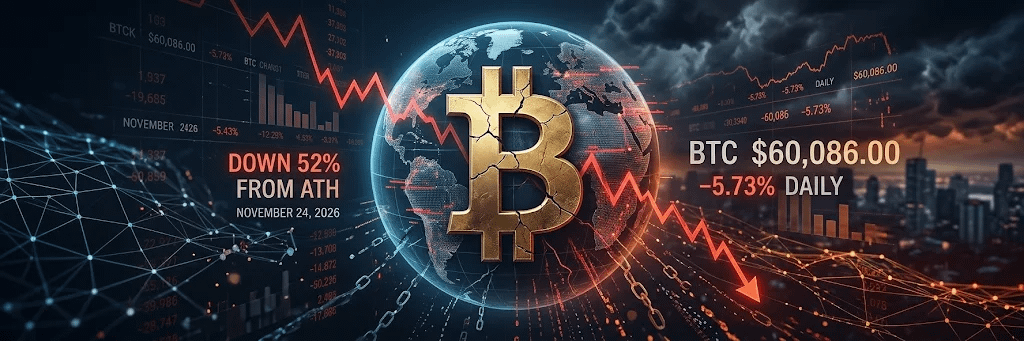
The November 2026 crash raises serious questions, but it does not automatically invalidate Bitcoin's long-term investment thesis.
Bitcoin's broader story continues to revolve around limited supply, decentralized settlement, global accessibility, digital ownership, institutional adoption, and the possibility of an alternative monetary asset.
However, long-term potential and short-term price performance are two very different things.
Bitcoin can have strong long-term adoption prospects while simultaneously experiencing severe drawdowns. It can also recover from a crash without immediately returning to previous highs.
Investors must recognize that Bitcoin is still a highly volatile asset, sensitive to liquidity conditions, investor sentiment, regulation, macroeconomic developments, leverage, and technological or security risks.
The November crash is an important reminder that the crypto market has matured in some areas—but it has not eliminated the risks that make it capable of experiencing extreme price movements.
The market is increasingly connected to Wall Street, ETFs, institutional portfolios, global liquidity, and technology-sector sentiment. That connection brings greater participation, but it also means Bitcoin can be affected by forces outside the crypto industry.
FINAL THOUGHTS
THE MARKET IS TESTING CONFIDENCE, NOT JUST PRICE.
Bitcoin's November decline is the result of several pressures colliding at the same time:
1. Federal Reserve uncertainty and persistent inflation are keeping financial conditions restrictive and making risk-taking less attractive.
2. The Binance security crisis has shaken confidence, raised questions about exchange security, and added another layer of uncertainty to an already fragile market.
3. The technology-stock sell-off, capital outflows, shrinking liquidity, and leveraged liquidations have amplified selling pressure and turned market weakness into a deeper correction.
The most important lesson is that financial markets rarely collapse for only one reason. A single negative event may trigger a reaction, but when monetary policy, investor confidence, liquidity, and leverage all move in the same direction, the consequences can become much more severe.
Bitcoin's next major move will depend on whether the market can restore confidence, attract fresh capital, stabilize liquidity, and absorb remaining selling pressure.
Until then, volatility, patience, risk management, and independent analysis remain more important than predictions.
A market crash creates fear. A market recovery requires evidence. And a disciplined investor must understand the difference.
Market Risk Disclaimer: This article is for informational and educational purposes only and does not constitute financial or investment advice. Cryptocurrency markets are highly volatile, and investors may lose some or all of their capital. Market scenarios are analytical possibilities, not guaranteed forecasts. Always conduct your own research (DYOR) and assess your risk tolerance before making investment decisions.
#Bitcoin #BTC #CryptoCrash #CryptoMarket #FederalReserve #Inflation #BinanceSquare #Ethereum #ETFOutflows #MarketLiquidity #CryptoInvesting #RiskManagement #Blockchain #PositiveMindsGlobalResults
