The ECB just gave tokenized securities something they've never had: a seat at the central bank's table.
On November 23, the European Central Bank's Governing Council approved accepting marketable assets issued on DLT platforms licensed under the EU DLT Pilot Regime as eligible collateral for Eurosystem credit operations. In plain terms: banks will be able to pledge tokenized securities to borrow from the central bank. The details arrive in spring 2027, with implementation planned for June 2027.
This builds on the ECB's January 2026 framework for DLT assets in central securities depositories, and on Pontes, its settlement platform launched in September — through which President Lagarde says a €1 billion transaction has already settled.
The honest caveat: this does not cover $BTC, stablecoins, or any open-market crypto. Only regulated, institutionally issued securities that still travel through the TARGET2-Securities rails qualify. Tokenization just got central-bank legitimacy — but on the central bank's terms, not crypto's.
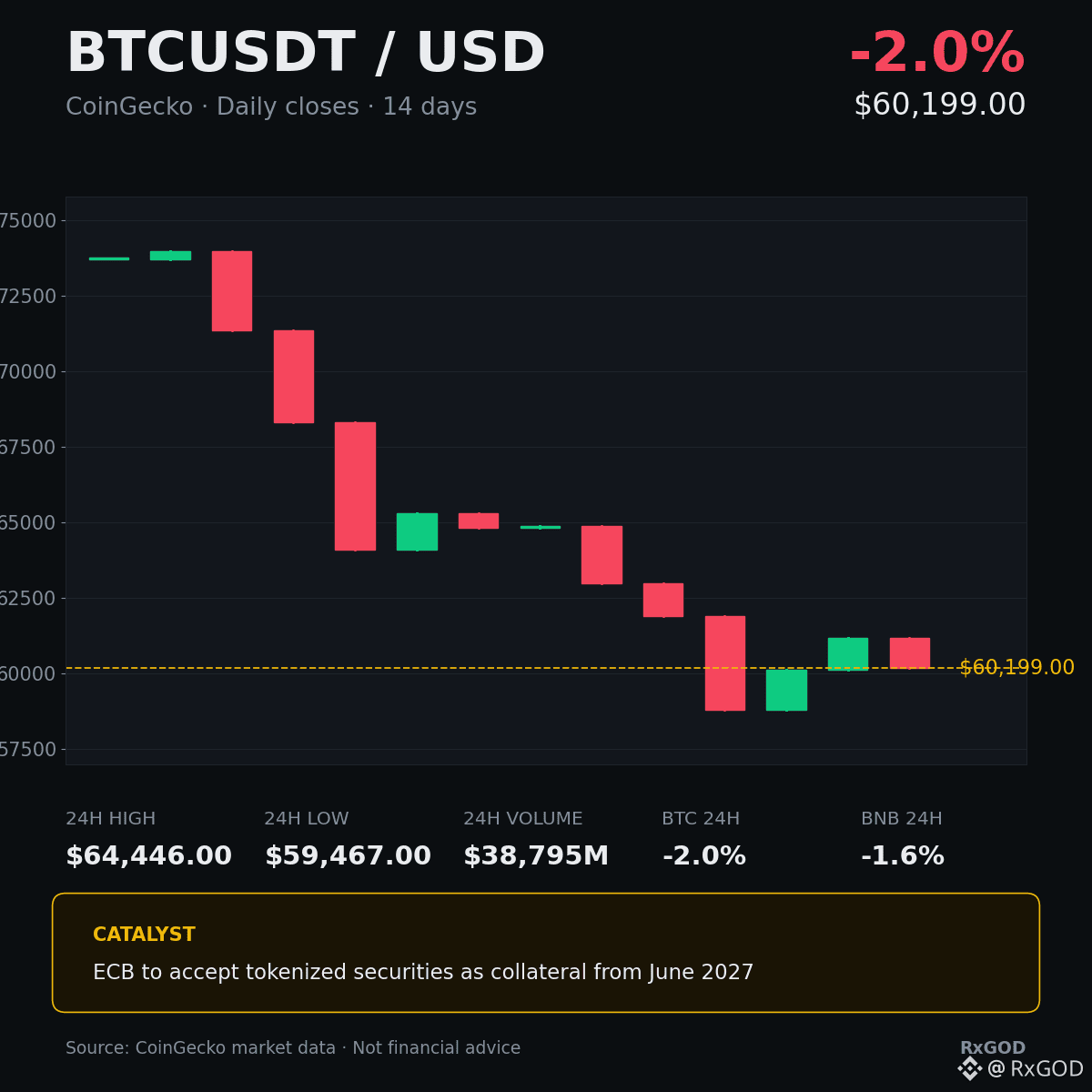
Meanwhile $BTC trades at $60,319, down 1.9% in 24 hours after being rejected at $64,603, with Fear & Greed at 9 — Extreme Fear. The market barely blinked: tokenization is a slow institutional story, not a price catalyst for today.
So here's the debate: is this the real start of tokenized finance going mainstream, or a narrow pilot dressed up as a milestone? And if tokenized bonds can back central-bank loans, which asset class gets tokenized next — real estate, equities, or something nobody expects?
Not financial advice — DYOR.
#Bitcoin'sReboundFadesBelow$60K #TokenizedSecurities #RWA #CryptoNews