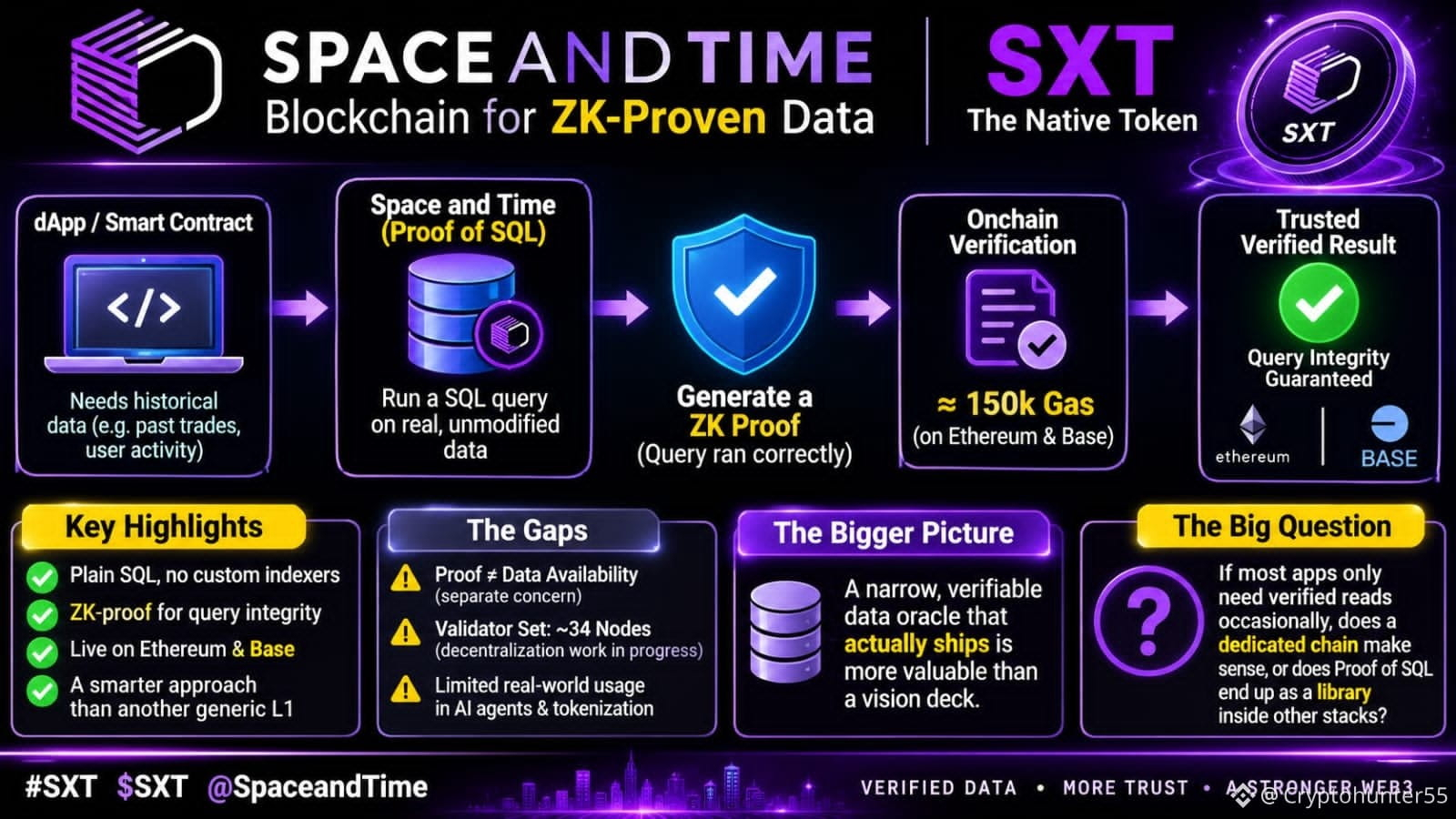

I went down a Space and Time rabbit hole this week, and what stuck with me is how unglamorous the core idea is. Smart contracts can't natively read history, so SXT gives them a SQL database they don't have to trust.
Here's the interesting part. Proof of SQL generates a ZK proof that a query ran correctly over untampered data. The docs cite onchain verification at roughly 150k gas, with QueryRouter and verifier contracts live on Ethereum and Base. Plain SQL instead of custom indexers is a smarter wedge than another generic L1 pitch.
But I kept wondering about the gap. "Blockchain for ZK-proven data" sounds sweeping, yet the proof guarantees query integrity, not data availability. The docs treat that as a separate concern. The validator set is also around 34 nodes, so decentralization looks like a work in progress, not a finished fact.
That's not a knock. A narrow, verifiable data oracle that actually ships is worth more than a vision deck. Still, the roadmap leans on AI agents and tokenization, and I haven't seen much production usage there yet.
#SXT $SXT @SpaceandTime
If most apps only need verified reads occasionally, does a dedicated chain make sense, or does Proof of SQL end up as a library living inside other stacks?$SXT #sxt @SpaceandTime