$ZRO: Why Peer Alignment Can Mislead on Range Breaks
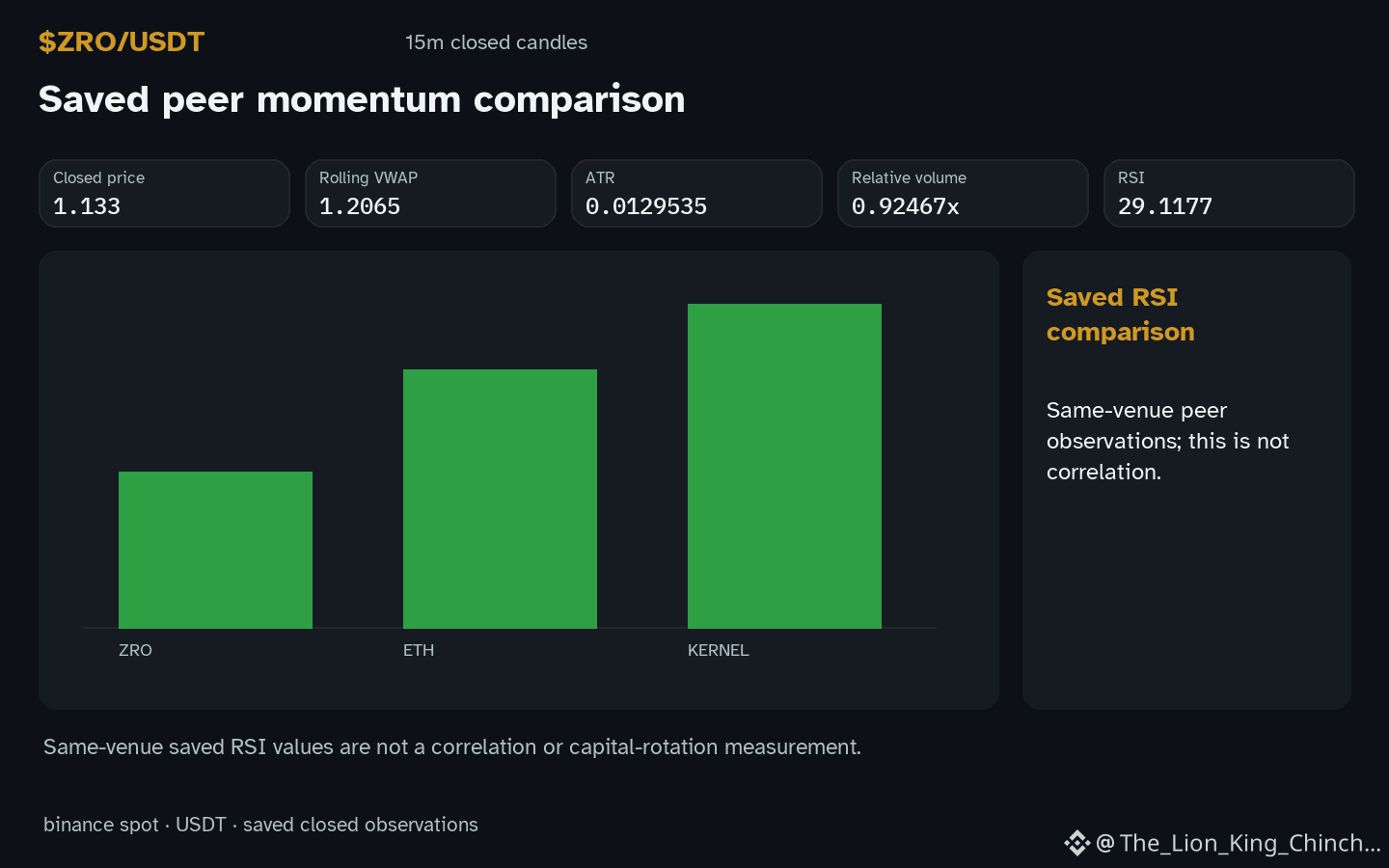
When $ZRO sits below support, does a peer's rise validate the move? Supplied facts show $ZRO with hourly direction down, while ETH USDT and KERNEL USDT show hourly direction up with volume above their baselines. This creates a structural tension. A common assumption treats shared venue access as causal linkage. The counterexample is that independent assets can diverge in direction and volume simultaneously. The mechanism here involves local range bounds, not global flow. Using 1.134 and 1.187 as local bars, $ZRO is testing the downside limit. If this fails, the next observation point is whether price reclaims the range. The RSI 29.1 provides context but does not confirm reversal. Relative volume 0.92x baseline indicates current activity levels without proving intent. The limit of this comparison is that ETH and KERNEL data describes their specific sessions, not $ZRO 's order book. A self-check requires waiting for a closed candle to see if the range holds. If price stays below support with declining volume, the initial range break interpretation remains weak. This hypothetical mechanism helps avoid attributing causation to same-venue listing. The reassessment condition is a simple price action check: sustained trading above resistance invalidates the bearish range hold. This approach prioritizes verified structure over assumed correlation.
Probabilistic market research, not a recommendation or guaranteed return.
A useful cross-check: $ETH has hourly direction up and volume above its baseline; $KERNEL has hourly direction up and volume above its baseline. This alone does not establish correlation.
#ZRO