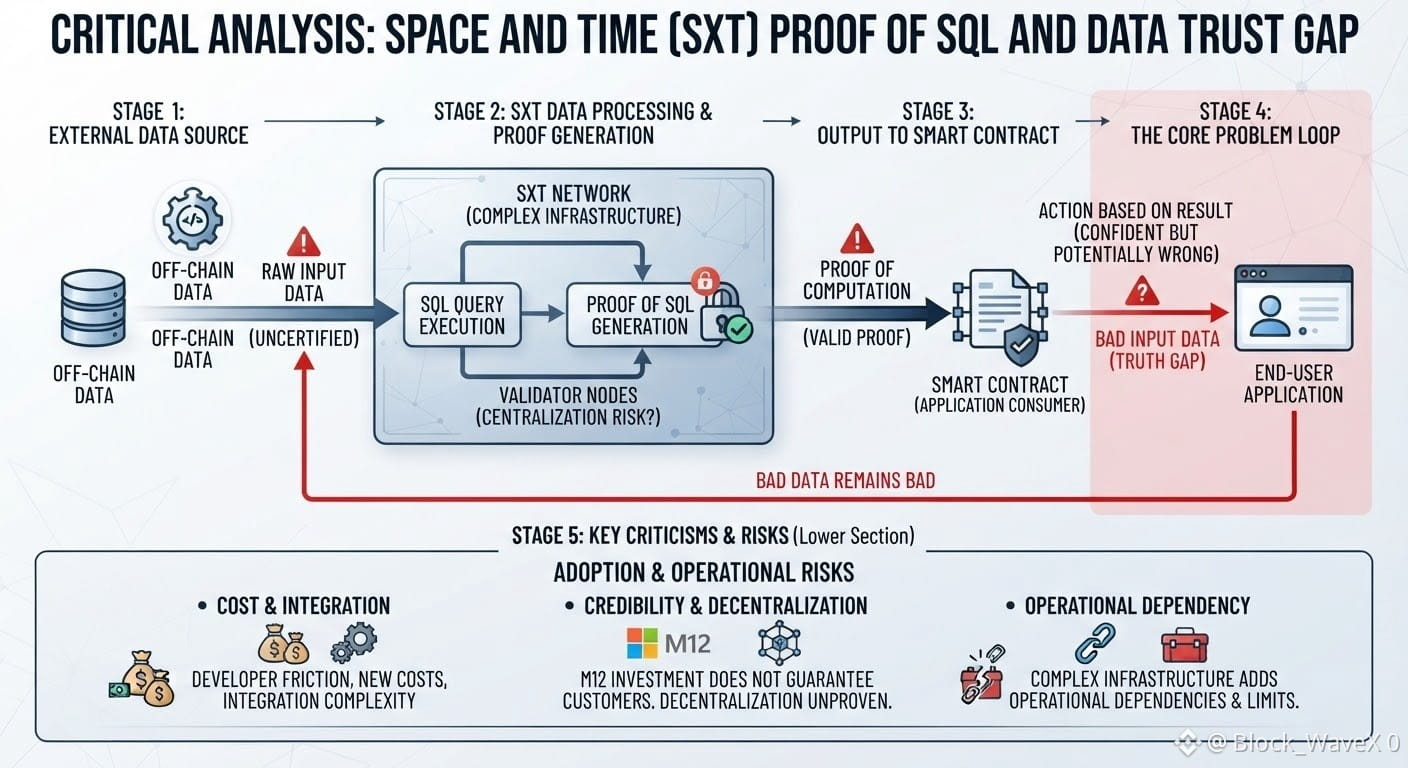
Look, Space and Time is tackling a real blockchain weakness: applications often rely on external databases, but cannot easily verify whether returned calculations are correct.
Its Proof of SQL uses cryptographic proofs to check database queries. Useful idea. But proving a calculation does not prove the underlying data is truthful.
That distinction matters. Bad input can still produce a perfectly valid proof, leaving applications confidently acting on information that was wrong from the start.
I’ve seen this movie before: complex infrastructure arrives with big promises, while developers must absorb new costs, integrations, performance limits and operational dependencies from launch.
Microsoft's M12 investment adds credibility, not guaranteed customers. And decentralisation depends on who runs validators, controls infrastructure and responds when something breaks under real pressure.
The catch is adoption: will businesses pay repeatedly, and will SXT capture meaningful demand? Without evidence, clever proofs remain expensive plumbing with a token attached.
#sxt $SXT @SpaceandTime