
A roughly $705 MILLION cryptocurrency.
⠀
More than 90% of its maximum supply already circulating.
⠀
Nearly ONE MILLION daily transactions in the latest tracked snapshot.
⠀
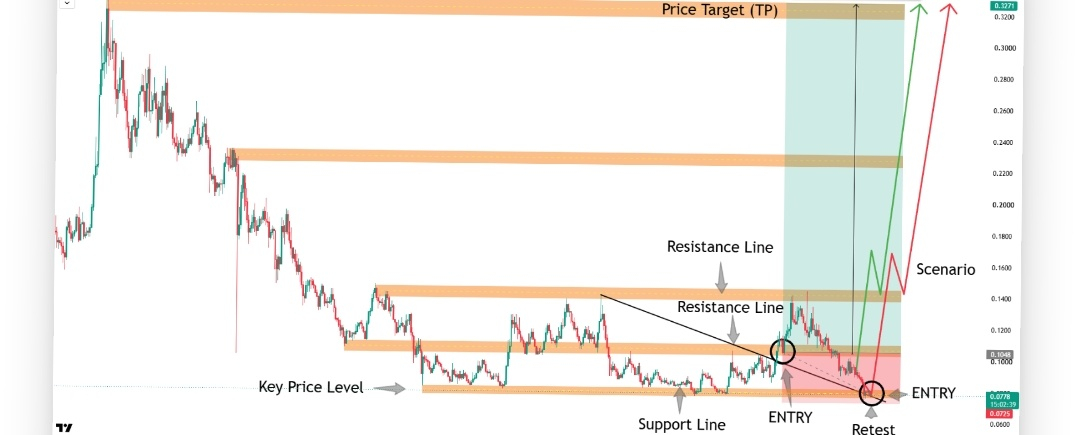
And a token trading approximately 97.6% below its all-time high.
⠀
But here's the contradiction.
⠀
Algorand can process activity cheaply.
⠀
That does not automatically mean the activity generates enough revenue to support its economics.
⠀
Is $ALGO an overlooked infrastructure turnaround?
⠀
Or does low-cost execution remain difficult to monetize?
⠀
Let's examine the numbers.
⠀
01 | WHAT IS ALGORAND?
⠀
Algorand is a Layer 1 blockchain using Pure Proof-of-Stake.
⠀
Its design emphasizes rapid finality and inexpensive transactions.
⠀
ALGO is the network's native token.
⠀
It supports transaction payments and participation in consensus.
⠀
The investment thesis is that reliable infrastructure can attract financial applications and recurring usage.
⠀
But technical capability is only the starting point.
⠀
Applications need customers.
⠀
Customers need reasons to stay.
⠀
And their activity must create a meaningful economic benefit for ALGO.
⠀
A functioning blockchain and an attractive token investment require different evidence.
⠀
02 | THE NUMBERS THAT MATTER
⠀
November 19, 2026 snapshot:
⠀
ALGO Price: ~$0.07763
Market Cap: ~$704.99M
FDV: ~$776.35M
Circulating Supply: ~9.081B ALGO
Total / Maximum Supply: 10B ALGO
Circulating / Maximum Supply: ~90.8%
24H ALGO Trading Volume: ~$46.73M
All-Time High: ~$3.28
Decline From ATH: ~97.6%
⠀
NETWORK FUNDAMENTALS:
⠀
DefiLlama DeFi TVL: ~$23.99M
Stablecoin Market Cap: ~$123.4M
24H DEX Volume: ~$433.9K
7D DEX Volume: ~$3.27M
24H Active Addresses: ~71,008
24H Transactions: ~969,695
24H Chain Fees: ~$180
24H Chain Revenue: ~$104
30D Chain Fees: ~$1,260
30D Chain Revenue: ~$1,033
⠀
These are retrieved dashboard measurements.
⠀
Chain fees, application fees, and staking rewards measure different things.
⠀
They should not be combined into one revenue headline.
⠀
03 | THE LOW-FEE PARADOX
⠀
Cheap execution benefits users.
⠀
It also means each transaction may contribute very little revenue.
⠀
A network can process substantial activity while collecting relatively little.
⠀
That does not make the activity worthless.
⠀
It changes the scale required for a sustainable business model.
⠀
The investment question is whether usage can grow enough, or become valuable enough, to support the network's economics.
⠀
Transaction count alone cannot answer that.
⠀
Ten thousand low-value automated operations can mean less economically than a smaller number of recurring paid services.
⠀
The useful evidence is retained demand and the income it produces.
⠀
04 | APPLICATION SUCCESS IS NOT CHAIN REVENUE
⠀
Algorand applications can earn borrowing interest, trading fees, or service income.
⠀
Those payments do not automatically belong to ALGO holders.
⠀
DefiLlama separately tracks application economics and base-chain economics.
⠀
For example, its Folks Finance fee methodology includes borrowing interest and gross consensus rewards associated with liquid staking.
⠀
That is broader than customers paying Algorand transaction fees.
⠀
Treating all ecosystem fees as external demand for blockspace would exaggerate monetization.
⠀
The right questions are:
⠀
Who paid?
⠀
Who received the payment?
⠀
And what portion directly supports ALGO's economics?
⠀
05 | THE SUPPLY ADVANTAGE
⠀
ALGO has a maximum supply of 10 billion tokens.
⠀
Approximately 9.081 billion are classified as circulating.
⠀
That leaves roughly 919 million outside the reported circulating supply.
⠀
Relative to current circulation, that represents approximately 10.1% additional tokens.
⠀
This is a smaller remaining supply gap than many low-float tokens face.
⠀
But it is not zero.
⠀
Distributions from existing reserves can still expand tradable supply without creating tokens beyond the cap.
⠀
A fixed maximum limits lifetime issuance.
⠀
It does not eliminate selling, treasury distributions, or changes in liquid supply.
⠀
06 | HOW STAKING REWARDS WORK
⠀
Algorand rewards eligible accounts that actively participate in consensus and propose accepted blocks.
⠀
The published framework combines a share of transaction fees with supplementary rewards funded by the Foundation.
⠀
Its FAQ specifies 50% of transaction fees for block rewards.
⠀
The supplementary component comes from an existing allocation.
⠀
This is different from increasing the maximum supply.
⠀
However, distributing treasury tokens is also different from funding rewards entirely through customer payments.
⠀
Investors should separate:
⠀
Fees earned from usage.
⠀
Tokens distributed from reserves.
⠀
And the total reward received by participants.
⠀
Those sources have different implications for sustainability.
⠀
07 | THE JANUARY 2028 COMMITMENT
⠀
Algorand has committed to supporting staking rewards through January 2028.
⠀
That provides additional time to develop a more sustainable model.
⠀
It does not prove the network will be self-funding by that date.
⠀
The August report recorded approximately 6.74 million ALGO distributed in monthly staking rewards.
⠀
That historical figure should not be mistaken for current customer revenue.
⠀
The important trend is how much of participant compensation can eventually be supported by recurring economic activity.
⠀
Treasury support can fund the transition.
⠀
It cannot, by itself, demonstrate that the transition has succeeded.
⠀
08 | THE NOVEMBER STRATEGY CHANGE
⠀
Algorand's November 6 community update clarified several important points.
⠀
Project King Safety was paused indefinitely as a combined roadmap initiative.
⠀
Lifting the ALGO supply cap, capturing MEV, and increasing the minimum transaction fee were no longer under consideration at that time.
⠀
Usage-based transaction pricing could still be introduced or adjusted.
⠀
The same update announced an indefinite pause of xGov from December 6 and changes to advisory structures.
⠀
My assessment:
⠀
A narrower strategy may improve focus.
⠀
But investors should judge it through shipped products, transparent decisions, and measurable economic results.
⠀
A strategic reset is a starting point, not evidence of a completed turnaround.
⠀
09 | THE POST-QUANTUM OPPORTUNITY
⠀
The November update emphasized bringing Algorand's post-quantum capabilities to the wider digital-asset industry.
⠀
That creates a potential market beyond activity occurring directly on Algorand.
⠀
It also creates a token-value question.
⠀
If an external company adopts the technology, does it need ALGO?
⠀
Does the service generate network fees?
⠀
Who receives any commercial income?
⠀
Investors should not assume that every technology deployment creates proportional token demand.
⠀
The opportunity becomes more meaningful when the payment model and ALGO's role are explicit.
⠀
Security capability creates a potential product.
⠀
Customers and payment flows establish its commercial value.
⠀
10 | THE VALUATION QUESTION
⠀
Using the 10 billion maximum supply:
⠀
$0.10 ALGO implies a $1B fully diluted valuation.
$0.25 implies $2.5B.
$0.50 implies $5B.
$1.00 implies $10B.
⠀
A return to $3.28 would imply approximately $32.8 billion.
⠀
These are valuation illustrations, not price targets.
⠀
The token's small unit price does not make the network inexpensive.
⠀
Likewise, a deep historical drawdown does not establish fair value.
⠀
At roughly $705 million, the valuation depends heavily on future demand and improved economics.
⠀
Current chain fee generation alone offers limited support for that figure.
⠀
The turnaround thesis therefore needs identifiable progress beyond price recovery.
⠀
11 | THE BULL AND BEAR CASE
⠀
THE BULL CASE:
⠀
Algorand converts technical reliability into retained users.
⠀
Stablecoin activity supports recurring transactions.
⠀
Applications attract durable liquidity.
⠀
Post-quantum services find paying customers.
⠀
And a larger share of network rewards becomes supported by economic activity.
⠀
THE BEAR CASE:
⠀
Activity remains inexpensive but poorly monetized.
⠀
Application success produces limited ALGO demand.
⠀
Treasury support remains central to participant incentives.
⠀
Competing networks attract users and developers.
⠀
And strategic changes fail to produce meaningful commercial traction.
⠀
A supply cap can improve the framework.
⠀
It cannot substitute for demand.
⠀
12 | THE FINAL VERDICT
⠀
Algorand has measurable strengths.
⠀
Rapid settlement.
⠀
Inexpensive execution.
⠀
A defined maximum supply.
⠀
And substantial progress toward circulating that supply.
⠀
But its investment case remains conditional.
⠀
A roughly $705 million market capitalization.
⠀
Approximately $776 million in fully diluted value.
⠀
Modest chain fee generation.
⠀
And staking economics that still include treasury-funded support.
⠀
My assessment:
⠀
ALGO is a commercialization and sustainability turnaround thesis.
⠀
The decisive evidence is whether technical capability becomes recurring demand that meaningfully benefits the token.
⠀
More transactions demonstrate activity.
⠀
More retained customers demonstrate usefulness.
⠀
More externally funded income strengthens sustainability.
⠀
The payment mechanism determines how much of that progress reaches ALGO.
⠀
Bookmark this analysis before the next Layer 1 rotation.
⠀
Which has the strongest long-term financial infrastructure thesis?
⠀
⠀
And can Algorand turn low-cost execution into sustainable token economics?
⠀
Drop your view below.