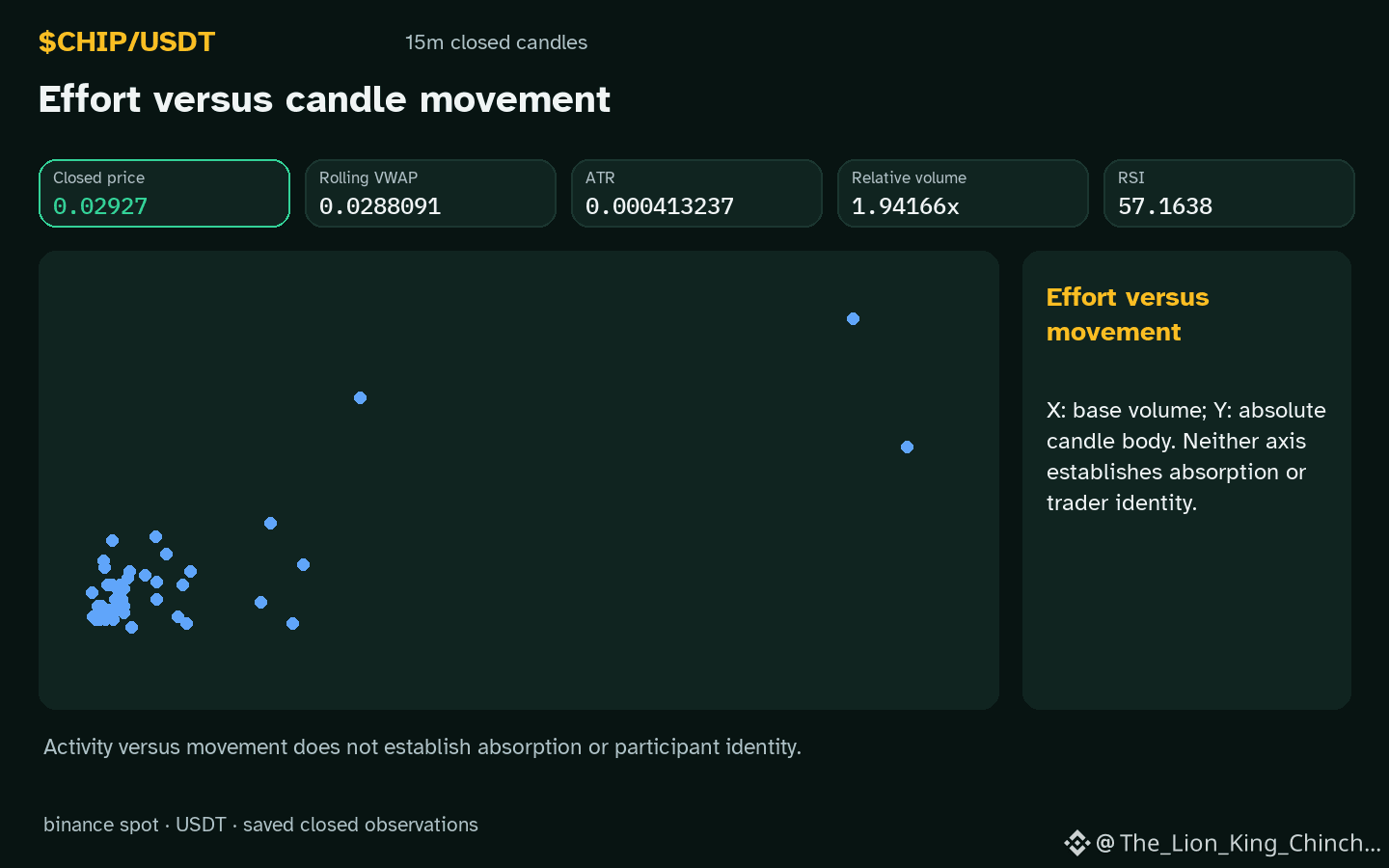
$CHIP: Noticing a Move Without Needing to Own It
Why does $CHIP feel urgent when price rises hourly with volume at 1.94x baseline? The tension is between acting fast and waiting for clarity.
Entry Quality vs Chasing
Chasing movement ignores the risk that price reverses quickly. In a thought experiment, entering immediately assumes the trend continues. A more patient approach defines invalidation first: if price falls back inside the local support 0.02814 and resistance 0.03012 range, the initial signal weakens. This trade-off prioritizes a cleaner entry point over the fear of missing the move. It acknowledges that not all upward ticks are sustainable.
A Rule Worth Testing
A non-attached observer might note the range bars 20 and relative volume without forcing a trade. The self-check asks: if I do not own this asset, does the hourly gain still look compelling? If the answer is no, the impulse is likely emotional. A counterexample is a candle that closes near the top but fails to break resistance. Such a close does not confirm strength. It may just show temporary buying. The limit of this view is that it relies on structural levels, not hidden order flow. Future closed candles below support would weaken the bullish interpretation. Waiting for confirmation reduces the risk of buying at a local high.
Probabilistic market research, not a recommendation or guaranteed return.
#CHIP