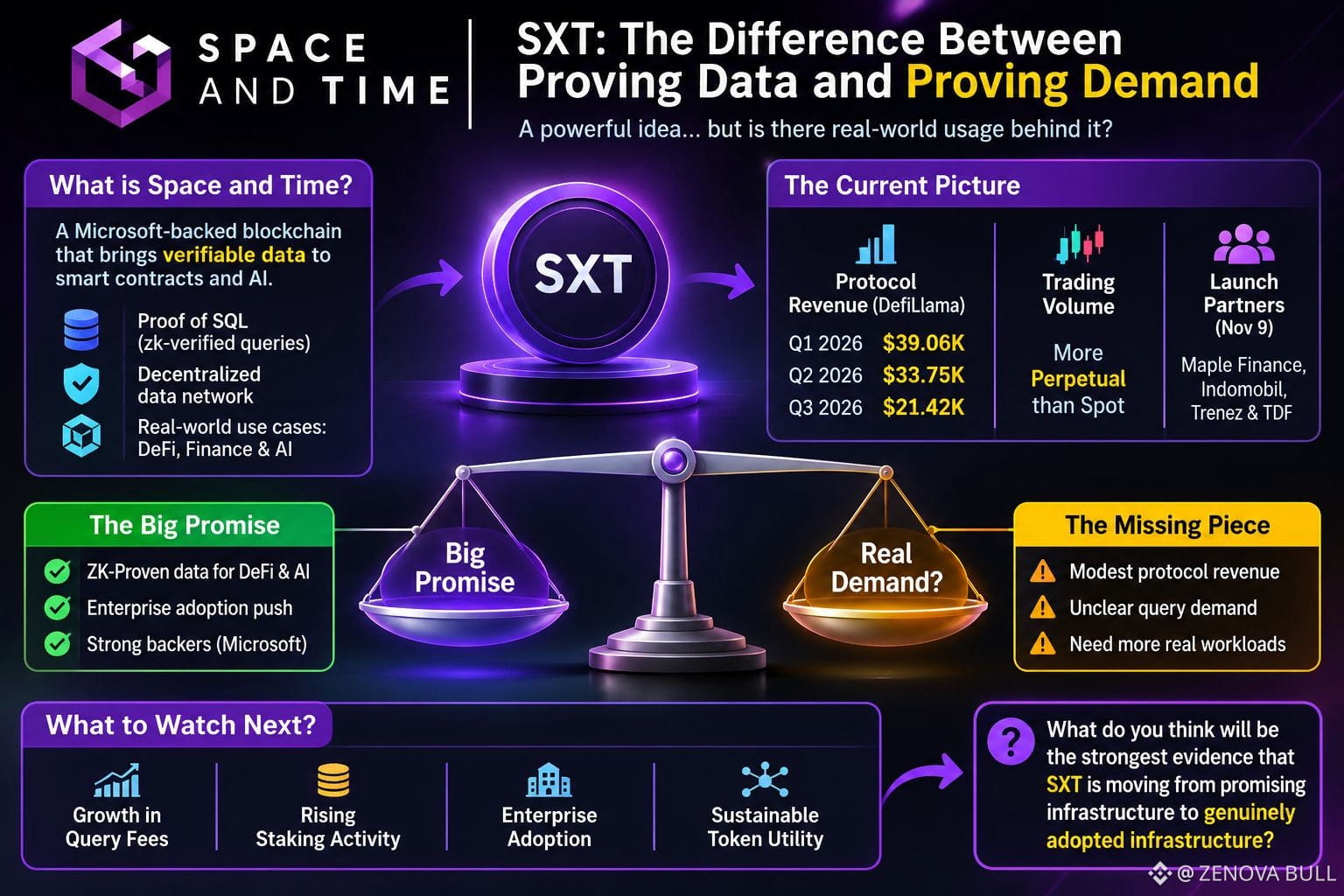
SXT: The Difference Between Proving Data and Proving Demand
One figure caught my attention while researching Space and Time: its maximum supply is 5 billion SXT, while the network's economic model is designed around actual SQL queries, data processing and cryptographic verification.
I went looking beyond the Microsoft-backed narrative because Proof of SQL is an interesting proposition, but infrastructure only becomes meaningful when developers actually depend on it.
What makes Space and Time different is its attempt to let smart contracts and AI applications verify database results without blindly trusting whoever operates the database. Its decentralized network uses validator-signed data commitments, while Proof of SQL provides cryptographic evidence that calculations were executed correctly. That's a practical problem to solve, particularly for DeFi collateral checks, financial reporting and AI-generated information.
The November 9 launch of Space and Time Enterprise adds an interesting development. Maple Finance, Indomobil, Trenez and The Data Foundation were named as launch partners. Businesses can now run verifiable queries on private infrastructure without exposing their underlying records.
But I noticed a gap when looking at the economics. DefiLlama recorded protocol revenue of $39.06K in Q1 2026, $33.75K in Q2 and $21.42K in Q3. Meanwhile, its recent market snapshot showed considerably more perpetual trading volume than spot activity.
I'm not saying adoption isn't happening. The enterprise launch is a meaningful step. But announced partners and actual recurring query demand are two different things.
That's the part that stuck with me: SXT needs real workloads, not simply attention around ZK technology. Can enterprise demand eventually translate into measurable query fees, staking demand and sustained token utility?
What do you think will be the strongest evidence that SXT is moving from promising infrastructure to genuinely adopted infrastructure?
#sxt $SXT @SpaceandTime