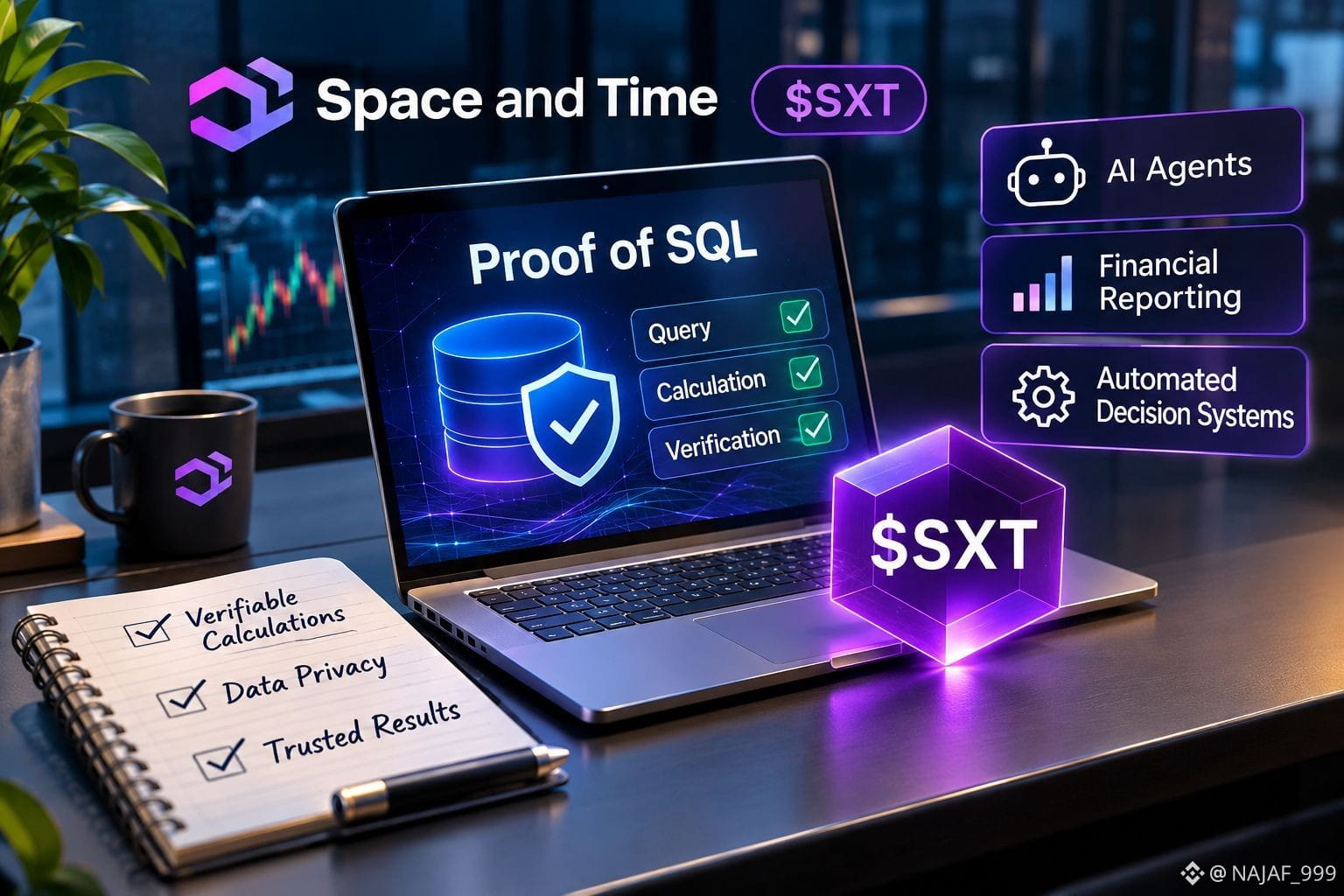

Lately, I've been thinking about something interesting. We often talk about AI becoming smarter, but how much attention are we paying to the data behind its answers?
Imagine an AI Agent working for a financial company. It analyzes thousands of transactions, checks market activity, and prepares a report that helps the company make an important decision.
Everything looks fine, but how can the company know that the numbers and calculations in that report are actually correct?
This is one of the challenges I find interesting about Space and Time ($SXT).
Its Proof of SQL technology allows data queries to come with cryptographic proofs. In simple words, it gives applications a way to verify that a calculation was performed correctly instead of simply trusting the result.
What makes this approach interesting is that verification does not always require exposing the original confidential data. This could be useful for businesses that want to use blockchain data while keeping sensitive information protected.
I can see why this matters for AI Agents, financial reporting, and automated systems. As these technologies become more involved in important decisions, being able to check their results could become just as important as producing them.
But there is another question worth thinking about.
Even if a calculation is mathematically correct, does that automatically mean the information behind it is reliable? I don't think so. Incorrect input data can still lead to misleading conclusions.
For me, this is where the bigger conversation around verifiable AI begins. We need systems that can prove how results were produced, while also paying attention to the quality of the information being used.
I'm interested to see how Space and Time develops this idea and how much real-world adoption it can achieve.
Still watching and learning. No unnecessary hype, just curiosity. 🤔
@SpaceandTime $SXT #SXT