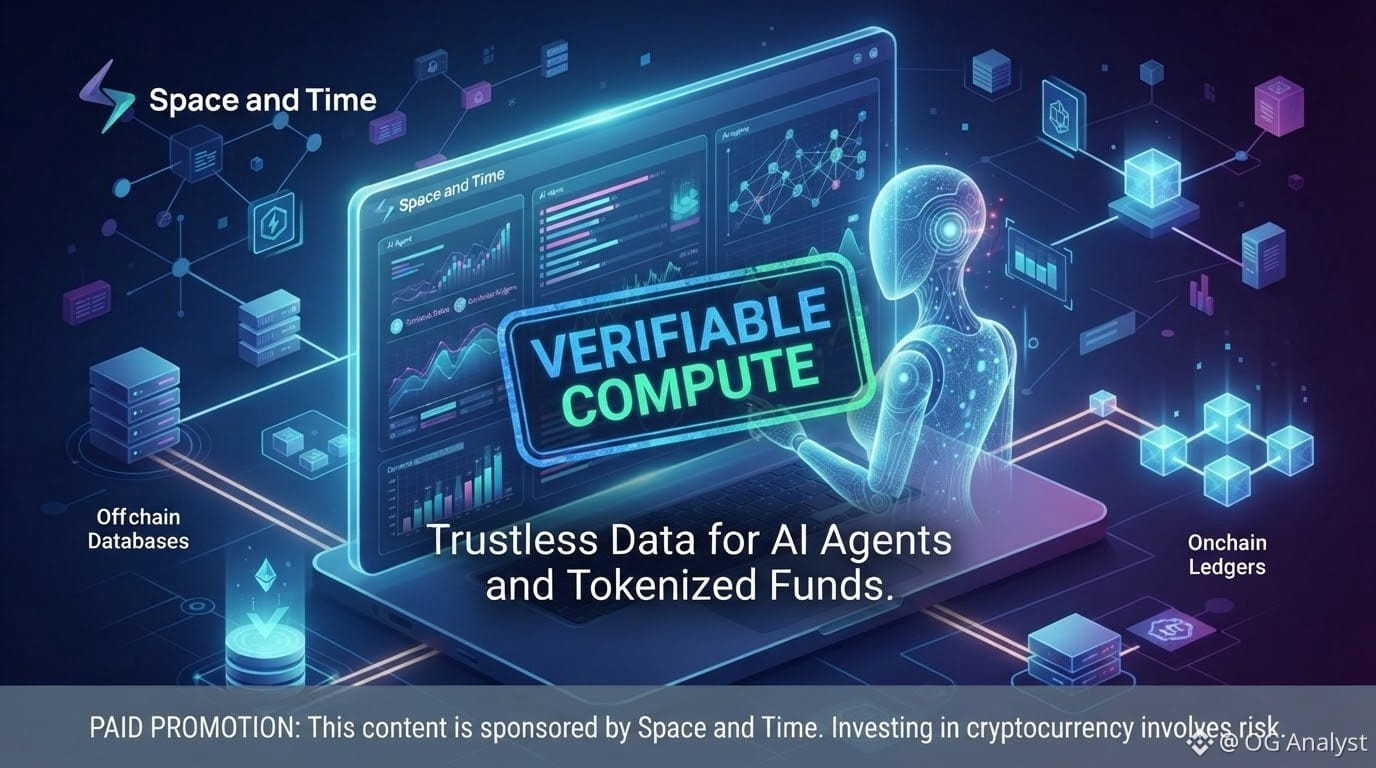

I spent some time going through Space and Time's technical documentation, and one thing kept coming back to me: how much can we really trust the data behind an automated financial decision?
AI agents may eventually handle more complex financial tasks, but their decisions are only as reliable as the information they use. If an agent reads incorrect historical fees, balances, or protocol activity, even a well-designed strategy could produce the wrong outcome. This is where verifiable query results become interesting. Instead of simply accepting an answer, applications can verify that the underlying calculation was performed correctly.
I also started looking at the institutional side. Tokenized funds need reliable records for holdings, cashflows, and valuations. Could verifiable NAV calculations eventually become a standard expectation rather than an optional feature?
Another interesting challenge is connecting offchain financial records with onchain activity. Cryptographic proofs could help verify supported calculations across these datasets, but data quality and the trustworthiness of the original inputs still matter.
The DeFi use case caught my attention too. Could protocols use verified historical activity to offer personalized swap-fee discounts without depending on centralized user tracking?
I'm curious how developers see these use cases evolving, especially around data security, decentralization, and governance.
Paid promotion disclosure: This content is sponsored.
Disclaimer: Purchasing SXT is risky. You are encouraged to DYOR and to consult professional advice before buying SXT or any other cryptocurrency.
#sxt $SXT @SpaceandTime