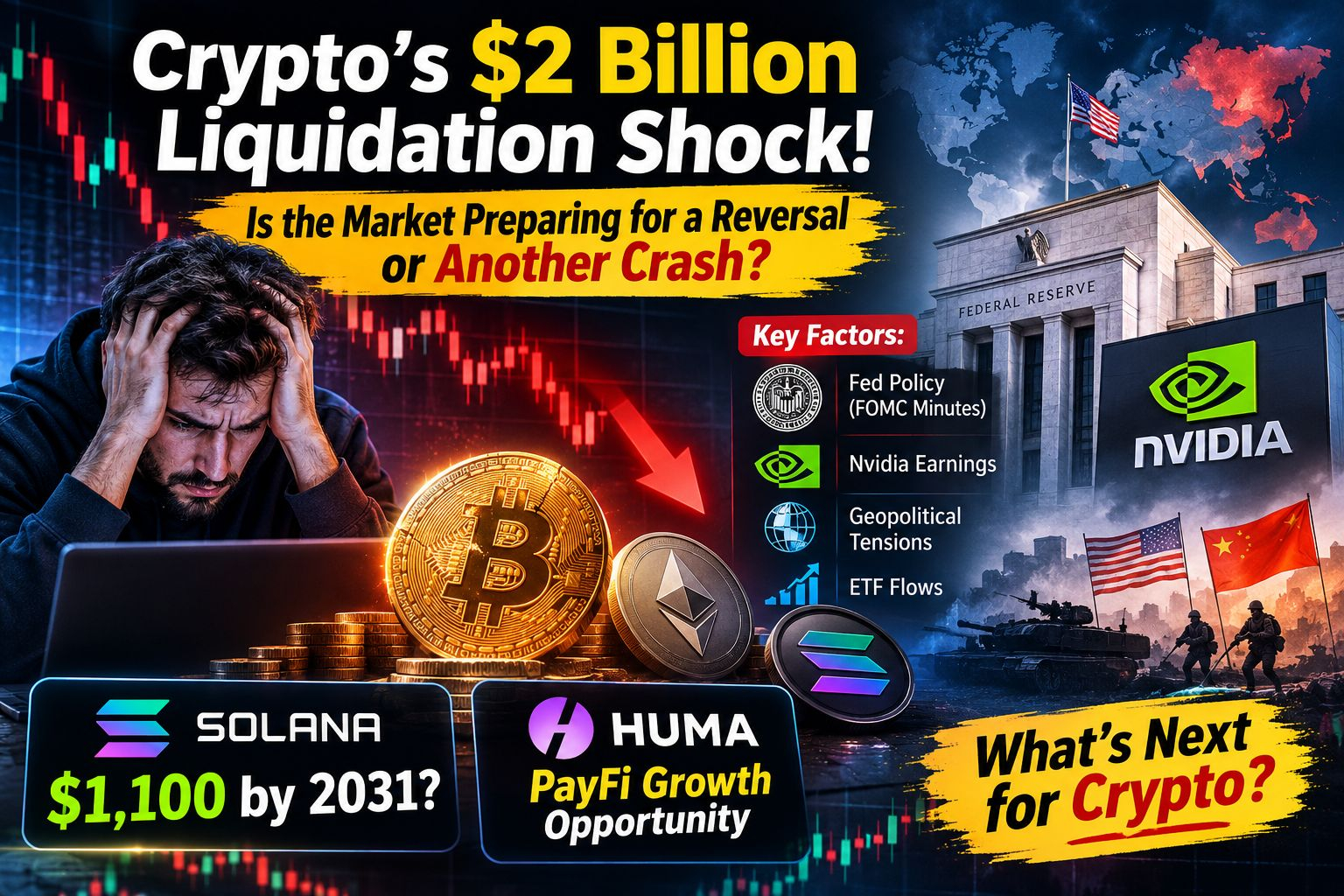

The Fed, Nvidia’s Earnings, Institutional ETF Flows and Geopolitical Tensions Could Decide the Next Major Move in Crypto and Technology Stocks.
Nearly $2 billion in liquidations. Billions of dollars leaving spot ETFs. Bitcoin struggling to regain market confidence.
But here is the question investors should be asking: Are we witnessing the final shakeout before a recovery, or is the market warning us that the worst may still be ahead?
The recent sell-off has exposed how vulnerable leveraged traders have become. Yet liquidations alone cannot tell us where the market is heading.
The next move will depend on something much bigger: global liquidity, institutional capital allocation, Federal Reserve policy and the growing geopolitical competition over technology and financial power.
1. The Liquidation Cascade: Has the Market Finally Flushed Out Weak Hands?
Bitcoin recently dropped towards $62,100, triggering nearly $2 billion in crypto liquidations within 24 hours. Most of the damage came from leveraged long positions.
This type of sell-off can create the conditions for a recovery.
When overleveraged traders are forced out, excessive speculation disappears. Open interest can decline, funding rates can normalize, and the market becomes less vulnerable to another chain reaction of forced selling.
But there is a catch.
A liquidation event is not the same as a market bottom.
For a sustainable recovery, fresh spot demand must return.
Two scenarios now deserve attention:
Bullish case: Bitcoin holds the $62,100 area, selling pressure weakens, ETF outflows slow and spot buyers begin accumulating. This could provide the foundation for a recovery.
Bearish case: Bitcoin loses recent support, institutional withdrawals continue and US Treasury yields remain elevated. In that situation, another decline towards the psychologically important $60,000 level becomes possible.
The real signal is not how many traders have been liquidated. It is whether buyers are willing to step in after the forced selling ends.
2. The Federal Reserve: Why One Policy Decision Can Move Every Market
Crypto investors cannot afford to ignore the Federal Reserve.
On October 28, the Fed maintained its benchmark interest rate at 3.75%–4.00%. However, two policymakers preferred a 25-basis-point increase, highlighting continuing disagreements over inflation and monetary policy.
Inflation remains a concern. US consumer inflation accelerated to approximately 4% year over year in October, adding uncertainty to the interest-rate outlook.
That makes the November 18 FOMC minutes particularly important.
Investors will be looking for clues about the Fed's thinking on inflation, economic growth and the possibility of further rate increases.
The market reaction could be significant.
Higher interest rates make safer investments more attractive, increase borrowing costs and generally reduce appetite for speculative assets.
That can put pressure on technology stocks and cryptocurrencies.
On the other hand, a less hawkish Fed could improve liquidity expectations and support risk assets.
For Bitcoin, Ethereum and Solana, the direction of monetary policy may matter more than short-term trading sentiment.
3. $NVDA Earnings: A Bigger Test for the AI Investment Boom
Nvidia's November 17 earnings report is another major event for global investors.
The company is expected to report approximately $109 billion in quarterly revenue, with analyst consensus earnings estimates around $2.48 per share.
However, the market is looking beyond the headline numbers.
Investors want to know whether global spending on AI infrastructure can continue growing at its current pace.
There is also an unexpected leadership development. Nvidia announced on November 12 that Jensen Huang had resigned as CEO, with CFO Colette Kress appointed interim CEO.
This transition adds another source of uncertainty around an already important earnings event.
Three things matter most:
- AI demand: Is demand for Nvidia's advanced chips still growing?
- Future guidance: Are major cloud companies maintaining their AI infrastructure spending?
- Geopolitical exposure: How will US-China technology restrictions affect Nvidia's international business?
The last point deserves particular attention.
Washington's restrictions on advanced AI chips and overseas data-centre access have made the semiconductor industry increasingly sensitive to geopolitical decisions.
This is no longer just a technology competition. It is also a contest over economic influence, strategic resources and global supply chains.
If Nvidia delivers strong results and confident guidance, technology stocks could regain momentum.
But even an earnings beat may not be enough if management's outlook disappoints investors.
And because Bitcoin increasingly moves alongside high-growth technology assets, weakness in the Nasdaq could create additional pressure on crypto.
4. Geopolitics: How Political Decisions Reach Your Investment Portfolio
History offers some important lessons.
The 1973 oil embargo showed how geopolitical decisions could disrupt energy supplies, accelerate inflation and force central banks into difficult choices.
The Russia-Ukraine war in 2022 provided another example. Energy disruptions and supply-chain uncertainty contributed to inflationary pressure, followed by aggressive monetary tightening.
The same transmission mechanism remains relevant today.
Consider how one geopolitical development can affect an ordinary investor:
Political or geopolitical event| Economic impact| Possible portfolio effect
Energy or shipping disruption| Higher oil prices and inflation| Pressure on stocks and crypto
US-China chip restrictions| AI supply-chain uncertainty| Nvidia and tech-stock volatility
Hawkish Fed policy| Tighter liquidity and stronger dollar| Pressure on BTC and altcoins
Institutional ETF withdrawals| Lower spot-market demand| Weakness in major cryptocurrencies
This connection is important.
A geopolitical conflict can increase energy prices. Higher energy prices can push inflation higher. That can force the Fed to maintain restrictive rates.
Higher rates can strengthen the dollar and reduce demand for risky investments.
By the time the impact reaches the crypto market, the original political event may seem unrelated.
But the connection is real.
5. Solana: Could $SOL Really Reach $1,100 by 2031?
While short-term market sentiment remains fragile, long-term institutional forecasts are telling a different story.
Bitwise has presented three potential Solana price scenarios for 2031:
- Bear case: $80
- Base case: $385
- Bull case: $1,100
The bullish forecast is based on the potential expansion of tokenized equities, on-chain trading and payment infrastructure.
Bitwise's bull-case assumptions include 5% of global stocks becoming tokenized by 2031, with Solana capturing approximately 65% of that trading activity.
That would translate into around $30.7 trillion in annual tokenized stock trading on Solana under the model's assumptions.
The projection also anticipates substantial growth in network activity, potentially reaching approximately 3.6 billion transactions per day.
These numbers are ambitious. They should not be mistaken for guaranteed outcomes.
Ethereum, its Layer-2 ecosystem and competing blockchain networks remain serious competitors.
Still, Solana's institutional infrastructure developments deserve attention.
On November 16, Ledger introduced Clear Signing support for Solana, initially covering applications such as Jupiter and Kamino.
The integration allows users to review supported transaction details in a more understandable format before approving them through their hardware wallets.
That is a useful improvement in security and user experience.
For long-term investors, the bigger question is whether Solana can turn infrastructure improvements into sustained adoption, transaction activity and economic value.
A $1,100 target remains a bull-case projection, not a price expectation that investors should automatically build into their portfolios.
6. HUMA: Is PayFi Becoming an Investment Opportunity?
Another project worth watching is $HUMA.
Huma Finance operates in the growing PayFi sector, focusing on payment financing, cross-border transactions and on-chain liquidity infrastructure.
The underlying opportunity is interesting.
Traditional financial institutions need faster settlement, more efficient liquidity management and better access to modern payment infrastructure.
If PayFi adoption expands, projects connecting real-world payment activity with on-chain liquidity could attract greater institutional interest.
However, investors need to separate the potential of a business model from the value captured by its token.
$HUMA also faces near-term supply pressure.
Approximately 459 million HUMA tokens are scheduled to unlock on November 26, representing around 4.6% of the total supply.
Additionally, the project's co-founder recently disclosed that a compromised early liquidity-provider wallet had sold approximately 12 million airdropped HUMA tokens.
Derivatives activity also deserves attention. Reported futures open interest increased from approximately 620 million to 1.1 billion tokens between November 2 and 7, while perpetual futures volume reached seven to ten times spot volume.
That suggests speculative positioning has become unusually large relative to actual spot trading.
For investors, three factors matter:
- Real payment adoption and network growth.
- Token utility and the ability to capture economic value.
- Liquidity conditions and market behaviour following the November 26 unlock.
HUMA could benefit from the expansion of institutional PayFi, but the upcoming token supply event makes risk management particularly important.
7. What Will Actually Trigger the Next Market Rally?
The next major move in financial markets will likely depend on four developments.
1. Institutional capital returning: A sustained reversal in Bitcoin and Ethereum ETF outflows would provide stronger evidence of recovery than a temporary futures-driven bounce.
2. The Fed's policy direction: The November 18 FOMC minutes could reshape expectations about interest rates and global liquidity.
3. Nvidia's forward guidance: Strong AI demand and continued infrastructure investment could restore confidence in technology stocks and potentially improve sentiment across crypto markets.
4. Real adoption of crypto infrastructure: Solana's tokenization ecosystem and Huma's PayFi business model offer longer-term opportunities, but adoption, competition and token economics will determine their actual value.
My assessment is straightforward: the recent liquidation event may have removed a significant amount of excessive leverage, but there is not yet enough evidence to declare a durable market bottom.
A real recovery needs more than short covering.
It needs returning institutional demand, improving liquidity and confidence in global economic growth.
Investors should avoid chasing sudden rebounds or assuming that every major liquidation marks the end of a correction.
Watch ETF flows, funding rates, open interest, Treasury yields and upcoming macroeconomic developments. These indicators can reveal more about the market's direction than headlines alone.
The Bottom Line
The crypto market is approaching an important test.
The Fed will influence liquidity. Nvidia will provide insight into the health of the AI investment cycle. Geopolitical decisions will shape technology supply chains, while institutional capital flows will help determine whether risk assets can recover.
Meanwhile, Solana and HUMA represent two different long-term investment themes: tokenized financial markets and payment infrastructure.
Both have potential, but neither is immune to macroeconomic pressure or market risk.
The question is no longer simply whether Bitcoin has reached its bottom. It is whether global capital is ready to take on risk again.
What Do You Think?
Is the recent $2 billion liquidation event the final flush before Bitcoin and altcoins recover, or should investors prepare for another leg down?
And between SOL tokenization opportunity and $HUMA's PayFi growth story, which one do you believe has stronger long-term potential?
Share your analysis in the comments.
Disclaimer: This article is for informational and educational purposes only. Price projections and market scenarios are not guaranteed. Always conduct independent research, assess token supply and liquidity, and manage your investment risk carefully. DYOR.



#NvidiaEarningsTonight:AIStocks’NextMove? #Geopolitics #CryptoAnalysis #cryptouniverseofficial #Crypto_Jobs🎯