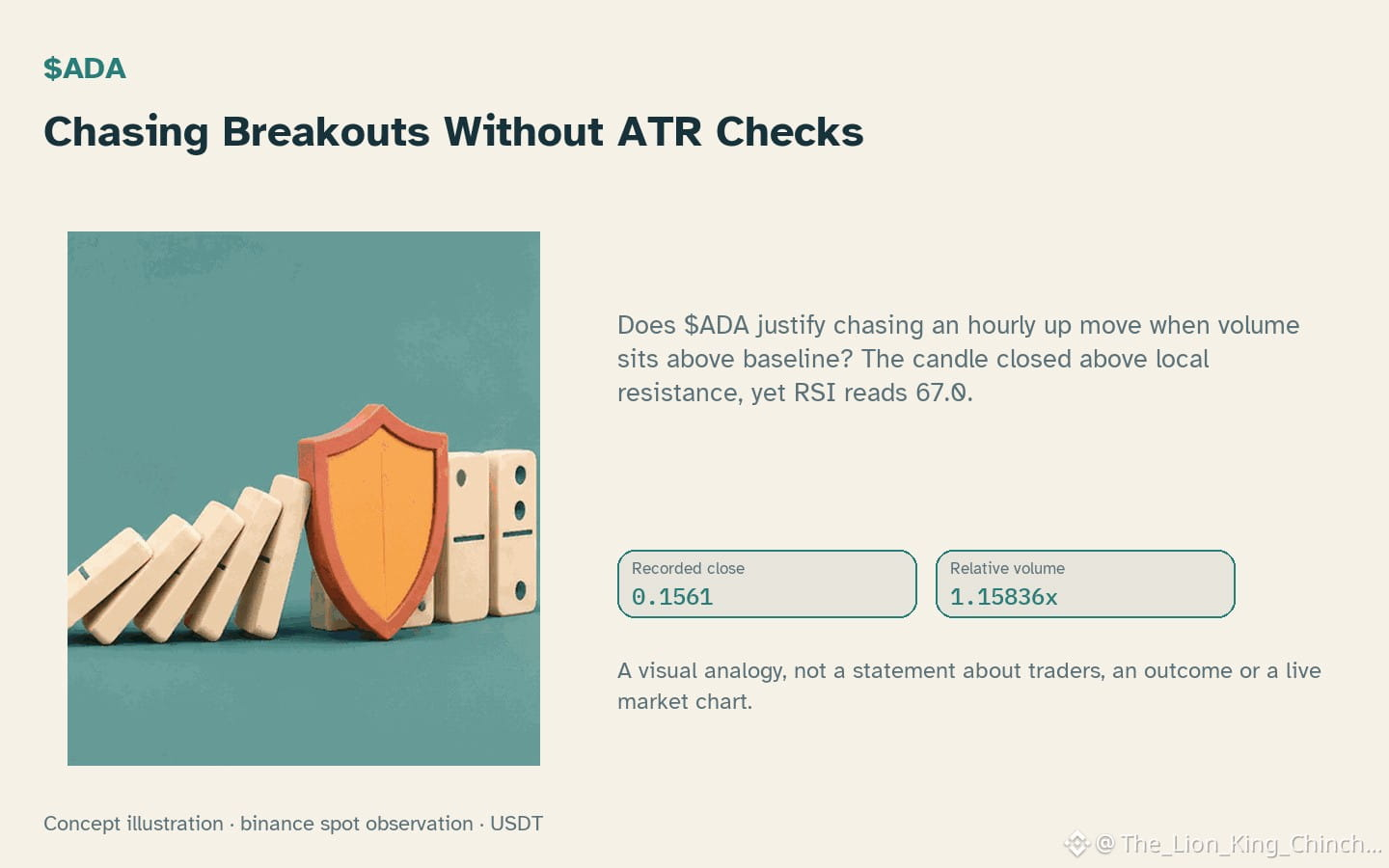
$ADA: Chasing Breakouts Without ATR Checks
Does $ADA justify chasing an hourly up move when volume sits above baseline? The candle closed above local resistance, yet RSI reads 67.0.
Consider a thought experiment. You enter at the breakout candle close. Your stop must stay beyond the recent low near 0.1486 plus noise. If ATR is 0.00120964, that stop distance often exceeds the expected profit target to 0.1559. This creates a negative expectancy trade. Waiting for price to retest the broken level offers better entry quality. A retest near 0.153521 could confirm structure continuation. If price fails that retest and closes back below the range, the initial break was a false signal. The trade-off is clear: paying a premium for immediate entry versus accepting a tighter stop at a lower price. Quantifying extension means comparing the current ATR to the distance between entry and exit. If the stop is wider than the target, the math works against you. This is not advice, but a structural check.
The evidence has limits. A single hourly candle above baseline volume does not prove sustained momentum. One up candle does not invalidate the prior range. RSI is a momentum snapshot, not a price bound. If the next several hourly candles close below the previous high, the breakout narrative weakens. Reassess if price trades below 0.1486 or if volume drops below baseline while price stalls. Without further closed candles, the extension remains unconfirmed. Use the ATR to define a reasonable stop, not hope. Check the distance before acting. If the reward does not cover the risk, wait.
Probabilistic market research, not a recommendation or guaranteed return.
A useful cross-check: $ETH has hourly direction down and volume above its baseline; $INIT has hourly direction up and volume not above its baseline. This alone does not establish correlation.
#ADA #ETH #INIT #RiskManagement #CryptoLearning