
#sxt $SXT @SpaceandTime
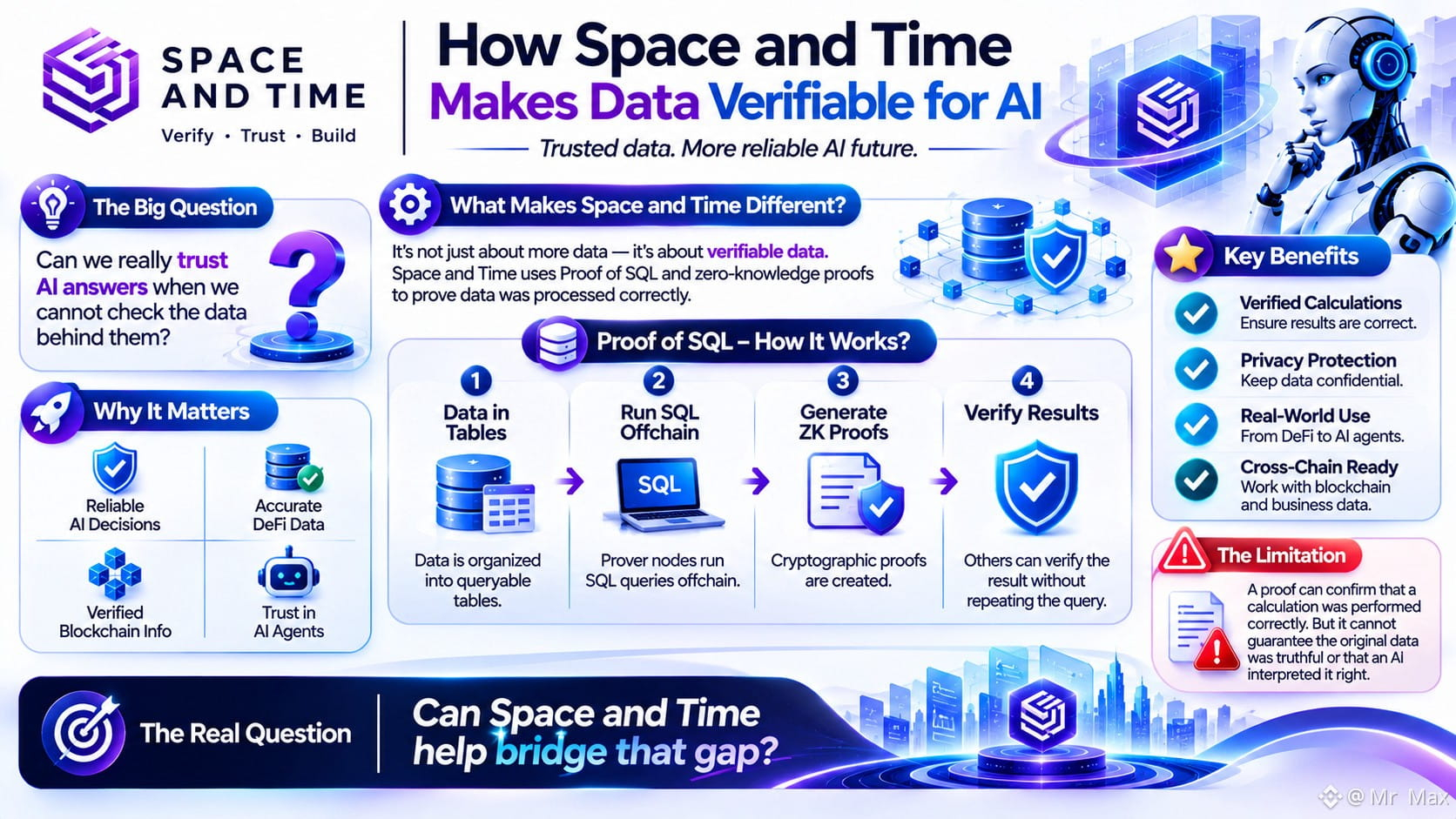
One thing I find interesting about AI is how easily an answer can sound convincing, even when we cannot check the information behind it. This matters even more when an AI agent works with financial records or blockchain activity. If the data is wrong, the answer can be misleading too.
That is one reason Space and Time caught my attention.
Its focus is not just on making more data available, but on allowing applications to verify how that data was processed.
A key part of this is Proof of SQL. Data is organized into queryable tables, while cryptographic commitments help protect its integrity. Prover nodes run SQL queries offchain and generate zero-knowledge proofs. These proofs let others verify that the calculation was performed correctly without repeating the entire process.
I can see this being useful for AI agents working with blockchain history, cross-chain information or business records. DeFi and tokenized assets can also benefit when applications depend on accurate balances and collateral figures.
But there is a limit. A proof can confirm that a calculation was performed correctly against committed data. It cannot guarantee that the original information was truthful or that an AI interpreted it correctly.
For me, that is the real challenge: making data verifiable is important, but it does not automatically make every AI decision reliable.
Can Space and Time help bridge that gap?