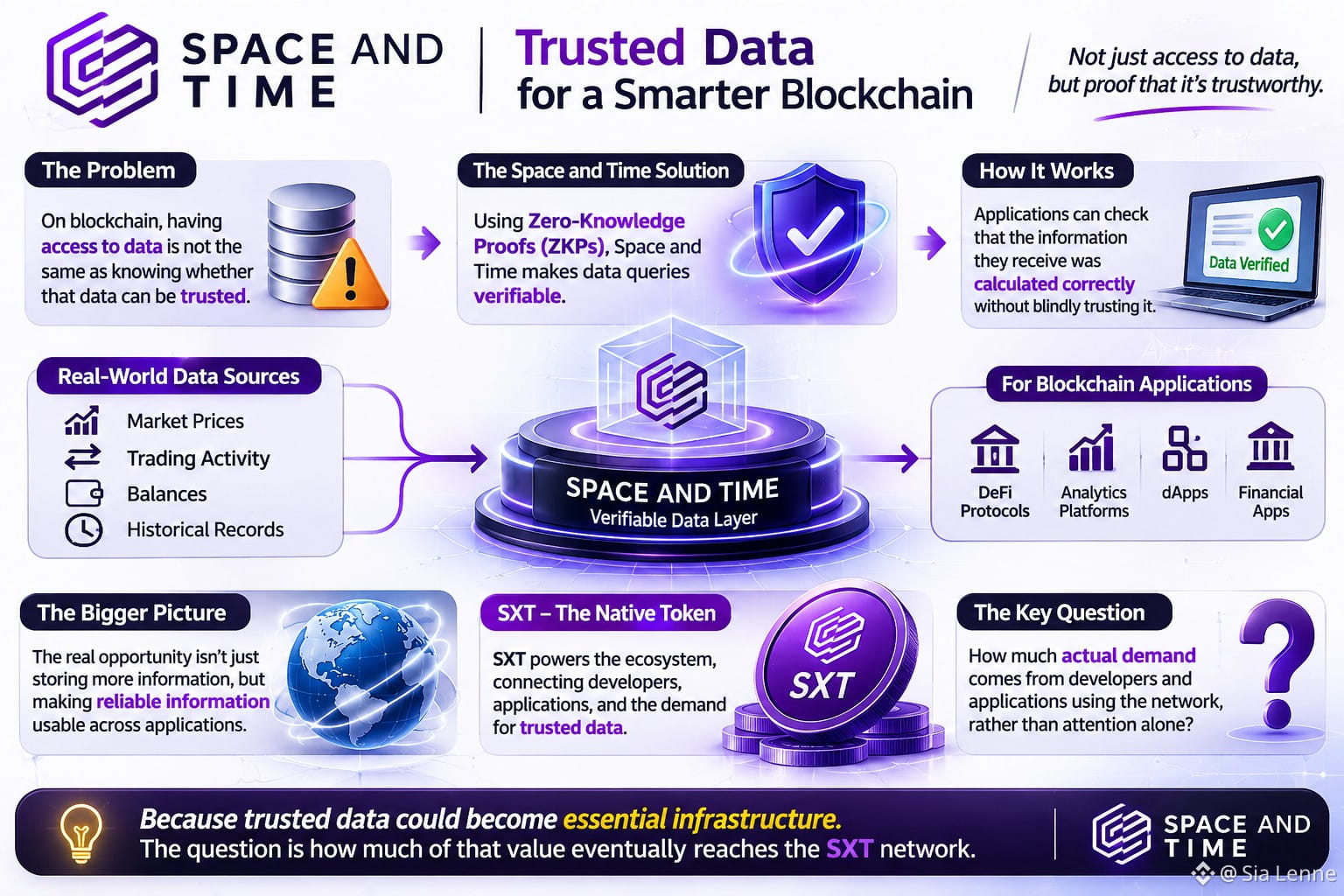
Space and Time is building around a problem that often gets overlooked in blockchain: having access to data is not the same as knowing whether that data can be trusted.
I find this distinction particularly interesting when looking at how financial applications are evolving. Smart contracts can execute transactions automatically, but they still need reliable information from outside their own execution environment. Market prices, trading activity, balances, and historical records all matter. If the underlying data cannot be independently verified, even a perfectly written contract has a limitation.
This is where Space and Time takes a different direction. Instead of asking applications to simply trust a database, its architecture uses zero-knowledge proofs to make data queries verifiable. In simple terms, applications can check that the information they receive was calculated correctly without having to blindly trust the system providing it.
That creates an interesting connection between blockchain and data infrastructure. The real opportunity isn't just storing more information, but making reliable information usable across applications.
SXT, its native token, is part of this ecosystem. But the long-term question is how much actual demand comes from developers and applications using the network, rather than attention around the technology or its Microsoft connection.
Because trusted data could become essential infrastructure. The question is how much of that value eventually reaches the network itself.
@SpaceandTime $SXT #sxt